Blog · Financial reporting
Are church finances public record?
June 28, 2026 · By Benjamin Reinke
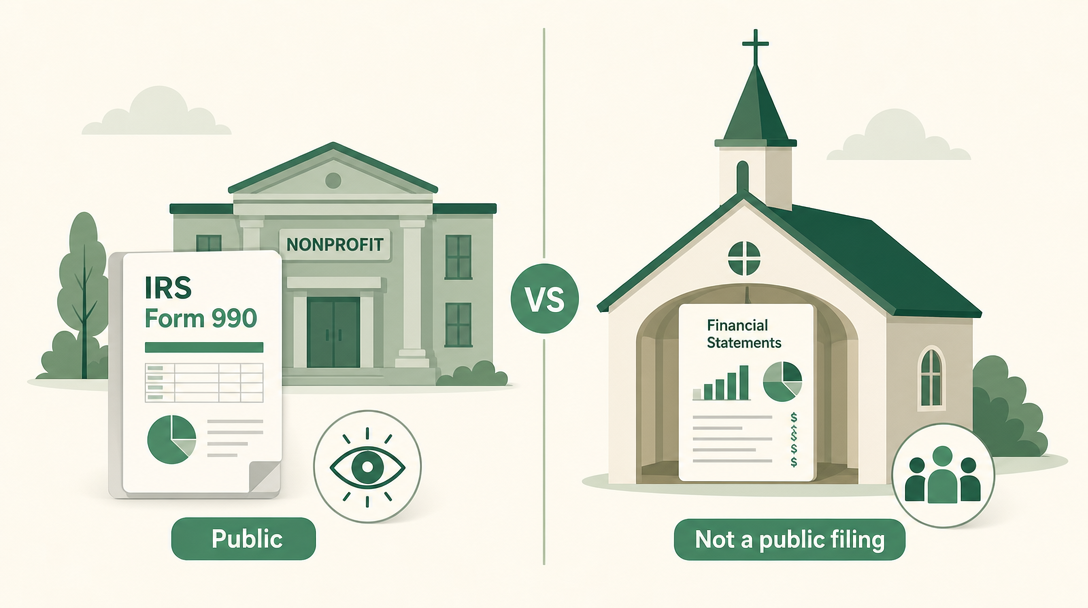
Short answer: A church’s finances are generally not public record the way most nonprofits’ are. The reason is one specific rule: churches are exempt from filing IRS Form 990, the annual information return that other tax-exempt organizations file and that anyone can read. No 990 means no public filing of a church’s revenue, expenses, or staff pay. That said, “not public” is not the same as “secret.” Church members often have a right to see the books under the bylaws, state nonprofit law, and denominational rules, and sharing regular financial reports with the congregation is standard practice for a trustworthy church.
Why a church’s finances usually aren’t public record
A church’s finances aren’t public record because a church almost never files the document that makes a nonprofit’s finances public: IRS Form 990. For most tax-exempt organizations, the 990 is an annual information return — revenue, expenses, top-paid people, programs — and it’s open to public inspection by law. A donor, a journalist, or a rating site can pull it for free. (For what that form contains, see IRS Form 990.)
Churches don’t file it. The IRS exempts churches, their integrated auxiliaries, and conventions or associations of churches from the annual return requirement entirely. The agency spells this out in IRS Publication 1828, the Tax Guide for Churches and Religious Organizations (irs.gov/pub/irs-pdf/p1828.pdf), which states that churches that meet the requirements of section 501(c)(3) are automatically considered tax exempt and are not required to file an annual return or notice with the IRS. Because the church files nothing, there’s no public 990 sitting in a database for outsiders to read. The absence is normal — it’s the law working as written, not a sign the church is hiding anything.
So when someone asks whether they can look up a church’s budget the way they’d look up a charity’s, the honest answer is usually no. There’s no equivalent public filing to find.
Church versus other nonprofit — what’s actually public
The cleanest way to see this is side by side. A typical 501(c)(3) nonprofit and a church are taxed under the same part of the code, but they file very differently, and that filing difference is exactly what makes one’s finances public and the other’s not.
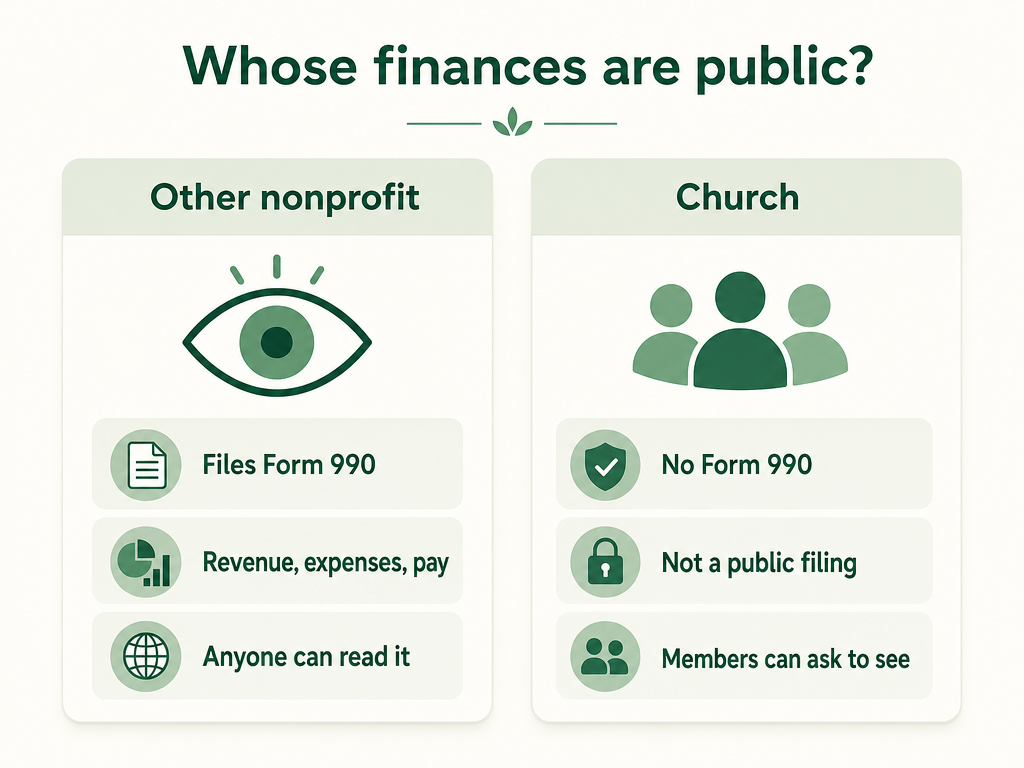
| What’s public | Other 501(c)(3) nonprofit | Church |
|---|---|---|
| Annual Form 990 (revenue, expenses) | Yes — files it; public record | No — exempt from filing |
| Executive / staff pay disclosed publicly | Yes — on the 990 | No — no public filing |
| Findable in a public 990 database | Yes (ProPublica, Candid, IRS) | No — there’s no 990 to find |
| Exemption application on public request | Yes — if it applied (Form 1023) | Yes — only if the church chose to apply |
| Financial reports to members | Varies by bylaws | Often a right under bylaws / state law |
The takeaway is the top three rows. A nonprofit that files a 990 has its core numbers out in the open, and you can read them through free tools, which is the whole point of a nonprofit 990 lookup. A church has no such filing, so those same tools turn up little or nothing for it, and that’s expected.
Church members usually have a right to see the financial records
Members are the exception that matters most. Even though a church’s finances aren’t public to the world, the people who belong to the church often do have a legal or governance right to inspect the financial records. That right doesn’t come from the IRS — it comes from three other places, and which one applies depends on the church.
- The church’s bylaws. Most well-run churches grant members the right to review financial statements, often at an annual meeting or on reasonable request. The church bylaws are the first document to check, because they usually spell out exactly what members can see and how to ask.
- State nonprofit corporation law. A church incorporated as a nonprofit (most are) is subject to its state’s nonprofit corporation act, and many of those statutes give members a right to inspect the corporation’s books and records for a proper purpose. The exact scope varies by state, so the specific statute governs.
- Denominational rules. Churches inside a denomination often answer to a higher governing body that requires financial reporting up the chain and may set members’ access rights from above.
If you’re a member and you want to see the numbers, the path is usually to read the bylaws, then ask the treasurer or board in writing. That’s a different question from “is this public record” — it’s a membership right, not an open-records right.
Financial transparency to the congregation is best practice, not a public-records law
Transparency and public record are two different things, and conflating them causes most of the confusion here. A church can be admirably transparent — handing out a clear monthly report, holding an open annual budget meeting, publishing a giving summary — without any of that making its finances “public record” in the legal sense. Transparency is a choice the church makes toward its own people; public record is a filing obligation toward the government and the world.
For a church, strong transparency is best practice rather than a legal mandate, and it’s how trust gets built. The practical habits that signal a healthy church:
- A regular financial report to the congregation — monthly or quarterly income and expenses against budget.
- An annual meeting where the budget is presented and questions are welcome.
- Clear answers when a member asks how money is spent, including a reasonable account of staff and pastoral compensation.
- An independent review or audit of the books, which adds a layer of outside accountability. (See what that involves in a church audit.)
None of this is required by a public-records law. All of it is what separates a church people trust with their giving from one they quietly worry about. The clean, plain-language church financial statements behind those reports are the engine of that trust.
If a church applied for 501(c)(3) recognition, its application can be available
Here’s the one wrinkle that pushes some church financial detail into the open. A church doesn’t have to apply to the IRS to be tax-exempt — it’s exempt automatically. But some churches choose to file Form 1023 and get an official IRS determination letter anyway, usually so donors and grantmakers have written proof of status. (For why that’s optional, see are churches tax exempt.)
A church that did apply takes on a disclosure duty. Under the IRS public-inspection rules, an organization recognized as exempt must make its exemption application — the Form 1023 and its supporting documents — available to anyone who asks. So for a church that applied, its application package (which can include financial projections and organizational details from the time it filed) is open to public request, the same as any other exempt organization. You can also confirm a church’s recognized status on the IRS Tax Exempt Organization Search if it appears there. A church that never applied has no such application on file and nothing to disclose this way.
This is a narrow exception, and it’s about the application from years ago, not this year’s budget. It doesn’t make a church’s current finances public.
FAQ
Are church financial records public? Generally no. A church is exempt from filing IRS Form 990, the annual information return that makes most nonprofits’ finances public record, so there’s no public filing of a church’s revenue, expenses, or staff pay. IRS Publication 1828 confirms churches aren’t required to file an annual return. The main path to a church’s finances runs through its members, who often have a right to see the books under the bylaws and state nonprofit law, not through a public database.
Can church members see the finances? Usually yes. Even though a church’s finances aren’t public to outsiders, members often have a right to inspect the financial records under the church’s bylaws, the state’s nonprofit corporation law, or denominational rules. The bylaws are the place to start, since they typically state what members can review and how to request it. Most healthy churches also share regular financial reports with the congregation as a matter of practice.
Are church salaries and pastor pay public record? Not the way nonprofit executive pay is. A 501(c)(3) that files Form 990 reports its top-paid people on a public return anyone can read; a church files no 990, so pastoral and staff compensation isn’t disclosed in any public filing. Members may still be able to learn compensation figures through the church’s own reports or by asking the board, and a transparent church will give a reasonable account of how its money is spent.
Vestrybooks keeps a church’s money-in-and-out clean and by-fund all year, so the reports your members and board ask to see are always one click away — even though your church never files a 990. See plans →
This is general information, not tax or legal advice — confirm your church’s specific obligations and your members’ inspection rights under your bylaws and state law with a qualified professional.
This article is general information for church treasurers, not professional tax or legal advice. For your church's situation, consult a qualified accountant or attorney.
Church accounting a volunteer can actually do.
Vestrybooks is church accounting + giving for the volunteer treasurer — fund tracking, one-click year-end statements, and online giving with $0 taken from every gift.
A real free plan · no credit card · your data stays yours