Blog · Financial reporting
The church statement of activities, explained
June 26, 2026 · By Benjamin Reinke
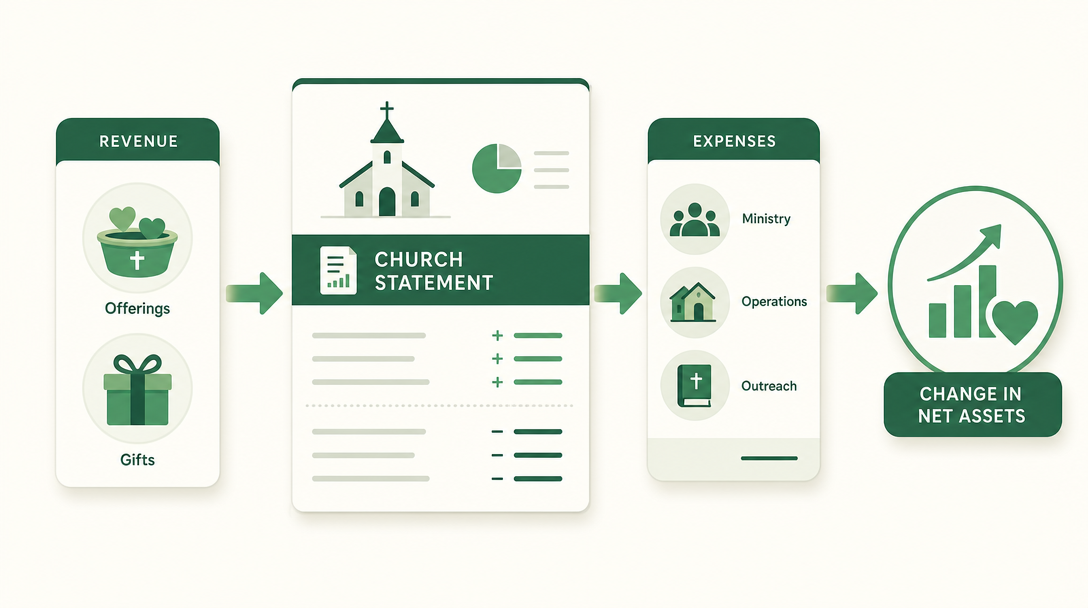
Short answer: A church statement of activities is the nonprofit version of an income statement. It covers a period of time — a month, quarter, or year — and shows revenue (offerings and other support) minus expenses (grouped by function), ending in the change in net assets. Like the rest of a church’s reporting, it separates amounts with and without donor restrictions, so the board can see not just whether the church ran a surplus, but whether the money was free to use.
What a church statement of activities is
The statement of activities is one of the core church financial statements, and it answers the question a budget really cares about: over this period, did more come in than went out? A business calls this a profit-and-loss statement; a nonprofit calls it the statement of activities because it ends in a change in net assets, not profit. It pairs with the balance sheet — the activities statement explains the movement, the balance sheet shows the resulting position.
How revenue appears on the statement
Revenue (often called support for a church) is everything that came in: tithes and offerings, designated gifts, program or event fees, rental income, and investment earnings. Each dollar is also tagged by restriction — a gift to the general fund is revenue without donor restrictions, while a building-fund gift is revenue with donor restrictions. When the church later spends a restricted gift on its purpose, that amount is shown as net assets released from restriction, moving from the restricted column to the unrestricted one — the presentation nonprofit accounting standards require (FASB ASC 958).
Expenses grouped by function
A church statement of activities groups expenses by function — what the spending accomplished — not just by type:
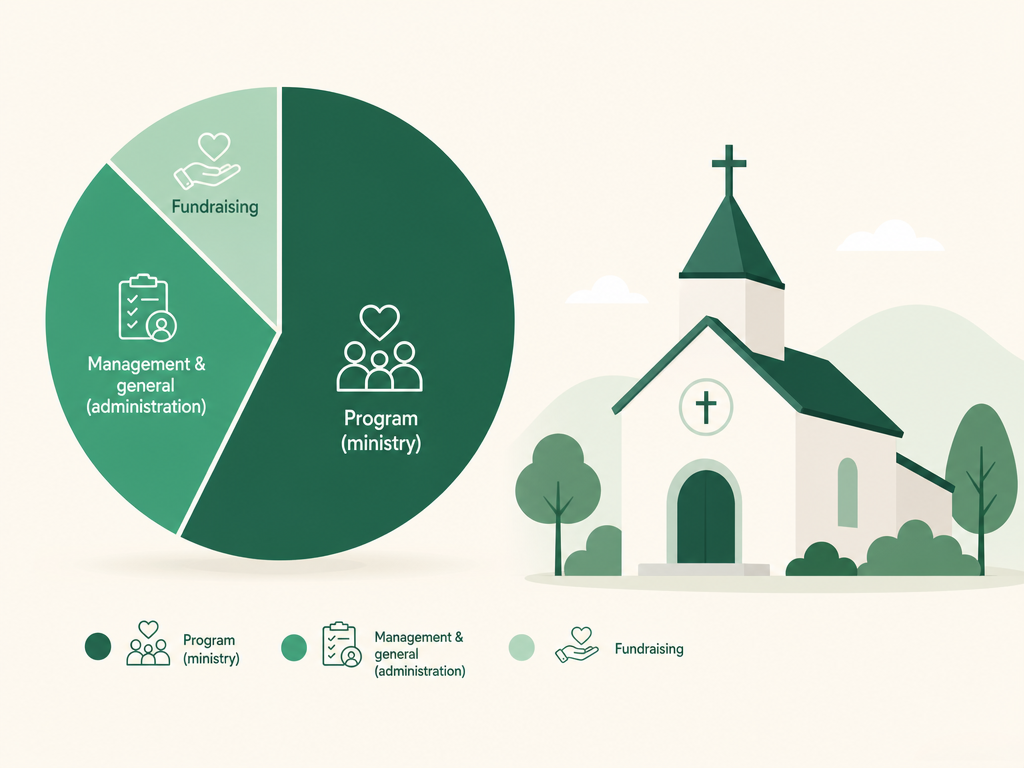
- Program — the church’s actual ministry: worship, missions, benevolence, education.
- Management and general — administration, office, and overhead.
- Fundraising — the cost of soliciting gifts (often small for a church).
Donors and watchdogs look at how much goes to program versus overhead, which is why functional grouping matters.
The change in net assets — the bottom line
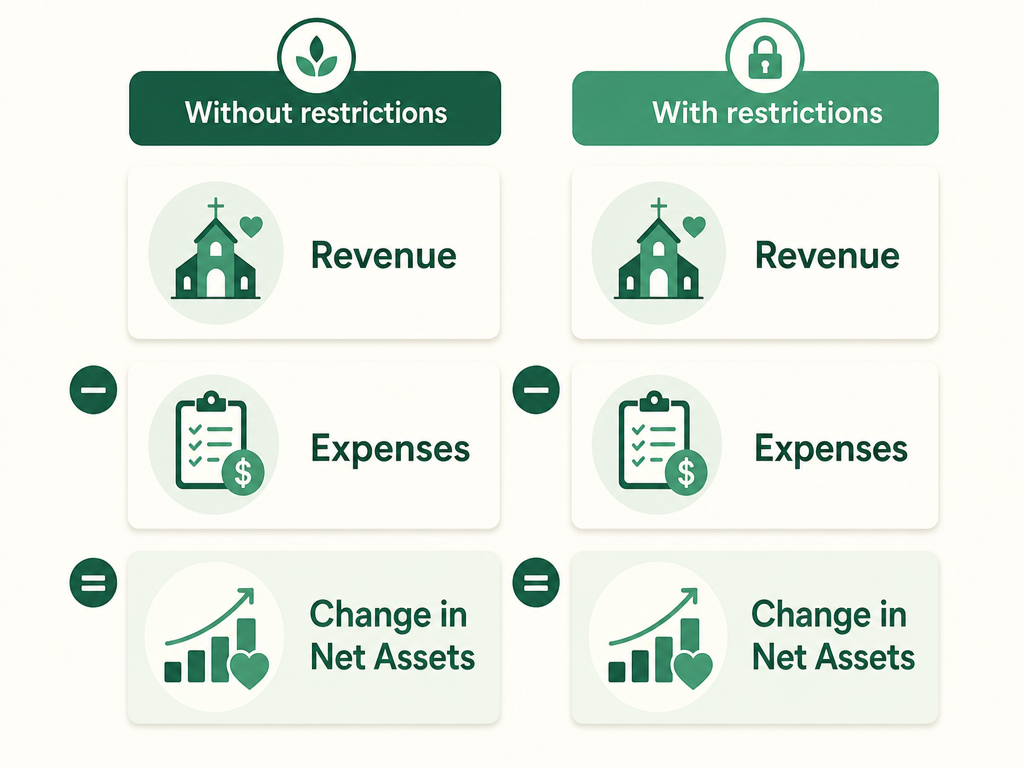
Revenue minus expenses gives the change in net assets for the period — the nonprofit’s “bottom line.” A positive change means the church added to its net assets (a surplus); a negative one means it drew them down. Because the columns are split by restriction, the statement shows whether a surplus is genuinely available or tied up in restricted gifts.
How to read a church statement of activities
Read it the way you’d read a budget: compare revenue to expenses for the period, but look at the unrestricted change in net assets first — that’s the church’s real operating result. A church can show an overall surplus purely because a big restricted building gift arrived, while its day-to-day operations actually ran at a deficit. The restricted columns keep that from hiding.
Statement of activities vs. the balance sheet
The statement of activities covers a period (money in and out); the church balance sheet is a snapshot on one date. They connect directly: the change in net assets reported here is exactly what moves the net-assets total on the balance sheet from the start of the period to the end.
Vestrybooks generates your statement of activities from everyday entries, with restricted and unrestricted columns and functional expense grouping already handled. See plans →
FAQ
What is the statement of activities for a church? The nonprofit income statement — it reports a church’s revenue and expenses over a period and ends in the change in net assets, split by donor restriction.
How do you write a statement of activities? List revenue (by restriction), list expenses grouped by function, then subtract to get the change in net assets — accounting software builds it from your recorded transactions.
What does a church statement of activity look like? Revenue at the top, functional expenses below, and a change in net assets at the bottom, usually in separate columns for amounts with and without donor restrictions.
How is it different from a balance sheet? The statement of activities covers a period of time; the balance sheet is a snapshot on a single date.
This is general information, not accounting advice — confirm your church’s reporting with a qualified professional.
This article is general information for church treasurers, not professional tax or legal advice. For your church's situation, consult a qualified accountant or attorney.
Church accounting a volunteer can actually do.
Vestrybooks is church accounting + giving for the volunteer treasurer — fund tracking, one-click year-end statements, and online giving with $0 taken from every gift.
A real free plan · no credit card · your data stays yours