Blog · Financial reporting
The nonprofit statement of activities, explained
June 27, 2026 · By Benjamin Reinke

Short answer: A nonprofit statement of activities is the nonprofit version of an income statement: it reports all the revenue and support that came in over a period, minus all the expenses that went out, ending in the change in net assets. What sets it apart from a business P&L is that it separates revenue and net assets by donor restriction, and it splits expenses by function — program, administrative, and fundraising — so readers can see how much of every dollar reached the mission.
What a statement of activities shows
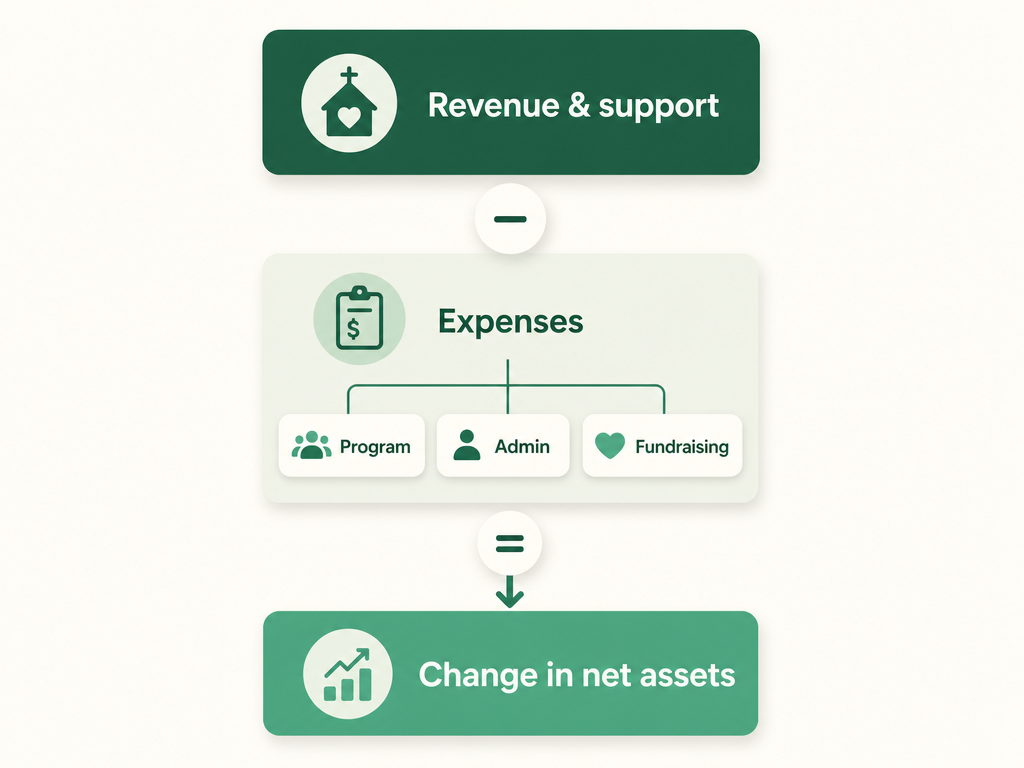
The statement runs top to bottom in three blocks and ends with the bottom line:
- Revenue and support — donations, grants, program fees, and investment income, separated into with donor restrictions and without donor restrictions.
- Expenses — what the organization spent, allocated across program, management and general, and fundraising.
- Change in net assets — revenue minus expenses. This is the nonprofit’s “bottom line,” though it isn’t called profit.
Restricted vs. unrestricted revenue
Just like the balance sheet, the statement of activities separates money by restriction. Revenue given for a specific purpose lands in the with donor restrictions column; when the nonprofit spends it on that purpose, the money is “released” from restriction and moves to the unrestricted column. That release is a line on the statement, and it’s where a lot of nonprofits make mistakes — recording a restricted gift as unrestricted income inflates the spendable bottom line and misleads the board.
Why functional expenses matter
Splitting expenses by function — program vs. administrative vs. fundraising — is unique to nonprofits, and it’s what donors and watchdogs scrutinize. The program expense ratio (program spending divided by total spending) is the number charity raters publish. The same figures feed the Form 990 most nonprofits file each year, so the statement of activities and the 990 should tell the same story.
Statement of activities vs. income statement (P&L)
A statement of activities and a business P&L play the same role, with three differences: the statement of activities ends in change in net assets rather than net profit; it separates revenue and net assets by donor restriction; and it splits expenses by function, not just by type. A business P&L does none of those.
The statement of activities is one of four statements that work together — see the full set in the guide to church financial statements, which applies to any nonprofit. Churches use this exact statement; the church statement of activities covers the church-specific version.
FAQ
What does a statement of activities look like? A vertical report: revenue and support at the top (split by restriction), functional expenses below, and the change in net assets at the bottom, usually with a column for each restriction class and a total.
Is a P&L the same as a statement of activities? They serve the same purpose, but a P&L ends in net profit while a statement of activities ends in change in net assets and adds restriction columns and functional expense categories a P&L doesn’t have.
How do you write a statement of activities? Pull revenue and expenses from reconciled books, separate revenue by restriction, allocate expenses across program, admin, and fundraising, then subtract to get the change in net assets. Fund-based software produces it automatically.
What is the 33% rule for nonprofits? The public support test — a 501(c)(3) generally must get at least 33⅓% of its support from public or government sources to remain a public charity. It’s measured from the revenue your statement of activities reports, by source.
Vestrybooks generates the statement of activities — restrictions and functional expenses handled — straight from your books. See how it works.
This article is general information for church treasurers, not professional tax or legal advice. For your church's situation, consult a qualified accountant or attorney.
Church accounting a volunteer can actually do.
Vestrybooks is church accounting + giving for the volunteer treasurer — fund tracking, one-click year-end statements, and online giving with $0 taken from every gift.
A real free plan · no credit card · your data stays yours