Blog · Fund accounting
Fund accounting vs. regular accounting, for churches
June 26, 2026 · By Benjamin Reinke

Short answer: Regular (for-profit) accounting answers one question — did we make a profit? Fund accounting answers a different one — did we use each dollar for the purpose it was given? A business tracks profit for its owners; a church tracks accountability for its donors and its mission. The bookkeeping engine underneath (double-entry) is the same; the goal, the structure, and the reports are different.
Two different questions
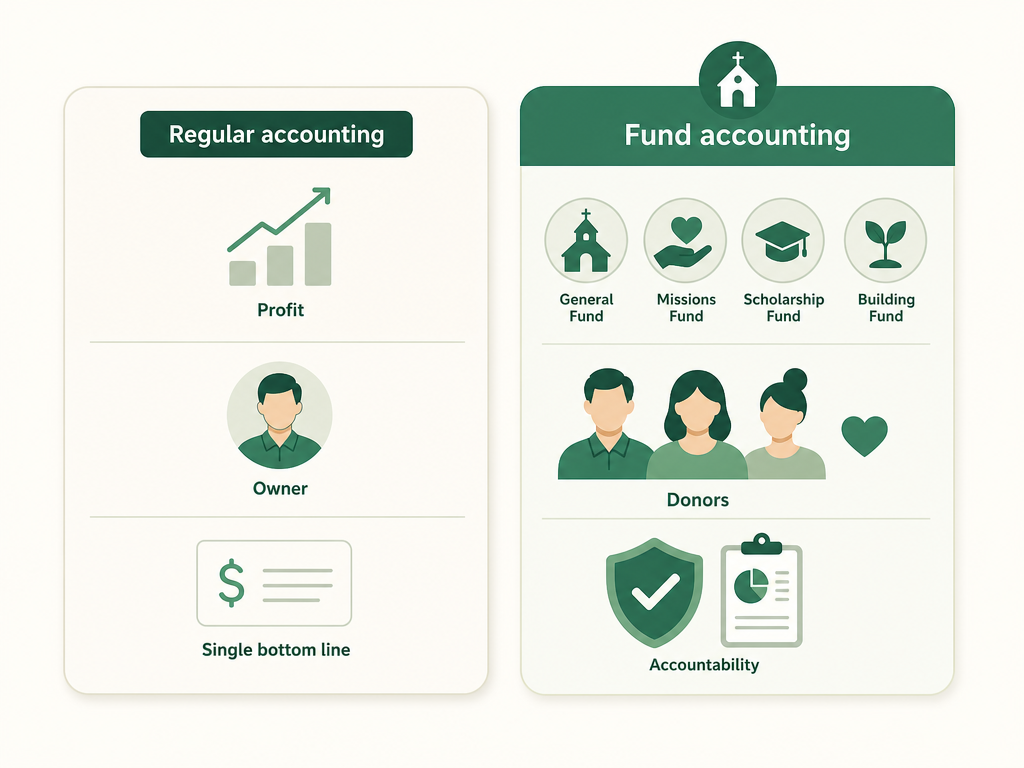
A business exists to make a profit, and everything rolls up to a single bottom line for the owners. A church doesn’t have owners or a profit motive — it has donors who trusted you with money for specific purposes, and a board accountable for honoring that trust. So the core question changes from “how much did we make?” to “did each gift do what it was given for?”
Fund accounting is simply the system built to answer that second question.
Side by side
| Regular (for-profit) accounting | Fund accounting | |
|---|---|---|
| Goal | Measure profit | Show money was used for its purpose |
| Answers to | Owners / shareholders | Donors / board / members |
| ”Equity” is | One owner’s equity | Net assets split by fund |
| Restrictions | Rare | Central — gifts come with purposes |
| Income statement | Profit & loss (P&L) | Statement of activities |
| Balance sheet | Balance sheet | Statement of financial position |
| Bottom line | Net profit | Change in net assets, by fund |
Why a church can’t just use plain business accounting
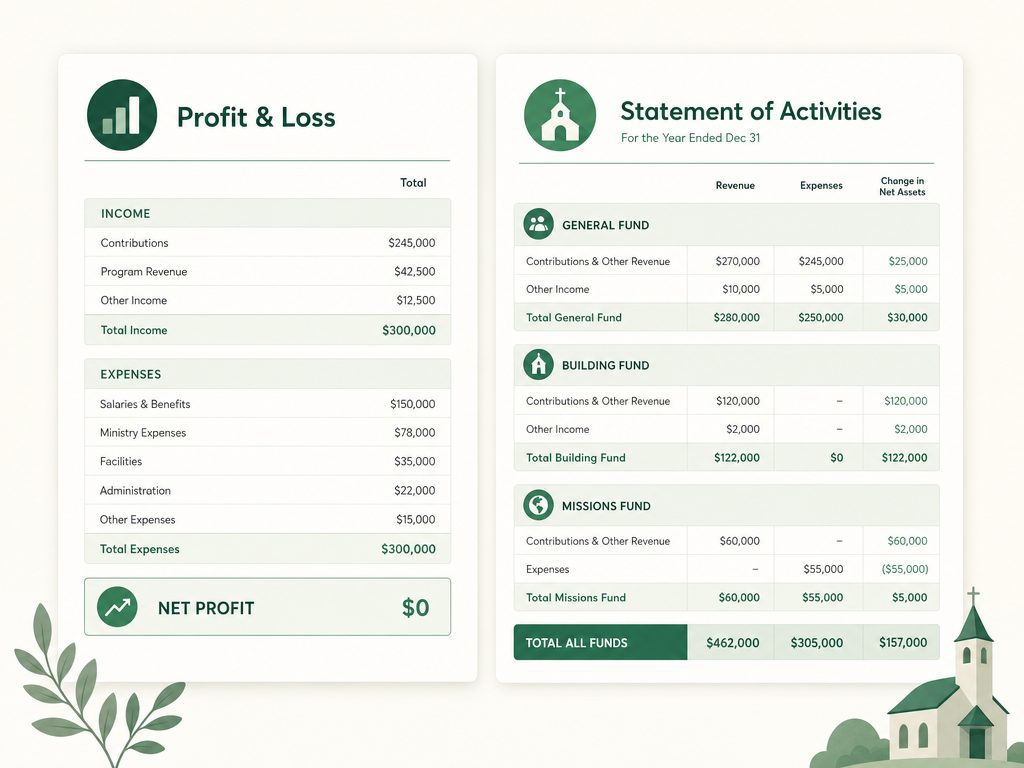
In a business, a dollar is a dollar — it all flows to the same bottom line. In a church, a dollar given “for the building” is not interchangeable with a dollar for general operations. If you track only a single bottom line, you literally cannot show that restricted money was kept on-purpose — and that’s the one thing a church most needs to prove. Churches report under nonprofit accounting rules, not for-profit ones (IRS Tax Guide for Churches, Pub 1828).
Fund accounting keeps each purpose in its own column, so at any moment you can show the building fund, the missions fund, and the general fund separately. (For how those columns sit on the books, see your church chart of accounts.)
Can a church use QuickBooks or other business software?
Honestly — you can, with workarounds. For-profit tools like QuickBooks don’t have a built-in “fund,” so churches approximate one using classes or tags, then build custom reports per class. It works, but it’s fragile: it’s easy to forget the class, the reports take fiddling, and restricted balances aren’t enforced.
Church-specific accounting software treats the fund as a real field on every transaction. You pick the fund from a dropdown, the double-entry happens behind the scenes, and reporting by fund just works — no class gymnastics, no forgotten tags. For a volunteer treasurer who isn’t an accountant, that difference is the difference between confident books and a stressful January. For the dedicated tools side by side, see the best fund accounting software.
Vestrybooks is fund accounting without the jargon: pick a fund, and the debits, credits, and by-fund reports take care of themselves. See plans →
FAQ
What is the difference between fund accounting and regular accounting? Regular accounting measures profit for owners. Fund accounting tracks whether money was used for the purposes it was given, for donors and the board. The double-entry mechanics are the same; the goal and reports differ.
Do churches use accrual or cash accounting? Most small churches use cash or modified-cash basis. That’s separate from fund accounting, which is a layer on top either way.
Is fund accounting harder than regular accounting? The concept is actually simpler — track money by purpose. The only added work is tagging each transaction to a fund, which good software reduces to a dropdown.
Can QuickBooks do fund accounting? Only by approximating funds with classes or tags and building custom reports. It’s a workaround, not a built-in feature — purpose-built church software handles funds natively.
This article is general information for church treasurers, not professional tax or legal advice. For your church's situation, consult a qualified accountant or attorney.
Track every fund the easy way.
Vestrybooks does real fund accounting in plain language — pick a fund, and restricted gifts stay separate automatically, across every account and card.
A real free plan · no credit card · your data stays yours