Blog · Church taxes
Do churches pay sales tax?
June 27, 2026 · By Benjamin Reinke
Short answer: It depends on the state. Sales tax is state-administered, not federal — so a church’s federal 501(c)(3) status doesn’t decide it. Many states exempt a church’s purchases when they’re for religious use, but the exemption usually isn’t automatic: the church has to apply for a sales-tax exemption certificate or number. Some states give churches no purchase exemption at all. And there’s a second question people forget — when a church sells taxable goods (a bookstore, a café, a fundraiser), it often has to collect and remit sales tax like any seller.
Sales tax is a state question, not a federal one
A church’s exemption from federal income tax is automatic and nationwide (IRS Publication 1828). Sales tax is the opposite: there is no federal sales tax, so every rule comes from the state (and sometimes the county or city). That means the answer to “do churches pay sales tax” changes the moment you cross a state line. Five states — Alaska, Delaware, Montana, New Hampshire, and Oregon — have no statewide sales tax at all, so the question doesn’t arise there. Everywhere else, you have to check that state’s rule.
Two practical takeaways:
- A church’s IRS letter does not grant a sales-tax exemption. States run their own exemption programs with their own paperwork.
- A church can be fully exempt from income tax and still owe sales tax on what it buys, depending on where it sits.
This is the same state-by-state pattern as do churches pay property taxes, and it sits underneath the bigger question of do churches pay taxes overall.
Buying versus selling: two different sales-tax questions
The phrase “sales tax” hides two separate situations, and a church can land differently on each.
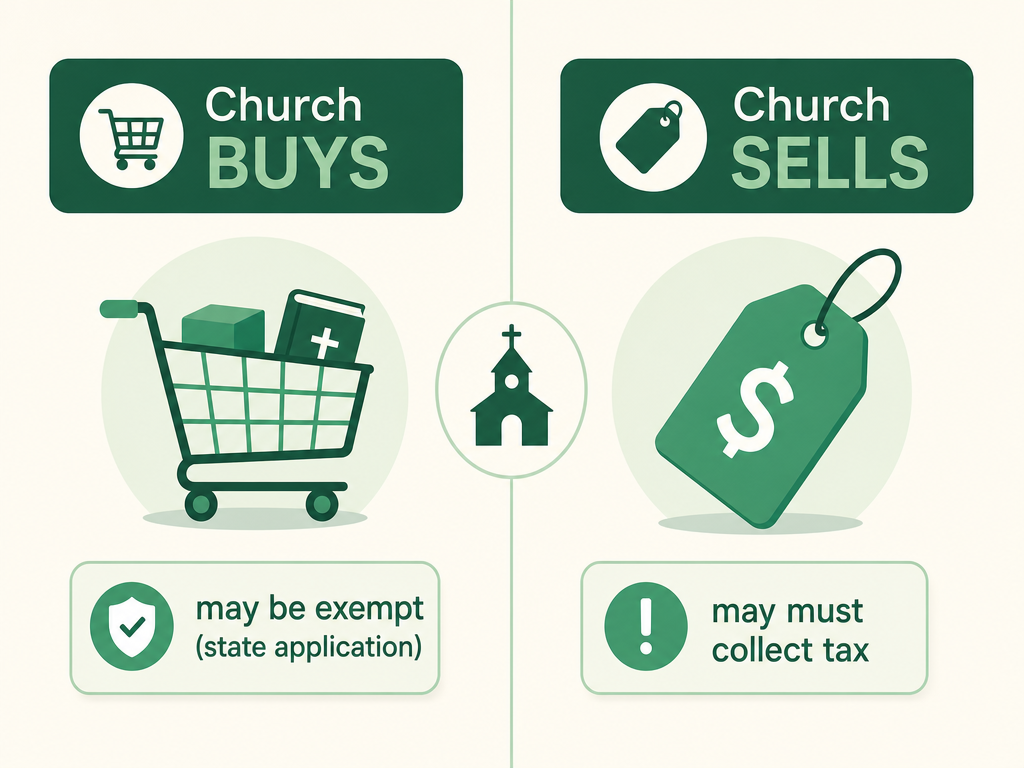
- When a church buys (chairs, supplies, sound equipment): in many states the church can buy these tax-free for religious use, usually by handing the vendor an exemption certificate it applied for. In other states the church pays the tax like anyone else.
- When a church sells (a bookstore, a coffee bar, T-shirts, a fundraiser dinner): the church is acting as a retailer, and many states require it to collect sales tax from the buyer and remit it — even though the church itself is tax-exempt. States often carve out occasional or fundraising sales, but the threshold varies.
So “is the church exempt?” isn’t one answer — it’s one answer for purchases and a different answer for sales.
How a church gets a sales-tax exemption on its purchases
Where a state does exempt church purchases, the exemption almost never happens by default. The church typically has to:
- Apply to the state revenue department for an exemption certificate, exemption number, or letter (the form name differs by state).
- Present that certificate to vendors at the point of sale so the tax isn’t charged.
- Use the purchase for exempt religious purposes — not for resale or an unrelated business.
- Renew the certificate when the state requires, and keep copies with the church’s records.
Miss the paperwork and the church pays full sales tax even in a state that would have exempted it. A few states also let a church pay the tax and then claim a refund rather than buy tax-free up front — North Carolina works this way, refunding sales tax churches paid rather than exempting purchases at the register.
States vary widely on church sales tax
There is no national rule, and the differences are real. A few examples that come up constantly (always confirm the current rule with the state directly):
| State | Church purchases | Notes |
|---|---|---|
| Texas | Exempt | Religious organizations can apply to the Comptroller for exemption (comptroller.texas.gov). |
| North Carolina | Taxed, then refunded | Churches pay sales tax and apply for a semiannual refund, not an up-front exemption. |
| Louisiana | Generally taxed | Louisiana generally does not exempt sales to churches and nonprofits from state sales tax. |
| Alabama | Generally taxed | Most churches are not exempt from Alabama sales and use tax unless a specific statute grants it. |
The pattern: “religious purpose” gets a church partway there in many states, but the entity still has to fit that state’s exemption rule and file for it. State definitions of “religious purpose” and “exempt use” are where most surprises hide.
When a church has to collect sales tax on what it sells
A church that runs any kind of sales operation should treat it as a retail activity until proven otherwise. Common examples that can be taxable sales the church must collect on:
- A church bookstore or gift shop selling books, merch, or coffee.
- A café or concession stand selling food or drinks.
- Branded T-shirts, mugs, or CDs sold to members or the public.
- Fundraiser sales of goods, where many states tax the transaction unless it qualifies as an occasional or exempt fundraising sale.
The buyer pays the tax; the church just collects and remits it. This is separate from the church’s own income-tax exemption, and it’s also separate from unrelated business income, which is about whether the profit is taxable, not whether sales tax applies. A church can owe sales-tax collection duties on activity that produces no taxable income at all.
Keeping church sales tax straight in the books
To stay clean on sales tax, a church generally needs to know three things and document them: which state(s) it operates in, whether it holds a current purchase-exemption certificate, and whether any of its activities are taxable sales it must collect on. Treasurers get caught most often by the selling side — a popular bookstore or annual fundraiser that quietly created a collect-and-remit obligation nobody registered for.
Vestrybooks keeps a church’s purchases, bookstore and fundraiser sales, and fund records organized, so it’s clear what was bought exempt and what sales might owe tax. See plans →
FAQ
What taxes do churches pay in the US? Churches skip federal income tax automatically, and are usually exempt from property tax on ministry space and sometimes sales tax on purchases. But they still pay payroll taxes on non-minister staff, can owe tax on unrelated business income, may have to collect sales tax on goods they sell, and their clergy owe self-employment tax.
Are churches in NC tax-exempt? For income tax, yes. For sales tax, North Carolina doesn’t exempt church purchases at the register — instead a church pays the sales tax and applies for a semiannual refund of the tax it paid on items used to carry out its work.
Are churches exempt from sales tax in Louisiana? Generally no. Louisiana does not broadly exempt sales to churches and nonprofit organizations from state sales tax, so a Louisiana church usually pays sales tax on its purchases unless a specific exemption applies.
Are churches in Alabama exempt from sales tax? Usually not. Alabama does not give churches a general sales- and use-tax exemption — most churches pay sales tax on purchases unless a specific statute exempts that organization or transaction.
Does a church have to collect sales tax when it sells things? Often yes. When a church sells taxable goods — bookstore items, food, merchandise, fundraiser products — many states require it to collect sales tax from the buyer and remit it, even though the church itself is tax-exempt. Check your state’s rule on occasional and fundraising sales.
This is general information, not tax or legal advice — sales-tax rules vary by state, so confirm with your state revenue department or a qualified professional.
This article is general information for church treasurers, not professional tax or legal advice. For your church's situation, consult a qualified accountant or attorney.
Church accounting a volunteer can actually do.
Vestrybooks is church accounting + giving for the volunteer treasurer — fund tracking, one-click year-end statements, and online giving with $0 taken from every gift.
A real free plan · no credit card · your data stays yours