Blog · Church taxes
Church tax forms: what the IRS makes you file
July 4, 2026 · By Benjamin Reinke

Short answer: A church is tax-exempt, but “exempt” is not the same as “files nothing.” The good news: a church does not file an annual Form 990 — the return every other nonprofit dreads. What a church does file depends almost entirely on whether it pays anyone. With no employees and no side business, a church files close to nothing all year. Once it has staff, the list is short and predictable: Form 941 every quarter for payroll, a W-2 and W-3 each January, a 1099-NEC for larger contractor payments, and — only if the church runs a genuine business on the side — Form 990-T. That’s the whole federal picture for most small churches.
What a tax-exempt church actually files (the short list)
A church’s filing duties come from two things: being an employer and, rarely, earning money from an unrelated business. Everything below flows from those. The exemption from income tax that a church gets automatically as a 501(c)(3) — the mechanics of which are covered in the pillar on whether do churches pay taxes — does not exempt it from information reporting or from payroll filings. Those are separate obligations that every employer, exempt or not, has to meet.
Here’s the entire federal list a church might touch, and when each one applies:
| Form | What it’s for | When a church files it |
|---|---|---|
| Form 990 (990-EZ / 990-N) | Annual nonprofit information return | Never — churches are specifically exempt |
| Form 941 | Quarterly payroll: income tax + FICA withheld | Every quarter, once it has employees |
| Form 944 | Annual version of 941, for tiny employers | Only if the IRS notifies the church to use it |
| Form W-2 + W-3 | Annual wage report for each employee (+ the summary) | Each January, for every employee including the pastor |
| Form 940 (FUTA) | Federal unemployment tax | Generally not — 501(c)(3)s are exempt from FUTA |
| Form 1099-NEC | Payments to non-employee contractors | For contractors paid the annual threshold or more |
| Form 990-T | Tax on unrelated business income | Only if gross unrelated business income is $1,000+ |
The rest of this page walks each row, then gives you a filing calendar so you know what’s due when.
Why a church doesn’t file Form 990
The single most reassuring fact for a church treasurer: a church does not file the annual Form 990. Most nonprofits must file some version of it every year — 990, 990-EZ, or the short 990-N e-postcard — or lose their exempt status after three missed years. Churches are carved out. The IRS states plainly that “a church, an interchurch organization of local units of a church, a convention or association of churches, or an integrated auxiliary of a church” is not required to file Form 990 or 990-EZ (IRS, Filing Requirements for Churches and Religious Organizations; IRS Publication 1828, Tax Guide for Churches & Religious Organizations).
This is a genuine, meaningful break. It means a church with no staff and no unrelated business has, at the federal level, essentially no annual return to file. It doesn’t have to prove its exempt status year after year the way a food bank or a booster club does. That’s part of the special treatment churches get automatically — the same treatment that shapes the narrow way does the IRS audit churches even when it looks.
The catch is that “no 990” is often misheard as “no filings at all.” It isn’t. The moment a church hires someone, the payroll forms below kick in — and those are due on a schedule whether or not a 990 ever is.
The payroll forms: Form 941 and the W-2 / W-3
If a church pays anyone — a pastor, a secretary, a custodian, a nursery worker — it becomes an employer, and employers file payroll returns. This is where nearly all of a church’s real filing work lives. The full mechanics of who’s an employee, who’s a minister with dual tax status, and who’s a contractor are laid out in the guide to church payroll; here we’re focused on the forms and their deadlines.
Form 941, Employer’s Quarterly Federal Tax Return, is the workhorse. Four times a year, the church reports the federal income tax it withheld from non-minister employees plus the Social Security and Medicare (FICA) owed — both the employee’s share and the church’s matching share (IRS, Instructions for Form 941). It’s due one month after each quarter ends: April 30, July 31, October 31, and January 31.
A small number of very small employers file Form 944, Employer’s Annual Federal Tax Return instead — the once-a-year version of 941 — but only if the IRS specifically notifies the church to use it. You don’t choose 944 on your own; the default is quarterly 941 until the IRS says otherwise.
At year-end, each employee gets a Form W-2 reporting the year’s wages and withholding, due to the employee and to the Social Security Administration by January 31. The church also files one Form W-3 — the transmittal summary that totals all the W-2s — with the SSA at the same time (IRS, General Instructions for Forms W-2 and W-3).
The pastor gets a W-2 too. This surprises treasurers, but a minister on staff is a W-2 employee for income tax — not a 1099 contractor — even though the church withholds no FICA from clergy pay because ministers are self-employed for Social Security. There’s a wrinkle: the pastor’s designated housing allowance is generally not reported as taxable wages in Box 1 of the W-2 (it’s excluded from income tax, though the minister still owes self-employment tax on it). That single line is where a lot of church W-2s go wrong.
The FUTA break: a church usually skips Form 940
Most employers file Form 940 each year to report and pay federal unemployment tax (FUTA). A church generally does not. Churches and other 501(c)(3) organizations are exempt from FUTA, so the typical church files no Form 940 at all (IRS Publication 1828; IRS Publication 15, Circular E). It’s one fewer annual form than a comparable small business deals with.
One honest caveat: state unemployment is separate. Some states require certain nonprofit employers to participate in (or reimburse) state unemployment funds, and a few states have their own withholding or payroll forms. The federal FUTA exemption is reliable; your state rules are not automatic, so confirm them locally.
Form 1099-NEC — and the new $2,000 threshold
A church also files an information return for the contractors it pays. If the church pays an unincorporated person or business for services — a guest speaker, a musician, a plumber, a contract bookkeeper — and the year’s total reaches the reporting threshold, the church files a Form 1099-NEC (Nonemployee Compensation), one copy to the contractor and one to the IRS, by January 31. Being tax-exempt does not excuse a church from this; the full treasurer’s workflow, including collecting a W-9 first and the corporation exceptions, is in the guide to whether do nonprofits issue 1099s.
The number to watch changed recently, so use the right one:
- For payments made in 2025 (the 1099s you file in January 2026), the threshold is the long-standing $600 or more.
- For payments made on or after January 1, 2026, the One Big Beautiful Bill Act (OBBBA) raised the threshold to $2,000 (IRS / Federal Register, “Increase in Threshold for Requiring Information Reporting”). Those higher-threshold 1099s are first filed in January 2027. After 2026 the $2,000 figure is indexed for inflation.
So a church tracking its 2026 contractor payments now applies the $2,000 trigger, not $600. A guest preacher paid $900 across the year needed a 1099 under the old rule; for 2026 payments, that same $900 falls under the new threshold and no 1099-NEC is required. (The contractor still owes tax on the money either way — the threshold change is about reporting, not about whether the income counts.) Don’t 1099 your salaried pastor regardless of the number: employees get a W-2, contractors get a 1099, full stop.
Form 990-T — only if the church runs an unrelated business
The one income-tax return a church might file is Form 990-T, Exempt Organization Business Income Tax Return — and only in a narrow case. If a church regularly carries on a trade or business that isn’t related to its religious mission and takes in $1,000 or more of gross income from it in a year, it must file Form 990-T and may owe unrelated business income tax (UBIT) on the profit (IRS, Unrelated Business Income Tax; IRS Publication 598).
Classic examples: renting the parking lot to commuters for a fee, running a coffee shop or bookstore open to the public as an ongoing business, or advertising income. Note what does not trigger it — ordinary tithes and offerings, and program income tied to the mission, are never unrelated business income. Most small churches never file a 990-T because they never run an unrelated business at the $1,000 level. It’s due the 15th day of the 5th month after the church’s tax year ends (May 15 for a calendar-year church).
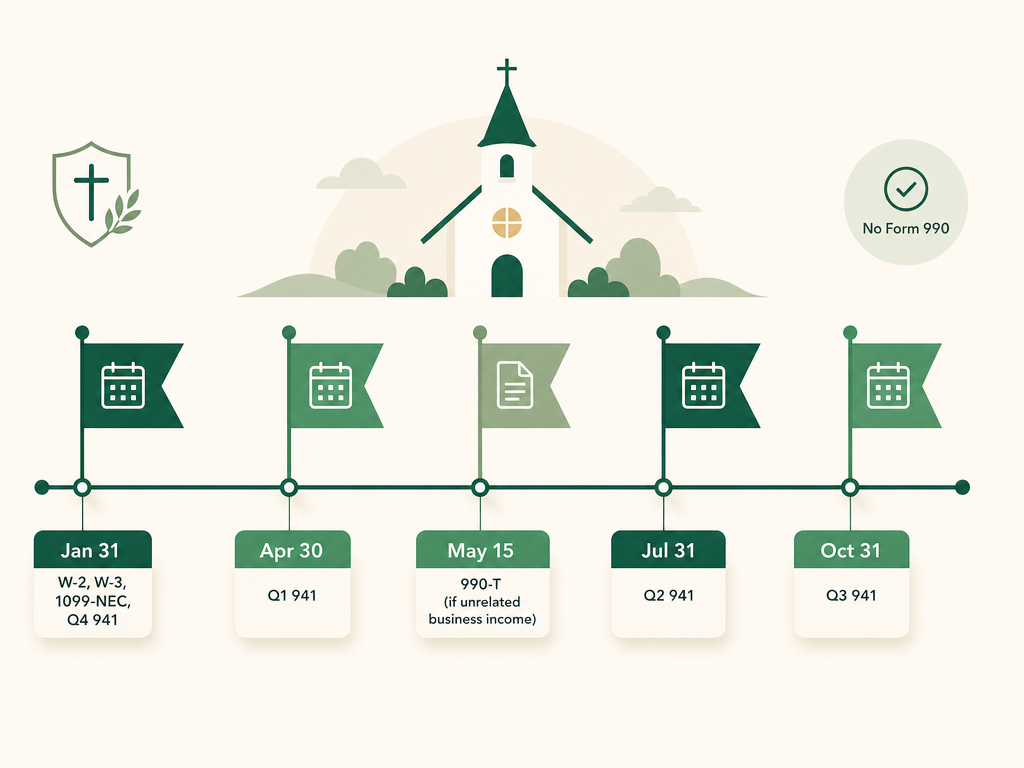
A church’s filing calendar, at a glance
Here is the whole federal year for a calendar-year church with employees. If your church has no staff and no unrelated business, almost all of this is blank — which is exactly the point.
| Deadline | What’s due | Applies if… |
|---|---|---|
| January 31 | Form W-2 (to employees + SSA), Form W-3, Form 1099-NEC, and Q4 Form 941 | You have employees / paid contractors over the threshold |
| April 30 | Q1 Form 941 | You have employees |
| May 15 | Form 990-T | You had $1,000+ of unrelated business income last year |
| July 31 | Q2 Form 941 | You have employees |
| October 31 | Q3 Form 941 | You have employees |
When a deadline lands on a weekend or federal holiday, it shifts to the next business day. And remember: no Form 990 appears anywhere on this calendar — that’s the church exemption in action.
The pattern to take away: a church’s filing burden scales with its payroll, not with its size or its offering plate. A tiny church with one part-time paid pastor files quarterly 941s and January W-2s, and that’s essentially it. Add more staff and the same forms just cover more people. There’s no surprise annual return waiting to ambush you.
Vestrybooks keeps your church’s payroll runs, housing-allowance designations, and contractor totals clean all year — so the quarter’s Form 941 figures and January’s W-2s and 1099-NECs come out of the records you already kept, not a shoebox scramble. See plans →
FAQ
Does a church file a tax return? Generally no annual income-tax return. A church does not file Form 990, 990-EZ, or 990-N like other nonprofits, and it usually doesn’t file Form 940 (FUTA). It only files an income-tax return — Form 990-T — if it has $1,000 or more of gross unrelated business income. Its real filings are payroll forms, which apply only once it has employees.
What IRS forms does a church file? For a church with staff: Form 941 each quarter for payroll, a W-2 for each employee plus a W-3 summary each January, and a 1099-NEC for contractors paid the threshold or more. It files Form 990-T only if it runs an unrelated business earning $1,000+. It does not file Form 990, and it generally does not file Form 940.
Do churches have to file Form 990? No. Churches, conventions or associations of churches, and integrated auxiliaries are specifically excepted from filing Form 990 or 990-EZ under IRS rules. A church keeps its exempt status without the annual filing that other nonprofits must do.
Does a church file Form 941? Yes, once it has employees. Form 941 is filed every quarter to report withheld income tax and FICA, due April 30, July 31, October 31, and January 31. A very small church files the annual Form 944 instead only if the IRS specifically notifies it to.
Do churches file 1099 forms? Yes. A church files Form 1099-NEC for unincorporated contractors it pays for services above the threshold — $600 for 2025 payments, and $2,000 for payments made in 2026 and later under the OBBBA. It’s due January 31. A salaried pastor gets a W-2, never a 1099.
When are church tax forms due? Form 941 is due one month after each quarter (April 30, July 31, October 31, January 31). W-2s, W-3, and 1099-NECs are due January 31. Form 990-T, if required, is due the 15th day of the 5th month after the tax year ends — May 15 for a calendar-year church.
This is general information, not tax or legal advice — confirm your church’s filing requirements with a qualified professional.
This article is general information for church treasurers, not professional tax or legal advice. For your church's situation, consult a qualified accountant or attorney.
Church accounting a volunteer can actually do.
Vestrybooks is church accounting + giving for the volunteer treasurer — fund tracking, one-click year-end statements, and online giving with $0 taken from every gift.
A real free plan · no credit card · your data stays yours