Blog · Payroll & clergy taxes
How the clergy housing allowance works
June 26, 2026 · By Benjamin Reinke
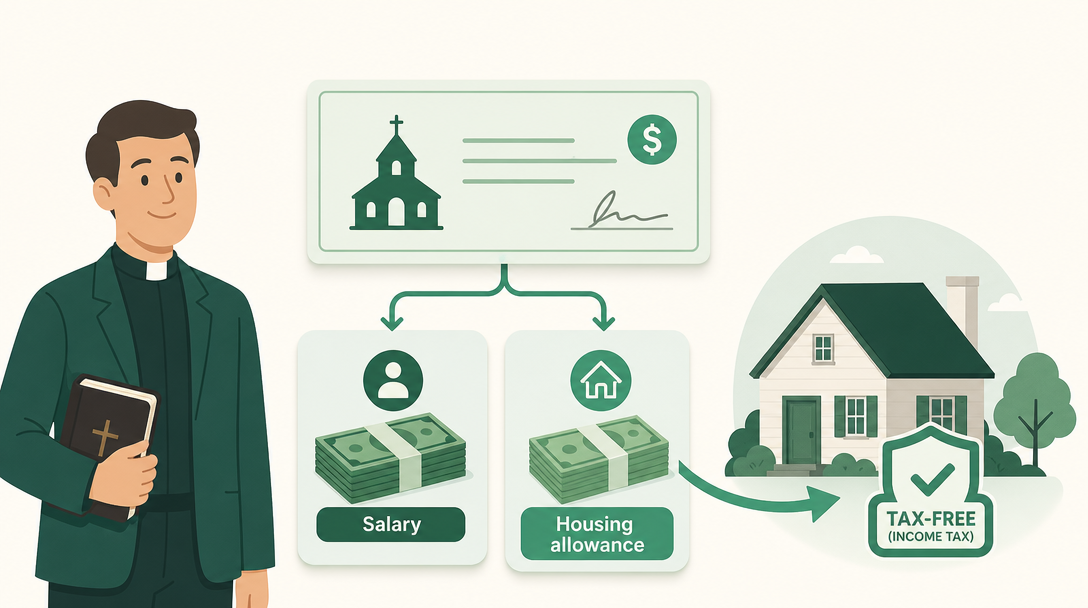
Short answer: The clergy housing allowance lets an ordained, licensed, or commissioned minister exclude part of their pay from federal income tax — the part the church officially designates as housing, used to provide a home. Two rules matter most: the church must designate it in advance, in writing, and the excludable amount is the least of three numbers (what was designated, what the minister actually spent on housing, and the home’s fair rental value). The catch nearly everyone misses: the allowance is exempt from income tax but still counts for Social Security / self-employment tax.
What the clergy housing allowance is
Under IRC §107, a “minister of the gospel” can exclude from gross income, for federal income tax, either the rental value of a church-provided parsonage or a cash housing allowance, to the extent it’s used to provide a home (IRS: Ministers’ Compensation & Housing Allowance). It’s the single biggest tax benefit in ministry — a major, tax-advantaged piece of a pastor’s pay package that scales with church size — and one of the easiest to get wrong.
There are two situations:
- Parsonage — the church provides a home. The fair rental value isn’t taxed as income.
- Cash housing allowance — the minister owns or rents, and the church designates part of pay as a housing allowance.
Who qualifies for the housing allowance
The allowance is only for a minister performing ministerial services — someone ordained, licensed, or commissioned, who conducts worship, administers ordinances, and is recognized as a religious leader. A church bookkeeper or secretary doesn’t qualify; the senior pastor performing ministerial duties does. (Whether a given staff member is a “minister” for tax purposes is a facts-and-circumstances test worth confirming with a CPA.)
The rule churches break most: designate it in advance
The housing allowance must be officially designated in writing before it’s paid — by a board resolution or in the approved budget. It cannot be applied retroactively. If a church forgets to designate and tries to fix it in December, the months before the designation don’t qualify.
The fix is simple: every year, before the new year starts, the board adopts a resolution setting each minister’s housing allowance for the coming year. Keep the resolution in the minutes.
How much can be excluded — the lesser-of-three rule
For a cash allowance, the amount a minister can actually exclude is the smallest of these three:
- the amount the church officially designated,
- the minister’s actual housing expenses for the year,
- the fair rental value of the home, furnished, plus utilities.
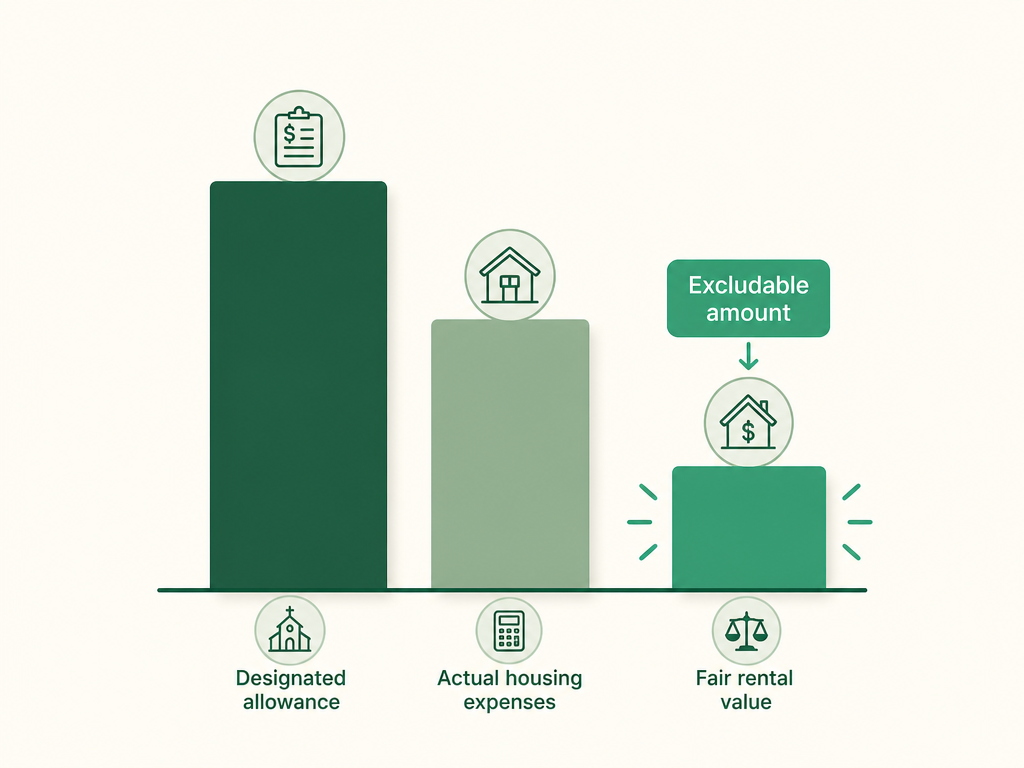
So designating a generous allowance doesn’t, by itself, increase the benefit — the minister still has to spend it on housing, and it’s capped at the home’s fair rental value. It’s smart to designate slightly more than expected expenses (you can’t exclude more than you spend, but you also can’t fix an under-designation later), and let the lesser-of-three do the limiting. (Calculate the housing allowance with a worked example, or run your numbers through the housing allowance calculator.)
What expenses count
Eligible housing costs include rent or mortgage payments (principal and interest), a down payment, property taxes, homeowner’s insurance, utilities, furniture and appliances, repairs, maintenance, and HOA dues. Food, clothing, and domestic help don’t count. The minister keeps records and receipts.
The trap: income tax vs. self-employment tax
Here’s what catches nearly every new pastor. The housing allowance is excluded from income tax — but it is not excluded from Social Security and Medicare. Ministers have a “dual tax status”: they’re employees for income tax (they get a W-2), but self-employed for Social Security, so they pay SECA (15.3%) on their salary and their housing allowance, unless they’ve formally opted out of Social Security. Because of that dual status, a church handles a minister’s pay differently from its other staff — the full picture is in how church payroll works.
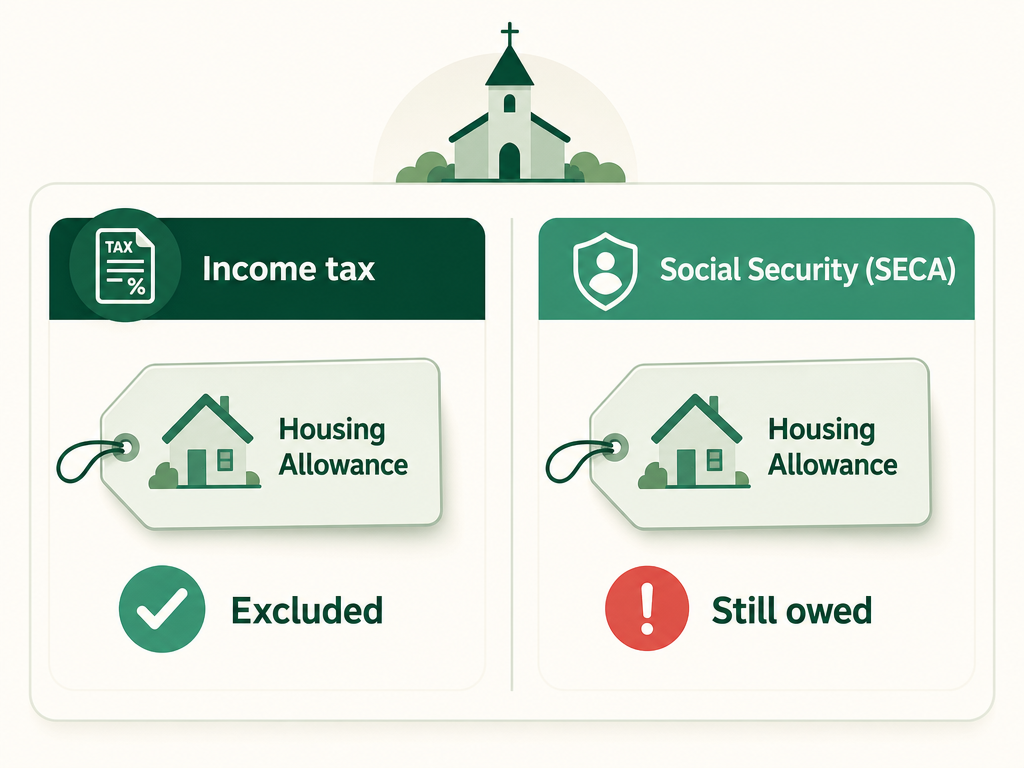
This is why a pastor can be surprised by a tax bill: their income-tax withholding looks fine, but SECA on the full salary-plus-housing wasn’t covered. The usual fix is to make quarterly estimated payments or have extra voluntary income-tax withholding set aside to cover SECA. (The clergy self-employment tax calculator estimates the bill on salary plus housing.)
Excess allowance, and how it’s reported
If the church designates more than the lesser-of-three, the extra is taxable income — the minister reports the excess on their Form 1040. The housing allowance itself is not included in W-2 Box 1 (wages). Churches commonly note the designated amount in Box 14 (informational) or in a separate letter — see the housing allowance on the W-2.
One genuinely generous quirk: a minister can still deduct mortgage interest and property taxes on Schedule A even though those were paid with tax-free housing-allowance money — a rare “double benefit” Congress chose to allow.
A note on retired ministers
Retired clergy can have distributions from a church retirement plan (a 403(b)(9)) designated as housing allowance, making part of their retirement income tax-free for housing — one of the most valuable, least-known parts of the benefit.
Vestrybooks keeps your church’s records clean so the board’s housing-allowance resolution and the year’s numbers are always one click away when it’s time to report. See plans →
FAQ
How does the clergy housing allowance work? The church designates part of a minister’s pay as housing in advance; the minister excludes the least of (designated amount, actual housing costs, fair rental value) from income tax. It still counts for self-employment tax.
What is the average housing allowance for ministers? There’s no set or average figure — it’s based on each minister’s actual housing costs, capped at the home’s fair rental value. Two pastors in different homes will have very different allowances.
Can pastors write off living expenses? Not as ordinary deductions. The housing allowance is an exclusion (better than a deduction), limited to genuine housing costs — not food, clothing, or other living expenses.
What is the housing allowance for clergy in 2026? There’s no IRS-set dollar amount. The church designates it before 2026 begins, based on the minister’s expected housing costs, and the lesser-of-three rule caps it.
Is the housing allowance subject to Social Security? Yes — unless the minister opted out with Form 4361. It’s excluded from income tax but included in self-employment (SECA) earnings.
This article is general information for church treasurers, not professional tax or legal advice. For your church's situation, consult a qualified accountant or attorney.
Church accounting a volunteer can actually do.
Vestrybooks is church accounting + giving for the volunteer treasurer — fund tracking, one-click year-end statements, and online giving with $0 taken from every gift.
A real free plan · no credit card · your data stays yours