Blog · Church taxes
Do nonprofits issue 1099s? Yes — here's the treasurer's workflow
June 27, 2026 · By Benjamin Reinke

Short answer: Yes. A nonprofit or church must issue Form 1099-NEC to any unincorporated person or business it pays $2,000 or more in a year for services (the 2026 threshold, up from $600 through 2025) — a guest speaker, a musician, the plumber, the cleaning crew, a bookkeeper hired as a contractor. Being a tax-exempt 501(c)(3) gets you out of paying income tax, not out of information reporting. The form goes to the recipient and the IRS by January 31, and you collect a Form W-9 before you pay so you have the name and tax ID to file it.
Why a tax-exempt nonprofit still files 1099s
A 501(c)(3) is exempt from income tax. It is not exempt from the rules that make every business and organization report what it pays to contractors. The IRS calls these information returns, and Form 1099-NEC (Nonemployee Compensation) is the main one a small nonprofit will touch. If your church or nonprofit pays someone for services in the course of its operations, you are the payer, and the payer files the 1099 — your exempt status doesn’t change that.
The trigger is simple: pay $2,000 or more in a calendar year (the threshold for 2026 payments; it was $600 through 2025) to one unincorporated payee for services, and you file a 1099-NEC for that person (IRS, About Form 1099-NEC). The same logic that makes a church still owe payroll tax on staff — covered in do churches pay taxes — is why it still files these forms: exemption is narrower than people think.
People your nonprofit commonly 1099s:
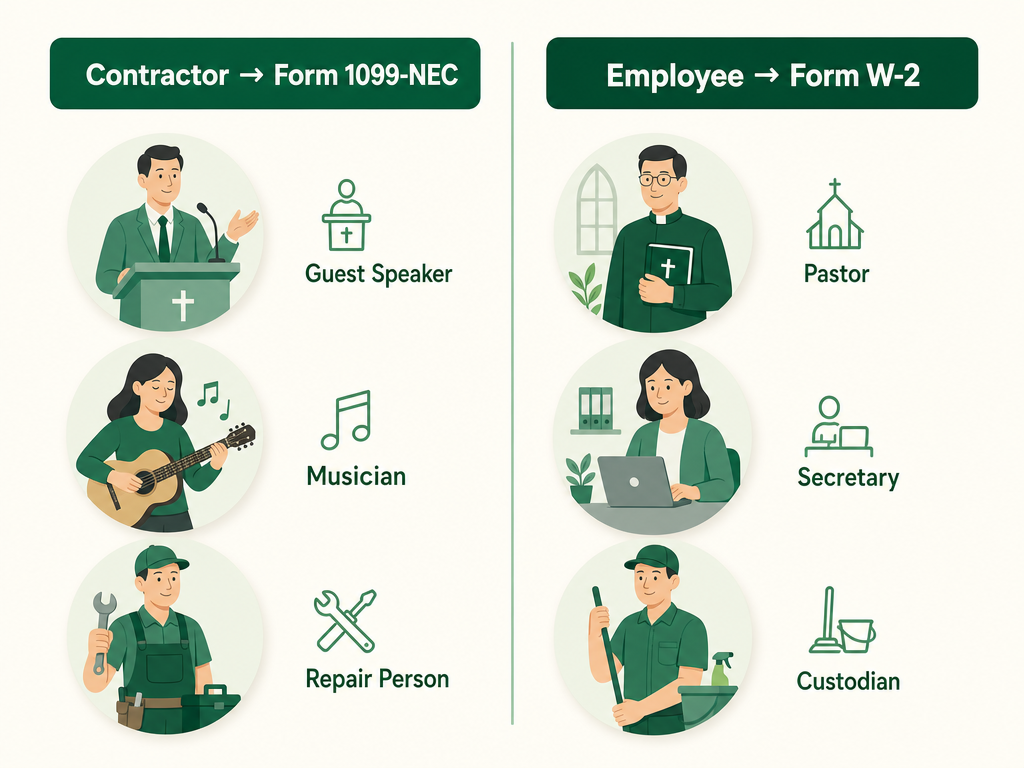
- A guest speaker or evangelist paid an honorarium of $2,000+
- A musician, worship leader, or sound tech hired for events
- A repair person, plumber, electrician, or HVAC contractor
- A cleaning service run by a sole proprietor
- A bookkeeper or accountant you pay as a contractor (not an employee)
- A landlord you pay rent to (rent goes on Form 1099-MISC, not 1099-NEC)
Collect a W-9 before you pay, not after
Form W-9 is the document that makes the whole 1099 process work, and the rule of thumb is to get it before you cut the first check. The W-9 gives you the payee’s legal name, their taxpayer identification number (TIN), and — critically — their entity type (sole proprietor, partnership, LLC, corporation). That entity type is what tells you whether a 1099 is even required (IRS, About Form W-9).
Chasing a W-9 in January, after a vendor has been paid and moved on, is how nonprofits end up unable to file. Get it up front. The flip side — when your own nonprofit is the one asked to provide a W-9 — is covered in a nonprofit’s own W-9.
Here’s the workflow start to finish:
- Before paying a new vendor, request a completed Form W-9.
- Read the entity type. Sole proprietor, single-member LLC, or partnership → likely a 1099. A corporation → generally no 1099 (see the exceptions below).
- Track the total you pay that vendor across the year.
- If it hits $2,000+ for services, file a 1099-NEC by January 31 — one copy to the vendor, one to the IRS.
- Keep the W-9 and records in case the amount or the relationship is ever questioned.
When a nonprofit does NOT issue a 1099
Plenty of payments don’t need a 1099-NEC, and over-issuing is its own small mess. You generally skip it when:
- The payee is a corporation. Payments to a C or S corporation are generally exempt from 1099-NEC reporting. The notable exception: payments to attorneys are reportable even if the law firm is incorporated.
- You paid less than $2,000 to that vendor for the whole year.
- You bought goods, not services — supplies, equipment, merchandise.
- You paid by credit card or a third-party network (e.g., PayPal). Those payments are reported by the card processor on a 1099-K, so you don’t also 1099 them.
- The person is your employee — they get a W-2, not a 1099 (next section).
When you’re unsure, the W-9’s entity box is the tie-breaker, and the IRS form instructions spell out the corporation exceptions.
Don’t 1099 your pastor — employees get a W-2
The line that trips up churches: a minister or staff member who is an employee gets a Form W-2, not a 1099. Don’t 1099 your pastor’s salary. Contractors get 1099s; employees get W-2s, full stop.
Most pastors of an established church are employees for payroll purposes, so their pay — base salary plus the designated housing allowance — is reported on a W-2, not a 1099-NEC. (Clergy have a quirk: they’re employees for income-tax reporting but self-employed for Social Security, paying SECA instead of having FICA withheld — the detail in how the clergy housing allowance works and in pastor salary.) A genuinely independent guest preacher you bring in for one weekend, by contrast, is a contractor and may well get a 1099.
| Independent contractor | Employee | |
|---|---|---|
| Form they get | 1099-NEC (if $2,000+) | W-2 |
| Examples | Guest speaker, musician, plumber, contract bookkeeper | Pastor on salary, secretary, custodian, paid childcare worker |
| You collect | Form W-9 | Form W-4 |
| Taxes withheld? | No — they handle their own | Yes — income tax + FICA (clergy pay SECA) |
| Deadline | January 31 | January 31 |
Misclassifying an employee as a 1099 contractor to skip payroll tax is a real risk for churches, and the IRS can reclassify and assess back taxes. When in doubt, the control test (who sets the hours, the work, the tools) decides it.
Do 501(c)(3)s and churches receive 1099s too?
Yes — a tax-exempt organization can be on the receiving end of a 1099. If another business pays your nonprofit $2,000+ for services it provides (say, your church rents out its hall or provides a paid service), that payer may issue a 1099 to your organization. Receiving one has no tax effect on your exempt income — donations, tithes, and program revenue tied to your mission stay tax-exempt regardless of whether a 1099 shows up. It does not make that money taxable. (Income from a true unrelated business is a separate question, covered under are churches tax exempt.) Practically, if you receive a 1099 for exempt-purpose income, you keep it with your records; it doesn’t create a tax bill.
Do nonprofit employees pay taxes on their wages?
Yes. A nonprofit’s exemption belongs to the organization, not to its people. Employees of a church or nonprofit pay federal income tax and FICA (Social Security and Medicare) on their wages exactly like employees anywhere else — the W-2 they receive reports it. The only major twist is for clergy, who pay self-employment SECA tax on salary plus housing instead of having FICA withheld, because of their dual tax status (IRS Publication 1828). Either way, “we’re a nonprofit” is never a reason an employee’s paycheck escapes tax. Keeping payroll and contractor payments clean is ordinary nonprofit bookkeeping, not anything exotic.
Vestrybooks tracks every vendor and the running total you’ve paid them, so you know in December exactly who crossed the $2,000 threshold and needs a 1099 — no scramble. See plans →
FAQ
Should nonprofits receive a 1099? A nonprofit can receive a 1099 if another business pays it $2,000+ for services. It has no tax effect on the organization’s exempt income — the money tied to its mission stays tax-exempt — so you simply file it with your records.
Do I have to issue a 1099 to a 501(c)(3)? Generally no. Payments to a 501(c)(3) (a corporation) are usually exempt from 1099-NEC reporting, the same as payments to any corporation. Get a W-9; the entity box confirms it. Attorney payments are the main exception.
What is a 1099 form for a nonprofit organization? Form 1099-NEC is the information return a nonprofit files to report nonemployee compensation — $2,000 or more (the 2026 threshold, formerly $600) paid to an unincorporated contractor for services in a year. The contractor and the IRS each get a copy by January 31.
Who is exempt from issuing 1099? No organization is broadly exempt from issuing 1099s — being tax-exempt doesn’t excuse you. A specific payment is exempt when it’s under $2,000 (the 2026 threshold; $600 through 2025), made to a corporation (other than attorneys), for goods rather than services, or paid by card (reported on a 1099-K instead).
When are nonprofit 1099s due? Form 1099-NEC is due to both the recipient and the IRS by January 31 of the year after payment.
This is general information, not tax or legal advice — confirm your organization’s situation with a qualified professional.
This article is general information for church treasurers, not professional tax or legal advice. For your church's situation, consult a qualified accountant or attorney.
Church accounting a volunteer can actually do.
Vestrybooks is church accounting + giving for the volunteer treasurer — fund tracking, one-click year-end statements, and online giving with $0 taken from every gift.
A real free plan · no credit card · your data stays yours