Blog · Church taxes
How a nonprofit fills out Form W-9 (and why it's asked)
June 28, 2026 · By Benjamin Reinke
Short answer: Yes — a nonprofit completes a Form W-9 whenever a payer, grantor, or customer asks for one. The form certifies three things: your organization’s legal name, its taxpayer ID (your EIN), and its federal tax classification. Filling it out takes a few minutes, and a 501(c)(3) is usually exempt from backup withholding, so you sign it, hand it back, and you’re done. You give the W-9 to whoever requested it — you do not send it to the IRS.
A W-9 trips people up because a tax-exempt organization rarely thinks of itself as a “payee” that someone needs tax information from. The same surprise drives the broader question in the pillar guide, do churches pay taxes: exemption is narrower than it sounds, and information reporting still touches your nonprofit from both directions. Below is the why, the line-by-line, and how this W-9 differs from the 1099s your own organization issues.
Why a nonprofit gets asked for a W-9
A payer requests Form W-9 because they have to file an information return with the IRS, and they need your details to do it correctly. The official form spells out the purpose plainly: a requester who is required to file an information return “is giving you this form because they must obtain your correct taxpayer identification number (TIN) to report on an information return the amount paid to you” (IRS, About Form W-9). The request is about the payer’s reporting duty, not a judgment about your organization.
A nonprofit commonly receives a W-9 request when:
- A grantor or foundation is about to send your organization grant funds and needs your legal name and EIN on file.
- A business pays your nonprofit for a service — renting your hall, a paid program, a sponsorship — and may have to issue a 1099 to you.
- A bank, vendor portal, or donor platform sets up your organization as a payee and collects a W-9 as part of onboarding.
- A church or denomination reimburses or pays a smaller affiliated ministry and wants its records straight.
The requester uses your W-9 to certify your name and EIN against IRS records, to decide whether a 1099 is required for what they pay you, and to determine whether backup withholding applies. When you certify exempt-payee status, you tell them up front that they should not withhold — more on that below.
Filling out Form W-9 as a 501(c)(3), line by line
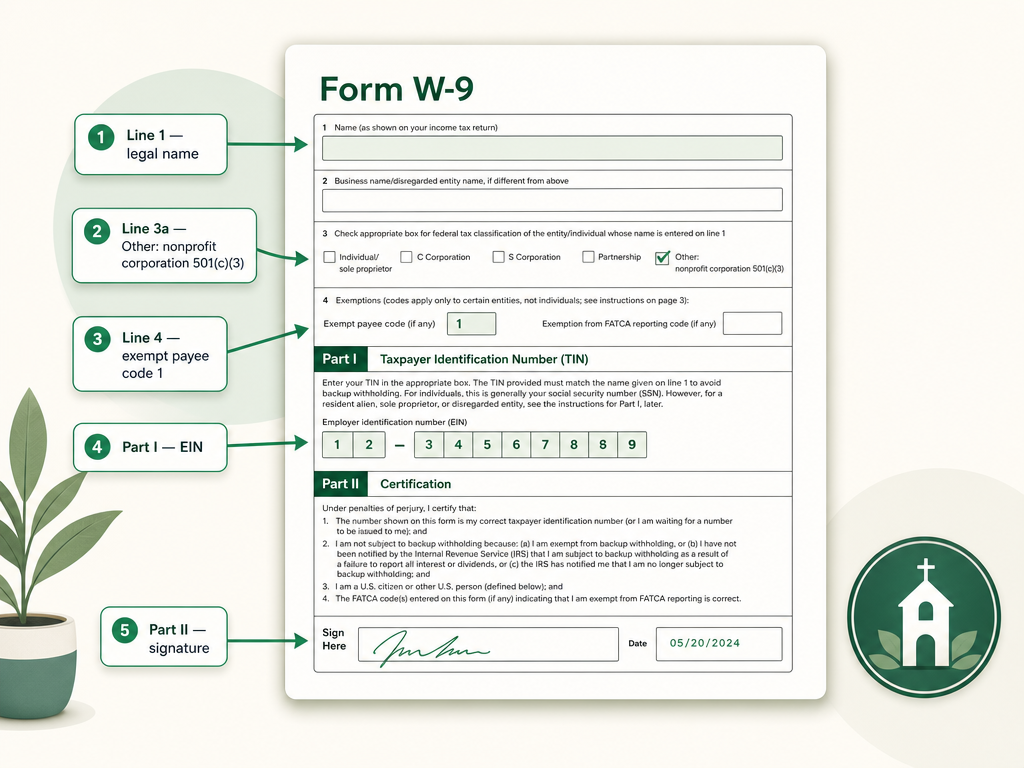
Form W-9 (Rev. March 2024) is one page, and a 501(c)(3) touches only a handful of fields. Here is each one (IRS, Form W-9 PDF).
Line 1 — Name. Enter your organization’s legal name exactly as it appears on your IRS records and your determination letter. The form states an entry on Line 1 “is required” and the name must match the name associated with your EIN. Do not put a person’s name here; the entity is the payee.
Line 2 — Business name / trade name. Leave this blank unless your nonprofit operates under a DBA or trade name different from Line 1. If your legal name is “First Avenue Community Church, Inc.” but you do business as “First Ave Outreach,” the DBA goes on Line 2.
Line 3a — Federal tax classification. This is the line nonprofits ask about most. The seven checkboxes are built for ordinary businesses, and none of them says “tax-exempt nonprofit.” The standard practice for a nonprofit is to check the “Other (see instructions)” box and write a short description of your status on the line beside it — for example, “Nonprofit corporation exempt under 501(c)(3).” (Because most 501(c)(3)s are incorporated, some organizations instead check “C corporation”; the IRS Line 3a table doesn’t carve out a tax-exempt row, so confirm which fits your legal structure. The certification on the form is what matters legally, not which box best matches an imperfect list.)
Line 4 — Exemptions (exempt payee code). Here you tell the payer you’re exempt from backup withholding. The IRS list of exempt payee codes leads with the one written for organizations like yours: “1—An organization exempt from tax under section 501(a)…” (IRS, Form W-9 instructions, Line 4). A 501(c)(3) is exempt under section 501(a), so exempt payee code “1” is the precise match. (An incorporated nonprofit is also a corporation, which is code “5”; code 1 is the more specific fit for a tax-exempt org — pick the one that describes you and confirm if unsure.)
FATCA reporting code. Leave this blank. The Foreign Account Tax Compliance Act code applies only to accounts maintained outside the United States, so it’s not applicable for a typical domestic nonprofit. The form labels both Line 4 boxes “if any.”
Lines 5 and 6 — Address. Enter the mailing address where the requester should send any information return, then your city, state, and ZIP. Line 7 (account numbers) is optional and usually left blank.
Part I — Taxpayer Identification Number. Enter your Employer Identification Number (EIN) in the EIN box, not a Social Security number. The form’s Part I instructions direct entities to use their EIN. This is the same EIN on your determination letter and your filings.
Part II — Certification. Sign and date. An officer or authorized signer attests, under penalties of perjury, that the TIN is correct, that the organization is not subject to backup withholding, and that it’s a U.S. person. After signing, give the form to the requester — “Do not send to the IRS,” as the top of the form says.
If you ever need to prove the exempt status you’re certifying, your 501c3 determination letter is the document the IRS issued for exactly that purpose. Keep a copy with your completed W-9 template so the whole package is ready the next time a grantor asks.
Exempt payee codes and backup withholding
Backup withholding is the mechanism behind the W-9. When a payee doesn’t furnish a correct TIN or doesn’t certify it, the payer must withhold a flat 24% of certain payments and send it to the IRS (IRS, Instructions for the Requester of Form W-9). The exempt payee code is how your nonprofit signals that it doesn’t belong in that bucket.
A 501(c)(3) that enters exempt payee code “1” and signs the certification is generally not subject to backup withholding. The IRS instructions list “an organization exempt from tax under section 501(a)” first among payees exempt from backup withholding, and they direct the requester to accept that exemption unless they have actual knowledge it’s wrong. Practically, certifying exempt-payee status means the payer pays you the full amount rather than holding back a quarter of it.
Two things still matter even when you’re exempt:
- Your EIN must be correct and must match your legal name. A name/TIN mismatch can trigger backup withholding regardless of exempt status, because the payer can’t rely on a certification that doesn’t reconcile with IRS records.
- Sign it. An unsigned W-9 isn’t a valid certification. The signature is what makes the exempt-payee claim and the “not subject to backup withholding” statement count.
None of this is tax advice, and the rules change. Confirm your exempt payee code and classification against the current Form W-9 instructions on irs.gov, or with a tax professional, before you certify — especially if your organization’s structure is unusual.
W-9 vs the 1099s your nonprofit issues
A W-9 your nonprofit fills out and a 1099 your nonprofit issues point in opposite directions, and mixing them up is a common bookkeeping mistake.
When you complete a W-9, your organization is the payee — someone else is paying you or setting you up in their system, and they need your information to report correctly. When you issue a 1099, your organization is the payer — you paid an unincorporated contractor $2,000 or more for services (the 2026 threshold, up from $600 through 2025), and you collect their W-9 first so you have the name and TIN to file. The full workflow for that direction lives in do nonprofits issue 1099.
| W-9 your nonprofit fills out | 1099 your nonprofit issues | |
|---|---|---|
| Your role | Payee (you’re being paid or set up) | Payer (you paid a contractor) |
| What you provide | Your legal name, EIN, exempt status | A completed 1099-NEC to the contractor and IRS |
| What you collect | Nothing — you hand over the W-9 | The contractor’s W-9, before paying |
| Goes to the IRS? | No — only to the requester | Yes — a copy goes to the IRS |
| Deadline | When asked | January 31 |
The shared thread is the W-9 form itself: it sits at the front of every contractor relationship, whichever side of it you’re on. Keeping a signed organizational W-9 on file — and a current W-9 from every vendor you pay — is ordinary recordkeeping that saves a scramble later.
FAQ
Does a nonprofit fill out a W-9? Yes. A nonprofit completes Form W-9 whenever a payer, grantor, or customer requests one, to certify the organization’s legal name, EIN, and federal tax classification. You hand the signed form to the requester; you don’t send it to the IRS.
What tax classification does a nonprofit put on a W-9? The common practice is to check the “Other” box on Line 3a and write a short description such as “Nonprofit corporation exempt under 501(c)(3).” Because the IRS checkboxes don’t include a tax-exempt option, confirm whether “Other” or “C corporation” fits your legal structure.
Is a nonprofit exempt from backup withholding? Generally yes. A 501(c)(3) enters exempt payee code “1” — an organization exempt from tax under section 501(a) — and signs the certification, which tells the payer not to apply the 24% backup withholding. Your EIN still has to match your legal name for the exemption to hold.
Do you send a W-9 to the IRS? No. The top of Form W-9 says “Do not send to the IRS.” You give the completed, signed form to the person or business that requested it; they keep it on file and use it to file their own information returns.
This is general information as of 2026, not tax or legal advice — verify the current Form W-9 and its instructions on irs.gov or with a qualified professional before you certify. Vestrybooks keeps your nonprofit’s EIN, exempt status, and a signed W-9 ready to hand over, and tracks every vendor whose W-9 you collect. See how it works
This article is general information for church treasurers, not professional tax or legal advice. For your church's situation, consult a qualified accountant or attorney.
Church accounting a volunteer can actually do.
Vestrybooks is church accounting + giving for the volunteer treasurer — fund tracking, one-click year-end statements, and online giving with $0 taken from every gift.
A real free plan · no credit card · your data stays yours