Blog · Church taxes
Unrelated business income tax (UBIT) for churches and nonprofits
June 27, 2026 · By Benjamin Reinke
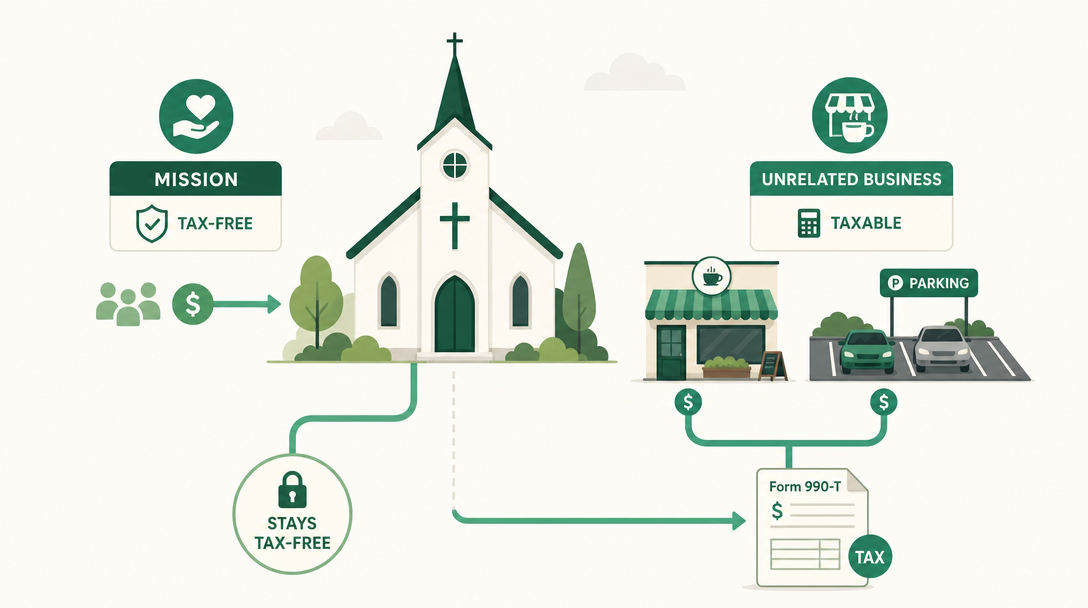
Short answer: Unrelated business income tax (UBIT) is the tax a tax-exempt organization — including a church — owes on net income from a business it runs that has nothing to do with its exempt purpose. Being a 501(c)(3) shields offerings and program income, not money from a side business. Income is taxable only when all three of these are true: it’s a trade or business, it’s regularly carried on, and it’s not substantially related to the organization’s exempt mission. An exempt org with $1,000 or more of gross unrelated business income files Form 990-T and pays at corporate rates (IRS Publication 598).
What unrelated business income tax (UBIT) actually taxes
UBIT exists so that a nonprofit running a real business can’t undercut taxpaying competitors using its exemption as a shield. A church or charity stays exempt on its mission money — tithes, offerings, program fees, grants. But when it operates a genuine business that’s unrelated to that mission, the net profit from that business is taxed like any company’s would be. The exemption covers the purpose, not every dollar that flows in.
The label matters: the income is unrelated business taxable income (UBTI), and the tax on it is UBIT. Same idea, two acronyms. This applies to nearly every kind of exempt organization, churches included — even though churches skip most other federal filings, a church with enough unrelated income still owes this one (IRS Publication 1828).
The three-part test that makes income taxable
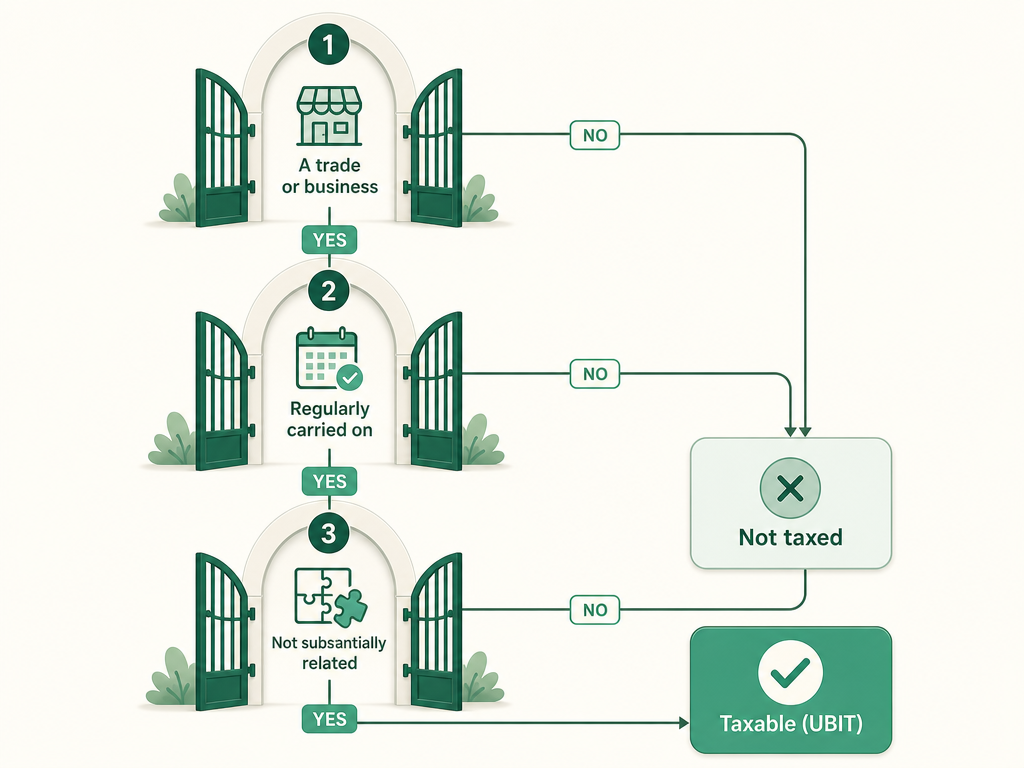
Income is unrelated business income only if it passes all three parts of the IRS test. Miss any one and the income is not taxed as UBIT.
| Part of the test | What it means | Example that meets it |
|---|---|---|
| 1. A trade or business | An activity carried on for the production of income from selling goods or services. | Running a coffee shop, selling ad space, operating a paid parking lot. |
| 2. Regularly carried on | Conducted with a frequency and continuity like a commercial business — not a one-off. | A coffee bar open daily, vs. an annual one-weekend bake sale. |
| 3. Not substantially related | The activity doesn’t substantially contribute to the exempt purpose (beyond just raising money). | A public bookstore selling general merchandise, not just religious materials. |
The third part trips up the most organizations. The test isn’t “does the money fund the mission” — every nonprofit spends its revenue on the mission. The test is whether the activity itself advances the exempt purpose. A seminary bookstore selling textbooks to its own students is related; the same store selling laptops and snacks to the public is not.
The exceptions that keep most nonprofit income tax-free
Even when an activity looks like a business, the tax code carves out several exceptions. If one applies, the income escapes UBIT entirely.
- Volunteer labor. A business in which substantially all the work is done by volunteers, without pay, is exempt. A church rummage sale run by unpaid members usually falls here.
- Convenience of members. An activity carried on primarily for the convenience of an organization’s members, students, employees, or congregation is exempt. A coffee bar or snack counter serving the people who attend services is the classic church example — it’s for attendees, not the public.
- Selling donated merchandise. Selling goods that were received as gifts or donations is exempt. This is the thrift-store exception — the income from reselling donated clothing and furniture isn’t taxed.
These three exceptions cover a large share of what small churches actually do. The line to watch is who the activity serves and who does the work: members and volunteers keep it clean; opening the doors to the paying public and hiring staff is what pulls an activity toward UBIT. For the bigger picture of what a church does and doesn’t owe, see do churches pay taxes.
Passive income is excluded — unless the property is debt-financed
Most passive investment income is specifically excluded from UBIT. That covers the income a church or nonprofit earns by simply owning assets rather than running a business:
- Rent from real property (renting out a building or land),
- Dividends and interest,
- Royalties (for example, licensing a name or copyrighted work),
- Capital gains from selling property.
So a church that rents its hall to a community group, or earns interest on a reserve account, generally owes no UBIT on that money. The exclusion is what lets nonprofits hold investments and rental property without their endowments being taxed.
The big exception is debt-financed property. If the organization borrowed money to acquire the income-producing property — a mortgaged rental building, for instance — a portion of that otherwise-passive income becomes taxable, in proportion to the debt. Rent that would be tax-free on a paid-off building can become partly taxable on a mortgaged one (IRS Publication 598). Personal-property rentals and rents tied to the tenant’s profits can also lose the exclusion.
Church and nonprofit examples of taxable vs. excluded activity
Whether an activity is taxed turns on the three-part test and the exceptions above. Here’s how common church and nonprofit activities tend to land:
| Activity | Usually taxable (UBIT)? | Why |
|---|---|---|
| Coffee shop open to the public | Likely taxable | A regular business, not substantially related, serving non-members. |
| Coffee bar for attendees only | Excluded | Convenience-of-members exception. |
| Bookstore selling general merchandise to the public | Often taxable | Regular trade or business, not substantially related. |
| Selling donated goods (thrift store) | Excluded | Donated-merchandise exception. |
| Advertising income (paid ads in a bulletin or on a website) | Taxable | Treated as an unrelated business; sponsor acknowledgments differ from paid ads. |
| Parking lot rented to the public for a fee | Often taxable | A regular business; bare-land rent rules can apply, but operated lots usually count. |
| Renting the fellowship hall to a community group | Generally excluded | Rent from real property (unless the building is debt-financed). |
| Interest and dividends on reserves | Excluded | Passive investment income. |
A useful contrast: paid advertising generally produces UBIT, but a corporate sponsorship acknowledgment — naming a donor without promoting their products or prices — is treated as a gift, not an ad, and isn’t taxed. The wording on the banner can change the tax answer.
This is also why the question is separate from property tax and sales tax, which are state-administered and follow their own rules — see do churches pay property taxes and do churches pay sales tax.
Filing Form 990-T and paying at corporate rates
An exempt organization — a church included — that has $1,000 or more of gross unrelated business income in a year must file Form 990-T and pay tax on the net income at the corporate income tax rate (currently a flat 21% federal). The $1,000 threshold is measured on gross income, before deducting expenses, so it’s hit sooner than people expect. Below $1,000 gross, no 990-T is required.
A few specifics worth knowing:
- Net, not gross, is taxed. The org deducts the expenses directly connected to the unrelated activity; UBIT applies to what’s left.
- A $1,000 specific deduction is allowed, so the first $1,000 of net unrelated income effectively isn’t taxed.
- Each activity is “siloed.” Under current law, a loss from one unrelated business generally can’t offset the profit from a different one.
- Estimated tax may be due during the year if the liability is large enough.
For a church, this is one of the few federal returns it can actually owe — a notable exception to the rule that churches don’t file. Too much unrelated business activity can also threaten exempt status if it stops being insubstantial, though most churches never get close. The broader rules of the exemption are covered in are churches tax exempt, and the contractor reporting a church still owes is in do nonprofits issue 1099s.
Vestrybooks keeps a church’s funds and income streams cleanly separated, so the line between exempt mission money and reportable unrelated income is easy to see at filing time. See plans →
FAQ
What qualifies as unrelated business income? Income that meets all three parts of the IRS test: it’s a trade or business, it’s regularly carried on, and it’s not substantially related to the organization’s exempt purpose. If any part fails, or an exception (volunteers, convenience of members, donated goods, passive income) applies, it isn’t UBIT.
What is the tax rate on unrelated business income? Net unrelated business taxable income is taxed at the corporate income tax rate — currently a flat 21% federal. The organization first deducts directly connected expenses and a $1,000 specific deduction.
How can a nonprofit avoid UBIT? Keep the activity tied to the exempt mission, run it with volunteers, limit it to members’ convenience, sell donated goods, or earn the income passively (rent, interest, dividends, royalties) on property that isn’t debt-financed — each of these is excluded by statute.
Does a church have to file if it has unrelated business income? Yes. A church with $1,000 or more of gross unrelated business income files Form 990-T and pays UBIT, even though it’s exempt from most other federal filings.
This is general information, not tax or legal advice — confirm your church’s situation with a qualified professional.
This article is general information for church treasurers, not professional tax or legal advice. For your church's situation, consult a qualified accountant or attorney.
Church accounting a volunteer can actually do.
Vestrybooks is church accounting + giving for the volunteer treasurer — fund tracking, one-click year-end statements, and online giving with $0 taken from every gift.
A real free plan · no credit card · your data stays yours