Blog · Church taxes
Does the IRS audit churches?
July 4, 2026 · By Benjamin Reinke

Short answer: Yes, the IRS can audit a church — but Congress made a church the hardest organization in the country to audit. Under Internal Revenue Code §7611 (the Church Audit Procedures Act), the IRS can’t just open a file on you. A high-level Treasury official must first put in writing a reasonable belief that something’s wrong, and even then the IRS has to move through a two-step, notice-heavy process with time limits. In practice, IRS church audits are rare and triggered by specific red flags — unrelated business income, insiders profiting, or political campaigning — not by ordinary church life. A small church that keeps clean books, files its payroll returns, and stays out of politics is at very low risk. Good records are the best protection there is.
Can the IRS audit a church at all?
The IRS can examine a church, but only after clearing a bar that exists for no other type of organization. That bar is Internal Revenue Code §7611, the Church Audit Procedures Act. It says the IRS may begin a “church tax inquiry” only if an appropriate high-level Treasury official — statutorily defined as the Secretary of the Treasury or a delegate no lower in rank than a principal Internal Revenue officer for a region — reasonably believes, based on a written statement of facts and circumstances, that the church may not qualify for exemption or may owe tax.
That’s a real constraint. A revenue agent’s hunch isn’t enough; the belief has to be documented and signed off at a high level before the process can even start. Compare that to a normal business or nonprofit, which the IRS can audit on routine selection. A church has a statutory gate in front of it.
One quiet wrinkle worth knowing: after the IRS reorganized in the late 1990s and eliminated the “regional commissioner” role the statute points to, a federal court in United States v. Living Word Christian Center (D. Minn. 2009) held that the IRS official who had authorized an inquiry wasn’t high-level enough to satisfy §7611. The IRS disagreed but has never cleanly resolved which official now holds that authority. The practical effect for a small church: the protection is, if anything, stronger than the statute alone suggests, because the “who can sign” question remains contested.
Why churches don’t get a Form 990 audit
Most people picture an audit starting from a filed return. For a church, there usually isn’t one to start from. A church is automatically tax-exempt and — unlike other nonprofits — does not file the annual Form 990 (IRS Publication 1828). No 990 means there’s no annual information return for the IRS to flag, question, or audit. That removes the single most common way exempt organizations land on the IRS’s radar.
What a church does file matters, though, and it’s where scrutiny actually comes from:
- Payroll (employment) tax returns — if you pay a pastor or staff, you file Form 941 each quarter and issue W-2s. These are ordinary IRS returns with ordinary IRS enforcement; the §7611 church protections generally don’t shield a straightforward payroll-tax question.
- Form 990-T — if the church runs an unrelated business (more on that below), it files this and pays tax on that income like any other business.
So the mental model is: no 990 audit, but real, normal exposure on payroll and on any business income. Getting the church bookkeeping right on both is what keeps you clear.
What triggers IRS attention to a church
Ordinary church operations don’t attract the IRS. Specific things do. The reasonable-belief statement that opens an inquiry can be built from news stories, public filings, church documents, or complaints — so the triggers are the situations that generate those. The common ones:
- Unrelated business income (UBIT). If a church regularly runs a trade or business unrelated to its religious purpose — say a commercial parking lot, a for-profit café, or advertising sales — the profit is taxable. Gross income of $1,000 or more from such activity means the church must file Form 990-T and pay tax (IRS — unrelated business income tax). Running the business is fine; not reporting it is the red flag.
- Excessive benefit / inurement. Tax-exempt money can’t flow to an insider’s private benefit. A pastor paid far above reasonable compensation, a sweetheart deal with a board member, or church funds used for personal expenses can trigger “excess benefit” scrutiny and penalties — and, in extreme cases, threaten exemption.
- Political campaign intervention. A 501(c)(3), including a church, cannot endorse or oppose candidates for public office. Cross that line and the IRS can impose an excise tax on the political expenditures — 10% on the organization plus 2.5% on the managers who approved them (IRS Publication 1828). Issue advocacy and nonpartisan voter education are allowed; picking sides in a race is the problem.
- Payroll and 941 problems. Late or missing employment-tax deposits, misclassifying a worker, or botching the clergy-tax rules (a minister is a W-2 employee for income tax but self-employed for Social Security) create ordinary payroll exposure.
- Filing a 990-T. Filing an unrelated-business return truthfully is correct and expected — but it also puts a return in front of the IRS that can be examined on its own merits, like any business return. For the fuller picture of what a church owes and doesn’t, see whether churches pay taxes.
Notice the pattern: every trigger is a choice or a mistake, not a routine part of being a church. Keep the money inside your exempt purpose and file what you’re required to file, and none of these fire.
The church tax inquiry vs. the examination
If the IRS does proceed, §7611 forces it down a specific two-step path, each step gated by notice. This is the heart of the protection, so it’s worth understanding.
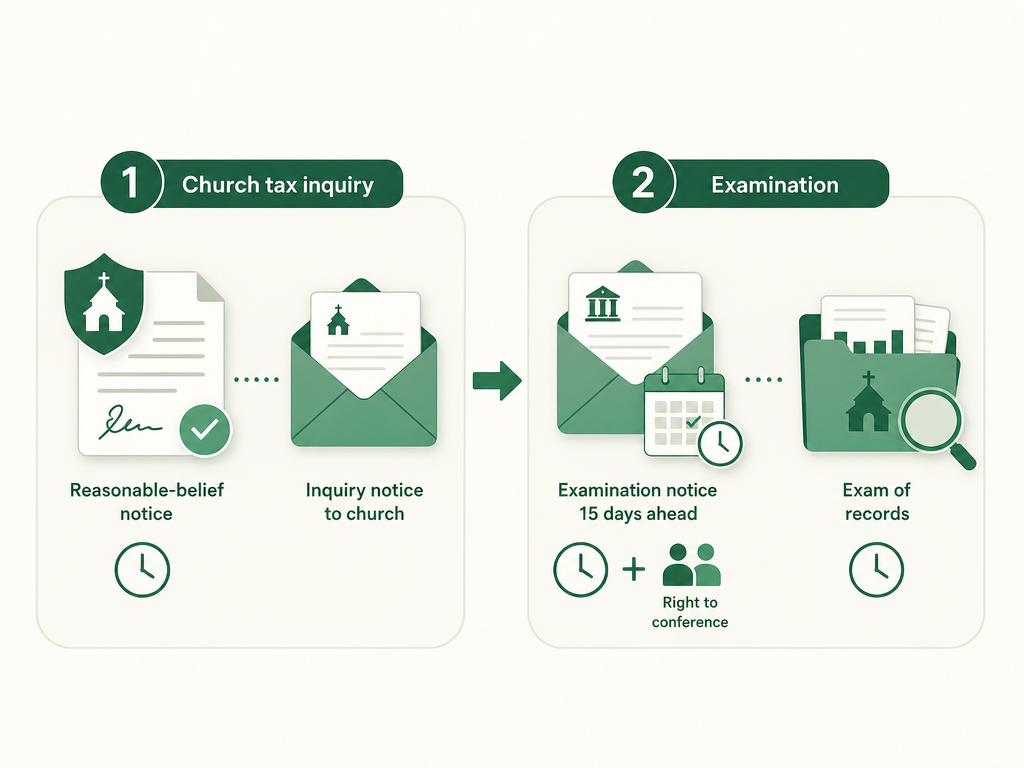
Step 1 — the church tax inquiry. After the high-level official signs the reasonable-belief statement, the IRS sends the church a written inquiry notice. It has to explain the concerns, the general subject matter, and the church’s rights. The inquiry is the IRS asking questions and reviewing what it already has; it is not yet an examination of your books.
Step 2 — the examination. The IRS can only move to a full examination after that. It must send a separate written examination notice at least 15 days before the exam begins, with a copy to the IRS regional counsel, and — importantly — that examination notice can’t go out until at least 15 days after the inquiry notice (26 U.S.C. §7611). The examination notice describes the records and religious activities the IRS wants to look at and tells the church it has the right to a pre-examination conference to talk it through first.
The examination itself is scope-limited: the IRS may look at church records only to the extent necessary to determine tax liability, and may inquire into religious activities only to the extent necessary to decide whether an organization claiming to be a church actually is one. It’s not a fishing expedition license.
The time limits that protect a church
§7611 doesn’t just gate the start of an audit — it puts a clock on the whole thing. Two limits matter:
- An inquiry that doesn’t lead to an examination must be completed within 90 days of the inquiry notice.
- A church tax examination must generally be completed within 2 years of the examination notice.
These caps mean a church can’t be left twisting under an open-ended investigation. There are exceptions that pause the clock (litigation, for instance), but the default is a defined, bounded process — another way the statute tilts toward the church.
What records the IRS can look at
When an examination does happen, the records in play are the ordinary financial records any well-run church already keeps: bank statements, the general ledger and fund balances, contribution and payroll records, board minutes authorizing spending and compensation, and any documents behind an unrelated business. The examination is confined to what’s necessary to resolve the specific tax question that opened it.
This is exactly why documentation is your defense. A church that can hand over reconciled books, a clean trail from each gift to its deposit, board minutes setting the pastor’s pay, and filed 941s has, in effect, already answered most of what an examiner would ask. The scary version of an audit is the one where the records don’t exist. Strong church internal controls — separation of duties, two-person offering counts, an approval trail — are what make those records trustworthy in the first place.
How worried should an ordinary small church be?
Barely. The realistic risk picture for a typical small congregation looks like this:
| Situation | Real IRS risk |
|---|---|
| Clean books, files 941s, no unrelated business, stays nonpartisan | Very low |
| Runs a small unrelated business and files 990-T correctly | Low — the filing is expected |
| Pays a pastor above-market with no reasonable-comp documentation | Higher (excess-benefit exposure) |
| Endorses or opposes a candidate | Higher (political-intervention penalties) |
| Missing or late payroll-tax deposits | Higher (ordinary 941 exposure) |
The through-line: risk comes from the choices in the bottom rows, not from being a church. Do the boring things right — keep the books current, file payroll returns on time, keep the money inside your mission, and keep politics out of the pulpit’s endorsements — and the §7611 gauntlet almost never gets a reason to open.
It’s also worth separating this from the church audit you want: the voluntary internal or independent review a church runs on its own books each year for accountability. That kind of audit is healthy, common, and entirely within your control — the opposite of an IRS examination, and the best rehearsal for one you could ask for.
How Vestrybooks keeps a church audit-ready
The best protection against an IRS problem is being the kind of church that never gives one a reason to start — and being able to prove it. Vestrybooks keeps your books reconciled by fund, records a clean trail from every gift to its deposit, and holds an immutable audit log of every financial change, so nothing can be quietly altered after the fact. Paired with filed payroll returns and documented board approvals, that’s a church that can answer any question the IRS could raise — calmly, with records, on day one. See how it works.
FAQ
Can the IRS audit a church? Yes, but only under strict limits. Internal Revenue Code §7611 requires a high-level Treasury official to first put in writing a reasonable belief that the church may not qualify for exemption or may owe tax. Then the IRS must follow a two-step inquiry-then-examination process with written notices and time limits. It’s the hardest audit the IRS runs, and it’s rare.
What triggers an IRS church audit? Specific red flags, not routine operations: unrelated business income that wasn’t reported, a pastor or insider getting an excessive benefit, endorsing or opposing political candidates, or payroll-tax (Form 941) problems. The reasonable-belief statement that opens an inquiry is often built from news stories, public filings, or complaints tied to one of these.
Do churches file a Form 990? No. Unlike other nonprofits, a church is automatically exempt and doesn’t file the annual Form 990, so there’s no 990 for the IRS to audit. Churches do file payroll returns (Form 941) if they have staff, and Form 990-T if they earn $1,000 or more from an unrelated business.
What is the Church Audit Procedures Act? It’s Internal Revenue Code §7611, the law that limits how the IRS can audit a church. It requires a documented reasonable belief approved by a high-level Treasury official, a two-step inquiry-then-examination process, written notice at least 15 days before an examination with a right to a conference, and time limits (90 days for an inquiry, generally 2 years for an examination).
How long can an IRS church examination last? Generally the IRS must complete a church tax examination within two years of the examination notice, and complete an inquiry that doesn’t become an examination within 90 days of the inquiry notice. Certain events, like litigation, can pause the clock, but the default is a bounded process.
Does a church have to let the IRS see everything? No. An examination is scope-limited: the IRS may review church records only to the extent necessary to resolve the specific tax question, and may look at religious activities only as far as needed to confirm the organization is a church. It isn’t an open-ended search of everything the church has.
Is a small church likely to be audited? Very unlikely. A small congregation that keeps clean books, files its payroll returns on time, doesn’t run an unreported business, and stays out of partisan politics gives the IRS no reason to open the §7611 process. Good records are the strongest protection.
This is general information for church leaders and treasurers, not tax or legal advice. Church tax rules — especially anything involving an IRS inquiry, unrelated business income, or clergy payroll — turn on your specific facts. Consult a qualified tax professional or attorney before acting.
This article is general information for church treasurers, not professional tax or legal advice. For your church's situation, consult a qualified accountant or attorney.
Church accounting a volunteer can actually do.
Vestrybooks is church accounting + giving for the volunteer treasurer — fund tracking, one-click year-end statements, and online giving with $0 taken from every gift.
A real free plan · no credit card · your data stays yours