Blog · Contributions & statements
Are church donations tax deductible?
June 26, 2026 · Updated July 4, 2026 · By Benjamin Reinke
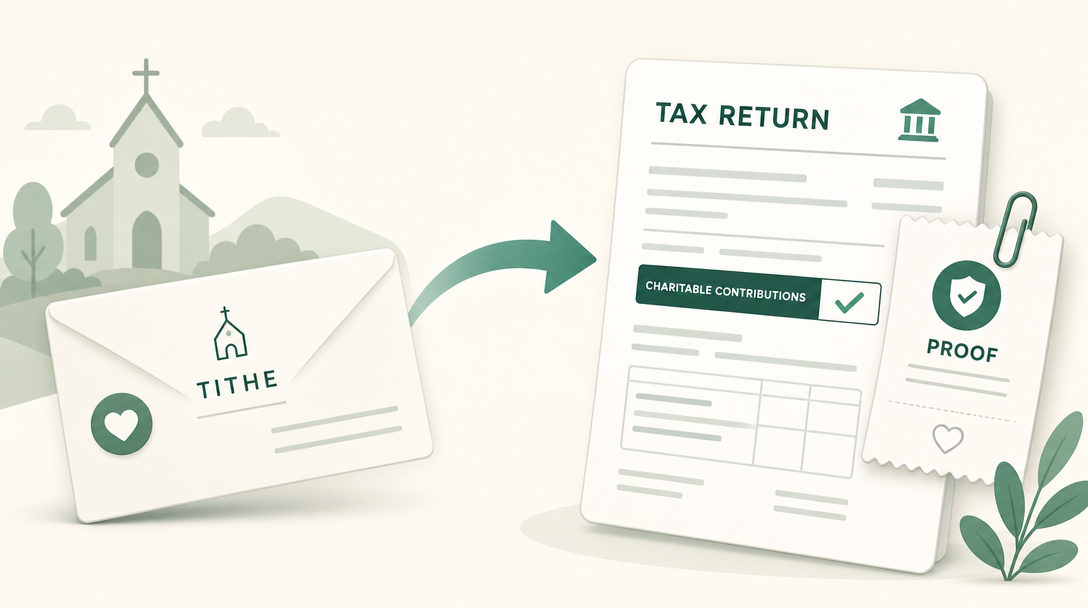
Short answer: Yes — donations to a church are tax deductible, because a church is a qualified charitable organization under IRS rules. For 2026 and later there are two ways it helps: if you itemize, your church gifts are fully deductible; and even if you take the standard deduction, a new above-the-line deduction lets you write off up to $1,000 (single) or $2,000 (married filing jointly) of cash gifts. Either way, you need the church’s written acknowledgment for any single gift of $250 or more.
When church donations are actually tax deductible
A church donation is deductible when three things are true: the church is a qualified organization (churches automatically qualify, even without a formal 501(c)(3) determination letter — part of why churches are tax-exempt), you itemize deductions on Schedule A, and you have the records to back the gift up. Tithes, weekly offerings, building-fund gifts, and most cash given to a church all count, as long as you didn’t get something of equal value in return.
Since the standard deduction roughly doubled, most households take it rather than itemizing. That used to mean church giving produced no separate deduction — but starting in 2026, non-itemizers can deduct up to $1,000 (single) or $2,000 (joint) of cash gifts above the line (covered below). Above that cap, extra giving only reduces your taxes if you itemize.
Why the standard deduction decides it
Whether your church giving lowers your taxes comes down to one comparison: your total itemized deductions (church and other charitable gifts, mortgage interest, state and local taxes up to the cap, and so on) versus the standard deduction for your filing status. You take whichever is larger.
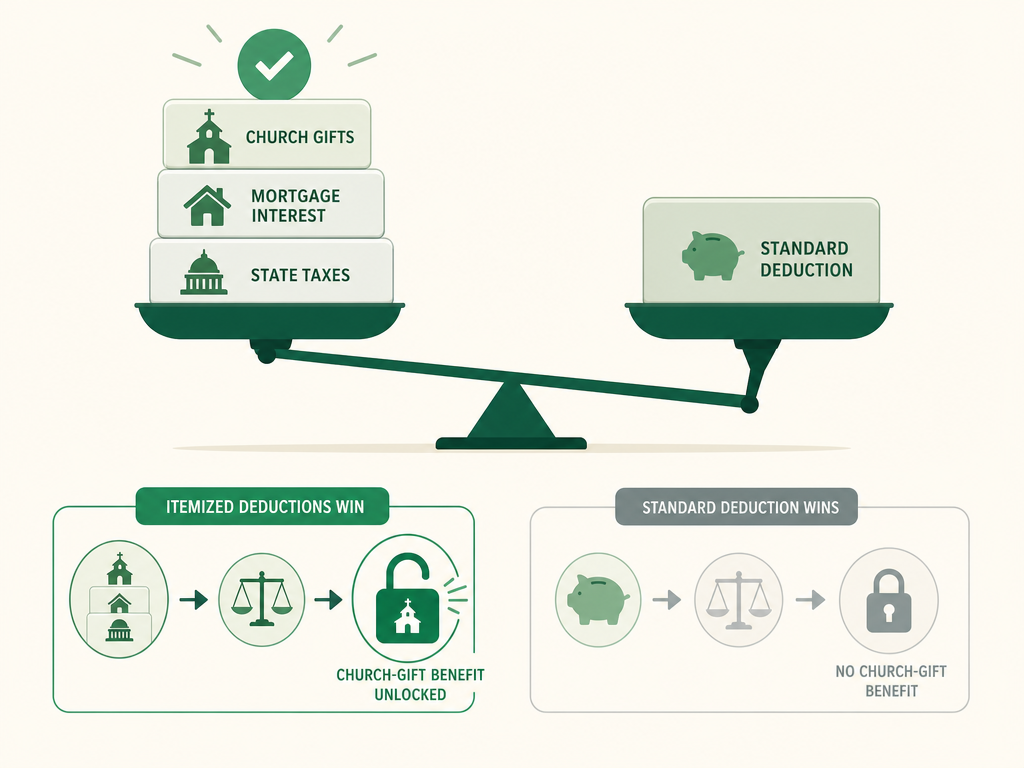
So a couple who gives $5,000 to their church but has few other deductions will usually still take the standard deduction. A household with a mortgage, high state taxes, and larger giving is more likely to clear the threshold, at which point each additional dollar of church giving is deductible.
A 2026 change worth knowing: the One Big Beautiful Bill Act created a permanent above-the-line deduction for non-itemizers — up to $1,000 (single) or $2,000 (married filing jointly) in cash gifts to qualifying charities like churches, claimed right on Form 1040 without itemizing. (Gifts to donor-advised funds don’t count, and it’s cash only — not donated stock or goods.) So the couple above can now deduct their cash tithes up to that cap even on the standard deduction; beyond it, only itemizing adds more. Confirm the current details in IRS Publication 526.
How much you can write off for church donations
For cash gifts to a church, the IRS lets you deduct contributions up to a large share of your adjusted gross income (AGI) — historically 60% for cash to public charities like churches, with lower ceilings (commonly 30%) for gifts of appreciated property such as stock. Almost no individual giver hits these ceilings, but they exist, and anything over the limit can generally be carried forward for up to five years. One new wrinkle for 2026: itemizers can only count charitable gifts above 0.5% of their AGI — a small floor that trims the deduction slightly. The exact AGI percentages shift with tax law, so confirm the current figures in Pub 526.
Non-cash gifts have their own rules: donate more than $500 in goods and you file Form 8283, and gifts of property over $5,000 generally need a qualified appraisal.
The records you need to claim the deduction
To deduct a church gift, you need proof — and the requirement steps up at $250:
- Under $250: a bank record (canceled check, bank or card statement) or a written receipt from the church.
- $250 or more (single gift): a contemporaneous written acknowledgment from the church that lists the amount and states whether you received any goods or services in return. A canceled check alone is not enough at this level.
In practice, churches cover both by sending each donor a year-end giving statement — exactly what belongs on it is covered in our guide to church contribution statements. Keep that statement with your tax records; you don’t file it, but you need it if the IRS asks.
How the IRS verifies church donations
The IRS verifies a claimed church deduction through your documentation, not by auditing the church’s books. If your return is examined, you’re asked to produce the written acknowledgment for gifts of $250+ and bank records for smaller ones. Deductions that look out of proportion to reported income can draw scrutiny, and a missing or late acknowledgment is the most common reason an otherwise-legitimate gift gets disallowed — the acknowledgment must be contemporaneous (in hand before you file). That’s the whole case for keeping the church’s statement somewhere you can find it.
Is it worth claiming church donations on your taxes?
Claiming church donations helps two ways in 2026: if you itemize and your itemized deductions beat the standard deduction, your gifts are fully deductible; and even as a non-itemizer, you can write off up to $1,000 (single) or $2,000 (joint) of cash giving above the line. If you give more than that and you’re close to the itemizing line, bunching two years of giving into one (so you itemize one year and take the standard deduction the next) can tip the math in your favor. Either way, the deduction is a reason to track every gift, not a reason to give: the tax savings are always a fraction of the amount donated.
Vestrybooks tracks every gift a donor gives and produces their IRS-ready year-end statement automatically, so your members always have the proof they need. See plans →
FAQ
How much can you write off for church donations? Cash gifts to a church are deductible up to a large share of your AGI (historically 60%) when you itemize; non-itemizers can deduct up to $1,000 (single) or $2,000 (joint) of cash gifts starting in 2026. Most givers deduct far less than the ceiling; check IRS Pub 526 for the current limits.
Is it worth claiming church donations on taxes? It helps if you itemize and your itemized deductions beat the standard deduction — and, starting in 2026, non-itemizers can also deduct up to $1,000 (single) or $2,000 (joint) of cash gifts above the line. Beyond that cap, standard-deduction takers see no further benefit.
How does the IRS verify church donations? Through your records — a written acknowledgment from the church for any single gift of $250 or more, and bank records or receipts for smaller gifts. The church’s year-end statement is the usual proof.
Are tithes tax deductible? Yes. A tithe is a cash gift to a qualified organization, so it’s deductible on the same terms as any church donation — by itemizing, or (for 2026 non-itemizers) up to the $1,000/$2,000 cash-gift cap — and you keep the records either way. Our guide to tithing and taxes walks through how regular giving fits a return.
Do church donations reduce your taxable income? Yes, within limits. Church gifts are a deduction, not a credit, so they lower the income your tax is calculated on rather than cutting your tax bill dollar-for-dollar. If you itemize, your gifts reduce taxable income in full; and starting in 2026, non-itemizers can reduce taxable income by up to $1,000 (single) or $2,000 (joint) of cash gifts through a new above-the-line deduction — beyond that, standard-deduction takers see no further reduction.
Are church donations a tax write-off? Yes — “write-off” is just an informal term for a deduction. A church gift is a charitable deduction, not a tax credit, so it reduces taxable income when you itemize (on Schedule A) — or, for 2026 non-itemizers, up to the $1,000/$2,000 cash-gift cap on Form 1040. The savings equal your gift times your marginal tax rate, not the full amount given.
Can a church accept stock donations, and are they deductible? Yes, if the church’s gift acceptance policy allows it. Donating stock held more than one year lets you deduct its fair market value and avoid capital-gains tax on the appreciation, which is often better than selling and giving cash. Gifts of appreciated property are deductible up to 30% of AGI (versus 60% for cash); see IRS Publication 526.
What is the maximum church donation you can deduct? For cash gifts to a church, the deduction is generally capped at 60% of your adjusted gross income, with anything over the limit carried forward for up to five years. Non-cash gifts such as stock have lower ceilings (commonly 30% of AGI). Almost no individual giver reaches these limits — confirm the current figures in Pub 526.
Do church donations count as charitable contributions for taxes? Yes. A qualifying church is treated as a 501(c)(3) public charity, so gifts to it are charitable contributions for tax purposes. They’re deductible if you itemize and keep the required records, the same as a gift to any qualified charity.
This is general information, not tax advice — confirm your situation with a qualified tax professional.
This article is general information for church treasurers, not professional tax or legal advice. For your church's situation, consult a qualified accountant or attorney.
Track every gift, print statements in one click.
Vestrybooks records each gift by donor and fund, builds IRS-ready year-end statements, and takes $0 of every online gift.
A real free plan · no credit card · your data stays yours