Blog · Nonprofit board & governance
What a nonprofit board of directors is responsible for
June 27, 2026 · By Benjamin Reinke

A nonprofit board of directors is responsible for governing the organization on behalf of the public — setting its mission and strategy, overseeing its money, hiring and supervising the executive director, and keeping it legal and true to its charitable purpose. Underneath those jobs sit three legal duties every director owes the organization: the duty of care, the duty of loyalty, and the duty of obedience. The board carries all of this as a body, not as a collection of individuals, and it answers to the public and the IRS for how the organization is run. This guide takes each responsibility one at a time, starting with the duties that the rest of the work hangs on.
For what a board is and how it fits into a 501(c)(3), start with the overview of the nonprofit board of directors. This page is the deep version of one question: once you’re on the board, what exactly are you on the hook for?
The three fiduciary duties every nonprofit director owes
A nonprofit director owes the organization three legal duties, and they’re the foundation every other responsibility rests on. Courts apply them to any nonprofit board, and a regulator, donor, or judge would measure a director against them if something went wrong. They aren’t a code of ethics you can opt into — they come with the seat.
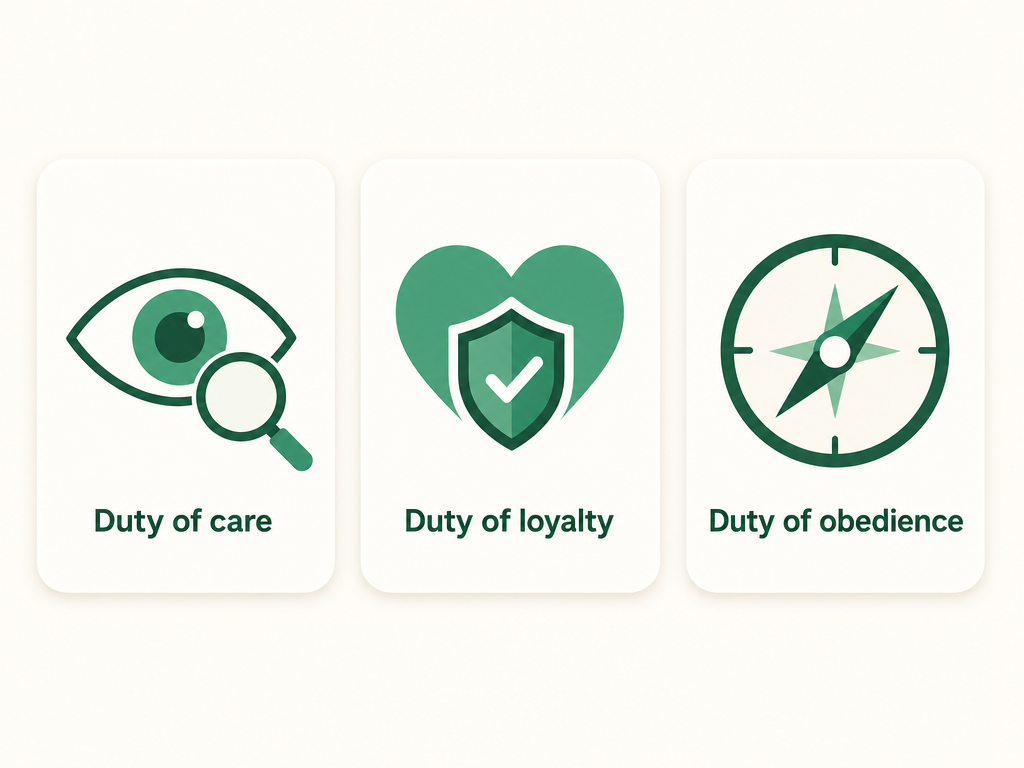
Duty of care is the obligation to pay attention. A director has to show up, read the materials, ask questions, and make the decisions a reasonably prudent person would make in the same spot. In practice that means reading the financial statements before voting to approve them, understanding the budget you’re adopting, and not rubber-stamping whatever staff puts in front of you. A director who skips meetings and signs off on things they never read has breached the duty of care, even if nothing was stolen.
Duty of loyalty is the obligation to put the organization ahead of yourself. A director can’t use their seat for personal gain, and when a decision touches their family, business, or pay, they have to disclose it and step out of the vote. This is the source of every conflict-of-interest rule a board has. It’s also why a board can’t approve a contract with a company a director owns without that director recusing — the loyalty runs to the organization, not to the director’s wallet.
Duty of obedience is the obligation to stay inside the lines. The board has to keep the organization within its stated charitable purpose, follow its own bylaws, and obey the law — including the conditions attached to its tax exemption. An animal-rescue nonprofit that quietly starts spending its money on something unrelated to animals has a duty-of-obedience problem, regardless of how worthy the new thing is. The mission the organization was granted exemption to pursue is the boundary.
Setting the mission and strategy is the board’s job, not the staff’s
The board owns the mission and the long-range direction — this is the first of its ongoing responsibilities and the one the others serve. The board decides what the organization is for, approves the strategic plan, and keeps the work pointed at the charitable purpose. Staff propose, research, and execute, but the board is the body that says this is who we are and where we’re going. When a nonprofit drifts — chasing grants that pull it off-mission, adding programs nobody planned — it’s usually because the board stopped owning the direction and let the work define itself.
This is also where the board sets the boundary for everything below it. A clear mission tells the board which budget lines belong, which contracts fit, and which opportunities to turn down. Without it, financial oversight has no standard to measure against.
Financial oversight is where most of the board’s real work lives
A nonprofit board’s most consequential responsibility is financial oversight, and it’s the one boards most often shortchange. Oversight does not mean doing the bookkeeping — it means making sure the bookkeeping is honest and the money is controlled. The board reviews; it doesn’t keep the ledger. A board that handles this well runs a short, repeatable list every year:
| Responsibility | What the board actually does |
|---|---|
| Approve the annual budget | Adopts the spending plan by vote and holds staff to it. A budget the board never voted on isn’t the organization’s plan. |
| Review financial statements regularly | Reads the statement of activities and the balances each month or quarter and asks questions — the way to catch a problem while it’s small. |
| Ensure internal controls exist | Confirms no one person controls money start to finish; the person who records income shouldn’t also reconcile the bank. |
| Commission a review or audit | Once a year, someone independent checks the books — an internal review for small budgets, an outside CPA for larger ones. |
| Oversee the treasurer and bookkeeper | Reviews what they report and confirms it against the bank, rather than handing them unchecked control. |
That last group — separation of duties, a real review, no single point of control — is the heart of the board’s value. The board’s signature on a budget means little if one person can still move money with nobody watching. One trusted individual controlling the money from start to finish is the single most common setup behind nonprofit embezzlement, and it’s the board’s job to make sure that setup never exists. This is oversight as a practice, not a report taken on faith — the same discipline that good nonprofit bookkeeping is built to support.
For the deeper mechanics of the once-a-year independent check, a church audit walks through how a small organization runs a real review without hiring a national firm — the process is the same for any small nonprofit.
Hiring, supporting, and evaluating the executive director
The board hires exactly one employee — the executive director — and that relationship is one of its core responsibilities. The board selects the executive director, sets their compensation, supports them, evaluates their performance on a schedule, and, if it comes to it, replaces them. What the board does not do is run the programs or manage the rest of the staff; that’s the executive director’s job. The board supervises through that one person rather than around them.
The line matters because crossing it is the most common governance failure in a young nonprofit. A board that starts directing individual staff or approving routine purchases has slipped from governing into managing, and it usually means the executive director isn’t being allowed to do the job. Setting the executive director’s pay is also a fiduciary moment: the board has to document that the compensation is reasonable and approved by people with no personal stake in it, because pay to insiders is exactly where the IRS looks for trouble.
Keeping the nonprofit legal and tax-compliant, including Form 990
The board is responsible for the organization’s legal and tax compliance — it can delegate the work, but not the accountability. That includes keeping up state registrations and charitable-solicitation filings, following the bylaws, maintaining the conditions of 501(c)(3) status, and making sure the annual return gets filed. Most tax-exempt nonprofits file a Form 990 with the IRS each year, which puts the organization’s finances on the public record; missing it for three years in a row revokes the exemption automatically. (Churches are a notable exception — they’re not required to file a 990.)
The biggest compliance trap is private inurement — the rule that none of a nonprofit’s earnings may benefit an insider beyond reasonable pay. The IRS explains it in IRS Publication 1828, which warns that an organization serving private interests rather than public ones risks losing its tax-exempt status. An independent board that approves pay and contracts at arm’s length, enforces a conflict-of-interest policy, and keeps clean books is the organization’s main defense against that outcome — the financial policies every board adopts are how it builds that defense in writing. Compliance isn’t a separate task bolted onto governance; it’s what good governance produces.
Raising and protecting the organization’s resources
A nonprofit board shares responsibility for making sure the organization has the money to do its work. That doesn’t mean every director writes big checks, but it does mean the board treats funding as its problem, not just the development staff’s. Directors are commonly expected to give personally at a level that’s meaningful for them, open doors to other donors and funders, and back the fundraising plan the board approves. A board that approves an ambitious budget and then leaves staff alone to find the money for it hasn’t really taken responsibility for the organization’s resources.
Protecting resources is the other half of this. The same board that helps bring money in is responsible for guarding it once it arrives — which loops back to the financial-oversight and internal-control work above.
The board acts as a body, not as individuals
A nonprofit board holds its authority collectively, and understanding that is the difference between a functioning board and a dysfunctional one. No single director — not even the chair — has the power to act alone, direct staff, or commit the organization. The board acts by vote, in a meeting, and records its decisions in minutes. A director who agrees with a decision at the table and then undercuts it afterward, or who tries to run the executive director privately between meetings, has misunderstood the role. The power lives in the board as a whole, exercised together and documented.
This is why the structure exists in the first place: spreading authority across a group so no one person runs the organization unchecked is the entire point of having a board instead of an owner.
Keeping the board itself healthy — recruitment and self-assessment
A nonprofit board is also responsible for its own composition and performance — an inward-facing duty that’s easy to skip and costly to ignore. That means recruiting new directors with the skills and independence the board needs, orienting them so they can actually contribute, and periodically assessing how the board is doing as a group. A board that never recruits ages and shrinks until it can’t function; a board that never evaluates itself never notices it’s stopped reading the financials. Renewing itself is part of governing.
Many practitioners frame the board’s full job as a set of roughly ten basic responsibilities — selecting and supporting the chief executive, setting mission and strategic direction, ensuring strong financial oversight and adequate resources, protecting assets and legal standing, building a competent board, and enhancing the organization’s standing in the community, among others. The exact list varies by source, but the throughline is the same as everything above: the board sets direction, guards the money, supervises the one person who runs the place, keeps the organization legal, and renews itself. If you want this as a document to hand to recruits and new directors, our free board roles and responsibilities template lays out the board’s duties, the three fiduciary duties, and each officer’s role, with a per-director agreement to sign.
How church boards carry the same responsibilities
Church boards are a faith-based version of the nonprofit board, with different names for an identical legal role. A church that incorporates is a nonprofit, so the people named in its incorporation papers are its board of directors in the eyes of the law — even if the congregation calls them trustees, elders, a vestry, or a session. Those people carry the same duties of care, loyalty, and obedience and the same responsibilities for budget, oversight, and compliance as any other nonprofit director. Churches do get a few breaks general nonprofits don’t, like automatic tax exemption and no Form 990 to file, but the governing work is the same. If you serve a congregation, the church board of trustees guide is this page written for churches.
FAQ
What are the three duties all board members should abide by? The three fiduciary duties every nonprofit board member owes are the duty of care (stay informed and make prudent decisions — read the financials before approving them), the duty of loyalty (put the organization ahead of yourself and step out of any vote you’d personally benefit from), and the duty of obedience (keep the organization inside its charitable purpose, its bylaws, and the law). Every other board responsibility rests on these three.
What should nonprofit board members not do? Board members should not act alone — no single director, not even the chair, can commit the organization or direct staff outside a board vote. They shouldn’t manage day-to-day operations or supervise individual staff; the board oversees the executive director and works through that person. They must not vote on their own compensation, steer contracts or money to themselves or their businesses, or let the organization drift from its stated mission. And they should never approve financials they haven’t actually read.
Who holds the most power in a nonprofit organization? The board of directors holds the most power in a nonprofit, but it holds that power collectively, not as individuals. The board acts as a body, by vote, and no single member can act alone. Day-to-day authority is delegated to the executive director, who runs the organization, but the executive director answers to the board, and the board can hire or remove that person — so ultimate authority sits with the board acting together.
Who holds a board of directors accountable? A nonprofit board is accountable to several parties at once: the state attorney general or charity regulator, who can investigate breaches of fiduciary duty; the IRS, which can revoke tax exemption for private inurement or off-mission spending; donors and grantors, who can withhold funding or sue over misused restricted gifts; and the public, through the Form 990 most nonprofits must file. The board has no owner above it, which is exactly why these outside checks exist.
Does a nonprofit need a treasurer? In most cases, yes. Most states require an incorporated nonprofit to have officers, and nearly every set of bylaws names a treasurer among them. The treasurer leads the board’s financial oversight — presenting the financials, watching the controls, and making sure the board sees honest numbers — though the role can vary in title from one organization to the next. The church treasurer guide walks through what the job actually involves day to day.
Do nonprofits have trustees, and are trustees personally liable? Many nonprofits do, and “trustee” and “director” are often used interchangeably for the same role — the people who govern the organization. Directors or trustees are generally shielded from personal liability when they act in good faith and meet their fiduciary duties of care, loyalty, and obedience. That protection isn’t absolute, though: a trustee can be personally exposed for breaching those duties, for self-dealing, or for unpaid payroll taxes the organization owed. Carrying directors-and-officers (D&O) liability insurance is the standard way boards protect their members against that risk.
What does a nonprofit finance committee do? A finance committee does the board’s financial homework. It reviews the budget, the financial statements, and the internal controls in detail, and it typically oversees the annual audit or review on the board’s behalf. The committee recommends — it doesn’t decide; the full board still votes to adopt the budget and approve major financial decisions. Its value is giving a few financially literate members the time to look closely so the whole board can oversee with confidence.
Does the nonprofit treasurer have to be a board member? Usually, yes. The treasurer is normally a board officer, so the role sits on the board and votes like any other director. Some organizations also bring in non-voting finance staff — a bookkeeper or an accountant — to handle the day-to-day work, but that’s separate from the officer role, which stays on the board. So while paid staff can do the mechanics, the treasurer who answers to the board is generally a member of it.
A board can only oversee money it can actually see. Vestrybooks gives the board view-only access to live, reconciled books, so financial oversight is real instead of a report taken on faith. See how it works.
This is general information, not legal or tax advice — confirm your organization’s situation with a qualified professional.
This article is general information for church treasurers, not professional tax or legal advice. For your church's situation, consult a qualified accountant or attorney.
Nonprofit accounting, minus the headache.
Vestrybooks does fund accounting, donor tracking, and board-ready reports for churches and faith-based nonprofits.
A real free plan · no credit card · your data stays yours