Blog · Nonprofit tax filing
Form 990 late-filing penalties (and auto-revocation)
June 28, 2026 · By Benjamin Reinke
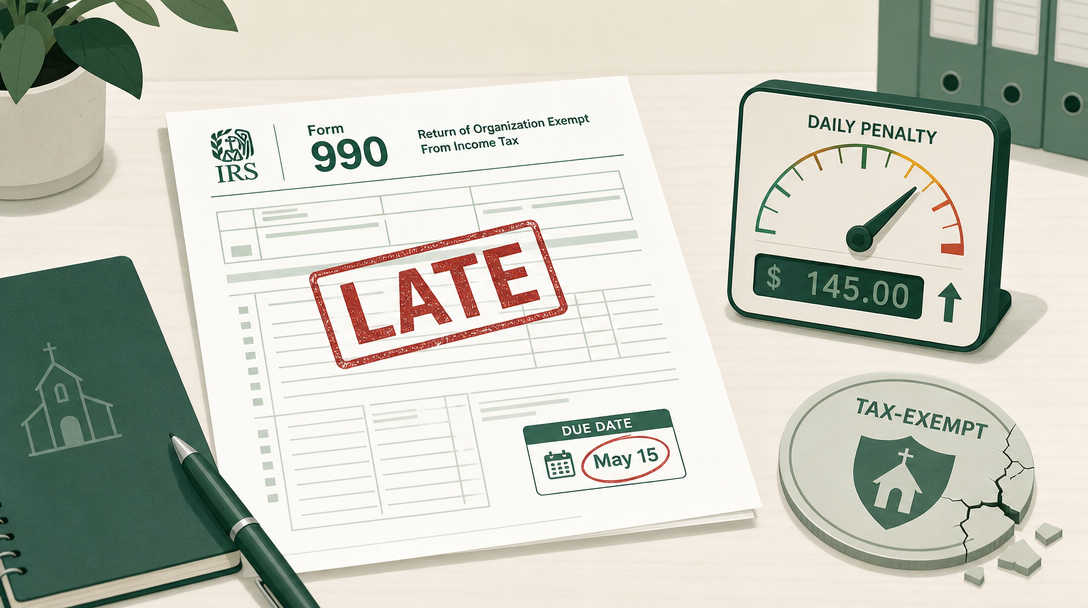
Short answer: Filing your Form 990 or 990-EZ late triggers a per-day penalty that scales with the organization’s size — a smaller daily amount and cap for smaller groups, a much larger one for big organizations. But the daily penalty isn’t the real danger. The worse outcome is losing your tax-exempt status entirely, which happens automatically after three consecutive years of not filing — and even the tiny 990-N counts toward those three years. Penalty dollar amounts are inflation-adjusted every year, so as of 2026, confirm the current figures with the IRS before you rely on any number below.
The late-filing penalty is one slice of the larger form 990 picture — the annual information return most tax-exempt nonprofits file. The pillar guide covers which version you file and why churches are exempt; this page is about what happens when a required return shows up late, or never shows up at all.
The daily late-filing penalty
A late Form 990 or 990-EZ isn’t a tax bill, but it does carry a failure-to-file penalty that accrues for every day the return is overdue past its due date — including any extension you were granted. The amount, and the ceiling it can reach, depends on how big the organization is by gross receipts. The IRS sets two tiers, and the figures are adjusted for inflation each year, which is exactly why you should treat the numbers here as a snapshot rather than a permanent rule.
For smaller organizations — those whose annual gross receipts fall at or below the large-organization threshold — the penalty is, as of 2026, $25 a day, with a maximum for any one return of the lesser of $13,000 or 5% of the organization’s gross receipts for the year. The percentage cap matters for genuinely small groups: a nonprofit with modest receipts hits the 5% ceiling long before it would ever reach $13,000, so the real exposure stays proportional to the organization’s size. Even so, confirm the current amounts with the IRS, because the daily rate and the dollar cap both move with inflation.
For large organizations — defined, as of 2026, as those with annual gross receipts exceeding $1,309,500 — the penalty is steeper: $130 a day, up to a maximum for any one return of $65,000. The jump from the smaller tier is deliberate. A large, well-resourced nonprofit has no good excuse for a missing return, so the daily rate and cap rise sharply. Both the threshold and the penalty amounts are inflation-adjusted, so as of 2026, confirm the current figures with the IRS rather than assuming last year’s numbers still hold.
Both amounts come straight from the IRS. See the agency’s page on penalties for failure to file and the current Form 990-EZ instructions, both on irs.gov, for the figures in effect for the return you’re filing. One relief valve is built in: the penalty doesn’t apply if the organization can show the late filing was due to reasonable cause rather than neglect — a documented explanation attached to the late return, judged case by case.
The same penalty structure also bites when a return is filed on time but incomplete or incorrect — a 990 that omits required schedules or reports wrong figures can draw the daily penalty just as a late one does, until the organization supplies the missing or corrected information.
Penalties on responsible persons
The penalty above lands on the organization itself. A separate penalty can fall on individuals — the officers, directors, or employees responsible for filing.
When an organization fails to file a complete, correct return, the IRS can send a written demand setting a firm date by which the organization must fix the problem. Miss that date, and the person responsible for the failure becomes personally liable for a penalty of, as of 2026, $10 a day for each day past the deadline in the demand letter, up to a maximum on all persons for any one return of $6,500 (confirm the current amount with the IRS, since it too is inflation-adjusted). The point of this rule is pressure: once the IRS has formally demanded the return and named a deadline, the people who run the organization can’t keep ignoring it without personal cost. These figures, again, come from the IRS penalties for failure to file page on irs.gov — as of 2026, confirm the current amounts with the IRS.
A note on the smallest filing: the 990-N e-Postcard has no monetary late penalty of its own. A small organization that files its e-Postcard late owes no per-day fee. That sounds forgiving, but the absence of a dollar penalty hides the consequence that matters most — and it applies to every version of the form, the 990-N included.
The bigger risk: automatic revocation after three years
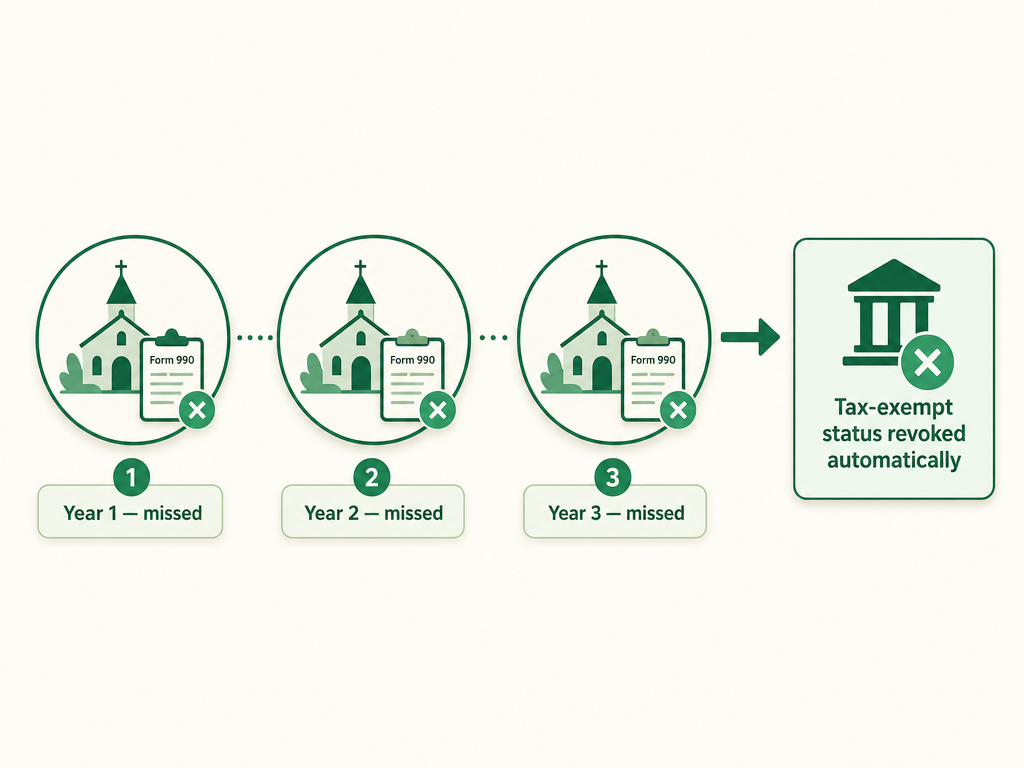
Here is the consequence that dwarfs every daily penalty: an organization that fails to file its required 990, 990-EZ, or 990-N for three consecutive years loses its tax-exempt status automatically. No warning letter, no IRS judgment call, no negotiation. By law, the exemption is revoked on the due date of the third missed return, and the organization is then published on the IRS Auto-Revocation List — a public, searchable database that donors, grantmakers, and watchdogs can check.
What revocation actually does is the painful part. A revoked organization may owe federal income tax on its revenue, can lose state tax exemptions that piggyback on the federal one, and — the blow that hurts a charity most — donations to it stop being tax-deductible until the status is restored. Grant eligibility often evaporates too, since most foundations only fund recognized 501(c)(3)s. A single rule, triggered by silence, can unwind years of fundraising goodwill.
The detail that catches small nonprofits off guard: even the 990-N counts. A tiny all-volunteer group that thinks it’s too small to bother with anything still has to file the e-Postcard, and three skipped e-Postcards revoke its exemption exactly as three skipped full 990s would. The 990-N carries no dollar penalty, but it carries the full weight of the three-year rule. The IRS spells this out on its automatic revocation of exemption page on irs.gov.
Churches are the standing exception. A church, an integrated auxiliary, and a convention or association of churches aren’t required to file an annual return in the first place, so they aren’t subject to automatic revocation for failing to file. Church-affiliated organizations that aren’t themselves churches — a separately incorporated school or a parachurch ministry — usually do have to file, and the three-year rule applies to them in full.
Getting reinstated after revocation
Reinstatement after automatic revocation isn’t an appeal — it’s a fresh application for tax-exempt status. The organization re-files Form 1023 (or Form 1023-EZ for eligible small 501(c)(3)s, or Form 1024 for non-501(c)(3) groups), pays the user fee, and asks the IRS to recognize the exemption again. The IRS lays out the full set of reinstatement procedures on its how to have your tax-exempt status reinstated page on irs.gov.
The smoothest path is the streamlined retroactive relief for small organizations. A group that was eligible to file the 990-N or 990-EZ, and that hasn’t been auto-revoked before, can be reinstated retroactively to its revocation date — closing the taxable gap as if the lapse never happened — provided it applies within 15 months of the later of its revocation letter date or the date it appeared on the Auto-Revocation List, and files the missing returns. Miss that 15-month window, or run a larger organization, and the path gets harder: you must show reasonable cause for the missed filings to erase the gap retroactively, or accept reinstatement effective only from the date you re-apply, leaving the lapse period taxable.
None of that is cheap or quick. The reinstatement application takes months to process, the user fee is real money, and donors who saw your name on the Auto-Revocation List may hesitate. Filing on time is, by a wide margin, the better deal.
How to avoid all of it
Avoiding every penalty on this page comes down to one habit: file the right version of the 990 on time, every year. A few specifics make that easier.
Know your due date. The return is due on the 15th day of the 5th month after your fiscal year ends — May 15 for a calendar-year nonprofit — and if you need breathing room, Form 8868 buys an automatic six-month extension. The mechanics and the extension are covered in Form 990 due date and extension. Mark the deadline the day your books close, not the week it’s due.
Don’t skip the small filing. If your organization is tiny, the Form 990-N (e-Postcard) takes about five minutes and asks only eight confirming questions — but skipping it three years running revokes your exemption just like skipping a full 990 would. The e-Postcard’s lack of a dollar penalty makes it easy to forget, which is exactly the trap.
Keep clean books year-round. Most late filings happen because the numbers aren’t ready, not because someone forgot the date. An organization whose income and expenses are categorized as they happen can file in an afternoon; one scrambling to reconstruct a year of transactions is the one that misses the deadline and starts the three-year clock.
FAQ
What is the penalty for filing Form 990 late? For smaller organizations, the failure-to-file penalty is, as of 2026, $25 a day, capped at the lesser of $13,000 or 5% of gross receipts; for large organizations with gross receipts over $1,309,500, it’s $130 a day up to $65,000. The amounts are inflation-adjusted annually, so confirm the current figures with the IRS before relying on them.
Does the 990-N (e-Postcard) have a late penalty? The 990-N has no monetary late-filing penalty of its own. But filing it late three years running still triggers automatic revocation of tax-exempt status, so the e-Postcard carries the same ultimate consequence as the larger forms even without a daily fee.
What happens if a nonprofit doesn’t file for three years? The IRS automatically revokes its tax-exempt status on the due date of the third missed return — no warning. The organization is published on the Auto-Revocation List, may owe income tax, and donations to it stop being tax-deductible until the status is reinstated.
Can a revoked nonprofit get its tax-exempt status back? Yes, by re-applying with Form 1023 or 1024 and paying the user fee. Small organizations eligible for the 990-N or 990-EZ can often be reinstated retroactively if they apply within 15 months of revocation and file the missing returns; otherwise they must show reasonable cause to close the taxable gap.
This is general information, not tax or legal advice — penalty amounts are inflation-adjusted annually, so confirm your organization’s current figures and filing requirements with the IRS or a qualified professional.
Vestrybooks keeps your income and expenses categorized by fund all year, so when the 990 deadline comes the numbers are already ready — and the three-year clock never starts. See how it works
This article is general information for church treasurers, not professional tax or legal advice. For your church's situation, consult a qualified accountant or attorney.
Nonprofit accounting, minus the headache.
Vestrybooks does fund accounting, donor tracking, and board-ready reports for churches and faith-based nonprofits.
A real free plan · no credit card · your data stays yours