Blog · Nonprofit tax filing
Form 990-N (e-Postcard): who files it and how
June 28, 2026 · By Benjamin Reinke
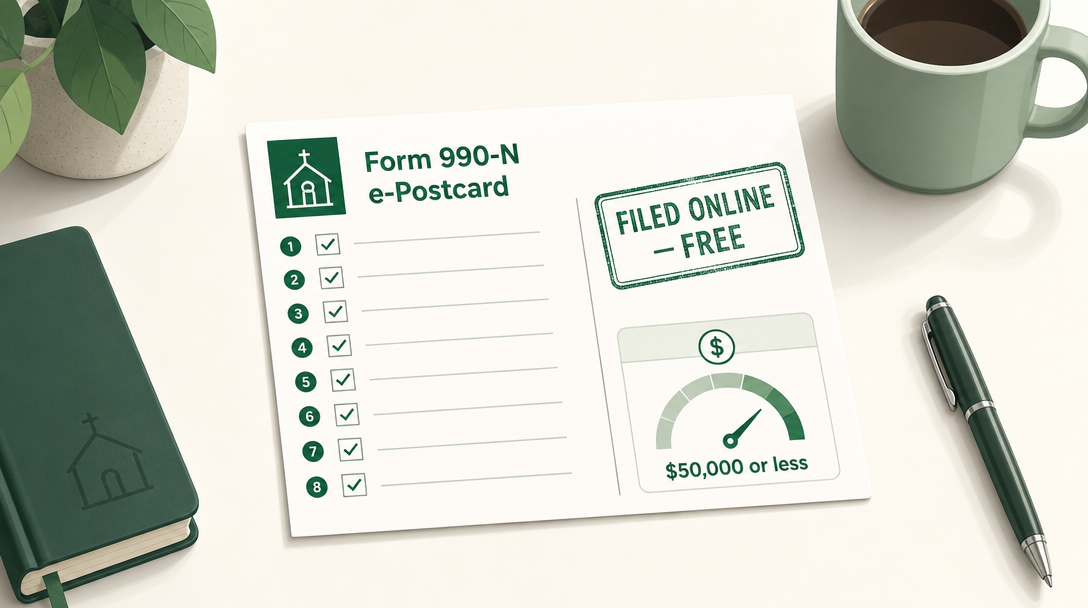
Short answer: Form 990-N is the IRS “e-Postcard” — an eight-question electronic notice that the smallest tax-exempt nonprofits file each year. An organization can use it when its gross receipts are normally $50,000 or less. There’s no paper version, it costs nothing, and it’s filed online through the IRS e-Postcard system. The deadline is the 15th day of the 5th month after your fiscal year ends (May 15 for calendar-year groups), and unlike the longer returns, the e-Postcard can’t be extended. Skip it for three years running and the IRS revokes your tax-exempt status automatically.
Form 990-N is the smallest of the three sizes of form 990, the annual information return most tax-exempt organizations file. The pillar guide covers all three versions side by side; this page goes deep on just the e-Postcard — who qualifies, the exact questions it asks, how to file it, and the deadline rules that trip people up. (Churches are the big exception to the whole system: a church files nothing at all, not even the e-Postcard.)
Who has to file Form 990-N
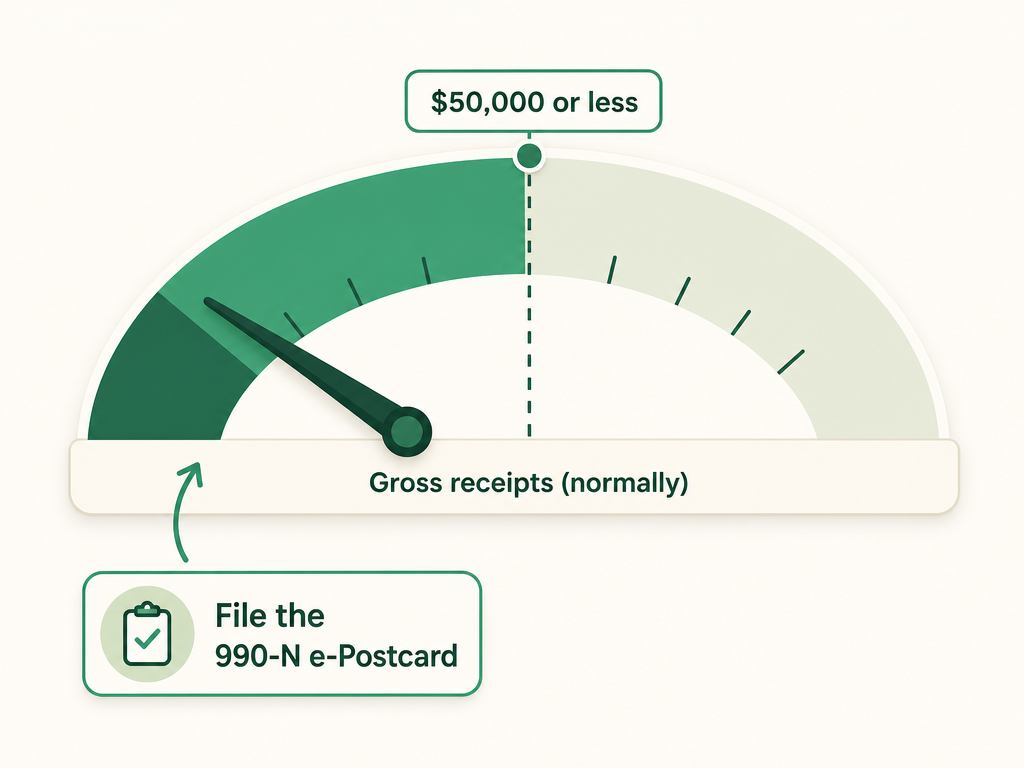
Form 990-N is for small tax-exempt organizations whose annual gross receipts are normally $50,000 or less. A group at that size files the e-Postcard instead of the longer 990-EZ or the full 990. Filing is still mandatory — the e-Postcard is the floor of the requirement, so even a $5,000-a-year volunteer nonprofit has to send the IRS something every year, and this is it.
The word doing the heavy lifting is “normally.” A single big year — a one-time bequest, a capital campaign — doesn’t automatically push a small nonprofit off the e-Postcard. The IRS uses an averaging rule that depends on how long the organization has existed, and it sets the bar higher than $50,000 for brand-new groups. Per the IRS 990-N e-Postcard page, “normally $50,000 or less” breaks down like this:
| Age of the organization | ”Normally $50,000 or less” means |
|---|---|
| In existence 1 year or less | Received, or was pledged, $75,000 or less |
| In existence between 1 and 3 years | Averaged $60,000 or less in each of its first two tax years |
| 3 years or older | Averaged $50,000 or less over the prior 3 tax years |
So an established nonprofit looks at its last three years, averages the gross receipts, and files the 990-N if that average lands at $50,000 or under. A newer group gets more headroom. Read the thresholds slowly — these are the exact figures the IRS publishes, and they’re the only numbers that decide which form you owe.
A few organizations can’t use the e-Postcard even at this size. Private foundations file Form 990-PF no matter how small, and a handful of other types are barred from the 990-N and must file a longer return instead. Most small public charities, though, fit the e-Postcard cleanly.
The eight questions on the e-Postcard
Form 990-N earns the “e-Postcard” nickname because of how little it asks. There are no financial schedules, no balance sheet, no program narrative — just eight pieces of identifying information that confirm the organization still exists and still qualifies. The IRS e-Postcard page lists the items you’ll need:
- Employer Identification Number (EIN), also called a Taxpayer Identification Number (TIN)
- Tax year — the calendar or fiscal year you’re reporting
- Legal name and mailing address of the organization
- Any other names the organization uses (a DBA, for example)
- Name and address of a principal officer
- Website address, if the organization has one
- Confirmation that annual gross receipts are still $50,000 or less
- A statement that the organization has terminated or is going out of business, if that applies
Eight items, and the filing is done. Notice what isn’t there: no revenue and expense detail, no list of board members, no compensation figures. The e-Postcard is a notice, not a financial report — its only job is to keep the IRS’s records current and confirm the organization is still under the size threshold. Item 7 is the one that matters most for your books, because answering it honestly means knowing your true gross receipts for the year.
How to file the 990-N (step by step)
Filing the e-Postcard is a short online task, not a form you download and mail. Here’s the path the IRS lays out:
- Gather the eight items above — most of all, your EIN and your gross-receipts total for the tax year. Have last year’s figure handy too, since the system asks you to confirm you’re still under $50,000.
- Wait until your tax year has actually ended. The IRS won’t accept a 990-N for a year that’s still in progress; you can only file after the close of the fiscal year you’re reporting.
- Go to the IRS e-Postcard system. Form 990-N is submitted only through the IRS’s online filing system at IRS.gov — there are no paper forms and nothing to mail.
- Sign in or create an account. Since 2022, filers authenticate through the IRS’s modernized sign-in: an existing IRS username, an existing ID.me account, or a new ID.me account you create on the spot.
- Enter the eight items, review, and submit. The system confirms receipt on screen. Filing the e-Postcard is free — the IRS charges nothing to submit Form 990-N.
For a walk-through with screenshots, the IRS publishes a Form 990-N Electronic Filing System (e-Postcard) User Guide (Publication 5248) alongside the filing system itself. If the system rejects your EIN, it’s often because the IRS hasn’t finished adding a newly recognized organization to its database — a short wait and a retry usually clears it.
When the 990-N is due (and why it can’t be extended)
Form 990-N is due every year by the 15th day of the 5th month after the close of your tax year. For the common calendar-year nonprofit, whose books close December 31, that lands on May 15 of the following year. A fiscal year ending June 30 makes the e-Postcard due November 15. The due date is the same one the 990 and 990-EZ use — the size of your organization changes which form you file, not when it’s due.
Here’s where the e-Postcard differs from its bigger siblings: you can’t extend it. Form 8868 grants an automatic six-month extension for the 990, 990-EZ, and 990-PF, but it does not apply to the 990-N. Because the e-Postcard takes only minutes to complete, the IRS doesn’t offer an extension for it. The flip side is gentler than you’d expect — the IRS states there are no late-filing or delinquency penalties for the 990-N. File it a week late and nothing bad happens beyond a possible reminder notice. (The longer returns aren’t so forgiving; see Form 990 late-filing penalties for what a late 990 or 990-EZ actually costs.)
So the e-Postcard has no extension and no late fee. That sounds like a wash, but it sets a trap for the inattentive, which is the next section.
Miss it three years and you lose your exemption
A late e-Postcard costs nothing — but three consecutive years of skipping it costs everything. By law, a tax-exempt organization that fails to file its required 990, 990-EZ, or 990-N for three years running has its tax-exempt status automatically revoked. There’s no warning letter and no IRS judgment call; the revocation takes effect on the due date of the third missed return, and the IRS then lists the organization on its public Auto-Revocation List.
Because the 990-N carries no late penalty, small all-volunteer nonprofits are exactly the ones most likely to forget it — and they’re the ones automatic revocation was designed to catch. The fallout is real: a revoked organization can owe income tax, and donations to it stop being tax-deductible until the exemption is restored. Getting it back means reapplying for tax-exempt status with Form 1023 or 1024, paying the user fee, and (for groups eligible for the 990-N or 990-EZ) often qualifying for streamlined retroactive reinstatement if you act within 15 months. A five-minute e-Postcard once a year is far cheaper than buying your exemption back.
(Churches sit outside all of this. A church isn’t required to file the 990-N — or any 990 — so it’s never subject to automatic revocation for not filing.)
When to file the 990-EZ instead
The e-Postcard only fits while you’re small. Once your gross receipts climb past $50,000 on a normalized basis, you move up to the next form. For most organizations crossing that line, the next stop is Form 990-EZ, the short return for mid-size groups with gross receipts under $200,000 and total assets under $500,000.
Watch the trend, not a single year. A nonprofit whose three-year average creeps over $50,000 has outgrown the e-Postcard and should file the 990-EZ for the year it crosses — and the EZ asks for real financial detail the e-Postcard never did, so it’s worth knowing the jump is coming. The full breakdown of who files the short form, and what it asks, lives in the Form 990-EZ guide. Cross $200,000 in receipts or $500,000 in assets and you graduate again, this time to the full Form 990. You can always file a longer version voluntarily, but never a shorter one than your size allows.
FAQ
Who can file Form 990-N? Small tax-exempt organizations whose annual gross receipts are normally $50,000 or less can file the e-Postcard. “Normally” is an average: a group three years or older qualifies if it averaged $50,000 or less over the prior three years, while newer organizations get a higher limit. Private foundations and a few other types can’t use the 990-N and must file a longer return.
Is there a fee to file the 990-N? No. Form 990-N is filed for free through the IRS e-Postcard system at IRS.gov. There’s no paper form and nothing to mail — the entire filing is online, and the IRS charges nothing to submit it.
Can you get an extension for Form 990-N? No. Form 8868, which extends the 990, 990-EZ, and 990-PF by six months, does not apply to the e-Postcard, so there’s no way to extend it. There’s also no late-filing penalty for the 990-N — but missing it for three consecutive years still triggers automatic revocation of your tax-exempt status.
What happens if you don’t file the 990-N for three years? The IRS automatically revokes your tax-exempt status. The revocation takes effect on the due date of the third consecutively missed filing, with no warning, and the organization is added to the public Auto-Revocation List. Getting the exemption back means reapplying with Form 1023 or 1024 and, for small groups, possibly qualifying for retroactive reinstatement.
This is general information as of 2026, not tax or legal advice — confirm your organization’s filing requirements with the IRS or a qualified professional.
When your books are kept clean and by fund all year, the one question on the e-Postcard that actually depends on your numbers — confirming gross receipts stayed under $50,000 — answers itself. Vestrybooks gives small nonprofits and churches that running, fund-by-fund picture. See how it works
This article is general information for church treasurers, not professional tax or legal advice. For your church's situation, consult a qualified accountant or attorney.
Nonprofit accounting, minus the headache.
Vestrybooks does fund accounting, donor tracking, and board-ready reports for churches and faith-based nonprofits.
A real free plan · no credit card · your data stays yours