Blog · Nonprofit tax filing
Form 990 due date and how to get an extension
June 28, 2026 · By Benjamin Reinke

Short answer: Form 990 is due on the 15th day of the 5th month after your organization’s fiscal year ends. For the common calendar-year nonprofit — books closing December 31 — that’s May 15 of the following year. If you need more time, Form 8868 buys an automatic six-month extension, no reason required, as long as you file it by the original due date. The same deadline applies to the full 990, the 990-EZ, and the 990-N e-Postcard, though the 990-N can’t be extended.
Knowing the date is half the battle with form 990 — the annual information return most tax-exempt nonprofits file. This guide is the deadline-and-extension piece of that bigger picture: when your return is actually due, how the date shifts with your fiscal year, how to push it back six months, and what it costs if you let it slide. Everything below tracks the rules the IRS publishes for exempt organizations.
When Form 990 is due
The rule is one sentence: Form 990 is due on the 15th day of the 5th month after the end of your organization’s accounting period. The IRS states it plainly on its annual return due date page — the 990, 990-EZ, or 990-PF “must be filed by the 15th day of the 5th month after the end of your organization’s accounting period.”
Count it out for the most common case. A nonprofit whose books close on December 31 — a calendar-year filer — adds five months to get to May, and the 15th of that month is the deadline. So calendar-year nonprofits file Form 990 by May 15 of the following year. That single date covers the large majority of organizations, because most run on a calendar year, and it’s the deadline you’ll see referenced everywhere.
Two details ride along with the basic rule. First, the deadline is the same across all three sizes — the full Form 990, the 990-EZ short form, and the 990-N e-Postcard all share the 15th-day-of-the-5th-month due date. Picking the right form is a separate question from when it’s due; the date doesn’t change with size. Second, if the due date lands on a Saturday, Sunday, or legal holiday, it rolls to the next business day. The IRS confirms this on its 990-N filing FAQ: “If the due date falls on a Saturday, Sunday or legal holiday, the due date is the next business day.” So in a year when May 15 falls on a weekend, a calendar-year filer’s real deadline is the following Monday.
Your deadline by fiscal year-end
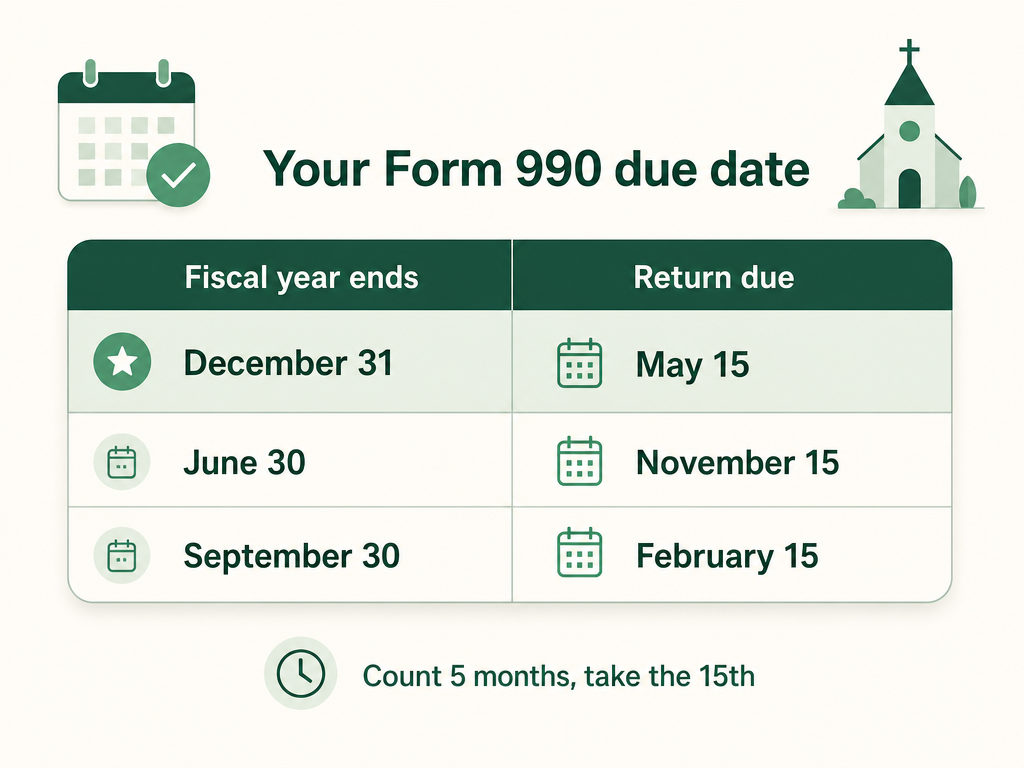
Not every nonprofit runs on a calendar year. A nonprofit can choose a fiscal year that ends on the last day of any month — common ones are June 30 (matching a school year) and September 30. The due-date rule never changes; you just count five months from whenever your year closes and land on the 15th.
A few worked examples make the pattern clear:
| Fiscal year ends | Form 990 is due |
|---|---|
| December 31 (calendar year) | May 15 |
| June 30 | November 15 |
| September 30 | February 15 |
The June 30 example is one the IRS itself uses: a return for a fiscal year ending June 30 is due November 15 of that same calendar year. The math is identical every time — find your fiscal year-end, count forward five months, take the 15th. If that day is a weekend or holiday, slide to the next business day as described above.
If you’re unsure which fiscal year your organization uses, check your IRS determination letter or your last filed return — the accounting period is set when you apply for exemption, and it’s the period your 990 reports on. The deadline simply follows from it.
Getting a six-month extension with Form 8868
Need more time? File Form 8868, the Application for Extension of Time To File an Exempt Organization Return, and you get an automatic six-month extension — no explanation, no reasonable-cause statement, no IRS approval to wait on. The IRS describes it on its extension of time to file page as a request for “a 6-month automatic extension of time to file.” The one firm condition: Form 8868 has to be filed by the original due date of the return. Miss the original deadline and there’s nothing left to extend.
For the typical calendar-year filer, that moves the wall from May 15 to November 15. A June 30 fiscal-year nonprofit moves from November 15 to May 15. The extension is a flat six months in every case — the IRS allows only one extension of six months per return for a tax year, so there’s no second extension to stack on top.
One form is left out: the 990-N e-Postcard cannot be extended with Form 8868. The IRS says so directly — “Form 8868 cannot be filed to extend the due date of a Form 990-N.” That sounds harsh, but the e-Postcard is an eight-question online notice that takes minutes, so there’s rarely a reason to want more time on it. If your organization files the 990-N, the move is simply to file it on time rather than reach for an extension that doesn’t exist.
A practical note on filing the extension itself: Form 8868 is filed electronically through an IRS-authorized e-file provider, the same channel the 990 itself moves through, and it’s a short application — you’re identifying the organization and the return you’re extending, not justifying the request. Because the extension is automatic the moment a timely 8868 is on file, you don’t wait for an approval notice before you stop worrying about the original date; filing it is the approval. The only mistake that breaks it is filing the 8868 a day late, after the original deadline has already passed.
Worth flagging for any nonprofit that does owe tax — say, on unrelated business income reported on Form 990-T: an extension to file is not an extension to pay. Any tax due is still due on the original deadline, and interest and penalties run on a late payment even when the return itself is properly extended. The IRS is explicit that extending the time to file “does not extend the time for paying tax.” Most exempt organizations owe no income tax and never hit this, but it matters if yours does, so estimate and send the balance with the 8868 rather than waiting for the extended filing.
What if you miss the deadline
Letting the deadline pass — without an extension on file — starts the clock on consequences. For the full 990 and the 990-EZ, the IRS charges a daily penalty for each day the return is late, scaled to the organization’s size, and it can also penalize a return that’s filed but incomplete or inaccurate. The exact dollar amounts, the per-day rates, and the caps are their own subject, laid out in Form 990 late-filing penalties.
The bigger danger isn’t a single late year — it’s a pattern of them. An organization that fails to file its required 990, 990-EZ, or 990-N for three consecutive years loses its tax-exempt status automatically, by law, with no warning letter and no IRS judgment call. The revocation takes effect on the due date of that third missed return, and getting the exemption back means reapplying from scratch. That’s why even the smallest nonprofit, filing nothing but the tiny e-Postcard, has to treat the deadline as real. A five-minute filing on time each year is the whole defense.
Filing on time
Hitting the deadline is mostly about not being surprised by it. Mark your due date the moment you know your fiscal year — May 15 for calendar-year filers, or five months past your year-end otherwise — and back up a few weeks so the books are closed and reconciled before you sit down to file. If the date is going to be tight, send Form 8868 early; an automatic extension filed in April is far calmer than a return rushed on May 14.
A simple cadence keeps the date from sneaking up. Close and reconcile the books in the first month or two after your fiscal year ends, while the year’s transactions are still fresh. Pull together the figures the return asks for — revenue and expenses by category, a list of officers and key staff, and a plain description of the year’s programs — well ahead of the deadline rather than the week of. Decide which version you’ll file based on your size, since that determines the form and the level of detail. Then e-file through an IRS-authorized provider with time to spare. None of these steps is hard on its own; missing the deadline usually comes from starting all of them at once, in May.
The actual filing is a step-by-step process — gathering financials, choosing the right version, and e-filing through an IRS-authorized provider. The full walkthrough lives in how to file Form 990. Pair an early start with a clean set of books and the deadline stops being a scramble.
FAQ
When is Form 990 due? Form 990 is due on the 15th day of the 5th month after your organization’s fiscal year ends. For a calendar-year nonprofit with a December 31 year-end, that’s May 15 of the following year. The same date applies to the full 990, the 990-EZ, and the 990-N. If it falls on a weekend or legal holiday, the deadline moves to the next business day.
Can you get an extension on Form 990? Yes. Filing Form 8868 by the original due date grants an automatic six-month extension — no reason or IRS approval needed. For a calendar-year filer, that moves the deadline from May 15 to November 15. Only one six-month extension is allowed per return per tax year, and the extension to file does not extend the time to pay any tax owed.
What’s the deadline for a calendar-year nonprofit? A calendar-year nonprofit — one whose books close December 31 — must file Form 990 by May 15 of the following year. That’s five months after the December 31 year-end, on the 15th. With a timely Form 8868, the extended deadline becomes November 15.
Can the 990-N be extended? No. Form 8868 cannot be used to extend the due date of the 990-N e-Postcard. Because the e-Postcard is a short, eight-question online notice that takes only a few minutes, the practical answer is to file it by its 15th-day-of-the-5th-month deadline rather than seek an extension.
This is general information, not tax or legal advice — confirm your organization’s filing deadline with a qualified professional.
Vestrybooks keeps your church or nonprofit’s books closed and reconciled all year, so when the 15th-day-of-the-5th-month deadline arrives, the numbers behind your return are already in order — no scramble, no surprise. See how it works
This article is general information for church treasurers, not professional tax or legal advice. For your church's situation, consult a qualified accountant or attorney.
Nonprofit accounting, minus the headache.
Vestrybooks does fund accounting, donor tracking, and board-ready reports for churches and faith-based nonprofits.
A real free plan · no credit card · your data stays yours