Blog · Nonprofit tax filing
Form 990-EZ: who files the short form, and how
June 28, 2026 · By Benjamin Reinke

Short answer: Form 990-EZ is the short-form version of the annual IRS return, written for mid-size nonprofits. An organization can use it when both size tests are met — gross receipts under $200,000 and total assets under $500,000 at year-end. It runs about four pages instead of the full 990’s dozen-plus, but it isn’t a free pass: a 501(c)(3) still attaches Schedule A (public charity status) and Schedule O (the required narrative), plus Schedule B and others when they apply. And the 990-EZ now has to be filed electronically — paper is no longer an option. Its due date is the same as every other 990: the 15th day of the 5th month after the fiscal year ends.
The 990-EZ is one of three sizes of the annual return. The pillar guide to form 990 covers all three and the rules that bind them together; this page stays on the middle form — who lands on it, what’s inside it, and how it goes to the IRS.
Who qualifies to file the 990-EZ
Eligibility for the 990-EZ comes down to two numbers, and the word between them does the heavy lifting: and. An organization may file the short form when its gross receipts are under $200,000 and its total assets are under $500,000 at the end of the tax year. Both have to be true. The moment either number crosses its line — receipts at $200,000 or more, or assets at $500,000 or more — the organization files the full Form 990 instead. The IRS lays out these thresholds on its about Form 990-EZ page and in the Form 990-EZ instructions.
The “and” catches people who assume the short form is purely about income. A modest charity that takes in only $90,000 a year but is sitting on a $700,000 endowment or a paid-off building does not qualify for the 990-EZ — the asset side alone pushes it onto the full 990. Size, for this form, is measured on two axes, and you have to clear both.
Gross receipts is the broad figure here: the total an organization brings in from all sources before subtracting any costs — donations, program fees, grants, investment income, fundraising proceeds, the lot. Total assets is the year-end book value of everything the organization owns, taken straight from its balance sheet. A handful of organization types are pushed to the full 990 no matter how small they are — sponsoring organizations of donor-advised funds and certain others named in the instructions — so the thresholds are the general rule rather than the only rule.
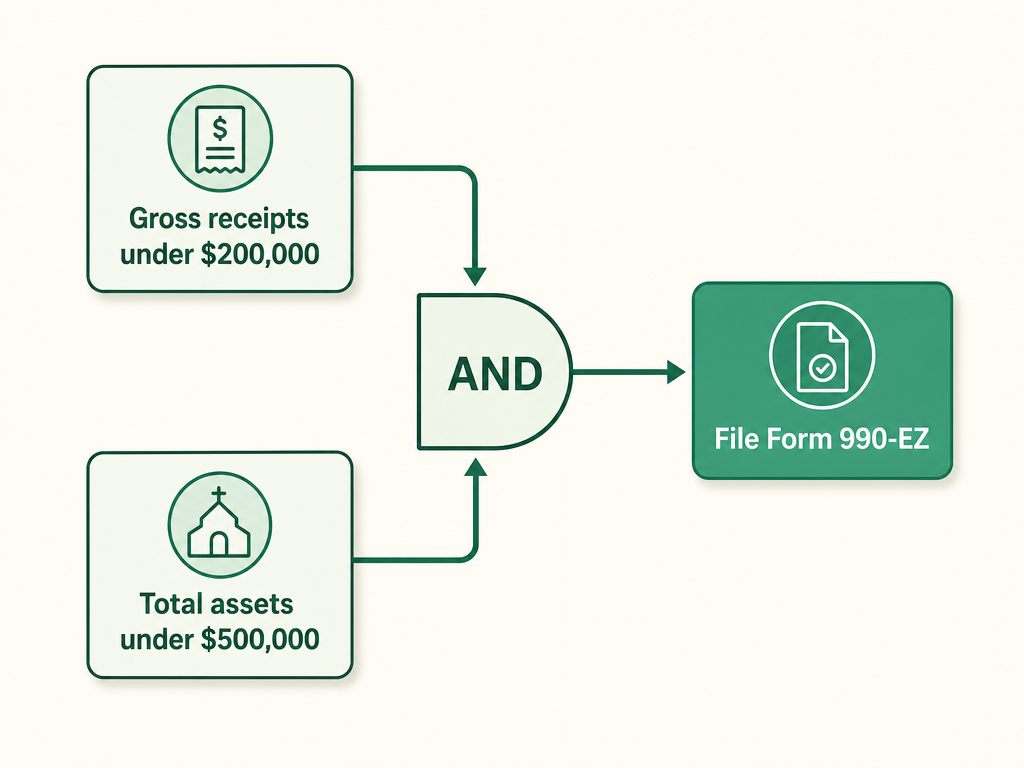
Worth saying plainly: a smaller organization may always file up. A group eligible for the 990-EZ can choose to file the full Form 990 voluntarily, and one eligible for the smallest filing, the e-Postcard, can choose the 990-EZ. The thresholds set a ceiling on how short you can go, not a floor on how long.
The six parts of the 990-EZ
Despite its length, the 990-EZ asks for a full financial picture — just in fewer lines than the long form. The IRS Form 990-EZ instructions organize it into six parts, and reading them in order is a fair tour of what the IRS wants to know about a nonprofit.
Part I — Revenue, Expenses, and Changes in Net Assets is the income statement. Money in (contributions, program service revenue, membership dues, investment income, special-event proceeds) sits against money out (grants paid, salaries, occupancy, printing, other expenses), and the difference moves net assets up or down for the year. Part I is the heart of the form.
Part II — Balance Sheets is the snapshot. Cash, savings, land and buildings, and other assets on one side; liabilities on the other; net assets as the remainder. The total-assets figure that decided whether you could use this form in the first place is reported right here.
Part III — Statement of Program Service Accomplishments is where numbers give way to words. An organization describes what it actually did — its largest programs, who they served, what they achieved — and attaches the spending to each one. A reader scanning a 990-EZ to judge whether a charity is doing real work tends to land on Part III first.
Part IV — List of Officers, Directors, Trustees, and Key Employees names the people in charge and what each was paid, including those paid nothing. Part V — Other Information is a checklist of compliance questions covering political activity, lobbying, related organizations, and similar matters that may trigger an extra schedule. And Part VI — Section 501(c)(3) Organizations is completed only by charities, capturing a few questions specific to that status.
The schedules that still attach
A shorter core form does not mean a shorter filing. The 990-EZ carries its own set of schedules, and for a 501(c)(3) two of them are routine rather than optional. Per the IRS Form 990-EZ instructions, the ones most filers meet are:
- Schedule A — Public Charity Status and Public Support. Required for every 501(c)(3) filing the 990-EZ. Schedule A is how a charity proves it’s a public charity rather than a private foundation, usually by showing that its support comes broadly from the public. Skipping it leaves the return incomplete.
- Schedule B — Schedule of Contributors. Required when an organization received contributions above a reporting threshold from any single donor. It lists those larger contributors; the public-disclosure copy of the return generally has donor names and addresses removed.
- Schedule O — Supplemental Information. The required narrative. Schedule O is where an organization explains answers, expands on a program, or adds context the short lines can’t hold — and the instructions treat it as a standard attachment, not an afterthought.
- Schedule G — Fundraising or Gaming Activities. Required when an organization runs fundraising events or gaming (raffles, bingo) above set thresholds.
Other schedules attach when an organization’s activities call for them — Schedule C for political and lobbying activity, Schedule E for schools, Schedule L for transactions with insiders, Schedule N for an organization that’s shutting down. The pattern is consistent: the short form covers the common case, and a schedule fills in whenever something specific applies. A church, worth noting, sidesteps all of this — churches are exempt from filing the 990 family altogether, a point the Form 990 pillar covers in full.
How to file the 990-EZ
Filing the 990-EZ is now an electronic-only affair. The IRS Form 990-EZ instructions state that a current-year Form 990-EZ must be filed electronically; the old option of printing the form and mailing it has closed. Filing runs through IRS-authorized e-file software or a tax professional who handles exempt-organization returns — there’s no free fill-in-and-mail PDF the way there once was.
The deadline matches the rest of the 990 family: the 15th day of the 5th month after the organization’s accounting period ends. For a nonprofit on a calendar year (books closing December 31), that’s May 15. A fiscal year ending June 30 makes the 990-EZ due November 15. Need more time? Form 8868 (Application for Extension of Time To File an Exempt Organization Return) grants an automatic six-month extension when filed by the original due date — no explanation required, which for a calendar-year filer moves the deadline to November 15.
Before any of that, the form has to be filled in correctly, and the work happens in the books long before May. Clean, fund-by-fund records make Parts I and II almost mechanical to complete; messy ones turn the 990-EZ into a reconstruction project. The mechanics of working through the parts and schedules get their own walkthrough in how to file Form 990; the short version is that the return is only as easy as the bookkeeping behind it.
990-EZ vs the 990-N and the full 990
Picture the three returns as rungs. The bottom rung is the Form 990-N (e-Postcard), an eight-question electronic notice for the smallest organizations — those with gross receipts normally $50,000 or less. No financial statements, no schedules, just a handful of confirming details filed online.
The middle rung is the 990-EZ: the four-page short form for an organization that has outgrown the e-Postcard but stays under the two ceilings — receipts under $200,000 and assets under $500,000. Real financials, the core schedules, but a fraction of the full form’s depth.
The top rung is the full Form 990, required once an organization crosses either line — gross receipts at $200,000 or more, or total assets at $500,000 or more. It runs a dozen-plus pages with a far longer roster of schedules and governance questions.
Organizations move between rungs as they grow or contract, and the move is driven entirely by those two numbers measured each year. A nonprofit that crosses $200,000 in receipts steps up from the 990-EZ to the full 990 for that year; one whose receipts fall back under $50,000 can step down to the e-Postcard. The form follows the size, recalculated annually — there’s no permanent assignment, just whichever rung your two numbers land on this year.
FAQ
Who can file Form 990-EZ instead of the full 990? A tax-exempt organization may file the 990-EZ when its gross receipts are under $200,000 and its total assets are under $500,000 at the end of the tax year. Both conditions must be met. If either number reaches or exceeds its threshold, the organization files the full Form 990. A few organization types are required to file the full 990 regardless of size.
Does Form 990-EZ have to be filed electronically? Yes. The IRS now requires Form 990-EZ to be filed electronically — the paper-and-mail option has been retired. Filing goes through IRS-authorized e-file software or a tax professional. Confirm the current rule in the IRS Form 990-EZ instructions.
What schedules do I attach to a 990-EZ? Most 501(c)(3) filers attach Schedule A (public charity status) and Schedule O (the supplemental narrative); both are routine for charities. Schedule B lists larger contributors when a reporting threshold is met, and Schedule G covers fundraising or gaming activities. Other schedules — C, E, L, N — attach only when the organization’s specific activities call for them.
When is Form 990-EZ due, and can I get an extension? The 990-EZ is due on the 15th day of the 5th month after the fiscal year ends — May 15 for a calendar-year nonprofit. Filing Form 8868 by that date grants an automatic six-month extension, moving a calendar-year deadline to November 15.
This is general information, not tax or legal advice — confirm your organization’s filing requirements with a qualified professional.
Vestrybooks keeps a nonprofit’s money-in and money-out clean and by-fund all year, so the revenue, expense, and balance-sheet figures behind your 990-EZ are already in shape when the form is due. See how it works
This article is general information for church treasurers, not professional tax or legal advice. For your church's situation, consult a qualified accountant or attorney.
Nonprofit accounting, minus the headache.
Vestrybooks does fund accounting, donor tracking, and board-ready reports for churches and faith-based nonprofits.
A real free plan · no credit card · your data stays yours