Blog · Fundraising & giving
Church fundraising ideas that actually work
July 4, 2026 · By Benjamin Reinke

Short answer: The best church fundraising isn’t an event — it’s the weekly rhythm of tithes and offerings, made easy to give. Events, seasonal appeals, capital campaigns, and online giving are supplements that fill specific gaps: a new roof, a mission trip, a benevolence fund. So the smart order is to make regular giving frictionless first (ideally free online giving with no platform cut), then pick a fundraiser that fits a real need, set a dollar goal tied to your budget, promote it well, and — the part most lists skip — track the money correctly so a “building fund” dollar stays a building-fund dollar and every giver gets a proper receipt.
Start with regular giving, then add fundraisers
Before you plan a single event, get the boring thing right: regular, recurring giving. It’s not glamorous, but it’s where almost all of a healthy church’s money comes from. Recurring givers give far more than one-time givers — one industry benchmark puts recurring donors at about 42% more per year on average (M+R Benchmarks, via Fellowship Development) — and roughly 60% of church contributions now arrive digitally (Fellowship Development). A church that makes online and recurring giving easy captures more money with zero event fatigue.
So think of fundraising as two layers. The base is tithes and offerings — the giving your budget depends on, that you want to be as frictionless as possible. The top layer is targeted fundraising: events, seasonal appeals, and campaigns that raise money for a specific need beyond the operating budget. A fundraiser is a supplement, not a substitute. If you’re leaning on bake sales to cover the electric bill, the real fix is the base layer, not a better bake sale.
This page is the map of that top layer — every kind of church fundraiser, when each one fits, how to actually run it, and how to keep the money straight afterward.
Church fundraising ideas by type
There’s no single “best” church fundraiser — the right one depends on what you’re raising for and how many volunteers you have. Here are the six families of ideas, from the steady base to the big one-time push, with concrete, small-church-doable examples in each.
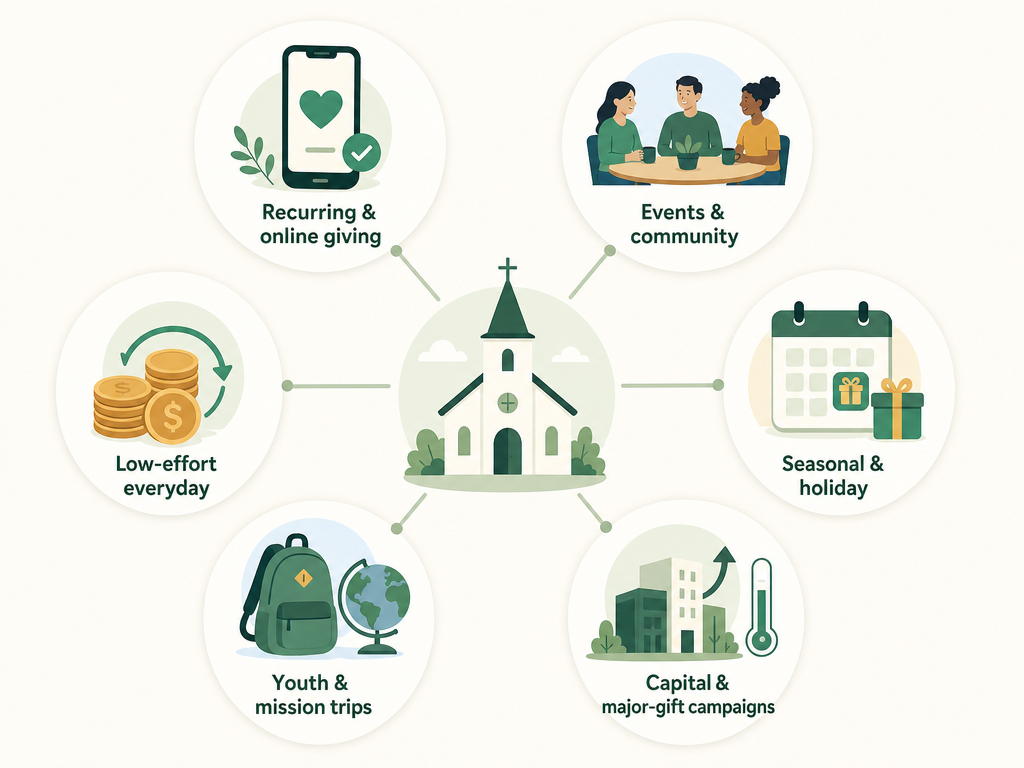
Recurring and online giving (the steadiest “fundraiser”)
Recurring online giving is the one that matters most, and it barely feels like fundraising. Set up an online giving page and let members schedule recurring gifts. Recurring givers account for a wildly outsized share of total giving — one dataset found recurring givers were about 22% of donors but 41% of all giving (Fellowship Development). Concrete moves:
- Online and mobile giving — add online giving to your church website with a link, a Give button, or a QR code in the bulletin so anyone can give in ten seconds.
- Recurring giving — invite members to set up an automatic weekly or monthly gift; this is the single biggest lever on annual income.
- Text-to-give — a short code people text to give from the pew or from home.
Watch the fees here. Many giving platforms skim 2–5% of every gift, which quietly taxes your congregation’s generosity. Vestrybooks takes no platform cut on online giving, so a $100 gift lands as $100 (minus only the card processor’s fee). Over a year, that difference is real money.
Events and community fundraisers
Events do double duty — they raise money and they build community, which is often the bigger win for a small church. Keep them low-effort-per-dollar and rooted in something people already enjoy. Reliable, small-church-friendly options (Zeffy, CauseVox):
- Church dinner or potluck with a suggested donation or ticket.
- Trivia night — teams of four to six, a modest entry fee per team, a small prize.
- Movie night in the fellowship hall — tickets at the door plus a concessions table.
- Talent show with a small entry fee and donations at intermission.
- Yard or rummage sale from donated items.
- Bake sale or coffee-and-cake morning after a service.
- Benefit concert — one of the higher-earning event formats, since ticket sales plus optional donations draw from the wider community, not just members (abcfundraising).
For events where people pay and get something back (a dinner, a concert ticket), there’s a tax wrinkle covered below — only the amount above the value of what they received is deductible.
Seasonal and holiday appeals
Giving spikes around the calendar, so ride it. A focused appeal tied to a season raises more than a generic “please give” because it has a story and a deadline. Ideas:
- Christmas and Easter offerings — a special designated offering with a clear purpose (missions, benevolence, a building need).
- Year-end giving push — December is the biggest giving month; a simple email and pulpit reminder captures gifts people already intend to make.
- Advent or Lent giving calendars — a small daily or weekly ask across the season.
- Harvest or Thanksgiving offering — a gratitude-framed appeal that fits the season.
A seasonal appeal pairs naturally with a strong operating plan — see how the year’s giving maps to a church budget so each appeal funds a real line item rather than a vague hope.
Capital and major-gift campaigns (the big one-time push)
When the need is large and specific — a new building, a roof, debt payoff, a major expansion — a fundraiser won’t cut it. You run a capital campaign: a time-limited, goal-driven effort separate from the operating budget, usually collected as multi-year pledges. Done well, a campaign can raise one to three times a church’s annual tithes and offerings over about three years (Steier Group), far beyond what any single event does.
The mechanics are different too: campaigns lead with major gifts (a handful of larger commitments, often asked for in person, that set the pace) before opening to the whole congregation. There’s a real playbook here — the quiet phase, the leadership gifts, the public ask, and years of pledge collection. Read the full walkthrough in the guide to a church capital campaign. For a building project especially, grants for churches — historic-preservation and community-development funds — can supplement what the congregation gives.
Youth and mission trip fundraising
Youth groups and short-term mission teams almost always fundraise their own way, and the ideas skew toward hands-on, community-facing events: car washes, sponsored walks or “-athons,” pancake breakfasts, service auctions where members bid on chores, and personal support letters to family and friends.
This category comes with a tax trap worth flagging up front: money raised “for” a specific person’s trip, or a gift a donor earmarks for a named individual, is usually not tax-deductible — and it can even create problems for the church. The fix is running the money through a church-controlled fund, not a per-person tally. The full mechanics — support letters, deductibility, and how to keep it clean — are in the guide to mission trip fundraising.
Low-effort, everyday (passive) fundraising
Not every fundraiser needs volunteers on a Saturday. Passive fundraisers run in the background and add up:
- Employer matching gifts — many companies match employee donations; a reminder can double gifts you’re already getting.
- Restaurant and retail “give-back” nights — a local restaurant donates a share of a night’s sales.
- Online store or shopping programs — a small percentage of members’ everyday purchases.
- Coffee, cookbooks, or merchandise sold at cost-plus.
- Peer-to-peer fundraising — members create their own small giving pages and share them, which extends reach beyond your immediate membership — a strategy that punches above its weight for small congregations (Big Fundraising Ideas).
These won’t fund a building, but they capture money between events with almost no labor — exactly what a stretched volunteer team needs.
How to actually run a church fundraiser
Ideas are the easy part. Here’s the repeatable process that separates a fundraiser that hits its goal from one that raises $340 and burns out three volunteers.
- Set a specific dollar goal tied to your budget. “Raise money for the church” is not a goal. “Raise $8,000 to replace the fellowship-hall HVAC by October” is. Anchor the number to a real line in your budget or a real project cost, so people know exactly what their gift buys.
- Pick the fundraiser that fits the need and your volunteers. A $150,000 building need is a capital campaign, not a bake sale. A $2,000 youth-trip gap is a car wash and support letters. Match the tool to the size.
- Promote it on every channel, more than once. Pulpit announcement, bulletin, email, text, and social — and repeat. Most people need to hear an ask several times. Give a clear deadline and a clear way to give (a QR code beats “see the table in the lobby”).
- Make giving effortless. Every extra step costs you gifts. Online, mobile, text-to-give, and a card reader at the event itself. If someone has to find their checkbook, you’ve lost some of them.
- Track the money correctly — and this is where most guides go silent. See the next section. This is the difference between a fundraiser that builds trust and one that quietly creates a mess.
- Thank people specifically and report the result. Tell the congregation you hit (or how close you got to) the goal, and thank givers promptly. Gratitude and transparency are what make the next fundraiser work.
The money side most fundraising guides skip
The money side is the part that turns a good idea into good stewardship — and it’s the part treasurers actually lose sleep over. Three things have to be right.
Track designated gifts so a building-fund dollar stays a building-fund dollar
When someone gives “for the new roof,” that gift is restricted — you’re legally and ethically obligated to spend it on the roof, not on payroll or utilities. The way churches keep that promise is fund accounting: each purpose (general, building, missions, benevolence) is its own set of books with its own running balance, even though it all sits in one bank account. Give the building fund $5,000 and the general fund $0, and your books show exactly that — so you can always answer “how much is in the building fund?” without guessing.
This is not optional bookkeeping nicety. Spending restricted money on the wrong thing — even to cover a real bill — breaks the donor’s trust and, if it’s a large or repeated pattern, can create legal exposure. Vestrybooks handles this behind the scenes: pick a fund from a dropdown when you record a gift, and the restricted balances stay separate automatically.
Acknowledge gifts properly (and handle the “you got something back” rule)
Donors need a written acknowledgment to deduct their gifts, and the IRS has specific rules — the full requirements are in the guide to church contribution statement requirements. For a straightforward donation, a receipt with the church’s name, the amount, the date, and a statement of whether the donor got anything in return does the job.
Fundraisers where people pay and get something back — a dinner, a gala seat, a concert ticket — trigger the quid pro quo rule. Only the amount above the fair-market value of what they received is deductible. If someone pays $100 for a benefit dinner worth $40, just $60 is a deductible gift, and if the payment is over $75 the church must give the donor a written statement saying so (IRS Publication 1771). Miss that and there’s a small per-contribution penalty. So: for pay-to-attend events, tell people the deductible portion in writing.
Vestrybooks generates year-end contribution statements for every giver in one click — the “January Button” — so nobody’s assembling them by hand in a spreadsheet at 11pm on January 30.
Know which fundraiser gifts are actually tax-deductible
Here’s the rule that surprises people most: a gift earmarked for a specific individual is usually not tax-deductible, even if it flows through the church. If a donor writes “for the Johnson family” or “for Emma’s mission trip” and the church is just a pass-through, the IRS treats it as a personal gift to that individual — not a charitable contribution (IRS Publication 526; Church Law & Tax).
The deciding factor is control. A gift is deductible when the church has full control and discretion over how it’s used, toward the church’s own purposes — and the donor’s mention of a person is treated as a non-binding suggestion, not a directive. That’s why a properly run benevolence fund or mission fund can accept deductible gifts even when a donor names a beneficiary: the church, not the donor, decides. Set your youth-trip and benevolence giving up as church-controlled funds, make clear that designations are recommendations, and the gifts stay deductible. Fund it as a named individual’s account, and they usually don’t.
For the full picture on deductibility and receipts, see are church donations tax deductible.
This is general information, not tax or legal advice. Church benevolence and designated-gift rules are genuinely tricky — confirm your setup with a qualified tax professional or CPA.
Fundraising is one piece of stewardship
A church that only shows up asking for money when the roof leaks will struggle to raise it. Fundraising works best inside a culture of stewardship — teaching generosity year-round, being transparent about where money goes, and connecting every ask to the church’s mission. The events raise dollars; the stewardship culture is what makes people want to give in the first place. That fuller picture — teaching, transparency, and the trust that giving depends on — is in the guide to church stewardship. And if you want a sense of how giving behaves across churches — who gives, how much, and through what channels — the church giving statistics roundup has the numbers.
FAQ
What is the most profitable church fundraiser? For a single event, high-ticket formats raise the most — benefit concerts, galas or dinners with an auction, and silent auctions consistently top the list because they draw from the wider community and combine ticket sales with optional donations. But over a full year, the most profitable “fundraiser” isn’t an event at all: it’s a strong recurring online giving program, which quietly out-raises events because it captures giving every week instead of only on event nights. If you want the biggest one-time total for a specific need, run a capital campaign — those can raise one to three times a church’s annual giving over about three years.
How do churches raise money? Mostly through regular tithes and offerings from members — that’s the base that funds the operating budget. On top of that, churches use targeted fundraising: online and recurring giving, seasonal offerings (Christmas, Easter, year-end), community events (dinners, concerts, yard sales), passive fundraisers (matching gifts, give-back nights), and — for big one-time needs like a building — capital campaigns with major gifts and multi-year pledges. The healthiest approach makes regular giving easy first, then layers targeted fundraising on top for specific needs.
Are church fundraiser donations tax deductible? It depends on the fundraiser. A plain gift to your church is deductible if the church is a qualified organization. But two common cases aren’t fully deductible: (1) pay-to-attend events — if someone buys a $100 dinner ticket and the dinner is worth $40, only $60 is deductible, and the church must disclose that in writing for payments over $75; and (2) gifts earmarked for a specific person — money designated for a named individual (a family in need, a particular person’s mission trip) is generally not deductible, because the IRS treats it as a personal gift. Gifts to a church-controlled benevolence or mission fund, where the church decides how money is used, can be deductible even if a donor names a beneficiary. This is general information — confirm specifics with a tax professional.
What is a good fundraising goal for a small church? Tie it to a real need, not a round number. For an operating gap or a small project, a goal in the hundreds to low thousands is realistic for one event. For a capital need, the benchmark is one to three times your annual tithes and offerings across a multi-year campaign. Whatever the size, name the exact dollar figure and what it buys — specific goals raise more than vague ones.
How do you fund a church without a big congregation? Focus on per-giver depth rather than volume. Make recurring online giving effortless, use peer-to-peer fundraising so members reach beyond the congregation, chase passive money (matching gifts, give-back nights) that needs no volunteers, and run one or two well-promoted community events a year instead of many draining ones. Small congregations do best with low-effort, high-yield ideas and a strong recurring-giving base.
Should a church use an online giving platform that charges a fee? Not if you can avoid it. Many platforms take 2–5% of every gift, which is a standing tax on your members’ generosity. Some tools (Vestrybooks included) take no platform cut, so only the card processor’s unavoidable fee applies. Over a year of regular giving, keeping that percentage in the church rather than the platform adds up to real ministry dollars.
Vestrybooks gives your church free online giving with no platform cut, fund accounting that keeps every restricted gift separate, and one-click year-end contribution statements — so raising the money and keeping it straight are the same easy job. See how it works.
This article is general information for church treasurers, not professional tax or legal advice. For your church's situation, consult a qualified accountant or attorney.
Church accounting a volunteer can actually do.
Vestrybooks is church accounting + giving for the volunteer treasurer — fund tracking, one-click year-end statements, and online giving with $0 taken from every gift.
A real free plan · no credit card · your data stays yours