Blog · Fundraising & giving
Mission trip fundraising ideas (and the tax trap)
July 4, 2026 · By Benjamin Reinke

Short answer: The best mission trip fundraising ideas are a mix of a few simple, repeatable ones — support letters, sponsor-a-day, a service auction, a dinner, a car wash, t-shirt sales, an online giving page, and employer matching gifts — run together rather than betting on one big event. But there’s a tax trap almost every fundraising article skips: when a donor earmarks a gift for a specific named participant, the IRS generally treats it as a non-deductible gift to that person, not a deductible charitable contribution. To keep gifts deductible, the church has to keep full control and discretion over the money — gifts go to the mission-trip fund, not “to send Jamie.” Get the ideas right and the accounting right, and you raise more with less awkwardness at tax time.
The fundraising ideas, and the compliance part nobody covers
Most “mission trip fundraising ideas” lists are the same twenty events copied around the internet. Those ideas are useful, and they’re below — organized so a youth leader or a volunteer treasurer can pick a few and go. But there’s a second half almost every list leaves out, and it’s the half that gets small churches in trouble: how the money is asked for, tracked, and receipted. Hand donors receipts that overstate what they can deduct, or let cash get earmarked “for my kid,” and you’ve turned a good thing into a compliance mess. This guide does both — the ideas, then the money side done correctly.
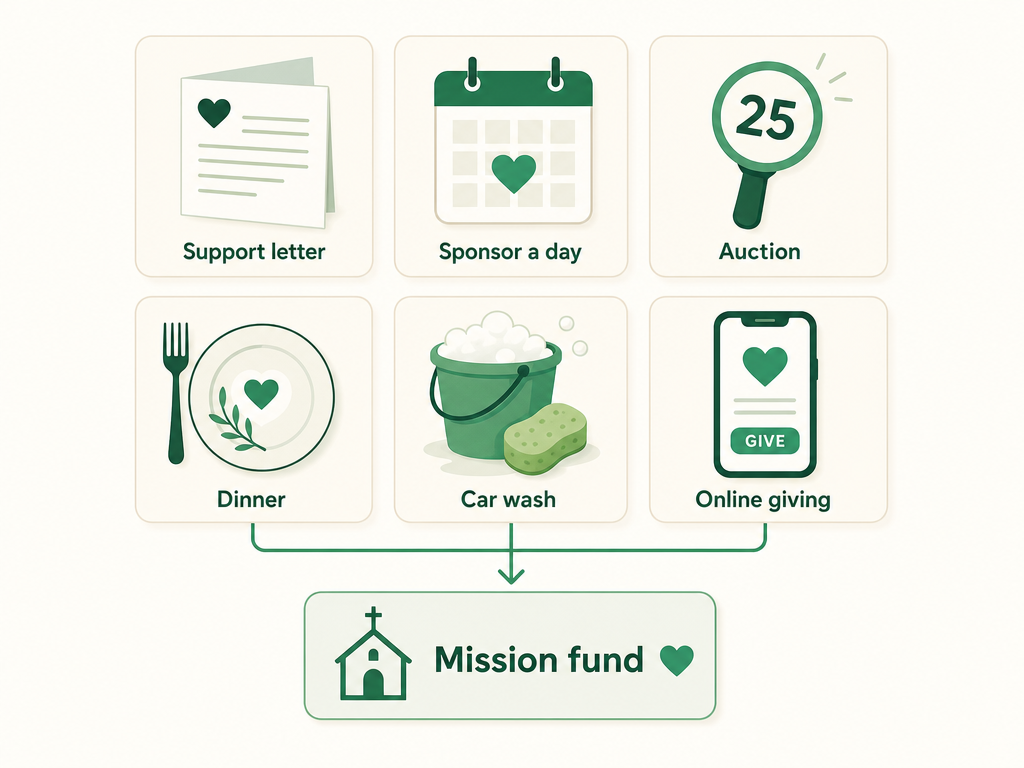
12 mission trip fundraising ideas that work for small churches and youth groups
Here’s the working list. None of these need a big budget or a pro fundraiser — just a team, a date, and a place for the money to land. Pick three or four, not all twelve.
- Support letters. The oldest tool and still the best return per hour. Each participant writes a short, personal letter — where they’re going, why, what the trip costs, how to give — and mails or emails it to their own circle of family, friends, and church contacts. A warm letter to 40 people you know beats a cold event for strangers almost every time. (Read the tax section below before you write the “make checks payable to…” line — this is exactly where the earmarking trap lives.)
- Sponsor-a-day. Break the trip into days and let donors “sponsor” one — day 3 for $50, a full week for $350. It makes an abstract total feel concrete and gives you a natural thank-you (“you covered our Wednesday building the school”). A “wall of giving” or numbered-envelope board works the same way: 100 numbered envelopes, give the amount on the one you take.
- Service auction. Instead of selling stuff, sell time and skills. Members and the youth donate services — a home-cooked dinner, a weekend of yard work, guitar lessons, babysitting, a handyman afternoon — and the congregation bids. High margin (the “cost” is donated labor) and it builds relationships across the church.
- A meal or dinner. Spaghetti and pancake breakfasts are classics because pasta and batter are cheap in bulk and easy for teens to serve; churches commonly charge in the $15–$25-a-plate range for a themed dinner. Ask a local grocer to donate ingredients so almost all of it is profit.
- Car wash. Low setup, high energy, one Saturday, all ages. A donation-based (“pay what you want”) wash often beats a fixed price. Park it somewhere with foot traffic and let the team’s enthusiasm do the selling.
- T-shirt sales. Design one trip shirt and sell it to friends, family, and the congregation. Done right it does double duty — it raises money and turns everyone who wears it into a walking reminder to give, especially the week before you leave.
- An online giving page. Put up a simple page for the mission fund and share it everywhere — the church site, a QR code in the bulletin, texts, social posts. Short videos of participants explaining why they’re going convert better than any flyer. Watch the platform fee, though: many giving processors skim 2–5% plus per-transaction cents off every gift, which is real money off a $6,000 trip.
- Matching gifts. Two flavors, both underused. First, ask a donor or family to match every dollar raised up to a cap, announce it publicly, and give it a two-week deadline — the urgency doubles gifts. Second, remind participants to check whether their (or their parents’) employer offers a matching-gift program; many companies match employee donations to a church dollar-for-dollar, and that money is left on the table constantly.
- A talent show, trivia night, or movie night. Cheap-to-run ticketed events the youth can host themselves — good for people who’d rather buy a $10 ticket to a fun evening than answer a letter.
- A percentage-of-sales restaurant night. Many local restaurants donate a share of one night’s sales when your group brings the crowd. Zero upfront cost — you fill the seats and promote it.
- A yard sale or craft/bake sale. Members donate goods, the youth run the tables — closet clutter into trip funds.
- Loose-change and jar drives. Collection jars at coffee hour, a “coin war” between youth classes, or a jar at a friendly local business. Small money, but it keeps the trip visible for weeks.
The pattern across all of these: run a few together, start early, and make giving easy. One support-letter round plus a dinner plus an online page and an employer match will almost always outperform a single big gamble event.
The mission trip tax trap: earmarked gifts to a named person are usually not deductible
Here’s the part that matters more than any single fundraiser, and the part almost every list skips. If a donor gives money earmarked for a specific named participant, the IRS generally treats it as a non-deductible personal gift to that individual — not a deductible charitable contribution to the church. This is settled guidance, not a gray area, and small churches trip over it every summer.
The rule comes straight from the IRS. Revenue Ruling 62-113 holds that if contributions to a fund are earmarked for a particular individual, they’re treated in effect as gifts to that designated individual — and gifts to individuals aren’t deductible. IRS Publication 526, the charitable-contributions guide, says it plainly: you can’t deduct “a contribution to a specific individual,” and money given “for the use of” an organization must “not [be] set aside for use by a specific person.” So “Here’s $500 to send my nephew Jamie on the trip” is, in the eyes of the IRS, a gift to Jamie. It’s a lovely thing to do. It’s just not tax-deductible, and the church must not receipt it as if it were.
What makes a gift deductible instead is control. The test the IRS applies — reaffirmed in later guidance like Private Letter Ruling 200530016 — is whether the church has full control of the donated funds and discretion as to their use, so the money serves the church’s exempt purpose rather than a private one. If the church genuinely controls the money, the gift is to the church and it’s deductible. If the donor controls where it lands, it’s a gift to a person and it isn’t.
There’s an important nuance that keeps this workable: preferences are allowed; earmarks are not. A donor may express a preference — “I’d love this to help with Jamie’s trip” — as long as the church makes clear it retains ultimate discretion over how all mission funds are used. What breaks deductibility is a binding earmark: money the church is obligated to spend on one named person and no one else. The dividing line is who has the final say.
How to keep mission trip gifts deductible
- Raise for the fund, not the person. Ask people to give to the “mission trip fund” or “the missions team,” not to “send [name].” Say so in the support letter and on the giving page.
- Make checks payable to the church, never to a participant. Money for a named individual routed through the church is the classic earmark the IRS looks straight through.
- State the church’s discretion in writing. A short line in the appeal and on the receipt — “the church retains full control and discretion over all mission-fund gifts” — is exactly the language the guidance wants to see.
- Let participants share support-letter contacts, but let the church do the receipting. Participants can absolutely reach out to their own networks; the gift just has to land in a church-controlled fund with the church deciding how it’s spent.
- Follow the substantiation rules. A donor needs a written acknowledgment from the church for any single gift of $250 or more to deduct it, per IRS Publication 1771 — so accurate receipts aren’t optional. For the fuller picture of what does and doesn’t qualify, see are church donations tax deductible.
Get this wrong and two bad things happen: donors claim deductions they aren’t entitled to, and the church’s receipts are inaccurate — the kind of thing that surfaces in an audit. Get it right and you lose nothing; the money still helps the trip, it’s just structured so it’s genuinely a gift to the church.
Track mission trip money as a designated fund
Once the gifts are coming in correctly, they need a home. Mission-trip money is restricted — donors gave it for the trip, not the general budget — so it can’t just blend into the church’s main account. The right way to hold it is church fund accounting: a dedicated “mission trip” fund with its own running balance, tracked separately even though it sits in the same bank account as everything else.
Fund accounting answers the questions that come up constantly around a trip: How much have we actually raised? How far from the goal? Did the car wash outperform the dinner? Are we allowed to spend this on flights? Because the fund is walled off, you always know the mission-trip balance without doing mental math against the general account, and you can show the board or the parents a clean number any time. This is also what keeps you honest: money given for missions gets spent on missions, full stop.
What happens to leftover mission trip funds
Trips almost never land exactly on budget, so plan for the leftover before you raise a dollar — it’s a restricted-fund question, and the money isn’t simply yours to redirect. Because donors gave for a specific purpose, you generally can’t quietly move a surplus into the general fund. The clean options: roll it into next year’s mission trip, apply it to another qualifying missions purpose, or — safest — tell donors up front how any overage will be used (“gifts beyond our goal support future mission work”). That single sentence turns an awkward “what do we do with the extra $800?” into a decision you already made and disclosed. If a participant drops out, the same logic applies: money raised for the trip stays with the trip or the mission fund, not refunded as cash to a family, since it was a gift to the church.
Where Vestrybooks fits
This is the exact problem Vestrybooks is built for. You track the mission trip as its own fund — pick it from a dropdown, and the balance and reporting happen behind the scenes, no accounting jargon. Online giving runs through your own page with no platform cut — we don’t skim a percentage off every gift, so more of each donation actually reaches the trip. And at year-end, the January Button produces proper, IRS-ready contribution statements that reflect what donors can actually deduct — the fund gifts, receipted correctly, without the earmarked ones dressed up as something they’re not.
FAQ
Are mission trip donations tax deductible? Sometimes. A gift to the church’s mission-trip fund, where the church keeps full control and discretion over the money, is generally deductible. A gift earmarked for a specific named participant — “to send my daughter” — is treated by the IRS as a personal gift to that individual and is not deductible (Rev. Rul. 62-113; Publication 526). The difference is who controls how the money is spent. Ask people to give to the fund, make checks payable to the church, and state that the church retains discretion.
How do you raise money for a mission trip? Run a few simple fundraisers together rather than one big event: support letters to each participant’s own circle, sponsor-a-day, a service auction, a spaghetti or pancake dinner, a car wash, t-shirt sales, an online giving page, and employer matching gifts. Start early, make giving easy, and route every dollar into one church-controlled mission fund.
Can a participant’s own family and friends give and still deduct it? Yes — as long as they give to the church’s mission fund, with the church retaining discretion, rather than to the participant directly. They can express a preference for the trip, but a binding earmark for one named person loses the deduction. It hinges on control, not on who the donor knows.
What happens to leftover mission trip money? Because it’s restricted to the trip, you generally can’t move a surplus into the general budget. Roll it into next year’s trip, apply it to another missions purpose, or — best practice — tell donors in advance how any overage will be used. Decide and disclose it before you fundraise.
This article is general information, not tax or legal advice. Mission-trip gifts and earmarking rules can turn on specific facts — before you finalize how you receipt trip donations, confirm your situation with a qualified tax professional or accountant.
Vestrybooks tracks your mission trip as its own fund, runs online giving with no platform cut, and produces IRS-ready contribution statements — so the money is right from the first gift to the year-end receipt. This is one piece of the bigger picture; for the full playbook see church fundraising ideas. See how it works.
This article is general information for church treasurers, not professional tax or legal advice. For your church's situation, consult a qualified accountant or attorney.
Church accounting a volunteer can actually do.
Vestrybooks is church accounting + giving for the volunteer treasurer — fund tracking, one-click year-end statements, and online giving with $0 taken from every gift.
A real free plan · no credit card · your data stays yours