Blog · Fundraising & giving
Church stewardship: building a culture of giving
July 4, 2026 · By Benjamin Reinke
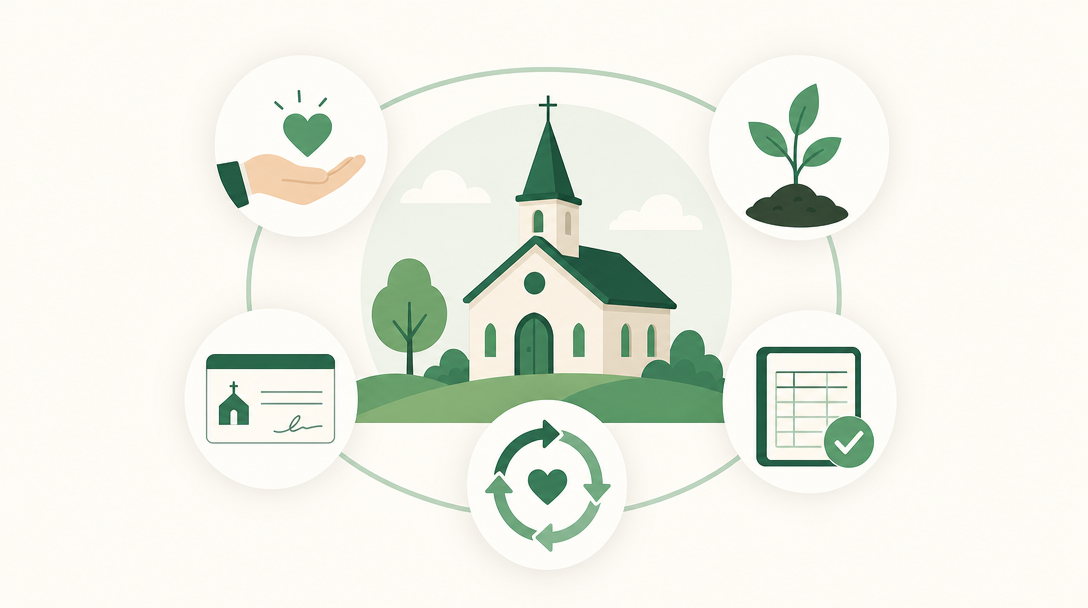
Short answer: Church stewardship is teaching and cultivating generous, faithful giving as part of discipleship — the conviction that everything we have belongs to God and we manage it on his behalf. It is not the same thing as a fundraiser. A fundraiser asks for money to hit a number; stewardship forms people over time so that giving flows from a changed heart. The practical shape of it is an annual stewardship campaign (a theme, teaching, testimonies, estimate-of-giving cards, a commitment Sunday, and follow-up), a year-round culture of generosity, and — underneath all of it — the trust that comes from handling money well. People give when they believe their gifts are tracked honestly, used as promised, and reported back. Good books are not a side issue to stewardship; they are its foundation.
What stewardship means in the church, and how it differs from fundraising
Stewardship in the church is the practice of managing God’s resources — time, talent, and money — as a trustee rather than an owner. The word itself comes from the idea of a steward: someone who cares for what belongs to another. Applied to giving, it means teaching a congregation that their generosity is a spiritual response, an act of worship and discipleship, not a membership fee or a bill for services. As the Lake Institute on Faith & Giving frames it, stewardship touches every aspect of life, and increased giving flows from a stewardship way of living rather than being the point of it.
That is the line that separates stewardship from fundraising. A fundraiser is a transaction aimed at a target — raise $40,000 for the roof. Stewardship is formation aimed at a person — help this family grow into joyful, intentional generosity over years. The two overlap in method (both use letters, testimonies, and asks), but they differ in goal. The danger, as ministry practitioners warn, is that when “stewardship” quietly becomes a code word for the annual money drive — mentioned only during the fall campaign — people tune it out. Stewardship done well moves givers “from obligation to opportunity,” and it is preached and lived year-round, not switched on when the budget is short.
Here is the practical difference, side by side:
| Fundraiser | Stewardship | |
|---|---|---|
| Goal | Hit a dollar target | Form generous disciples |
| Timeframe | One push | Year-round, lifelong |
| Frame | ”We need money" | "God has given; how do we respond?” |
| Success measured by | Amount raised | Changed hearts and habits (giving follows) |
| What it asks for | A gift | A practice |
Both have a place — a church can absolutely run a targeted church capital campaign for a building without contradicting its stewardship theology. But the capital campaign sits inside a culture of stewardship, not the other way around.
How to run an annual stewardship campaign
An annual stewardship campaign is the seasonal, concentrated expression of a year-round conviction. Most churches run one in the fall to set the ministry budget for the coming year, and — done well — it takes real planning. The Lewis Center for Church Leadership notes that a thoughtful campaign runs about five to six months end to end (or three if you sprint), with time on the front for planning and on the back for follow-up and thank-yous. Think of it as a season, not a Sunday.
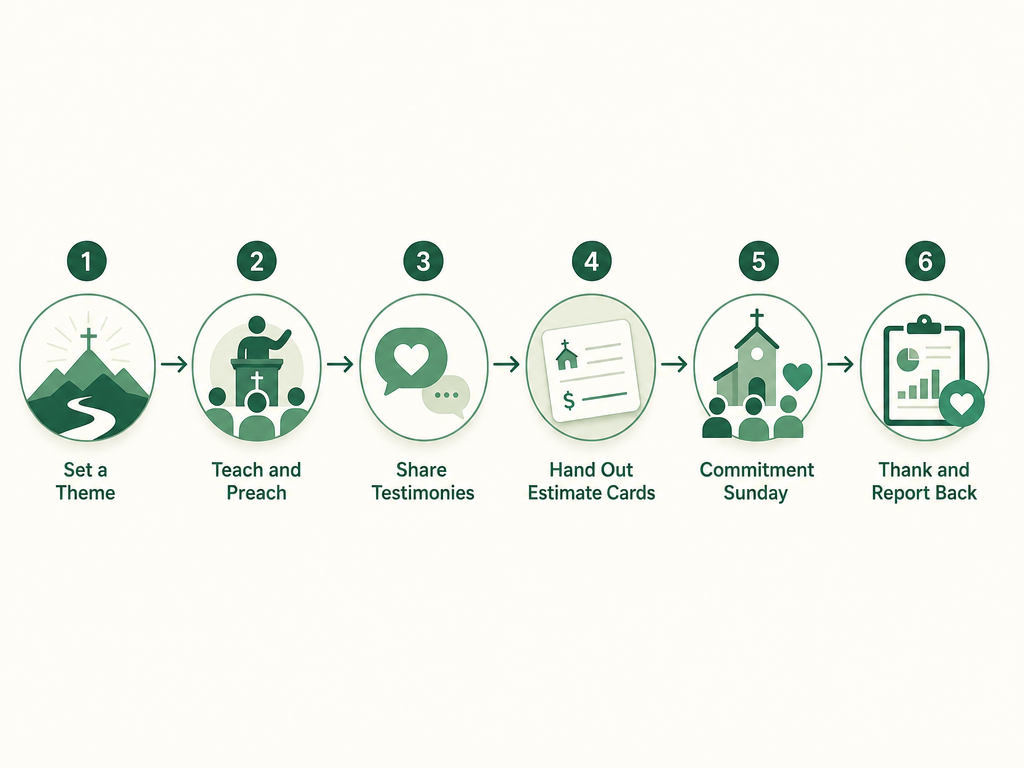
The steps that make up a campaign:
- Set a theme. A short, memorable frame (“Rooted and Growing,” “All Belongs to God”) that ties the season to Scripture and gives every letter, sermon, and card a common thread. The theme should be about generosity and mission, not the shortfall.
- Teach and preach it. Devote a few weeks of preaching, small-group study, and prayer to what the Bible says about money and generosity. This is the discipleship core — the part that makes it stewardship and not a fund drive.
- Share testimonies. Have real members tell, briefly, why they give and what generosity has done in their lives. The Lewis Center recommends a stewardship testimony for the three weeks leading up to and including commitment Sunday. Nothing teaches generosity like a peer’s honest story.
- Hand out estimate-of-giving cards. These are pledge cards — a faithful estimate, as Episcopal parishes put it, of what a household intends to give in the coming year. A pledge is an estimate to help the church budget, not a legal or moral obligation, and it can be changed anytime circumstances change. Framing it that way lowers anxiety and raises participation.
- Hold a commitment Sunday. A single celebratory Sunday when members return their cards — often by coming forward and placing them in a basket, treating it as a joyful act of worship rather than a collection. Mail the cards, brochure, and pastor’s letter a couple of weeks ahead so people arrive ready.
- Follow up and report back. Commitment Sunday is the beginning of the follow-up period, not the end. Send prompt thank-yous to everyone who pledged, gently invite those who haven’t, and then — through the year — report how the gifts were used. This is where the loop closes and next year’s trust is built.
Building a culture of year-round generosity
The healthiest churches don’t limit generosity to one month a year — they build it into the ordinary life of the congregation. That means teaching about money more than once, celebrating generosity when you see it, and giving people easy, dignified ways to respond whenever the Spirit prompts them rather than only on commitment Sunday. When generosity is only ever mentioned during the fall drive, people reasonably conclude the church is talking about generosity because it needs cash. When it’s woven into discipleship year-round, giving becomes a settled habit rather than a seasonal appeal.
A year-round culture also means thinking about giving as a habit to enable, not just a decision to prompt. That’s where the mechanics of giving start to matter — and where recurring, online giving becomes a genuine stewardship tool rather than a mere convenience.
Recurring and online giving as a stewardship tool
Recurring and online giving turn a one-time decision to be generous into a sustained, consistent practice — which is exactly what stewardship is trying to form. The behavior data backs this up. Donors enrolled in recurring giving contribute meaningfully more than one-time givers, and automatic recurring gifts have become a large and growing share of church income — industry reporting shows automatic recurring donations now make up a substantial and rising portion of transactions and dollars. Preference has shifted too: a majority of church donors now prefer to give electronically, and most churchgoers say being able to give online matters to them. For the fuller picture of how giving behavior is changing, see our roundup of church giving statistics.
The stewardship logic is simple: a member who sets up a modest weekly recurring gift has decided in advance to be generous, and then keeps that commitment even on the Sundays they travel, are sick, or forget their checkbook. Consistency isn’t just good for the budget — it’s the outward shape of a formed, faithful heart. Offering recurring and online options is a way of removing friction from a good habit.
One caution worth naming: many giving platforms take a percentage cut of every gift, so a slice of each family’s generosity never reaches the ministry. Vestrybooks offers online giving with no platform cut — the whole gift goes to the church — because a stewardship tool shouldn’t quietly tax the very generosity it’s meant to encourage.
Transparency and trust: the real foundation of giving
People give when they trust that the money is handled well — this is the quiet foundation under every campaign, and it’s the part churches most often neglect. The research is blunt about it. Nonprofits that share financial information openly earn markedly more: an analysis of more than 6,300 organizations found that those demonstrating transparency averaged 53% more in contributions the following year. Academic work confirms the mechanism — there is a strong positive relationship between donors’ perception of financial transparency and their trust in the organization, and trust is what convinces people a gift is legitimate and safe to make.
For a church, transparency is not a marketing gloss — it’s a stewardship duty and a trust-builder. Concretely, it looks like:
- Clean, current books that can show, at any time, what came in and where it went.
- Regular financial reporting to the congregation — a plain-language summary of income, spending, and fund balances that a non-accountant can follow.
- Honest oversight — more than one set of eyes on the money, so no single person controls it end to end, and a board that reviews the numbers.
- Reporting back on the campaign — closing the loop by showing members that the ministry they pledged toward actually happened.
This is the point where stewardship theology meets the ledger. A congregation that can see its money is handled with care gives more freely; a congregation that suspects sloppiness or secrecy holds back, no matter how good the sermon. Bookkeeping, in other words, is a spiritual issue.
The money side of stewardship: pledges, thank-yous, and year-end statements
The back-office work of stewardship — tracking pledges, thanking givers, and issuing year-end statements — is what makes a campaign trustworthy rather than just inspiring. Four tasks carry the load:
- Track estimates of giving. Record each household’s pledge and compare giving against it through the year, so the finance team can budget realistically and follow up gently with anyone whose circumstances seem to have changed. This isn’t surveillance; it’s care and planning.
- Thank givers promptly and specifically. A fast, warm acknowledgment after commitment Sunday — and again when recurring gifts arrive — is both good manners and good stewardship. Gratitude is part of the discipleship, not an afterthought.
- Issue year-end contribution statements. Every giver needs an accurate annual statement for their own taxes, and the IRS has specific rules about what those statements must contain — see church contribution statement requirements for the details on the $250 threshold and the “no goods or services” language. Getting these right, on time, is one of the plainest signals that a church takes its givers seriously.
- Report how gifts were used. Show the congregation, in plain terms, that the money they gave toward missions actually went to missions and the building fund actually reduced the mortgage. This closes the trust loop and quietly funds next year’s generosity.
Every one of these is a bookkeeping task, and every one of them either builds trust or erodes it depending on how well it’s done. A stewardship campaign can have a beautiful theme and moving testimonies, but if the thank-yous are late and the year-end statements are wrong, the trust leaks out the bottom.
This is exactly the gap Vestrybooks is built to close. Trustworthy books on true fund accounting, giving records tied to each donor, online giving with no platform cut, and one-click year-end contribution statements — the January Button — give a treasurer the clear, honest financial picture that a culture of stewardship rests on. Stewardship is about hearts; the books are how you keep faith with the hearts that respond.
Stewardship also isn’t the only way churches raise support, and the broader menu of approaches — from seasonal appeals to events to matching gifts — sits alongside it. For the wider view, see our guide to church fundraising ideas, of which a stewardship campaign is the disciplined, discipleship-centered core.
FAQ
What is stewardship in the church? Stewardship in the church is the practice of managing everything God has given — time, talent, and money — as a trustee rather than an owner, and teaching the congregation to give generously as an act of worship and discipleship. It’s broader than money and broader than any one campaign: it’s the conviction that all we have belongs to God and we’re responsible for using it faithfully. Financial giving is one expression of it, and healthy churches teach it year-round rather than only during a fall drive.
How is stewardship different from fundraising? Fundraising aims at a dollar target and is usually a one-time push; stewardship aims at forming generous people over a lifetime, and giving follows as a byproduct. A fundraiser says “we need money for the roof.” Stewardship says “God has been generous with us; how will we respond?” Both use similar tools — letters, testimonies, asks — but the goal differs. When stewardship collapses into “the annual money drive,” people tune out; kept as discipleship, it changes hearts and the giving follows.
How do you run a stewardship campaign? Run it as a season, not a Sunday. Set a Scripture-rooted theme, spend a few weeks teaching and preaching on generosity, share real members’ testimonies, hand out estimate-of-giving (pledge) cards, and hold a celebratory commitment Sunday where households return their cards. Then follow up: thank every giver promptly, gently invite those who haven’t pledged, and report through the year on how the gifts were used. A thorough campaign takes about five to six months end to end, with planning up front and follow-up on the back.
What is an estimate-of-giving card? An estimate-of-giving card (also called a pledge or commitment card) is a household’s faithful estimate of what they intend to give in the coming year. It helps the church build a realistic budget, but it isn’t a legal or moral contract — a giver can raise or lower it anytime their circumstances change. Framing it as an estimate rather than a binding promise lowers anxiety and tends to raise participation.
Does financial transparency actually increase giving? Yes. Nonprofits that openly share financial information have been found to receive markedly more in contributions — one large study put it at about 53% more the following year — and research consistently links perceived financial transparency to donor trust. For churches, that means clean books, plain-language reports to the congregation, honest oversight, and reporting back on how gifts were used aren’t just good practice; they measurably strengthen giving.
This article is general information, not tax or legal advice. For questions about your church’s specific situation — including the requirements for contribution statements — consult a qualified accountant or attorney.
Vestrybooks gives a volunteer treasurer trustworthy books, clear giving records, free online giving with no platform cut, and one-click year-end statements — the financial trust that a culture of stewardship is built on. See how it works.
This article is general information for church treasurers, not professional tax or legal advice. For your church's situation, consult a qualified accountant or attorney.
Church accounting a volunteer can actually do.
Vestrybooks is church accounting + giving for the volunteer treasurer — fund tracking, one-click year-end statements, and online giving with $0 taken from every gift.
A real free plan · no credit card · your data stays yours