Blog · Fundraising & giving
Grants for churches: what you can actually get
July 4, 2026 · By Benjamin Reinke
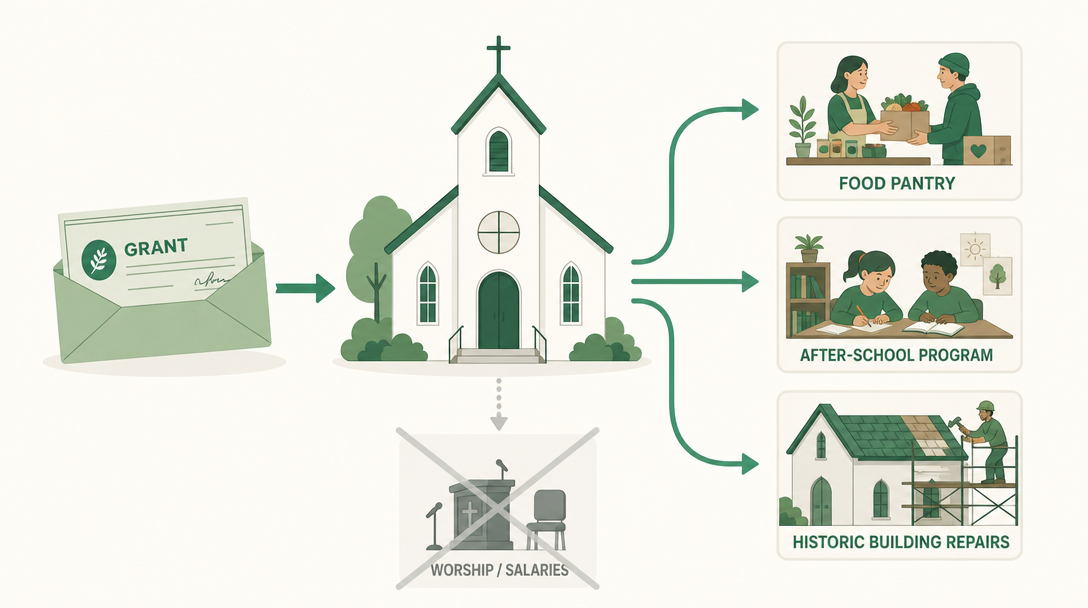
Short answer: Most grants won’t fund the church itself. Foundations rarely pay for worship, evangelism, or a pastor’s salary, and federal money legally can’t fund religious activity at all (the Establishment Clause). What churches can win grants for is the community services they run — a food pantry, an after-school program, disaster relief, addiction recovery, or repairs to a historic building. So the realistic path is: identify a genuine community program, prove it serves the public (not just members), get your 501(c)(3) house in order, write a clear proposal with a budget and measurable outcomes, and then — because a grant is restricted money — track it in its own fund and report back to the funder. Do that last part well and you win the next grant too.
The hard truth: a grant rarely funds “running the church”
Let’s start where most articles won’t. If you’re hoping a grant will cover your pastor’s salary, your Sunday worship, or your outreach evangelism, you’re almost certainly going to be disappointed. This isn’t a technicality — it’s built into how grants work, from two directions.
Private foundations generally steer clear of funding religious activity. Their mission statements point at education, hunger, housing, health, the arts — public goods in secular terms. A foundation funding “worship” or “discipleship” isn’t advancing a broad public purpose the way its charter usually requires, so most won’t. There are exceptions (denominational and faith-focused funders, below), but the default is: foundations fund programs that serve the community, not the spiritual life of a congregation.
Government grants go further — they legally can’t fund religious activity. Under the Establishment Clause of the First Amendment, you cannot use any part of a direct federal grant to fund religious worship, instruction, or proselytization; government money may support only the non-religious social services an organization provides (HHS). A faith-based group that takes direct government funds must separate its religious activities — in time or place — from the funded services. Recent Supreme Court cases (like Trinity Lutheran v. Comer) say a church can’t be excluded from a neutral public benefit just for being a church (Legal Information Institute) — but that’s equal access to fund a secular purpose, not permission to fund worship.
So the honest headline: a church rarely gets a grant to be a church. It gets grants for the good it does outside the sanctuary.
What churches actually win grants for
Reframe the question and the money appears. Funders don’t fund “First Baptist”; they fund what First Baptist does for its town. Churches routinely win grants for:
- Food pantries, soup kitchens, and clothing closets — the most fundable church program there is, because hunger is measurable and non-religious.
- After-school and youth programs — tutoring, childcare, mentoring, summer programs.
- Disaster relief and emergency assistance — shelter, rebuilding, utility and rent help.
- Addiction recovery and mental-health support — recovery groups, counseling space, sober-living support.
- Community development — job training, financial literacy, immigrant and refugee services.
- Historic-building preservation — capital repairs to an architecturally or historically significant church building (more below).
The pattern: describe the outcome for the community, in plain secular terms. “Serving 200 families a month through our food pantry” is fundable. “Outreach ministry” is not — same program, wrong framing. As one funder guide puts it bluntly, emphasize measurable community impact over religious activity, and frame the pantry as families served rather than ministry (REACHRIGHT).
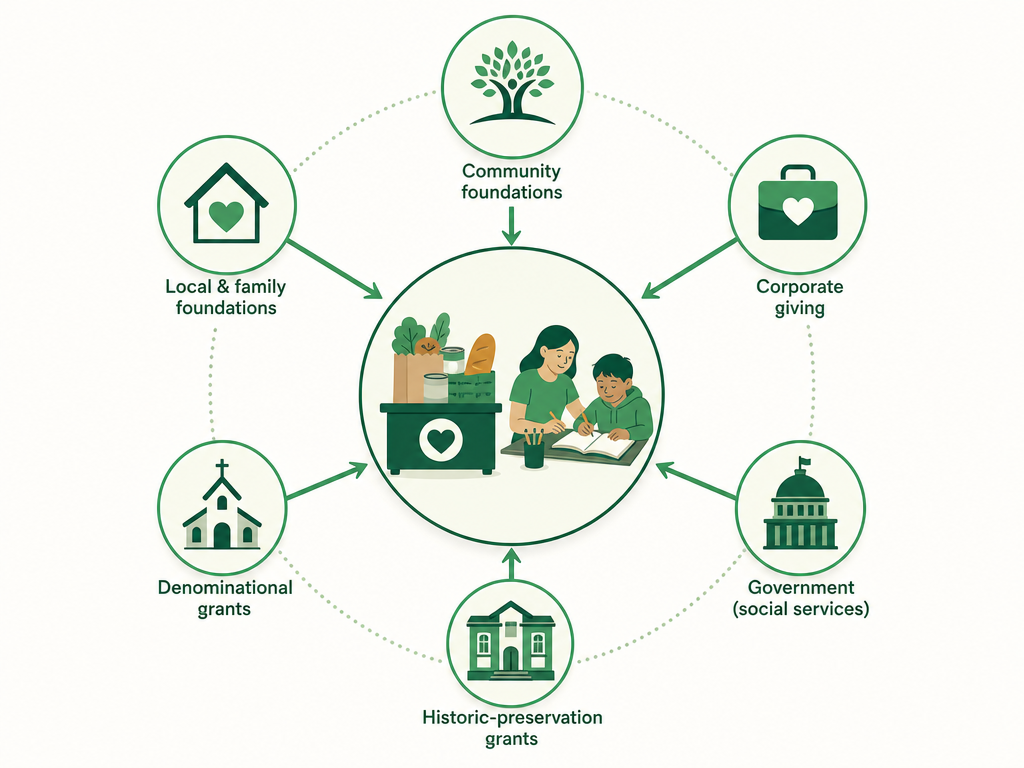
The realistic grant sources for a church
Community foundations (start here)
A community foundation pools donations from local families and businesses and regrants the money to nonprofits in one city or county. They are the single best starting point for a small church, because they fund local work and they know your area. They tend to favor organizations with a 501(c)(3) and a track record, and they love to see churches collaborate with schools, food banks, and social-service agencies (Zeffy). Search “[your county] community foundation” and read their grant guidelines — you’ll usually find a modest ($1,000–$25,000) program grant your food pantry or youth program can fit.
Local and family foundations
Below the big national names sit thousands of small family and local foundations giving in one region for causes the founding family cared about — youth, hunger, the elderly, education. They’re less competitive than national funders and more likely to fund a neighborhood program from a church they recognize. Foundation directories (many public libraries offer free access to Candid’s Foundation Directory) let you search by geography and cause.
Corporate giving programs
Large employers run corporate giving and store-level grant programs, often for exactly the community services churches run. Walmart’s Spark Good Local Grants, for example, explicitly lists food pantries, soup kitchens, and clothing closets run by faith-based organizations as eligible when the project benefits the community at large (Walmart.org). Grocery chains, banks, and utilities frequently have similar local-giving pages. These grants are smaller but far easier to win than a national foundation grant.
Denominational and faith-focused grants
Here’s the exception to “foundations won’t fund religion.” Some funders exist specifically to strengthen congregations. The Lilly Endowment has poured money into congregational life — its Thriving Congregations Initiative alone approved grants to 104 organizations, ranging from $250,000 to $1.25 million each and totaling more than $115 million (Lilly Endowment). Most of that flows through denominations, seminaries, and regional networks rather than directly to a single small church, so the practical move is to ask your own denomination — many hold grant funds, revolving loans, and new-church support that individual congregations can apply for. Your regional judicatory (diocese, presbytery, conference, association) is the first call.
Government grants — usually via careful program design
Government social-service money (federal, state, and local) is real and large, but it comes with the Establishment Clause strings above and heavy compliance. Two ways churches access it: (1) design a genuinely secular program with religious activity kept separate in time and place, and apply directly; or (2) spin the program into its own separate 501(c)(3) — a “friends of” or standalone nonprofit — that runs the service and takes the grant, keeping the church’s worship life at arm’s length. The separate-entity route is common for larger programs because it cleanly resolves the church/state line. Federal opportunities are searchable at Grants.gov.
Historic-preservation grants for old church buildings
If your building is genuinely old or architecturally significant, its bricks may be fundable even when its worship isn’t. The National Fund for Sacred Places (a program of Partners for Sacred Places with the National Trust for Historic Preservation) gives matching grants of $50,000 to $500,000 to congregations doing major capital projects on historic houses of worship, and has awarded or pledged over $33 million to 168 community-serving congregations across 28 faith traditions (National Trust for Historic Preservation). Note the requirements that recur in this category: a 1:1 cash match and a demonstrated role as a community-serving building, not just a place of worship. State historic-preservation offices and local landmark programs often have smaller versions.
What funders require before they’ll fund you
Grantmakers screen hard, because they answer to their own boards and the IRS. Before you write a word of proposal, get these in order.
501(c)(3) recognition — and the church wrinkle
Almost every foundation and government grant requires the applicant to be a recognized 501(c)(3), which for most nonprofits means an IRS determination letter. Churches are the odd case: a church is automatically tax-exempt under 501(c)(3) without filing Form 1023 or holding a letter — the full explanation is in are churches tax exempt. But “automatically exempt” and “can prove it to a funder” are different things. Many grantmakers’ portals require you to upload a determination letter and have no box for “exempt without one.” So a church that plans to seek grants often files for the optional letter anyway — $275 (Form 1023-EZ) or $600 (full 1023) — because it’s the paperwork that lets a funder tick the eligibility box. Without a 501(c)(3) ruling on file, many churches simply can’t receive foundation or government money (REACHRIGHT).
A clear, secular program with real outcomes
Funders fund programs, not organizations. You need a defined program (the food pantry, the tutoring center), described in secular terms, with a statement of need grounded in local data — county-level hunger, poverty, or education numbers from the Census or your state agency, not “our town has needs” (OpenGrants). You need measurable outcomes: not “we’ll help families” but “150 families receive weekly groceries; 40 students raise their reading level by one grade.” The distinction between an output (“delivered 200 sessions”) and an outcome (“reading scores rose”) is where reviewers separate serious applicants from vague ones (Instrumentl).
A budget and clean books
Every grant wants a budget — the program’s costs, line by line, with each line tied to an activity. And increasingly, funders want evidence you can manage money: prior financials, and the ability to track and report on their grant separately. This is where a church’s everyday bookkeeping quietly becomes a grant qualification. A funder who sees organized church fund accounting — clean funds, real reports — trusts you with their money. A shoebox of receipts is a decline.
How to write a basic grant proposal
You don’t need a professional grant writer for a small local grant. A basic proposal is a handful of sections a clear-eyed treasurer or volunteer can write:
- Cover / summary — who you are, what you’re asking for, and what it accomplishes, in a paragraph.
- Statement of need — the problem, quantified with local data. This section wins or loses proposals; use recent, credible, local numbers (OpenGrants).
- Program description — exactly what you’ll do, for whom, and how. Secular framing throughout.
- Goals and measurable outcomes — SMART outcomes with a way to measure each one. Separate outputs (how much) from outcomes (what changed).
- Budget — every cost line, mapped to an activity, plus how the grant fits your total program cost.
- Organization and capacity — your track record, partners (schools, food banks), and evidence you can manage the money (your books, your 501(c)(3)).
Write to the funder’s rubric, not to your mission — find how they score applications and spend your words where the points are. And match the ask to the funder: a $2,000 corporate local grant and a $200,000 preservation grant are different documents. For the wider menu of ways a church raises money beyond grants, see the guide to church fundraising ideas — grants are one lever among many, and rarely the biggest.
A grant is restricted money — track it or lose the next one
Here’s the part that ties a grant back to your books, and the part that decides whether you ever win a second grant. When a funder gives you $20,000 “for the food pantry,” that money is restricted — you are legally and ethically bound to spend it on the pantry, on the timeline and budget you promised, and to report back that you did. It is not general operating money you can borrow from to cover the electric bill.
The way you honor that promise is fund accounting: the grant gets its own fund, every related expense is tagged to it, the balance draws down as you spend, and at report time you pull the numbers straight off your books instead of reconstructing a year of activity from memory. The bookkeeping mechanics — conditional vs. unconditional grants, releasing the restriction as you spend, and the funder report itself — are covered end to end in grant accounting. That post owns the “money you already have” side; this one owns getting it in the door.
Why it matters for the next grant: funders talk to each other, and every grant ends with a report. A clean report that shows the money went exactly where promised is the single best application you can submit for your next grant. A messy one — or worse, a grant accidentally spent on the wrong thing — closes doors quietly and permanently. Grant compliance isn’t paperwork nicety; spending restricted money on the wrong thing can trigger a demand to repay it and the loss of all future funding.
Vestrybooks makes the tracking the easy path: open a fund for the grant, tag each expense to it, and watch the balance release as you spend — so your report to the funder is basically written by the time they ask for it.
FAQ
Can a church get a grant? Yes — but usually not to fund the church itself. Foundations rarely fund worship, evangelism, or salaries, and government grants legally can’t fund religious activity at all. What a church can win grants for is the community services it runs: food pantries, after-school programs, disaster relief, addiction recovery, community development, and repairs to a historic building. The trick is describing the program in secular, outcome-focused terms (“families served”), holding a 501(c)(3) ruling, and applying to funders that support that kind of work.
What grants are available for churches? Community-foundation grants (local, the best starting point), small family and local foundation grants, corporate giving programs (some explicitly list church-run food pantries and clothing closets), denominational and faith-focused grants (your own denomination plus funders like the Lilly Endowment, mostly flowing through networks), government social-service grants (via careful program design or a separate 501(c)(3)), and historic-preservation grants for old church buildings (such as the National Fund for Sacred Places, matching grants of $50,000–$500,000). All of them fund community programs, not the church’s worship or operating budget.
How do you get a grant for a church? Identify a genuine community program (not a religious activity), get your 501(c)(3) recognition in order, then research funders whose mission matches that program — start with your local community foundation and your denomination. Write a proposal with a data-backed statement of need, a clear program description, measurable outcomes, and a real budget, and write it to the funder’s scoring rubric. Then, once you win, track the grant as its own restricted fund and report back cleanly — that report is what wins your next grant.
Can a church get a government grant? Sometimes, with limits. A direct federal grant cannot fund religious worship, instruction, or proselytization; it can only support non-religious social services, kept separate from religious activity in time or place. Churches access government money by designing a clearly secular program with worship kept separate, or by running the service through a separate 501(c)(3). A church also can’t be excluded from a neutral public benefit just for being religious — but that’s equal access to fund a secular purpose, not permission to fund ministry.
Do you need a 501(c)(3) to apply for grants? For almost all foundation and government grants, yes — the applicant must be a recognized 501(c)(3). Churches are automatically tax-exempt without an IRS determination letter, but many grant portals require you to upload one anyway, so churches that plan to seek grants often file for the optional determination letter (Form 1023-EZ at $275, or the full 1023 at $600) just to satisfy funders’ eligibility systems.
This is general information, not tax or legal advice. Grant eligibility, church/state rules, and 501(c)(3) requirements are genuinely fact-specific — confirm your setup with a qualified attorney or CPA.
Vestrybooks gives your church fund accounting that keeps every grant separate, clean reports funders trust, and free online giving with no platform cut — so winning a grant and proving you spent it right are the same easy job. See how it works.
This article is general information for church treasurers, not professional tax or legal advice. For your church's situation, consult a qualified accountant or attorney.
Church accounting a volunteer can actually do.
Vestrybooks is church accounting + giving for the volunteer treasurer — fund tracking, one-click year-end statements, and online giving with $0 taken from every gift.
A real free plan · no credit card · your data stays yours