Blog · Contributions & statements
How church contribution statements work
June 25, 2026 · Updated June 26, 2026 · By Benjamin Reinke

Short answer: A church contribution statement is the written record a church gives each donor listing their gifts for the year and confirming that no goods or services were provided in exchange (other than intangible religious benefits). The IRS requires a contemporaneous written acknowledgment for any single gift of $250 or more, and a separate disclosure for quid-pro-quo gifts over $75. Most churches send one year-end statement that covers all of it by January 31. Here’s exactly what to include, the language to use, and how to make it painless — or start from our free church donation letter template, which already has the required wording. (To acknowledge a single gift instead of the whole year, use a donation receipt template.)
What a church contribution statement is
A church contribution statement — also called a year-end giving statement or donation receipt — is the document a donor relies on to substantiate a charitable deduction. It pulls together every gift a person gave the church — their tithes and offerings — during the year, states the total, and carries the specific IRS language that makes those gifts deductible. The church produces it; the donor keeps it with their tax records. Done well, one statement per donor satisfies the IRS rules for the entire year. And with giving increasingly digital — see the latest church giving statistics — most of those gifts are already recorded the moment they arrive by church donation tracking software, so the statement mostly builds itself.
What the IRS requires on a contribution statement
For any single contribution of $250 or more, a donor cannot claim a deduction unless they hold a contemporaneous written acknowledgment from the church (IRS: Charitable Contributions — Written Acknowledgments). That acknowledgment must state:
- The name of the church and the amount of cash contributed.
- Whether the church provided any goods or services in return for the gift.
- If the only benefit was intangible religious benefits, a statement saying so.
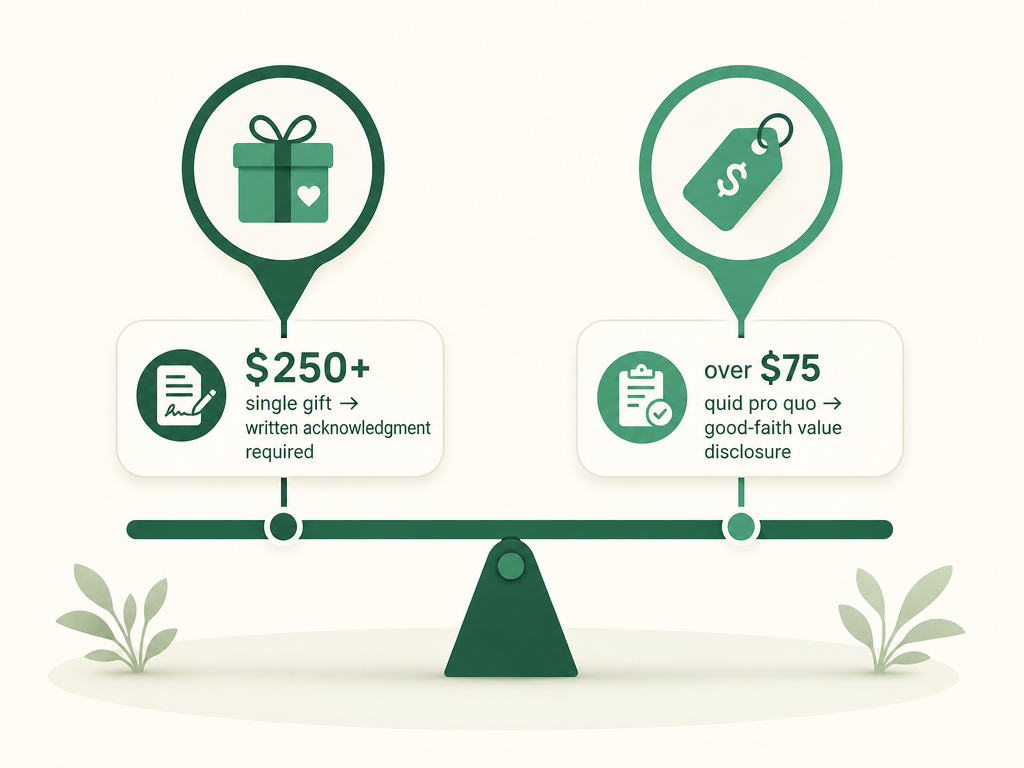
For quid-pro-quo contributions over $75 — where the donor received something of value back, like a banquet ticket or event seat — the church must provide a written disclosure with a good-faith estimate of that value, so the donor only deducts the net gift (IRS Publication 1771). “Contemporaneous” matters: the donor needs the acknowledgment in hand before they file their return.
What to include on a year-end giving statement
A compliant statement is mostly a structured list with the right closing language:
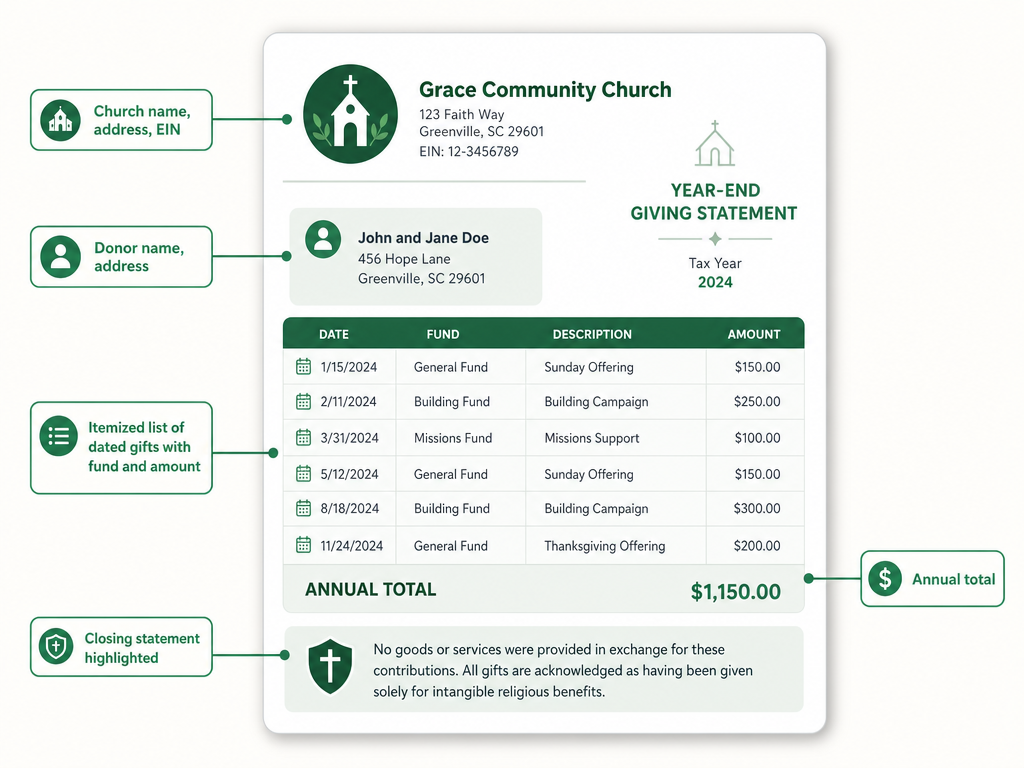
- Your church’s name, address, and EIN.
- The donor’s name and address.
- Each gift: date, fund or designation, and amount.
- The total for the year.
- The required disclaimer line (below).
- A note to retain the statement for tax records.
The exact disclaimer language to use
The line that does the legal work is the no-goods-or-services statement. For an ordinary church where donors received nothing tangible back, the standard wording is:
“No goods or services were provided in exchange for these contributions, other than intangible religious benefits.”
If a donor did receive something of value (a quid-pro-quo gift over $75), the statement instead describes that benefit and gives a good-faith estimate of its value, so the donor deducts only the difference. Getting this one sentence right is what separates a compliant statement from a list of numbers.
Whether your donors can actually deduct these gifts
Issuing a correct statement is the church’s job; deducting the gift is the donor’s, and it only helps donors who itemize. A statement makes a gift deductible, but a donor who takes the standard deduction sees no separate tax benefit from it — a distinction worth understanding, and one we cover in are church donations tax deductible. Sending accurate statements regardless is still the right move: the donors who do itemize need them, and they signal a church that handles money carefully.
How benevolence and designated gifts appear on a statement
Not every dollar that flows through the church is a deductible gift to the donor. A contribution earmarked for a specific individual — including money routed through a benevolence fund for one named person — is not a deductible charitable gift and shouldn’t be acknowledged as one. Gifts to the church’s general funds and programs, where the church controls the money, are the ones that belong on the deductible total. When in doubt, the test is whether the church or the donor decided where the money went. A clear church benevolence fund policy spells out which gifts the church controls, so the deductible total stays clean.
Are churches required to send contribution statements?
A church is not penalized for failing to send statements — the obligation is functionally on the donor, who can’t deduct a gift of $250 or more without the written acknowledgment. So while it isn’t a legal mandate on the church, every well-run church sends them, because their donors need them and asking 140 people to chase down their own giving totals is no way to run a ministry. The easiest way to keep those totals accurate is to collect gifts online in the first place — see how to add online giving to your church website so each gift records itself against the donor.
When to send church contribution statements
There’s no hard federal deadline, but the practical one is January 31, since donors start filing early in the year. Sending by then gives every donor their acknowledgment before they need it and keeps the church off anyone’s follow-up list.
The one-click way (the January Button)
In Vestrybooks, every gift a donor gives — whether you recorded it by hand or it came in through online giving — is already tracked against that donor. At year-end you click once: it generates an IRS-ready statement for every donor with the correct disclaimer language and emails them. The task that used to eat your January becomes a button.
Vestrybooks takes $0 of your online giving, and the January Button is included in the Core plan. See pricing →
FAQ
Are churches required to send contribution statements? Not under penalty — but the donor can’t deduct a gift of $250 or more without a written acknowledgment, so churches send them as a matter of course and good ones make it easy.
What is an example of a donation disclaimer? “No goods or services were provided in exchange for these contributions, other than intangible religious benefits.” If the donor received something of value over $75, the statement describes it and estimates its value instead.
Do small gifts under $250 need a receipt? The strict written-acknowledgment rule applies per single gift of $250 or more, but a year-end statement listing every gift is the standard, donor-friendly practice for all amounts.
How do donors write off church donations on their taxes? They itemize on Schedule A and keep the church’s written acknowledgment as proof; if they take the standard deduction instead, the gift doesn’t separately lower their taxes.
This guide is general information, not tax or legal advice — consult a qualified professional for your church’s situation.
This article is general information for church treasurers, not professional tax or legal advice. For your church's situation, consult a qualified accountant or attorney.
Track every gift, print statements in one click.
Vestrybooks records each gift by donor and fund, builds IRS-ready year-end statements, and takes $0 of every online gift.
A real free plan · no credit card · your data stays yours