Blog · Fundraising & giving
How to run a church capital campaign
July 4, 2026 · By Benjamin Reinke
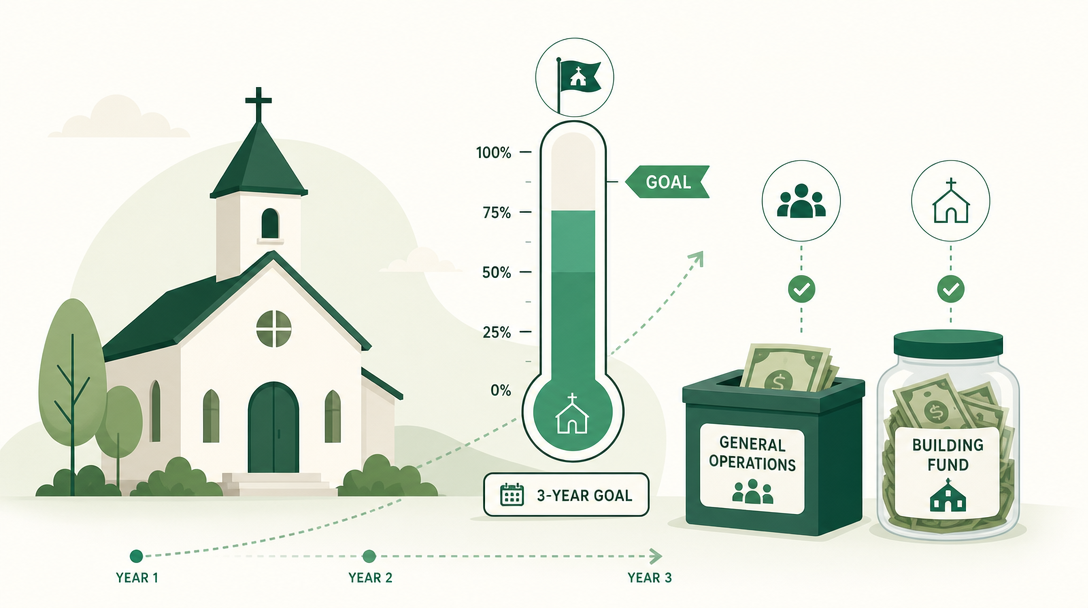
Short answer: A church capital campaign is a focused, multi-year effort to raise a large sum for one big goal — build or renovate a building, retire a mortgage, or launch a major ministry — separate from the regular offering. It runs in four phases: planning and a feasibility study, a quiet phase where a handful of lead gifts quietly cover 40–60% of the goal, a public phase for the whole congregation, and years of pledge fulfillment. Goals are usually set at two to three times the annual budget, and most of the money comes from a few large gifts, not many small ones. The part most guides skip is the money side: capital-campaign gifts are almost always donor-restricted, so they must live in their own fund, be reported separately, and never be spent on operations.
What a church capital campaign is and when a church needs one
A capital campaign is a one-time, time-limited push to raise major money for a specific capital goal — something too big for the weekly offering to cover. That usually means a building project (new construction, an addition, a renovation), retiring debt on property the church already owns, or funding a large new ministry or endowment. It sits on top of the regular budget, not inside it: people keep giving their normal tithes and offerings and make a separate, above-and-beyond commitment to the campaign, typically paid over three to five years.
A church needs one when the vision is bigger than cash flow. If the roof is failing, the congregation has outgrown the sanctuary, or the mortgage is eating the ministry budget, you can’t get there $50 at a time in the plate. A capital campaign concentrates the whole congregation’s generosity on a single goal over a defined window, then ends. It is a project with a start and a finish — not a permanent fundraising program. Deciding whether the project is even worth it is a budgeting question first; walk the numbers in your church budget before you launch anything.
The four phases of a church capital campaign
Nearly every successful campaign moves through the same four phases, and the order matters. The most common mistake churches make is going public too early — announcing a goal on a Sunday before a single lead gift is committed, then watching the momentum stall.
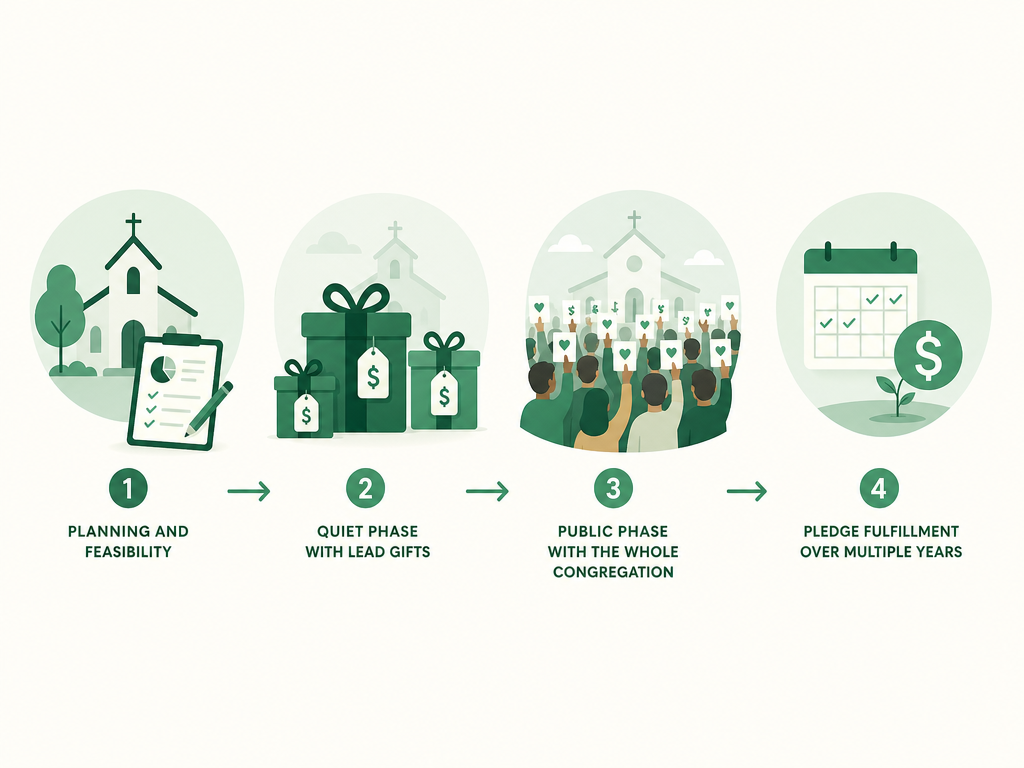
| Phase | What happens | Roughly how long |
|---|---|---|
| 1. Planning & feasibility | Define the project and cost, then run a confidential feasibility study — one-on-one interviews with key members to test the vision, gauge giving capacity, and set a realistic goal. | 2–4 months |
| 2. Quiet phase (lead gifts) | Private conversations with the families most able to give at the top. Around 40–60% of the goal is secured here before any public announcement. | 3–6 months |
| 3. Public phase | The whole congregation is invited in through a launch Sunday, testimonies, and a clear call to commit. Everyone makes a pledge. | 4–8 weeks |
| 4. Pledge fulfillment | Donors pay their commitments over the pledge period (usually 3 years). The church tracks, reminds, and reports. | 3–5 years |
The feasibility study is the phase churches most want to skip and most regret skipping. It’s a confidential assessment — typically 30–60 minute one-on-one interviews conducted by a trusted third party — that answers whether the church is actually ready, what goal is realistic, and where the resistance is (Ascend Stewardship). People tell an outside interviewer what they’d never say in a board meeting. Set the goal after this study, not before.
The quiet phase and the lead-gift reality
Here is the single most important fact about capital campaigns, and it surprises almost everyone: the money comes from a few people, not from everyone. The old rule of thumb was that 80% of the money comes from 20% of the donors. In modern campaigns it’s even more concentrated — the top handful of gifts often cover the majority of the goal.
That’s why the campaign starts quietly. Before anything is announced publicly, leaders sit down privately with the families who have the greatest capacity, and they secure the lead gifts first. Typically 40–60% of the goal is committed during this quiet phase before the congregation hears a number (Steier Group). The reason is momentum: when the church finally announces “we’re raising $600,000 — and $300,000 is already committed,” people believe it’s achievable and give accordingly.
Fundraisers plan this with a gift range chart. It starts with a single lead gift — usually at least 20% of the total goal, sometimes 30% or more for a church with a smaller donor base — then works down in levels, each roughly half the size of the one above and needing two or three times as many donors (Capital Campaign Pro). A $600,000 campaign might need one gift of $120,000, two of $60,000, and so on down to the many $500 and $1,000 gifts at the base. The chart tells you exactly how many gifts at each size you need — so you stop hoping and start asking specific people for specific amounts.
How much a church capital campaign should raise
Set the goal from two inputs: what the project actually costs, and what your congregation can realistically give (the number the feasibility study produces). Don’t pick a round number off the wall.
As a sizing rule of thumb, church capital-campaign goals commonly land at two to three times the annual operating budget, raised over three years — so a church with a $200,000 budget might target a $400,000–$600,000 campaign. That’s a starting frame, not a law; a wealthy congregation can go higher and a young one should go lower. The feasibility study is what turns the guess into a defensible number. And build the cost of running the campaign into the goal — a common benchmark is that campaign expenses run about 5–10% of the goal (Capital Campaign Pro), so if you need $600,000 for the building, you may need to raise a bit more to cover the campaign itself.
One more sizing input: the campaign shouldn’t cannibalize the regular offering. A healthy church culture of year-round generosity — the kind church stewardship is meant to build — is what makes a campaign possible in the first place. If weekly giving is already shaky, fix that before you launch a three-year ask.
Pledges vs. cash: tracking multi-year commitments
Most capital-campaign money doesn’t arrive as cash on launch Sunday. It arrives as pledges — written commitments to give a total amount over a period, usually three years, paid monthly or annually. This is the engine of a campaign: a family that could never write a $18,000 check can comfortably commit $500 a month for three years. Pledges let ordinary givers make extraordinary gifts.
That creates a tracking problem the weekly offering never had. For every pledge you now have to know: the total commitment, the schedule, how much has been paid, how much remains, and who’s fallen behind. Multiply that across a whole congregation over three to five years and a spreadsheet gets fragile fast.
A few things to build in from the start:
- Keep the pledge period to 3–5 years. Three years is the common recommendation; beyond five, unpaid pledges climb sharply (Capital Campaign Pro).
- Plan for some attrition. Strong campaigns collect 80–90% of what’s pledged; conservative planners budget for 8–10% shrinkage even though well-run campaigns often lose only 2–3% (The Curtis Group). Don’t spend the last dollar of the goal before it’s in the bank.
- Track pledged separately from received. The goal thermometer everyone watches is pledged; the money you can actually spend is received. Confusing the two is how churches over-commit.
- Make it easy to pay. Recurring online giving turns a three-year pledge into an automatic monthly gift the donor never has to remember. Every dollar that arrives on autopilot is a dollar you don’t have to chase.
The accounting most capital-campaign guides skip: restricted funds
This is the part almost every fundraising guide leaves out, and it’s the part that gets churches in trouble. Capital-campaign gifts are almost always donor-restricted. When someone gives to “the building fund,” they’ve told you what that money is for, and that instruction is legally binding — you cannot spend building-fund gifts on salaries, the electric bill, or anything else, even temporarily, even if operations are tight.
That’s not a preference; it’s how restricted gifts work. And it means capital-campaign money can’t just land in the general checking balance. It has to be tracked in its own fund, with its own running balance, kept clearly separate from operating money. This is exactly what church fund accounting is built for: one bank account can hold many funds, each with its own balance, so the building fund and the general fund never blur together. When the board or a donor asks “how much is in the building fund and where did it go?”, you can answer to the dollar — instantly, not after an afternoon of untangling.
Practically: create a dedicated campaign fund before the first gift arrives, route every campaign gift and expense through it, and report on it separately every month. Do that and two hard questions become easy — are we on track to our goal? and are we honoring what donors restricted their money for? Skip it, and you risk the worst outcome in church finance: spending restricted money on the wrong thing and having to explain it to the people who trusted you.
Acknowledging gifts and the IRS rules for large gifts and pledges
Big gifts come with paperwork, and campaigns are full of big gifts. Two IRS rules matter here.
First, a pledge is not deductible — only actual payments are. A promise to give doesn’t create a deduction; the donor deducts each payment in the year they actually make it (IRS Publication 526). So a family that pledges $18,000 over three years deducts roughly $6,000 a year as they pay, not $18,000 up front. Your acknowledgments should reflect what was received each year, not what was pledged.
Second, the $250 written-acknowledgment rule applies with full force. A donor can’t deduct any single contribution of $250 or more without a written acknowledgment from the church that states the amount and whether they received anything in return (IRS Publication 1771). Nearly every capital-campaign payment clears that bar, so every one needs proper substantiation. The clean way to handle it is the same year-end giving statement you already produce — as long as the campaign fund is tracked correctly, each donor’s capital gifts flow onto their annual statement automatically alongside their regular giving. For the full documentation rules, see the contribution statement requirements.
FAQ
How much should a church capital campaign raise? Set the goal from two things: the real cost of the project and your congregation’s realistic giving capacity (which a feasibility study measures). As a sizing rule of thumb, church campaigns often target two to three times the annual operating budget raised over three years — so a $200,000-budget church might aim for $400,000–$600,000. Also build in campaign costs, commonly about 5–10% of the goal (Capital Campaign Pro). The point isn’t to pick an impressive number; it’s to pick one you can actually reach.
How long does a capital campaign last? The raising part is short — a few months of quiet-phase lead-gift conversations, then four to eight weeks of a public phase where the congregation commits. The fulfillment part is long: donors typically pay their pledges over three years (up to five). So the campaign is publicly active for well under a year, but the church collects and tracks pledges for three to five years after.
What is the quiet phase of a campaign? The quiet phase is the private, pre-public period when leaders secure the largest gifts before announcing the campaign. Around 40–60% of the goal is committed here through one-on-one conversations with the families most able to give at the top (Steier Group). Going public only after the lead gifts are in place is what gives the congregation the confidence that the goal is reachable.
Can capital-campaign money be spent on operating costs? No. Gifts given to a building fund or campaign are donor-restricted, which is legally binding — you can’t move that money to cover payroll or utilities, even temporarily. It has to be tracked in its own fund, kept separate from general operating money, and spent only on what donors gave it for. That separation is the whole reason churches use fund accounting.
Do we need a consultant to run a capital campaign? Not always, but many churches hire one, especially for the feasibility study and the gift-range strategy — the phases where an outside, trusted voice draws out honest answers and keeps the plan disciplined. A small campaign with strong internal leadership can be run in-house. Whatever you decide, don’t skip the study and don’t announce a goal before the lead gifts are lined up.
This is general information, not tax or legal advice. Restricted-gift rules and charitable-substantiation requirements have real consequences — consult a qualified accountant or attorney for your church’s specific situation.
For more ways to fund the vision, this guide is part of our roundup of church fundraising ideas. And when the pledges start coming in, Vestrybooks keeps the campaign in its own fund — separate from operations, reportable to the dollar — with free online giving (no platform cut on pledge payments) and year-end statements that pull each donor’s campaign gifts in automatically. See how it works.
This article is general information for church treasurers, not professional tax or legal advice. For your church's situation, consult a qualified accountant or attorney.
Church accounting a volunteer can actually do.
Vestrybooks is church accounting + giving for the volunteer treasurer — fund tracking, one-click year-end statements, and online giving with $0 taken from every gift.
A real free plan · no credit card · your data stays yours