Blog · Fund accounting
Can a church invest money, and how to do it prudently
June 28, 2026 · By Benjamin Reinke
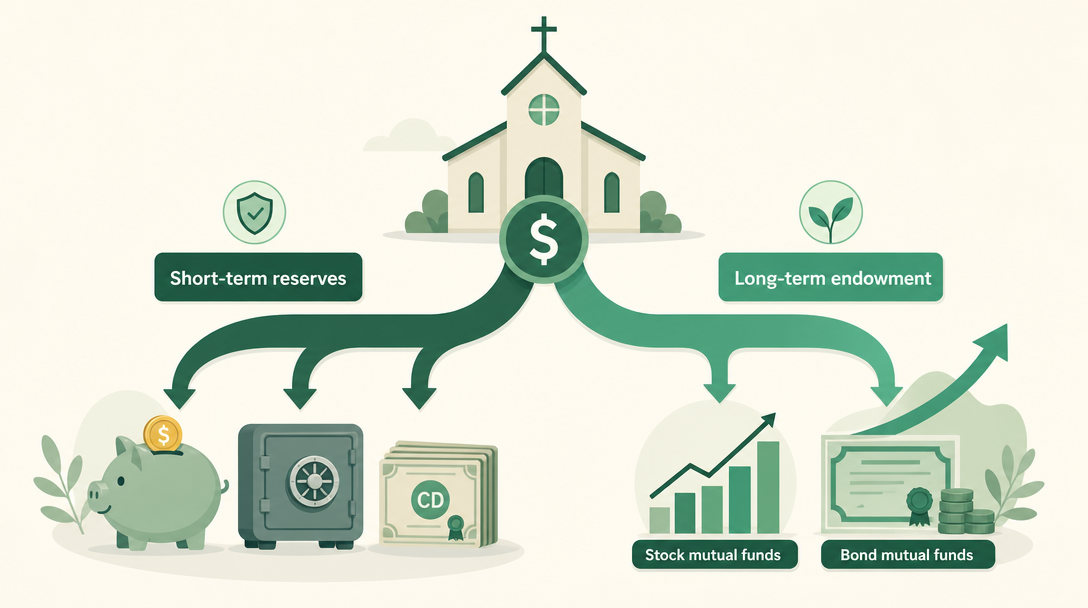
Yes — a church, as a 501(c)(3) tax-exempt organization, can legally invest its money, and most churches that hold meaningful reserves or an endowment already do. Nothing in tax-exempt status forbids a church from holding a savings account, CDs, money market funds, or a diversified portfolio of stocks and bonds. The catch is how: the money was given in trust, so a church can’t gamble it. The prudent way is to adopt a written investment policy, have the board or a finance committee oversee it, and manage the funds under the prudence standard state law already imposes on nonprofits (UPMIFA). Get those guardrails in place and investing church money is ordinary, responsible stewardship — not a legal risk.
This question sits inside the broader subject of church fund accounting — tracking money by its purpose — because what a church may do with a dollar depends on what that dollar was given for.
A church can legally invest its money as a 501(c)(3)
A 501(c)(3) church is allowed to invest its funds, and the IRS’s own guidance for churches assumes it will. Tax-exempt status is about a church’s purpose — operating exclusively for religious and charitable ends, with no earnings going to private individuals — not about keeping its cash idle in a checking account. A church that parks a six-month operating reserve in a money market fund, or invests a bequest so it can support the mission for decades, is still operating for its exempt purpose. The IRS Tax Guide for Churches and Religious Organizations (Publication 1828) lays out what jeopardizes exempt status — private benefit, political campaign activity, substantial lobbying — and prudent investing of the church’s own funds is not on that list.
What investing is not is a license to take wild risks with money people gave in good faith. A congregation’s funds are held in trust for the mission, so the duty isn’t “maximize returns” — it’s “manage prudently for what this money is for.” That duty is the whole reason the rest of this guide exists.
Where a church puts short-term reserves vs. long-term endowment money
The single most useful decision a church makes is matching each pot of money to its time horizon. Money you might need next quarter belongs somewhere safe and liquid; money you won’t touch for years can be invested for growth. Treating both the same is the common mistake — a church either leaves a decades-long endowment in a checking account earning nothing while inflation erodes it, or it puts next month’s payroll cushion into the stock market and gets caught in a downturn.
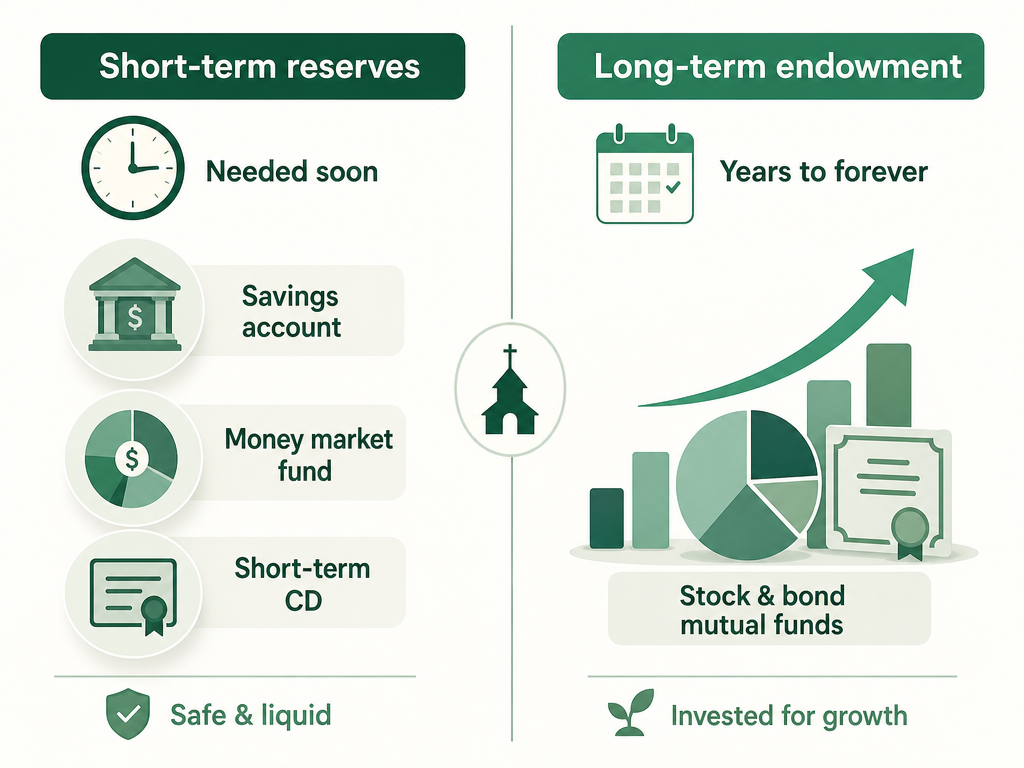
| Short-term operating reserves | Long-term / endowment money | |
|---|---|---|
| What it’s for | The cushion to cover payroll, bills, and emergencies | A bequest or fund meant to support the mission for years or in perpetuity |
| Time horizon | Months to a couple of years | Many years to forever |
| Where it usually goes | Bank savings, money market funds, short-term CDs | Diversified stocks and bonds, usually via mutual funds or a brokerage account |
| Top priority | Safety and liquidity — you can’t risk the money you’d tap in a bad quarter | Growth that outruns inflation over the long haul |
| Acceptable volatility | Very low | Higher, because the long horizon can ride out market swings |
A 6-month operating reserve and a permanent nonprofit endowment sit at opposite ends of this spectrum. The reserve is weighted almost entirely toward safety, because a 20% drop in the fund you’d use to make payroll is unacceptable. The endowment can tolerate that volatility because its horizon is measured in decades, so it leans toward growth. Naming what each fund is for is what tells the board how to invest it.
How a church invests money prudently — policy, oversight, and UPMIFA
The prudent way to invest church money rests on three things: a written policy, board-level oversight, and the legal standard of prudence that state law already sets. None of them requires an accounting degree — they require deciding the rules in advance, in daylight, instead of letting one person’s hunch move the money.
- A written investment policy. Before any money is invested, the board adopts a policy that states what each fund is for, how much risk the church will accept, the target mix of stocks, bonds, and cash, how much of an endowment may be spent each year, and who has authority to act. This turns “we trust the treasurer” into a standard anyone can be held to. The full anatomy of one is in nonprofit investment policy.
- Board or finance-committee oversight. Investing is a fiduciary act, so no single person — not the pastor, not the treasurer, not a board member with strong market opinions — should move the money alone. A finance or investment committee selects investments within the policy’s bounds and reports back to the full board; the board holds final authority and reviews performance.
- The UPMIFA prudence standard. UPMIFA — the Uniform Prudent Management of Institutional Funds Act, adopted in some form by nearly every U.S. state — is the law that governs how a nonprofit manages and spends its institutional funds. It doesn’t tell a church what to buy. It sets a standard of conduct: those responsible must act in good faith and with the care an ordinarily prudent person in a like position would use. It directs them to consider general economic conditions, inflation, expected return, the fund’s purpose, and to diversify unless there’s a good reason not to.
A church is a 501(c)(3) like any other nonprofit, so UPMIFA’s prudence standard applies to its reserves and endowment the same way it applies to a museum or a university. The body that does the overseeing might be called a vestry, a session, a board of trustees, or a finance committee — in the eyes of the law it plays the role of the board of directors and owes that same duty of prudence.
Keep donor-restricted gifts invested for their purpose
A church that invests money still has to honor what each gift was for. A bequest given “to endow the youth ministry” or a memorial gift “for the building” is a donor-restricted fund, and investing it doesn’t loosen the restriction — the money, and any return on it, stays bound to that purpose. This is where investing and fund accounting meet: the church can pool donor-restricted dollars into one invested portfolio for efficiency, but it has to track each restriction in the books so it can always show the money is being held and spent as the donor intended. How those restrictions work in the accounting is covered in restricted funds for nonprofits.
The risk to watch is spending restricted money — or its earnings — on the wrong thing because it’s all sitting in one brokerage account. Investing for growth is fine; quietly redirecting a restricted gift is a breach of donor intent, whether the money is in a checking account or a mutual fund.
How investment income is taxed for a church — and the debt-financed UBIT wrinkle
A church’s ordinary investment income is generally not taxable. Passive earnings — interest, dividends, capital gains, and most rents — that a church earns on its own investments are specifically excluded from the unrelated business income tax (UBIT), so a church does not normally pay tax on the interest from a CD, the dividends from a stock fund, or the gain when it sells an appreciated holding. This is one reason investing church reserves is so common: the return compounds without a tax drag.
The important exception is debt-financed investments. When a church borrows money to acquire an income-producing investment — taking out a loan to buy securities on margin, or buying a rental property with a mortgage — the income attributable to the borrowed portion can become debt-financed income, which is treated as unrelated business taxable income and can trigger UBIT. In other words, the passive-income exclusion protects investments the church paid for with its own money; it does not automatically protect investments bought with borrowed money. A church that invests only its own funds, with no borrowing, almost never has a UBIT problem from its portfolio. A church that borrows to invest should get tax advice first. The broader rules on when a tax-exempt organization owes tax on certain income are in unrelated business income tax.
For external financial reporting, a church that follows U.S. accounting standards reports its investments and any donor-restricted endowment under FASB ASC 958, the standard for not-for-profit entities (FASB: Not-for-Profit Entities standards).
How much a church should keep in reserve before investing for growth
A church should fund its operating reserve before it locks money up for the long term. A widely used rule of thumb is to hold roughly three to six months of operating expenses in safe, liquid reserves — enough to cover payroll, utilities, and obligations through a slow giving season or an unexpected shortfall. That cushion is the money that stays in savings, a money market fund, or short-term CDs, where it’s available and not exposed to market swings.
Only after that reserve is in place does investing for growth make sense. Locking principal into a long-term, market-exposed endowment while the church can’t cover this year’s bills is the wrong order of operations — the money does the most good keeping the lights on first. Once operations are funded and a real source of long-term money appears (often a bequest or major gift), the church can invest that longer-horizon money for growth under its policy.
FAQ
Can a church have a money market account? Yes. A church can hold a money market account or money market fund, and it’s a common place to keep operating reserves — money the church may need on short notice. Money market vehicles are designed to be safe and liquid, which is exactly what a reserve needs, and the interest a church earns on one is generally not taxable to it.
Can a church invest in mutual funds? Yes. A church can invest in mutual funds, and for most congregations that’s the practical way to hold a diversified portfolio of stocks and bonds without picking individual securities. A church typically invests longer-term or endowment money this way, under a written investment policy that sets the target mix and risk level. Dividends and capital gains the church earns from those funds are generally not taxable to it.
Can church funds be invested? Yes. Church funds can be invested, and there’s nothing in a church’s tax-exempt status that prohibits it. The prudent approach is to keep short-term reserves in safe, liquid places and invest only longer-horizon money for growth, under a board-adopted policy and UPMIFA’s prudence standard. Donor-restricted funds can be invested too, as long as they’re tracked and spent for their restricted purpose.
How much should a church keep in reserve? A common guideline is three to six months of operating expenses held in safe, liquid reserves — savings, a money market fund, or short-term CDs. The exact number depends on how steady the church’s giving is; a congregation with seasonal or lumpy income may want closer to six months, while one with very stable giving may be comfortable nearer three. Fund the reserve first, then invest longer-term money for growth.
Investing church money only works if the books behind it are trustworthy. Vestrybooks gives your board view-only access to live, reconciled finances — including restricted and endowment funds — so the money in the account always matches the policy your board adopted. See plans →
This is general information, not investment, legal, or tax advice — confirm your church’s situation with a qualified advisor.
This article is general information for church treasurers, not professional tax or legal advice. For your church's situation, consult a qualified accountant or attorney.
Track every fund the easy way.
Vestrybooks does real fund accounting in plain language — pick a fund, and restricted gifts stay separate automatically, across every account and card.
A real free plan · no credit card · your data stays yours