Blog · Fund accounting
How to build a nonprofit chart of accounts
June 27, 2026 · By Benjamin Reinke

Short answer: A nonprofit chart of accounts is the master list of every category your organization records money in, organized into five types — assets, liabilities, net assets, revenue, and expenses — and given a numbering system so every transaction has one clear home. A good one is built for two things business charts of accounts ignore: tracking money by donor restriction and fund, and allocating expenses across program, administrative, and fundraising functions so the numbers map cleanly to Form 990.
The five account types
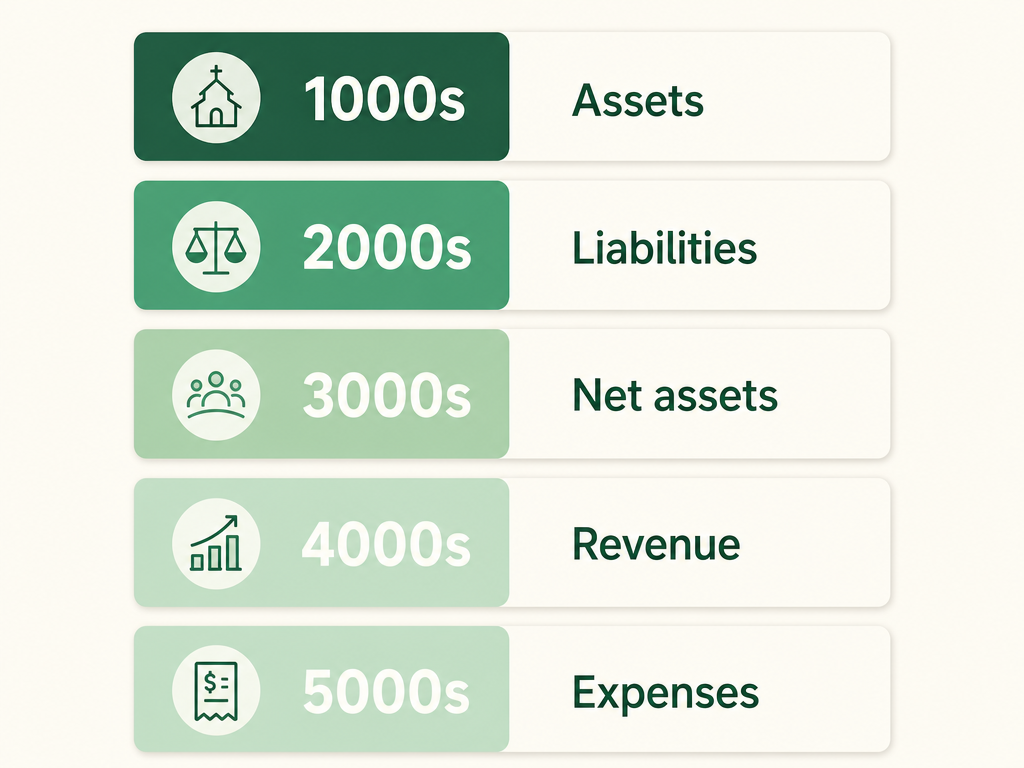
Every chart of accounts, nonprofit or not, is built from the same five types. A common convention gives each its own number range so accounts sort themselves:
| Range | Type | Examples |
|---|---|---|
| 1000s | Assets | Checking, savings, receivables, equipment |
| 2000s | Liabilities | Payroll due, loans, deferred revenue |
| 3000s | Net assets | With donor restrictions, without donor restrictions |
| 4000s | Revenue | Donations, grants, program fees, investment income |
| 5000s | Expenses | Salaries, occupancy, program costs |
What makes a nonprofit chart of accounts different
Two things separate a nonprofit chart of accounts from a business one:
- Net assets by restriction. Instead of owner’s equity, the 3000s hold net assets split into with donor restrictions and without donor restrictions — the same split that drives the financial statements.
- Functional expense allocation. Expenses need to be sortable by function — program, management and general, and fundraising — not just by type. Many nonprofits add a segment or class to each expense so the same salary can be split across functions.
This is really fund accounting in action; the full method is in the guide to church fund accounting, which applies to any nonprofit tracking restricted money.
Keep it short, and number with room to grow
The most common mistake is a chart of accounts with too many accounts. Twenty clean accounts that get used consistently beat eighty nobody maintains. Leave gaps in your numbering (1000, 1100, 1200) so you can add accounts later without renumbering. Add grant or fund segments rather than a new account for every grant — that keeps the list short while still letting you report by funder.
Mapping to Form 990 and standards
Structure your chart of accounts so it rolls up cleanly to the Form 990 most nonprofits file. Many organizations start from the Unified Chart of Accounts (UCOA), a standardized nonprofit chart designed to map directly to the 990 and audited financial statements — a useful template to adapt rather than copy wholesale. If you run a church, the church chart of accounts guide has a version tuned to church funds.
FAQ
How do you set up a chart of accounts for a nonprofit? List the accounts you actually need in each of the five types, number them by range with gaps for growth, add a fund or restriction tag and a functional-expense segment, and keep the total small. Build it before you record a single transaction.
What is the universal chart of accounts for nonprofits? The Unified Chart of Accounts (UCOA) — a free, standardized nonprofit chart of accounts designed to map directly to IRS Form 990 and FASB reporting. Most nonprofits adapt it rather than use it verbatim.
What are the five major accounts in a chart of accounts? Assets, liabilities, net assets (equity in a business), revenue, and expenses — the five types every chart of accounts is built from.
What is the 33% rule for nonprofits? The public support test: a 501(c)(3) generally must receive at least 33⅓% of its support from public or government sources to remain a public charity. Tag revenue accounts by source so your books can prove it.
Vestrybooks ships with a fund-ready chart of accounts built for restrictions and functional expenses, so the statements and 990 line up. See how it works.
This article is general information for church treasurers, not professional tax or legal advice. For your church's situation, consult a qualified accountant or attorney.
Track every fund the easy way.
Vestrybooks does real fund accounting in plain language — pick a fund, and restricted gifts stay separate automatically, across every account and card.
A real free plan · no credit card · your data stays yours