Blog · Fund accounting
Restricted funds for nonprofits, made clear
June 27, 2026 · By Benjamin Reinke
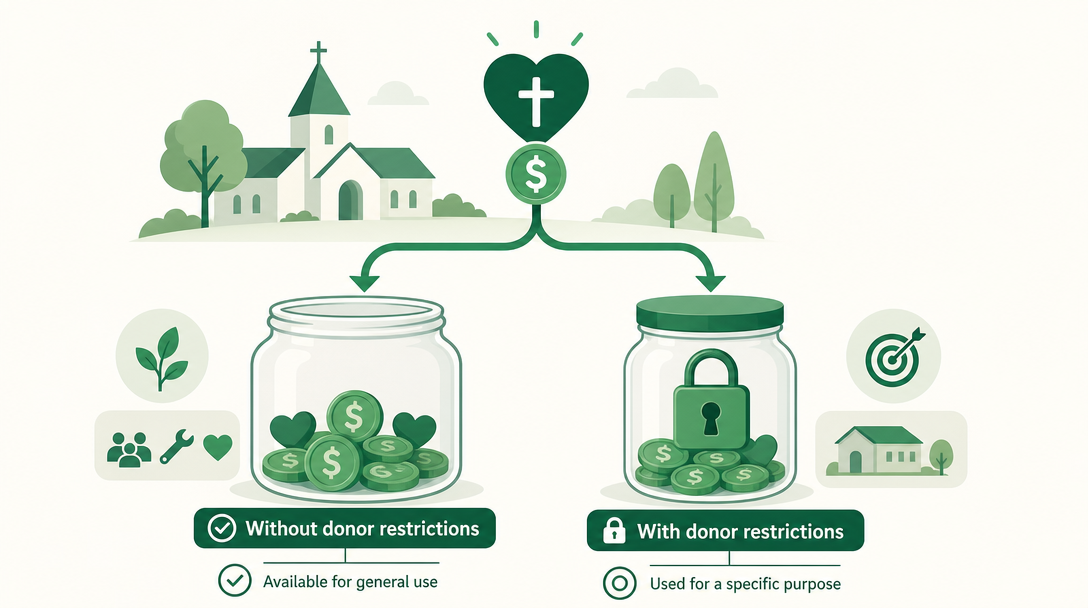
Short answer: A restricted fund at a nonprofit is money a donor gave for a specific purpose or time, and your organization is legally bound to use it only that way. Money with no such strings is unrestricted. Under U.S. accounting rules (FASB ASC 958), every gift lands in one of two net-asset classes — without donor restrictions or with donor restrictions — and only the donor can put a gift in the second one. Spending a restricted gift on the wrong thing is a breach of donor intent, not a paperwork slip, so the whole job is tracking each restricted dollar to its purpose and releasing the restriction only when you’ve actually met it.
What makes a fund “restricted” at a nonprofit
A restricted fund holds money the giver limited to a stated purpose, a stated time, or both. A foundation makes a grant of $50,000 “for the after-school tutoring program.” A donor gives $10,000 “to be spent in 2027.” A family endows $100,000 “to be held in perpetuity, with only the earnings spent.” Each carries a donor restriction your nonprofit has to honor — you can’t redirect that money to payroll because payroll is tight this month.
The opposite is unrestricted money: a regular gift, an unrestricted grant, or earned revenue the donor placed no condition on. Unrestricted dollars fund whatever the mission needs — salaries, rent, the general program budget — at the board’s discretion.
One rule causes most of the confusion: only a donor can restrict a gift. Your own organization setting money aside is something different (more on that below), and the wording the donor uses at the time of the gift is what creates the restriction. A “keep up the great work” note restricts nothing; “for the new roof” does.
With vs. without donor restrictions — the FASB ASC 958 model
The accounting rule that governs this is FASB ASC 958, the standard for not-for-profit entities. It sorts all of a nonprofit’s net assets into exactly two classes:
| Without donor restrictions | With donor restrictions | |
|---|---|---|
| Who decided | The organization (no donor condition) | The donor, in writing, at the time of the gift |
| Can you spend it on anything | Yes, at the board’s discretion | No — only the donor’s stated purpose or timeframe |
| Examples | General gifts, unrestricted grants, program fees | A grant for one program, a time-restricted gift, an endowment |
| Shown on the balance sheet as | Net assets without donor restrictions | Net assets with donor restrictions |
If you’ve read older guidance, you may know the three classic categories: unrestricted, temporarily restricted, and permanently restricted. ASU 2016-14 collapsed those three classes into the two above — temporarily and permanently restricted are now combined into the single “with donor restrictions” class on the face of the financial statements (FASB: Not-for-Profit Entities standards). The old distinction didn’t disappear — you still track why a gift is restricted (purpose, time, or held forever) in your records and disclose it in the notes — but the headline statement now shows two buckets, not three. This is the same idea churches use in church fund accounting, just stated in the formal FASB terms.
Donor-restricted vs. board-designated — they are not the same thing
The single most common mistake is calling board-designated money “restricted.” It isn’t. A board-designated fund is money your own board set aside for a future purpose — an operating reserve, a planned vehicle purchase, a “rainy day” fund. Because the board created that earmark, the board can vote to undo it. There’s no donor and no outside restriction, so on the financials it sits in net assets without donor restrictions.
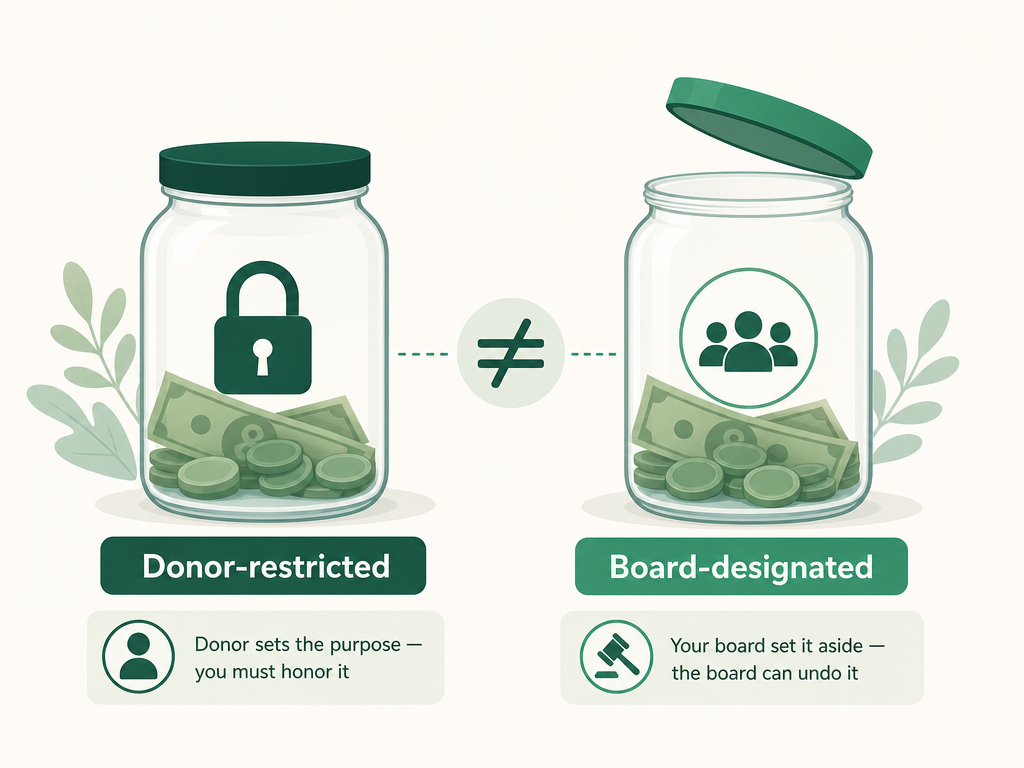
| Donor-restricted | Board-designated | |
|---|---|---|
| Who set the limit | A donor or grantor | Your own board |
| Can the board undo it | No — needs donor consent | Yes — a recorded board vote |
| Net-asset class | With donor restrictions | Without donor restrictions |
| What it really is | A legal obligation to the giver | An internal plan you can revisit |
Treating a donor-restricted grant as if it were merely board-designated is the dangerous direction — that’s how organizations quietly spend a grant on the wrong thing. The same line runs through church designated funds, where the board’s own earmarks get mixed up with gifts a member actually restricted.
How to track restricted funds and release a restriction
Tracking restricted money is just bookkeeping discipline laid over your nonprofit chart of accounts:
- Record the restriction when the gift arrives. Book the contribution as revenue with donor restrictions and note the purpose and any time condition. Restricted and unrestricted gifts get recorded separately from day one — don’t sort it out later.
- Tag every related expense to that fund. When you spend on the tutoring program, charge it to the tutoring fund so each restricted fund carries its own running balance.
- Release the restriction when its condition is met. This is the step most people miss. When you spend on the restricted purpose, or the time condition passes, you record a release from restriction — an entry that moves that amount from “net assets with donor restrictions” into “net assets without donor restrictions.” Nothing leaves the bank; the money changes class because the obligation is now satisfied, and it shows on the statement of activities as “net assets released from restrictions.”
- Report the balances. Show what’s still restricted and what’s been released so the board and donors can see the money went where it was promised. These flows surface on your nonprofit financial statements — the statement of financial position and the statement of activities.
A worked example: a $30,000 grant arrives for a job-training program. You book $30,000 of revenue with donor restrictions. Over the year you spend $22,000 on instructors and materials, so you release $22,000 to the unrestricted class as it’s spent. At year-end, $8,000 of the grant is still restricted and carries forward — restricted money stays restricted until it’s used for its purpose.
An endowment is the permanent case of a restricted fund
An endowment is a restricted fund the donor said to keep forever. The principal is held in perpetuity; only the investment earnings — or a spending-policy slice of them — may be used, sometimes for a purpose the donor also named. Under ASC 958 the permanently restricted principal lives in net assets with donor restrictions and never gets released, which is exactly why the old “permanently restricted” label folded into that class rather than vanishing. An endowment is the strictest restriction a nonprofit can carry: you can’t touch the principal even in a hard year without a legal process (and your state’s version of UPMIFA).
The compliance stakes of spending a restricted gift wrong
Using restricted money for the wrong purpose isn’t a rounding error — it’s a breach of the donor’s intent and, depending on the facts, a legal problem. A grantor can demand the money back or refuse future funding; a state attorney general can pursue misuse of charitable assets; and “we borrowed from the building fund to make payroll, just temporarily” is the move that gets organizations into trouble. The protection is boring and effective: record the restriction up front, never commingle restricted money into one undifferentiated pile, release restrictions only when you’ve truly met them, and report fund balances to the board on a schedule. Get those four habits right and restricted funds become proof you handle other people’s money faithfully.
Vestrybooks makes this the easy path: you pick a fund from a dropdown, restricted and unrestricted gifts are tracked separately, releases happen as you spend, and the board sees each fund’s balance without anyone building a spreadsheet. See plans →
FAQ
What is an example of a restricted fund? A $50,000 grant given “for the after-school program,” a gift marked “to be spent next year,” or an endowment whose principal must be held forever. In each case the donor named a purpose or time, so your nonprofit must use the money only that way.
Can a nonprofit borrow from restricted funds? Practically, no — using donor-restricted money for anything other than its stated purpose, even as a short-term loan to cover operating costs, breaches the donor’s restriction and can expose the organization to legal and reputational risk. If a restriction has truly become impossible to meet, the fix is donor consent or a court/state process, not a quiet internal transfer.
What is the difference between designated funds and restricted funds? A restricted fund is limited by a donor, and only the donor can lift the limit. A designated (board-designated) fund is set aside by your own board, which can vote to undo it. Restricted funds are a legal obligation; board designations are an internal plan.
What are restricted net assets for nonprofits? “Net assets with donor restrictions” is the FASB ASC 958 class for all assets carrying a donor-imposed purpose or time limit, including endowment principal. Since ASU 2016-14, it’s one of just two net-asset classes shown on the financial statements, alongside “net assets without donor restrictions.”
This article is general information for church treasurers, not professional tax or legal advice. For your church's situation, consult a qualified accountant or attorney.
Track every fund the easy way.
Vestrybooks does real fund accounting in plain language — pick a fund, and restricted gifts stay separate automatically, across every account and card.
A real free plan · no credit card · your data stays yours