Blog · Fund accounting
What a nonprofit endowment is and how to account for it
June 27, 2026 · By Benjamin Reinke
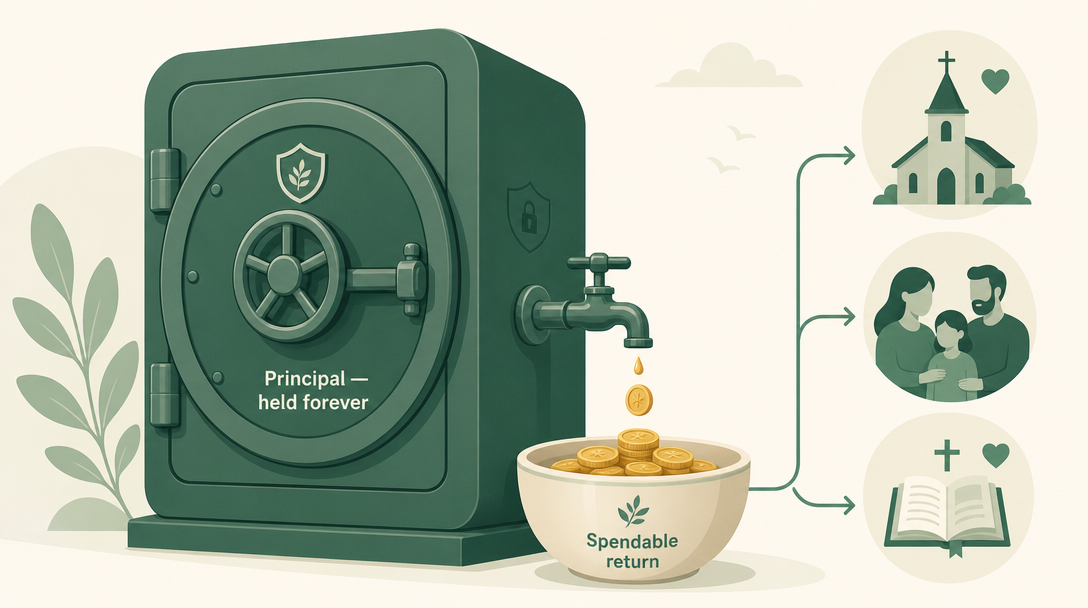
Short answer: A nonprofit endowment is a fund where the original gift — the principal, also called the corpus — is kept intact, usually forever, and the organization spends only the investment return it throws off (or a set yearly slice of it). A donor can lock that principal permanently, creating a true endowment the nonprofit cannot spend down; or the board can set its own money aside as a board-designated “quasi-endowment,” which the board can later release. Under U.S. accounting rules (FASB ASC 958), a donor-restricted endowment’s principal sits in net assets with donor restrictions held in perpetuity, and a state law called UPMIFA governs how much of it you may prudently spend.
What a nonprofit endowment actually is
A nonprofit endowment is a permanent savings engine, not a checking account. The gift goes in, gets invested, and the principal stays put — what the organization lives on is the return that principal generates year after year. Think of it as a vault you never open, fitted with a small tap on the side: the cash inside is sealed, but a steady trickle of earnings flows out to fund the mission.
That structure is the whole point. A $1 million endowment isn’t $1 million to spend; it’s $1 million that produces, very roughly, $40,000–$50,000 a year of spendable support indefinitely. The organization trades immediate firepower for a dependable income stream that outlives any single campaign, grant cycle, or executive director.
This is different from a reserve or a rainy-day fund, which exists to be spent when needed. An endowment exists not to be spent — the discipline is keeping the corpus whole so the income never stops.
True endowment vs. board-designated quasi-endowment
The most important distinction in endowment accounting is who locked the principal, because that decides whether the money can ever be released. This mirrors the donor-restricted-versus-board-designated line that runs through all of church fund accounting — an endowment is just the permanent, invested version of it.
- A true endowment (also called a permanent or donor-restricted endowment) is one where the donor said to hold the principal forever. The nonprofit is legally bound by that restriction and cannot spend the corpus, even in a brutal year, without a legal process. Only the earnings — or a spending-policy portion of them — may be used.
- A board-designated endowment, or quasi-endowment, is money the organization’s own board chose to set aside and invest like an endowment. There’s no donor restriction, so the board that created the designation can vote to release it and spend the principal if circumstances demand.
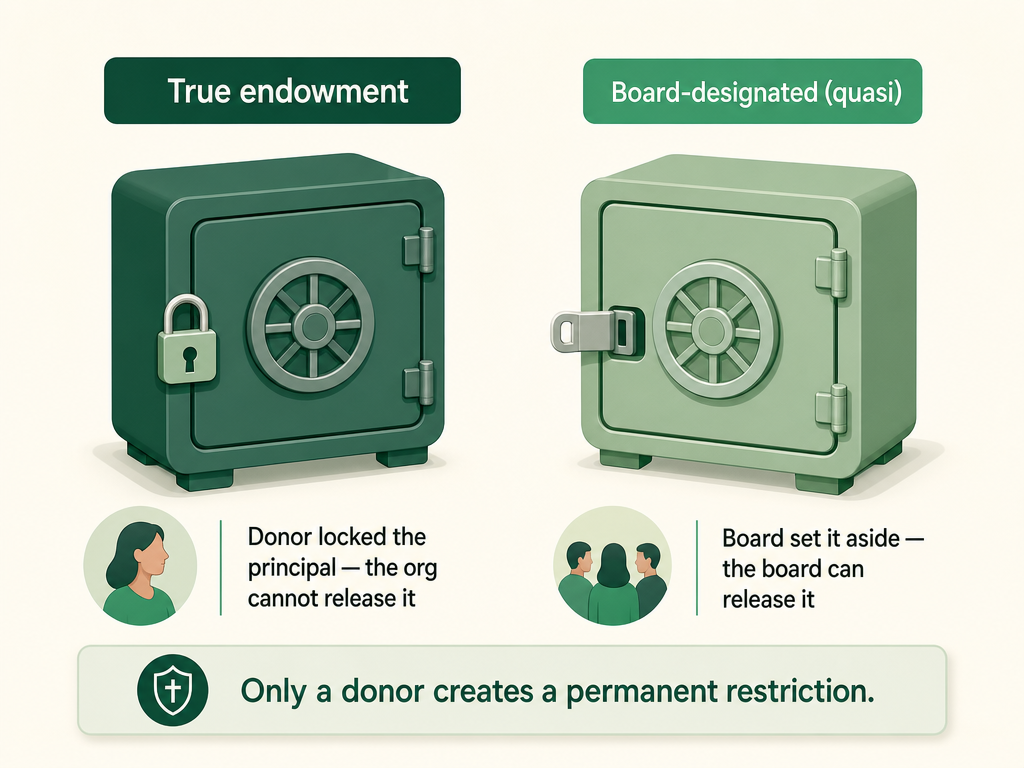
| True (donor-restricted) endowment | Board-designated (quasi-)endowment | |
|---|---|---|
| Who locked the principal | A donor, in writing, at the gift | The organization’s own board |
| Can the principal ever be spent | No — only by legal process or donor release | Yes — the board can vote to release it |
| Net-asset class | With donor restrictions (held in perpetuity) | Without donor restrictions |
| What it really is | A permanent legal obligation to the donor | An internal plan the board can revisit |
Mislabeling one as the other is the dangerous mistake. Treat a true endowment as if the board could spend it, and you’ve breached donor intent; treat board money as permanently locked, and you’ve tied your own hands for no legal reason. The same confusion shows up with ordinary church designated funds, where a board’s earmark gets mistaken for a gift the donor actually restricted.
How an endowment appears in the books under FASB ASC 958
A donor-restricted endowment is reported under FASB ASC 958, the accounting standard for not-for-profit entities. The permanently restricted principal lands in net assets “with donor restrictions” and is described as held in perpetuity — it never gets released, because the restriction never ends. The investment return the endowment earns is then classified by whatever the donor said about it: return the donor restricted to a purpose stays “with donor restrictions” until spent on that purpose, and return with no strings can be classified without restriction.
If you’ve seen older guidance, this used to be its own bucket called “permanently restricted.” ASU 2016-14 folded that into the single “with donor restrictions” class on the face of the statements, but the substance is unchanged — you still track and disclose the perpetual principal separately (FASB: Not-for-Profit Entities standards). A board-designated quasi-endowment, by contrast, has no donor restriction, so its whole balance sits in net assets without donor restrictions and gets disclosed as a board designation. The full two-class net-asset model is laid out in restricted funds for nonprofits, and all of this surfaces on your nonprofit financial statements — the statement of financial position and the notes.
The endowment spending policy and the ~4–5% rule of thumb
An endowment spending policy — usually one section of the broader nonprofit investment policy — is the board’s written rule for how much of the fund to appropriate for spending each year. The job is to take enough to support the mission while leaving enough — after inflation — that the corpus keeps its purchasing power for the next generation. A very common practice is to spend somewhere in the 4% to 5% range of the fund’s value each year, often smoothed over a trailing three-year average so a single bad market year doesn’t whipsaw the budget. That band is a widely used convention, not a legal requirement — the right number depends on your investment returns, inflation, and how aggressively the organization needs the income.
A worked example: an endowment averages $1,000,000 over the trailing period, and the board’s policy appropriates 4.5%. That releases $45,000 for the year. If the investments earned 7%, the corpus still grows after the appropriation; if they earned 2%, the board has to decide whether sticking to the policy rate is prudent or whether to take less.
UPMIFA and underwater endowments
The state law governing endowment management is UPMIFA — the Uniform Prudent Management of Institutional Funds Act — adopted in some form by almost every U.S. state. UPMIFA sets the standard of prudence a nonprofit’s board must meet when investing endowment assets and when deciding how much to spend. Its most practical feature: UPMIFA generally lets a charity spend a prudent amount from a donor-restricted endowment even when the fund’s current value has dropped below the original gift amount — a situation called an “underwater” endowment — provided the board acts prudently and the donor’s gift instrument doesn’t forbid it. Older law often froze spending entirely once a fund went underwater; UPMIFA replaced that hard line with a prudence standard. Because UPMIFA is adopted state by state, the exact rules and any notification requirements vary, so a board should know its own state’s version.
When a small nonprofit or church should start an endowment
Starting an endowment is right when an organization has a stable operating budget, reliable current income, and donors asking how to give a legacy gift. An endowment turns a one-time major or planned gift into permanent support and signals to legacy-minded donors that the mission is built to last.
Starting one is usually a mistake when the organization is still struggling to cover this year’s payroll. Locking up principal you can’t touch while you’re short on operating cash is the wrong order of operations — the money does the most good in the general fund first. A few honest tests before starting:
- Are operations funded? Build an operating reserve before a permanent endowment, not after.
- Is there a real source? Endowments are usually seeded by bequests and major gifts, not by skimming the annual budget.
- Can you administer it? Someone has to invest it, set a spending policy, follow UPMIFA, and report it correctly under ASC 958 every year.
For a small church, the same logic applies, just smaller. A congregation that has covered its operating needs and received a bequest “to benefit the church forever” has a true endowment whether it calls it that or not — and it now owes that donor perpetual stewardship of the principal, tracked alongside its other funds in its church chart of accounts.
In Vestrybooks, a permanent gift is just another fund you pick from a dropdown — its principal balance and the spendable return stay separated, and the board sees exactly what’s locked and what’s available without anyone building a spreadsheet. See plans →
FAQ
Can a nonprofit have an endowment? Yes. Any 501(c)(3) — including a church — can hold an endowment, either a true endowment a donor permanently restricted or a board-designated quasi-endowment the board set aside itself. The principal is preserved and the organization spends only the return.
How big should a nonprofit endowment be? There’s no required size. A useful frame is the income it produces: at a ~4–5% spending rate, a fund supplies roughly 4–5 cents of annual support per dollar of principal, so a $500,000 endowment yields about $20,000–$25,000 a year. The right size is whatever produces meaningful, dependable income without starving current operations.
What is the difference between a true endowment and a quasi-endowment? A true endowment is locked by the donor — the nonprofit can never spend the principal without a legal process. A quasi-endowment is locked by the board, which can vote to release it. The first is a permanent legal obligation; the second is the board’s own plan.
What is an underwater endowment? An underwater endowment is a donor-restricted endowment whose current market value has fallen below the original gift amount. Under UPMIFA, a board can usually still spend a prudent amount from it, rather than being frozen out as older law required.
What is the 33% rule for nonprofits? That’s a different concept — it refers to the public-support test for keeping public-charity status (broadly, getting at least a third of support from the public), not an endowment rule. An endowment’s principal isn’t “support” the organization spends, so it factors into that test differently; check the public-support rules directly rather than applying the 33% figure to your endowment.
This article is general information for church treasurers, not professional tax or legal advice. For your church's situation, consult a qualified accountant or attorney.
Track every fund the easy way.
Vestrybooks does real fund accounting in plain language — pick a fund, and restricted gifts stay separate automatically, across every account and card.
A real free plan · no credit card · your data stays yours