Blog · Fund accounting
Grant accounting for nonprofits, explained plainly
June 28, 2026 · By Benjamin Reinke
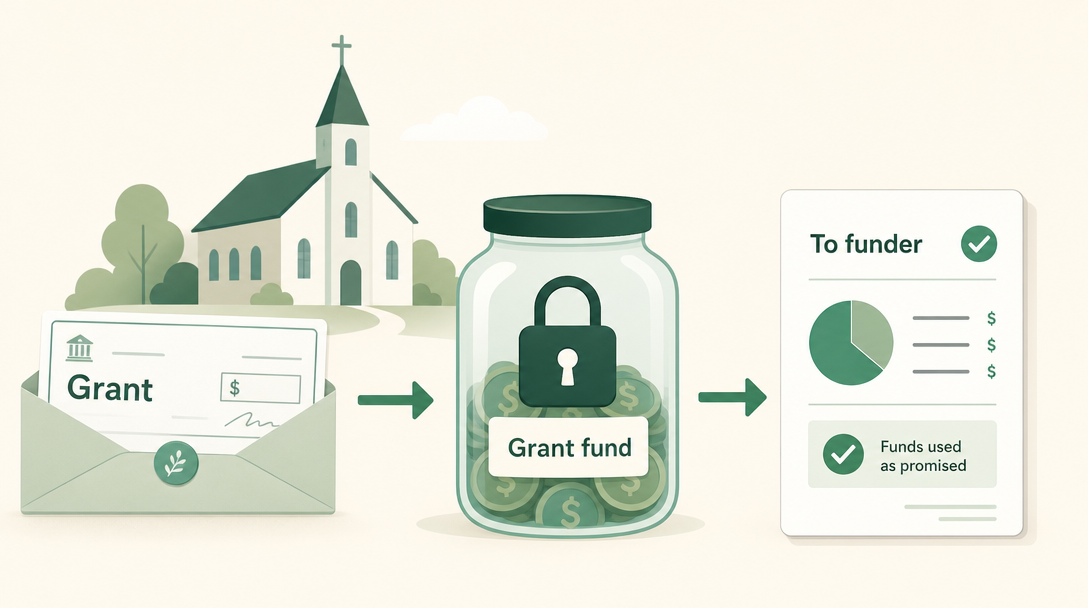
Short answer: Grant accounting is how a nonprofit records and tracks the grant money it receives — separate from any work of writing proposals to win the grant. A grant almost always arrives with a stated purpose, which makes it a restricted fund, so grant accounting is really fund accounting aimed at one grant: book the award in its own fund, spend only on the grant’s purpose, release the restriction as you spend, and report back to the funder that the money went where promised. Under U.S. accounting rules (FASB ASC 958), the one early decision that changes everything is whether the grant is conditional or unconditional — that decides when you recognize it as revenue.
What grant accounting means for a nonprofit that receives a grant
Grant accounting is the bookkeeping a nonprofit does for money a funder gives it for a specific job — a foundation grant “for the food pantry,” a government award “for after-school tutoring,” a corporate gift “for the youth program.” The grant accountant’s work starts the day the award letter arrives and runs until the last dollar is spent and the final report is filed. This is the accounting side of grants; it has nothing to do with grant-seeking, proposal writing, or fundraising, which are a separate discipline entirely.
The job has four moving parts, and the rest of this page walks each one:
- Classify the grant as conditional or unconditional, and as a contribution rather than an exchange, so you know when to record revenue.
- Track the grant in its own fund, spending only on the grant’s purpose.
- Compare spending to the grant budget as the money draws down.
- Report to the funder and keep the documentation that proves compliance.
A grant is usually a restricted fund, so grant accounting is fund accounting
A grant comes with strings — the funder named a purpose, and your nonprofit is bound to honor it. That makes the grant a donor-restricted fund, and tracking it is the same discipline covered in restricted funds for nonprofits: money a giver limited to a stated purpose, which you must use only that way.
So grant accounting is fund accounting applied to a single grant. The mechanics are the same ones in church fund accounting:
- Open a fund for the grant. Give the award its own fund (or class) inside your nonprofit chart of accounts so its money never blends into the general pot.
- Spend only on the grant’s purpose. Tag every related expense to that fund — the salary, the supplies, the contractor — so the grant fund carries its own running balance.
- Release the restriction as you spend. Each time you spend on the grant’s purpose, you move that amount from “net assets with donor restrictions” to “net assets without donor restrictions.” Nothing leaves the bank; the obligation is simply satisfied, dollar for dollar.
- Carry the balance forward. Whatever’s unspent stays restricted to the grant until it’s used — restricted money doesn’t reset at year-end.
A $40,000 grant for a literacy program books $40,000 of revenue with donor restrictions. As you spend $9,000 on tutors, you release $9,000. At year-end, if $12,000 is unspent, $12,000 is still restricted to the literacy program and carries into next year.
Conditional vs. unconditional grants under FASB ASC 958
The standard that governs grants a nonprofit receives is FASB ASC 958, the not-for-profit standard, as refined by ASU 2018-08 (FASB: Not-for-Profit Entities standards). The pivotal question it asks is whether the grant is conditional or unconditional, because that decides when you recognize revenue.
A grant is conditional when the agreement has both of two things: a barrier the nonprofit must overcome (a measurable output, a matching requirement, a spending milestone) and a right of return — the funder can take the money back if the barrier isn’t met. A conditional grant is not recognized as revenue until the condition is met. Until then, cash you’ve received sits as a refundable advance (a liability), not as income.
A grant is unconditional when there’s no such barrier-plus-right-of-return. An unconditional grant is recognized as revenue when it’s awarded, even if it still carries a purpose restriction on how the money is spent.
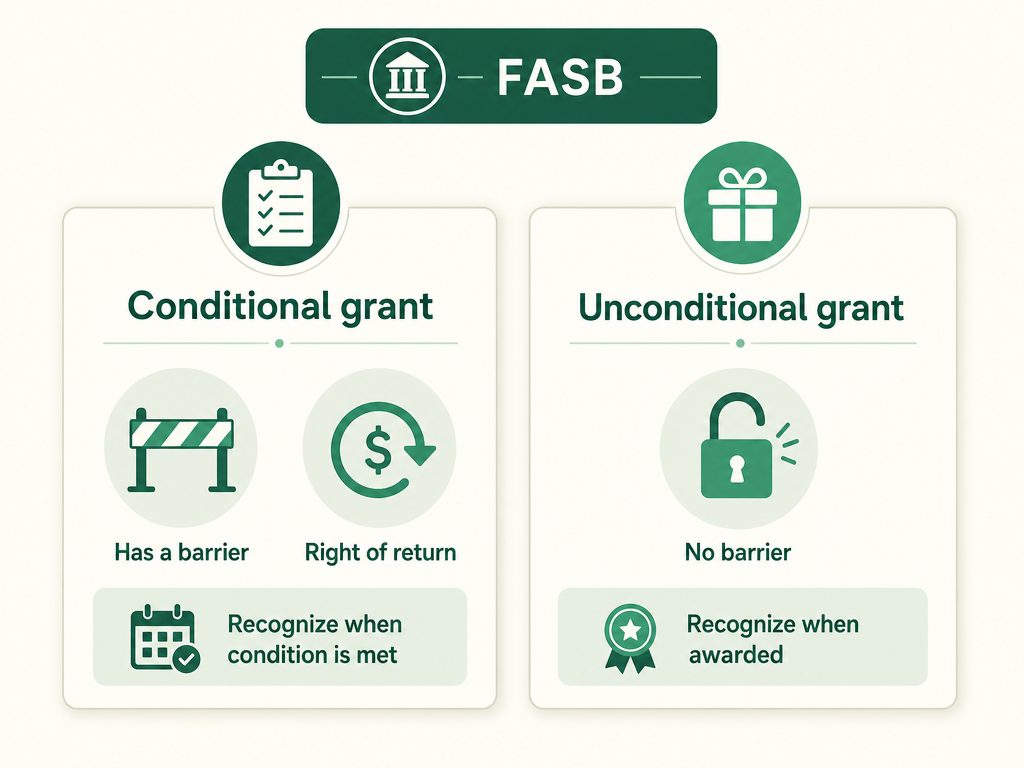
| Conditional grant | Unconditional grant | |
|---|---|---|
| Has a barrier to overcome | Yes — a measurable output, milestone, or match | No |
| Funder’s right of return | Yes — money comes back if the barrier isn’t met | No |
| When you recognize revenue | When the condition is met | When the grant is awarded |
| Cash received before that | Sits as a refundable advance (liability) | Recognized as revenue |
Keep the two questions separate: conditional vs. unconditional sets the timing of revenue, while with vs. without restriction sets how you track and release the money. A grant can be both unconditional (recognized now) and restricted (tracked in its own fund until spent on purpose).
Why a grant is a contribution, not an exchange transaction
Before the conditional test, ASC 958 makes you sort the money into one of two boxes: a contribution or an exchange transaction. A true grant is a contribution — the funder gives money to advance a public good and gets no commensurate value back, so it falls under the contribution rules (ASC 958-605). An exchange transaction is a swap of roughly equal value — a government paying you a fee to deliver a defined service it directly benefits from, for example — and it follows revenue-recognition rules (ASC 606) instead.
The distinction matters because the two paths recognize revenue differently, and ASU 2018-08 exists largely to help nonprofits tell a grant (contribution) apart from a fee-for-service (exchange). When the funder is mainly funding your mission rather than buying a service for itself, treat it as a contribution and run it through the conditional/unconditional test above.
Tracking spending against the grant budget and drawdowns
A grant comes with a budget — the line items the funder approved, like personnel, supplies, and travel. Grant accounting tracks actual spending against that approved budget, line by line, so you can see at any moment how much of each category is left. Funders often cap how far you can move money between lines without approval, so the budget isn’t a suggestion; it’s a control.
Many grants, especially government awards, pay on a reimbursement or drawdown basis: you spend first, then request the cash you’ve already laid out, backed by documentation. That makes accurate, current fund tracking non-negotiable — your drawdown request has to match what your books say you spent on the grant’s approved lines.
Reporting to the funder and keeping the documentation
Reporting to the funder is the visible product of grant accounting: a financial report that shows the money went where promised — spending by budget line, the balance remaining, and often a narrative tying dollars to outcomes. Funders set the schedule (quarterly, annually, at close-out), and a clean grant fund makes each report a matter of pulling balances rather than reconstructing a year of activity. These same flows appear on your nonprofit financial statements, where restricted grant revenue and its release show up on the statement of activities.
The supporting habit is documentation: keep the award letter, the budget, receipts and timesheets tied to the grant, and the math behind every drawdown. If a funder or auditor asks how a dollar was spent, the answer should be a folder, not a memory.
Grant compliance and the federal Single Audit threshold
Grant compliance is the obligation that sits over all of the above: use the funds only for the approved purpose, stay inside the budget, and keep documentation that proves both. Spending a grant on the wrong thing isn’t a paperwork slip — it can trigger a demand to repay the money and the loss of future funding.
Federal grants add one more layer. A nonprofit that spends enough federal money in a year must get a Single Audit — an organization-wide audit of its federal awards and compliance, under the federal Uniform Guidance (2 CFR Part 200). The federal single-audit threshold was long set at $750,000 of federal spending in a fiscal year; under the revised Uniform Guidance it was raised to $1 million for fiscal years beginning on or after October 1, 2024. If you’re unsure which figure applies to a given year, treat it as “the federal single-audit threshold, recently raised to $1 million” and confirm against the current Uniform Guidance rather than guessing — the number drives a real, expensive audit requirement.
How a church accounts for a grant it receives
A church that receives a grant accounts for it the same way any nonprofit does. The grant is a restricted fund, tracked in its own fund inside the church’s books, spent only on the funder’s purpose, released as it’s spent, and reported back to the funder. If the church takes federal money and crosses the single-audit threshold, the Single Audit requirement reaches it too. None of this changes a church’s usual books — it’s the same fund-accounting discipline a church already uses, pointed at one grant.
Vestrybooks makes the tracking the easy path: open a fund for the grant, tag each expense to it, and watch the balance release as you spend — so the report to your funder is already done when they ask. See plans →
FAQ
What is the difference between fund and grant accounting? Fund accounting is the broad method of tracking money by purpose across every fund a nonprofit has. Grant accounting is that same discipline aimed at one grant — opening a fund for the award, spending only on its purpose, releasing the restriction as you spend, and reporting to the funder. Grant accounting is fund accounting applied to a grant.
What is the accounting entry for a grant? For an unconditional grant, you record the cash (or a receivable) and recognize contribution revenue, marked “with donor restrictions” if it has a purpose. For a conditional grant, cash received before the condition is met is booked as a refundable advance (a liability), and you recognize revenue only once the barrier is overcome. As you spend on the purpose, you record a release from restriction.
How do you record grant money in accounting? Classify the grant first — contribution vs. exchange, then conditional vs. unconditional — to decide when revenue is recognized. Then book it into its own fund, tag every grant expense to that fund against the approved budget, release the restriction as you spend, and report the balances to the funder.
What does a grant accountant do? A grant accountant manages the money side of a grant after it’s awarded: classifying it under ASC 958, setting up the grant fund, tracking spending against the budget, preparing drawdown requests and funder reports, and keeping the documentation that satisfies grant compliance and any Single Audit.
This article is general information for church treasurers, not professional tax or legal advice. For your church's situation, consult a qualified accountant or attorney.
Track every fund the easy way.
Vestrybooks does real fund accounting in plain language — pick a fund, and restricted gifts stay separate automatically, across every account and card.
A real free plan · no credit card · your data stays yours