Blog · Budgeting
A sample church budget with real numbers
June 27, 2026 · By Benjamin Reinke
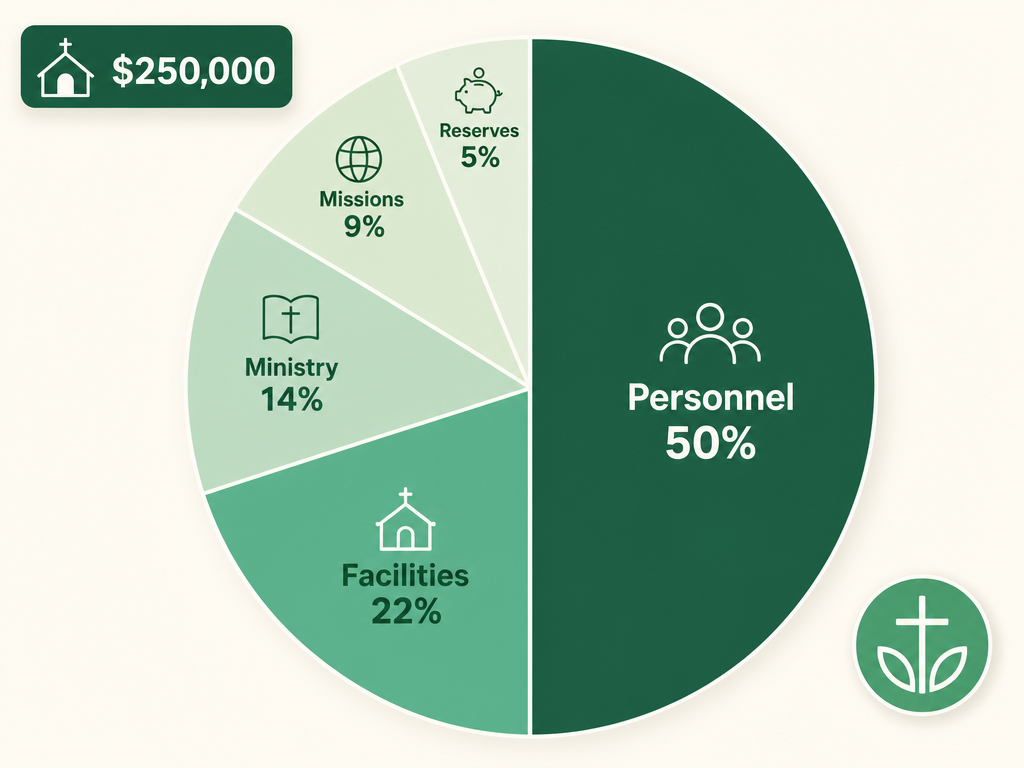
Short answer: A sample church budget for a mid-size congregation with about $250,000 in annual income plans giving on one side and spending on the other, split across five categories: personnel ~50% ($125,000), facilities ~22% ($55,000), ministry and programs ~14% ($35,000), missions and outreach ~9% ($22,500), and reserves ~5% ($12,500). The numbers below are an example you can scale up or down — a church running $80,000 or $1.2 million uses the same categories, just different totals.
The full sample church budget
The sample church budget below models a congregation of roughly 150–200 attenders that takes in about $250,000 a year. Every line is an example figure, not a rule — the point is to show how the categories fit together and what a realistic split looks like before you plug in your own church’s history.
Sample income side
Income for this church is almost entirely voluntary giving, with a small amount of other revenue. Most churches budget income conservatively, off the last two or three years of giving rather than a hoped-for jump:
| Income line | Amount | % of total |
|---|---|---|
| Regular tithes and offerings | $215,000 | 86% |
| Designated and special gifts | $20,000 | 8% |
| Facility rental (space use fees) | $9,000 | 4% |
| Interest and other income | $6,000 | 2% |
| Total income | $250,000 | 100% |
Sample expense side, by line item
Expenses for this church break into the five standard church budget categories, with the real line items inside each. The percentages are the share of the $250,000 total:
| Expense line | Amount | % of total |
|---|---|---|
| Personnel | $125,000 | 50% |
| Pastor salary | $58,000 | 23% |
| Pastor housing allowance | $24,000 | 10% |
| Worship/admin staff (part-time) | $22,000 | 9% |
| Payroll taxes and benefits | $21,000 | 8% |
| Facilities and operations | $55,000 | 22% |
| Mortgage or rent | $30,000 | 12% |
| Utilities | $12,000 | 5% |
| Insurance (property and liability) | $7,000 | 3% |
| Maintenance and repairs | $6,000 | 2% |
| Ministry and programs | $35,000 | 14% |
| Worship and music | $9,000 | 4% |
| Children, youth, and education | $13,000 | 5% |
| Benevolence (member assistance) | $8,000 | 3% |
| Office, software, and supplies | $5,000 | 2% |
| Missions and outreach | $22,500 | 9% |
| Denominational giving | $12,500 | 5% |
| Local and global missions | $10,000 | 4% |
| Reserves | $12,500 | 5% |
| Emergency and repair savings | $12,500 | 5% |
| Total expenses | $250,000 | 100% |
Notice the budget balances — total expenses equal total income, the mark of a plan that’s realistic rather than aspirational. The split tracks the ranges most church-finance advisors use; for the reasoning behind each number, see church budget percentages.
How to scale this sample to your church’s size
A sample church budget only helps if you can resize it. The categories hold across budget sizes; the dollar amounts and a few priorities shift. Here’s the same five-category split at three common sizes:
| Category | Small ($80k) | Mid ($250k) | Large ($1.2M) |
|---|---|---|---|
| Personnel (50%) | $40,000 | $125,000 | $600,000 |
| Facilities (22%) | $17,600 | $55,000 | $264,000 |
| Ministry (14%) | $11,200 | $35,000 | $168,000 |
| Missions (9%) | $7,200 | $22,500 | $108,000 |
| Reserves (5%) | $4,000 | $12,500 | $60,000 |
A small church plant often runs leaner on facilities (renting, not owning) and heavier on outreach, while a large church carries more fixed staff and building cost. To split your own income across these categories automatically, run it through the church budget calculator.
What this sample church budget includes — and the lines people forget
A complete church budget plans both income and expenses, but a few lines get left off and cause a shortfall mid-year. When you build from this sample, double-check these:
- Pastor housing allowance — a designated portion of pastor pay that’s excluded from federal income tax (though not self-employment tax), per IRS Topic No. 417. Budget it as its own line.
- Payroll taxes and benefits — easy to underestimate; they can add 10–20% on top of base salaries.
- Insurance — property, liability, and often workers’ comp; a real annual cost, not an afterthought.
- A reserve contribution — a planned transfer to savings, so an emergency repair doesn’t blow a hole in the year. A common target is three months of operating expenses held in reserve.
- Benevolence — money set aside to help members in hardship, kept inside the budget rather than handled ad hoc.
How to read a simple church budget report against this plan
A sample church budget is the plan; a budget report shows how the year is going against it. The simplest report puts three columns side by side — budgeted, actual, and the variance between them — for each category. A board member should be able to read it in two minutes:
| Category | Budgeted | Actual (YTD) | Variance |
|---|---|---|---|
| Income | $125,000 | $118,400 | −$6,600 |
| Personnel | $62,500 | $62,500 | $0 |
| Facilities | $27,500 | $28,900 | −$1,400 |
| Ministry | $17,500 | $15,200 | +$2,300 |
A negative income variance like the one above is the signal to act early — trim discretionary spending before a soft giving stretch turns into a deficit. That monthly budget-versus-actual review is the whole discipline; the underlying method for building the plan it checks is covered in the church budget guide. To start from a pre-built sheet, our free church budget template ships with these categories and formulas already in place.
Vestrybooks tracks every category against your budget as money moves, so the budgeted-vs-actual report writes itself instead of waiting for a year-end scramble. See plans →
FAQ
What should a church budget include? Expected income (tithes and offerings, designated gifts, facility rental, other income) and planned expenses across personnel, facilities and operations, ministry and programs, missions and outreach, and a reserve contribution — with a real dollar amount on every line.
What is the 3 3 3 budget rule? The 3-3-3 rule is a personal-finance habit — splitting effort or money across three buckets in equal thirds. It’s a household idea, not a church budgeting method; churches budget by ministry function, as the sample above shows.
What is a good example of a budget? A good example is one that balances — total planned expenses equal total expected income — and assigns a dollar figure to every category. The $250,000 sample above is balanced and covers all five standard categories.
How do you write a simple church financial report? List each budget category in a column, then show budgeted, actual-to-date, and the variance between them. Anyone on the board should be able to spot where the church is over or under plan in a couple of minutes.
This is general information, not financial advice — set your church’s budget with its leadership and a qualified advisor.
This article is general information for church treasurers, not professional tax or legal advice. For your church's situation, consult a qualified accountant or attorney.
Church accounting a volunteer can actually do.
Vestrybooks is church accounting + giving for the volunteer treasurer — fund tracking, one-click year-end statements, and online giving with $0 taken from every gift.
A real free plan · no credit card · your data stays yours