Blog · Budgeting
How to build a nonprofit operating budget the board can stand behind
June 27, 2026 · By Benjamin Reinke
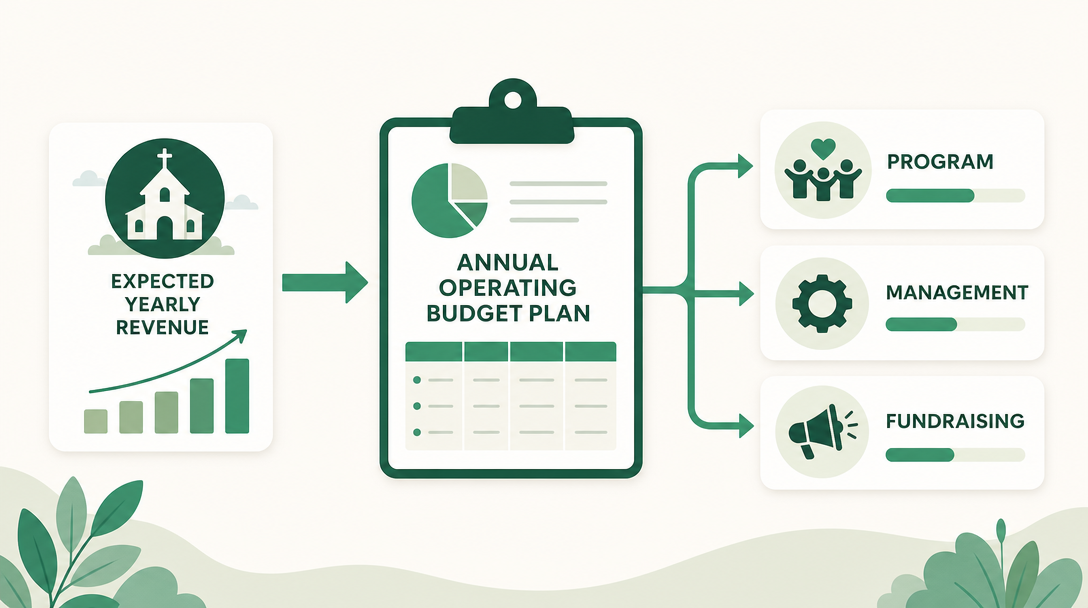
Short answer: A nonprofit operating budget is the board-approved financial plan for the year — what the organization expects to raise (by source) and what it plans to spend (by function: program, management, and fundraising). You build it by forecasting revenue conservatively from each source, planning expenses against your real program costs, balancing the two so the plan holds, and adopting it by a board vote. Then you run it: every month you compare budget against actual so a shortfall surfaces early, not at year-end. To confirm the cash is actually there, pair it with a cash flow statement.
What a nonprofit operating budget is and why the board owns it
A nonprofit operating budget is the organization’s adopted financial plan for a fiscal year — a forecast of revenue and a plan for expenses, in dollars. It is not a bookkeeping document; it is a governance one. The board of directors, not the staff, owns the budget, because adopting and overseeing it is part of the board’s fiduciary duty of care — the legal obligation to manage the organization’s resources responsibly. Staff draft it and run it day to day, but the board approves it, monitors it, and answers for it.
That ownership is the point. The budget turns mission into numbers — one that puts most of its money into program work says something different than one that doesn’t — and it’s the yardstick the board uses all year to ask the only two questions that count: are we on track, and if not, what do we change?
Budget nonprofit revenue by source, conservatively
Nonprofit revenue rarely comes from one place, and a budget that lumps it together hides risk. Plan each source as its own line, and forecast each one for what it is — some are predictable, some are not.
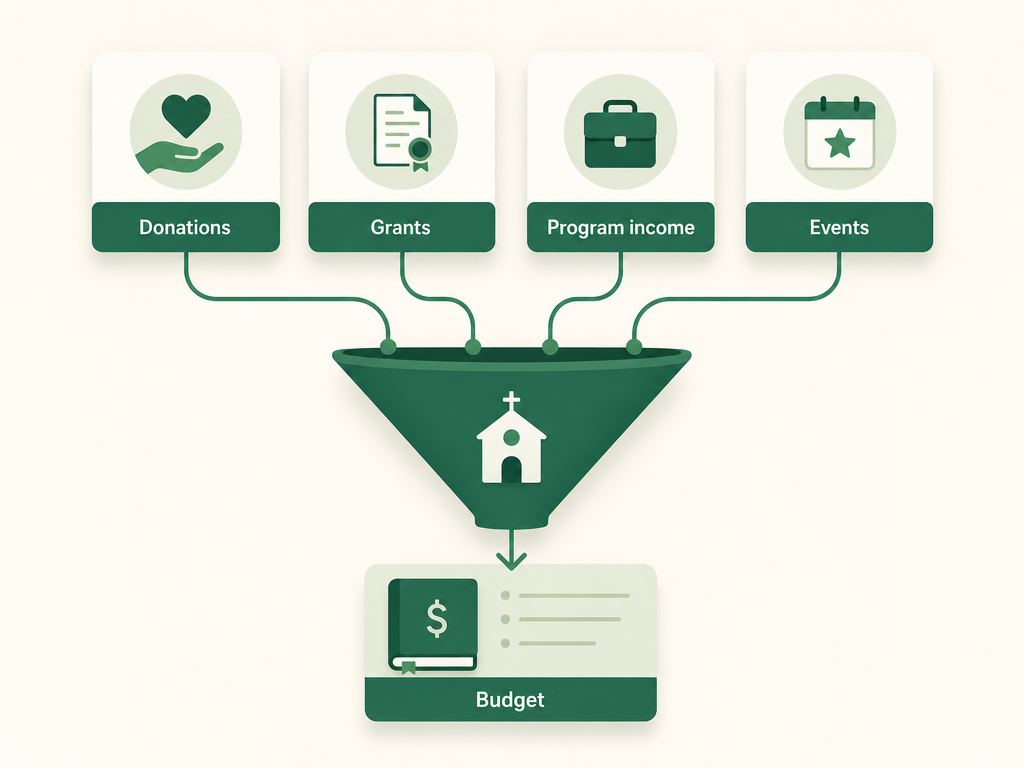
- Individual donations — recurring gifts, year-end giving, major gifts. Forecast from two or three years of giving history, adjusted for known changes, not for hope.
- Grants — foundation, government, and corporate. Budget committed and likely-renewed grants at full value; budget grants you have only applied for at a discount, or in a separate “pipeline” line you don’t spend against until the award lands.
- Earned and program income — fees for service, tuition, ticketed programs, memberships, a thrift store. Earned revenue is often your steadiest source, so give it a careful, defensible estimate.
- Fundraising events — galas, runs, auctions. Budget the net, not the gross — an event that grosses $50,000 and costs $20,000 to run contributes $30,000, and that $20,000 belongs in your fundraising expenses.
The discipline across all four is the same: be conservative on the income you can’t control. Concentrated revenue is fragile revenue — if one grant or one major donor funds a big share of the plan, a single loss blows a hole in it.
Budget nonprofit expenses by function — the split funders read
Where for-profit budgets group spending by department, nonprofits group it by function, into three categories the sector and the IRS use everywhere: program services, management and general (often called administrative or overhead), and fundraising. This functional split is the structure of the Statement of Functional Expenses that the IRS Form 990 requires, so building your budget this way means the plan already lines up with how you’ll report at year-end.
| Function | What it covers | Rough range of total expenses |
|---|---|---|
| Program services | The mission work itself — services delivered, the people doing them | 65%+ |
| Management & general | Leadership, finance, HR, rent, insurance, the cost of running the org | 15–25% |
| Fundraising | The cost of raising the money — staff, events, appeals, donor software | 5–15% |
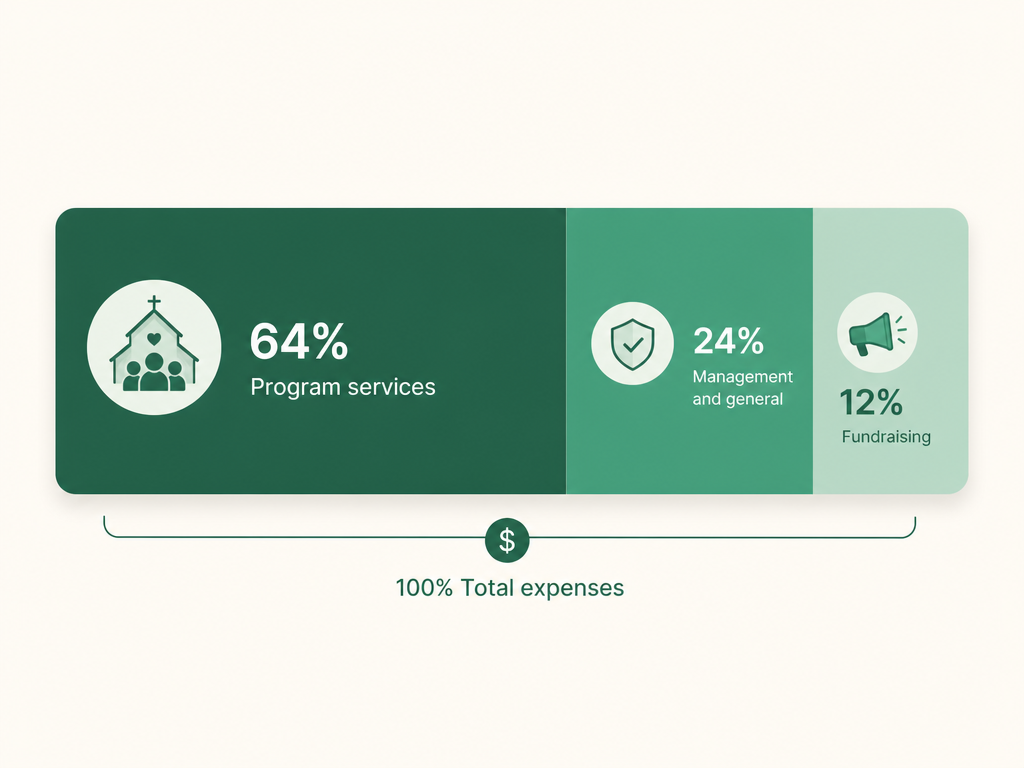
Some costs serve more than one function and get allocated across them — a director who spends half her time on programs and half on administration, or rent split by square footage. Watch your program-expense ratio (program spending divided by total expenses), because charity raters and many funders look for roughly 65% or more going to program. But don’t starve the other two to win the ratio. Underfunding administration and fundraising is its own failure — the “nonprofit starvation cycle” is what happens when organizations cut overhead so deep they can’t run — which is why true program costs include a fair share of the infrastructure that makes the program possible.
Build the budget with incremental or zero-based budgeting, and plan for a surplus
Two methods dominate nonprofit budgeting. Incremental budgeting starts with last year’s numbers and adjusts each line up or down — fast, but it quietly carries old assumptions forward. Zero-based budgeting starts every line at zero and makes each program justify its full cost — more work, but it catches spending that no longer earns its place. Many organizations run incremental most years and do a zero-based reset every three or four to clean house.
Whichever you pick, three rules make the plan hold:
- Forecast revenue conservatively, plan expenses against real costs. Most budgets fail on the income side, from optimism, not on the expense side. Build expenses up from what programs actually cost, including their share of overhead.
- Balance the two before you adopt it. If planned expenses exceed realistic revenue, close the gap before the vote — cut, phase, or fundraise for it — rather than adopting a budget you already know won’t work.
- Plan for a small surplus, and hold a reserve. Budgeting for a modest surplus is not betraying the mission. “Nonprofit” means no owners take the profit, not that you must spend every dollar you raise. A planned surplus builds the operating reserve — commonly three to six months of expenses — that carries you through a late grant or a slow quarter without cutting programs. A break-even budget with no cushion is one bad month from a crisis.
Adopt the nonprofit budget by a board vote
A nonprofit budget becomes real when the board adopts it by a formal vote recorded in the meeting minutes. The usual path: a finance committee or the treasurer drafts it with staff, the board reviews and questions the assumptions, and the full board approves it before the fiscal year begins. The vote is the moment the board formally takes ownership of the plan, and the minutes are part of the paper trail an auditor or the IRS may later want to see.
This is the same approval discipline behind a church budget, which is just a nonprofit budget for a congregation — voluntary giving in place of grants and earned income, ministries in place of programs, but the same revenue-and-expense structure and the same board-adoption step.
Run budget vs. actual through the year
A budget adopted in one meeting and forgotten until year-end isn’t a plan — it’s a guess nobody checked. The discipline that makes budgeting worth doing is the monthly budget-versus-actual review: line by line, planned against real, with the variance in front of the board or finance committee. That’s how a revenue shortfall or a grant that came in light shows up in month three, while there’s time to respond, instead of month eleven, when there isn’t.
Those actual figures come straight off your financials, which is why a clean budget and clean books go together — the same revenue-and-expense categories should run through both your budget and your nonprofit financial statements. Budget by function and report by function, and the year-end story tells itself.
When you’re ready to fill in the numbers, our free nonprofit budget template lays out revenue by source and expenses by function with example line items and a program-ratio check. This guide is the why and the how; the template is the grid.
Vestrybooks builds your budget in and shows budget-versus-actual automatically as money moves — by fund and by function — so the plan stays a living tool instead of a forgotten spreadsheet. See plans →
FAQ
How do you do a budget for a nonprofit? Forecast revenue by source (donations, grants, earned/program income, events), conservatively. Plan expenses by function — program, management and general, and fundraising — built up from real program costs. Balance the two so expenses don’t exceed realistic revenue, and aim for a small surplus to build a reserve. Then have the board adopt it by vote and review budget-versus-actual every month.
What is the 33% rule for nonprofits? The “33% rule” refers to a public-support test, not a budgeting rule. To keep public-charity status, the IRS generally expects an organization to receive at least a third of its support from the public and government rather than from a few large sources. It shapes how you raise and report revenue, but it isn’t a formula for splitting spending in a budget.
What is the 80/20 rule for nonprofits? The 80/20 rule is the common observation that roughly 80% of an organization’s donations come from about 20% of its donors. For budgeting, it’s a warning that revenue is more concentrated, and more fragile, than a donor head count suggests — a reason to forecast income conservatively and hold a reserve, not a rule for allocating expenses.
What is the 50/30/20 rule for charities? The 50/30/20 rule is a personal-budgeting framework (needs, wants, savings) that gets borrowed loosely for nonprofits as a rough split across program, operations, and reserves. It isn’t an official standard. The sector’s real benchmark is the functional split — program services, management and general, and fundraising — with most spending going to program.
This is general information, not financial, legal, or tax advice — build your organization’s budget with its board and a qualified advisor.
This article is general information for church treasurers, not professional tax or legal advice. For your church's situation, consult a qualified accountant or attorney.
Church accounting a volunteer can actually do.
Vestrybooks is church accounting + giving for the volunteer treasurer — fund tracking, one-click year-end statements, and online giving with $0 taken from every gift.
A real free plan · no credit card · your data stays yours