Blog · Clergy compensation
How much do pastors make? A 2026 pastor salary guide
June 28, 2026 · By Benjamin Reinke
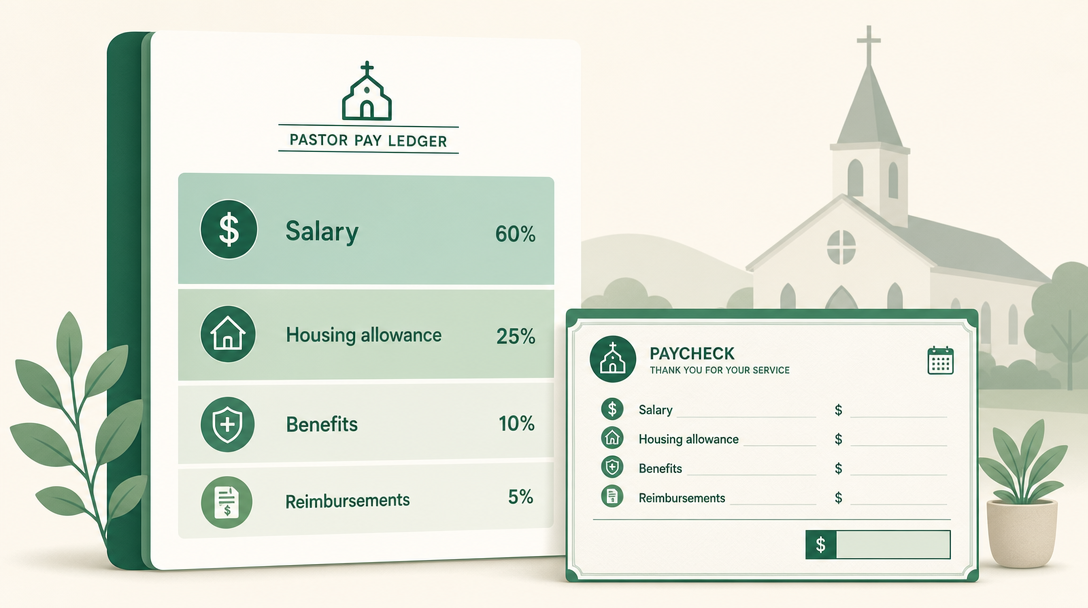
Short answer: There is no single pastor salary, but the federal government’s best estimate puts the median clergy wage at about $60,820 a year (U.S. Bureau of Labor Statistics, May 2024), and most full-time pastors land somewhere in a broad $45,000 to $90,000 band before you count the extras. Two caveats matter more than the headline number. First, pastor pay is a package — cash salary plus a tax-advantaged housing allowance plus benefits like health and retirement — so “salary” alone understates what a pastor actually receives. Second, the figure swings enormously with church size, region, denomination, role, and experience: a bivocational pastor of a 40-person plant and a senior pastor of a 3,000-member church are not in the same world. Every figure below traces to a named source, and all of it is as of 2026 from the studies cited.
What the data says pastors earn
No two compensation surveys count the same way — some report base salary only, others fold in housing and benefits — so read the ranges below as overlapping estimates, not a single paycheck. Wide variation is the honest finding: the same role can pay $40,000 in a rural church plant and $250,000 at a large suburban church, and both are “normal” for their context.
| Source (as of 2026) | What it measures | Figure / range |
|---|---|---|
| BLS, May 2024 | Median annual wage, all clergy (SOC 21-2011) | $60,820 |
| BLS, May 2025 | Mean annual wage, all clergy | $66,860 |
| Payscale | Average base pastor salary; typical range | $57,041 (range ~$37k–$85k) |
| ZipRecruiter | National average pastor pay | ~$60,900 |
| PCUSA Board of Pensions | Median effective salary (incl. housing + allowances) | $70,000 |
| Tithely / ChurchSalary-style data | Lead pastor, small church (1–500) | $63,000–$145,000+ by experience tier |
| Vanco / ChurchSalary-style data | Small / mid / large church bands | $35,494–$67,221 / $75,624–$96,656 / $95,000–$120,485+ |
| Vanderbloemen 2025 | Senior pastors, megachurches (5,000–10,000) | average >$250,000 |
A few cautions belong under the table as much as above it. The BLS median covers all clergy — rabbis, priests, and part-time and bivocational pastors included — which is part of why it sits below the figures the church-specific surveys report for full-time senior pastors. The church-survey ranges, by contrast, lean toward full-time lead-pastor roles at churches healthy enough to fund a compensation study. Neither is wrong; they count different populations. A church benchmarking its own pastor’s pay should pull comparables for its size, region, and role, not anchor on a national average. For how clergy pay sits against the wider sector, see nonprofit salaries.
What the data shows, stated plainly: the typical full-time pastor earns somewhere in the $50,000s to low $70,000s in cash salary, with total compensation running meaningfully higher once housing and benefits are counted, and the tails are long — well under $40,000 for many part-time and small-church pastors, and into the low-to-mid six figures for senior pastors of large churches. Pay has also been rising faster than the broader economy: church staff salaries grew about 5% in 2024 against roughly 3.5% for secular jobs, per the Tithely 2025 guide. As first-party survey data from churches accumulates, the most useful version of this table is a percentile breakdown — 25th, median, 75th — segmented by attendance and budget, because an average alone hides exactly the variation that matters.
What drives a pastor’s salary
Five factors explain most of the spread, and they compound.
- Church size and budget. Pay scales hard with attendance and giving. Small churches under 100 in attendance often cannot fund a full-time pastor at all, so many of those pastors are part-time or bivocational, while a large church’s senior pastor can clear six figures. The Vanco-published bands run from roughly $35,494–$67,221 at small churches up to $95,000–$120,485+ at large ones.
- Region and cost of living. Geography moves the number sharply. Vanderbloemen’s 2025 report found average senior-pastor pay highest in the West at $151,814 and lowest in the Midwest at $119,120, with the South at $132,535 — a spread that mostly tracks local housing and living costs.
- Denomination. Each tradition sets pay differently. Southern Baptist senior-pastor compensation, for instance, climbed 16.6% and the full pay package 13.9% from 2022 to 2024 (Lifeway Research / GuideStone 2024 study), while some mainline bodies publish fixed salary scales their churches are expected to follow.
- Role. A senior or lead pastor sits at the top; associate, youth, worship, and executive pastors earn less, and a solo bivocational pastor less still. Role is large enough that it gets its own breakdown below.
- Experience and education. Years in ministry and a seminary degree both nudge pay up. Payscale shows entry-level pastors averaging well under the mid-career figure, with average base pay around $57,041 rising over a career as tenure, credentials, and the scope of a pastor’s responsibilities grow.
Crucially, these factors interact rather than add up cleanly. A seminary-trained senior pastor with fifteen years of experience leading a 1,500-member church in an expensive metro can sit near the top of every survey at once; a part-time pastor planting a 50-person church in a low-cost rural county can sit near the bottom of all of them. A single “average pastor salary” number is therefore close to meaningless on its own — the honest answer is always a range with the church’s own size, region, denomination, and the pastor’s role and tenure plugged in.
Salary vs. total compensation: the housing allowance and benefits
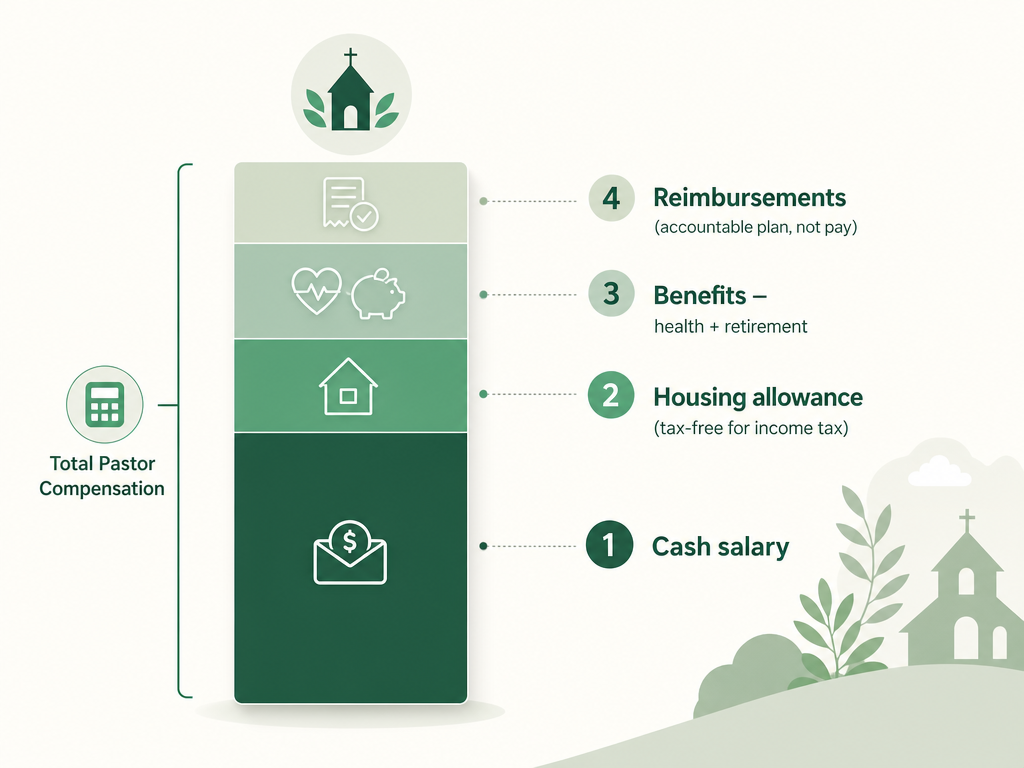
Here is the piece most “what do pastors make” answers miss: a pastor’s real compensation is a bundle, and the cash-salary line understates it. A typical full package has four parts.
- Cash salary — the taxable wage the surveys usually headline.
- Housing allowance — a portion of pay a minister can designate for housing and exclude from income tax. Around 70% of full-time pastors receive a tax-free housing allowance (Tithely 2025 guide), and it is a major, deliberately tax-advantaged chunk of pay. The mechanics, the “lesser of three” limit, and the catch that it is still subject to self-employment tax are covered in the clergy housing allowance guide.
- Benefits — health insurance and retirement contributions, plus paid vacation (about 90% of full-time pastors get paid vacation, per the Tithely guide).
- Reimbursements — ministry expenses (mileage, books, conferences) paid back under an accountable plan, which are not pay at all and not taxable.
One extra churches routinely mishandle: a love offering — a special collection given to the pastor, often for pastor appreciation — is taxable pay, not a tax-free gift. The housing allowance also collides with clergy’s unusual tax status. A pastor is a W-2 employee for income tax but self-employed for Social Security, paying SECA on salary and on the housing allowance. That dual status, and the way the housing allowance shows up on the W-2, is exactly the thing churches get wrong — the church payroll guide walks through how a pastor is actually paid and reported. Because the package, not the salary, is what a pastor lives on, comparing two jobs by base salary alone can be misleading: a lower-salary church with a generous housing allowance and full benefits can out-pay a higher-salary one with neither.
How a church sets a pastor’s salary
Setting clergy pay is a governance act, not a guess, and a careful church follows a short, defensible process. A board or compensation committee — never the pastor setting their own number — pulls comparable data for churches of similar size, budget, and region, then approves a full package: salary, a designated housing allowance, benefits, and an accountable reimbursement plan. Designating the housing allowance in advance and in writing is a hard requirement, not a formality. The IRS standard the whole package must meet is reasonable compensation.
Two reasons to do it this way. The first is fairness — a pastor should be paid reasonably for the work, and a documented, comparables-based number protects against both under- and over-paying. The second is legal: for a leader of a tax-exempt church, pay that is unreasonably high can trigger IRS “excess benefit” problems, so a board that sets pay against market data and minutes the decision is protecting the church’s exempt status as much as the pastor’s paycheck. The full step-by-step — building the package, documenting the housing designation, and keeping it reasonable — lives in the pastor compensation package guide.
Pastor salary by church size and by role
Two variables move the number more than any other, and each deserves its own data. Size first: a church’s attendance and budget set the ceiling on what it can pay, which is why the same title pays so differently across churches — the full breakdown is in pastor salary by church size. Role next: senior, associate, youth, worship, and executive pastors occupy different pay tiers within the same church, detailed in pastor salary by role.
One more benchmark ties pay back to the budget. A common planning question is what share of total income should go to staff compensation at all — the rough one-third to half rule of thumb, and why it varies, is covered in church budget percentages. Together those three answer “what should our pastor make” far better than any national average can.
FAQ
How much does the average pastor make? The federal median clergy wage is about $60,820 a year (BLS, May 2024), and job-data sites put the average pastor near $57,000–$61,000 in base salary (Payscale; ZipRecruiter). Most full-time pastors fall in a wide band, and total compensation runs higher once housing and benefits are added — figures vary widely by church size, region, denomination, and experience.
Do pastors get a salary or a housing allowance? Usually both. A pastor’s pay is split into a cash salary and a designated housing allowance, plus benefits. The housing allowance is a portion of the package set aside for housing costs and excluded from income tax, and roughly 70% of full-time pastors receive one (Tithely). The allowance must be designated in advance and in writing.
How much do megachurch pastors make? Far more than the median. Senior pastors of the largest churches — those with 5,000 to 10,000 in attendance — averaged over $250,000 in 2024 (Vanderbloemen 2025), and the very largest can run higher still. Those numbers are outliers that pull averages upward and do not reflect what a typical church pays.
Is a pastor’s salary taxable? Mostly, with one big exception. A pastor’s cash salary is subject to income tax, and a minister has a dual tax status — W-2 for income tax but self-employed for Social Security, so they pay SECA on their pay. A properly designated housing allowance is excludable from income tax, but it is still subject to SECA (BLS clergy data). Confirm specifics with a tax professional.
This is general information, not tax or legal advice — confirm your church’s situation with a qualified professional.
Once a church board sets the pastor’s pay, the work shifts to tracking it. Vestrybooks records the whole package — cash salary, the designated housing allowance, benefits, and reimbursements — in the church’s books, so the numbers stay clean for the budget, the W-2, and the next compensation review. See how it works.
This article is general information for church treasurers, not professional tax or legal advice. For your church's situation, consult a qualified accountant or attorney.
Church accounting a volunteer can actually do.
Vestrybooks is church accounting + giving for the volunteer treasurer — fund tracking, one-click year-end statements, and online giving with $0 taken from every gift.
A real free plan · no credit card · your data stays yours