Blog · Clergy compensation
Pastor appreciation month: ideas (and the tax rule)
July 4, 2026 · By Benjamin Reinke

Short answer: Pastor Appreciation Month is October, and Pastor Appreciation Day is the second Sunday in October — so in 2026 it lands on October 11. The tradition began with Hallmark in 1992 and grew into a full month after Focus on the Family started promoting Clergy Appreciation Month in 1994. The best ways to honor a pastor are usually the least expensive — a written note, real time off, a public thank-you. But there’s one thing well-meaning churches almost always get wrong: an appreciation gift the church collects and hands to the pastor is taxable pay, not a tax-free gift, and it belongs on the W-2. This guide covers both — the warm ideas first, then how to do the money part right.
When is Pastor Appreciation Month, and where did it come from
Pastor Appreciation Month runs the whole of October, and the focal point is Pastor Appreciation Day on the second Sunday — October 11 in 2026. Some churches also call it Clergy Appreciation Month, since the intent covers priests, ministers, associate and youth pastors, and anyone who shepherds the congregation.
The origin is more recent than the sentiment. The custom of setting aside a day to honor clergy started as a Hallmark initiative in 1992, and Focus on the Family began promoting Clergy Appreciation Month as a month-long observance in 1994. The idea itself is old, though — Paul told the church at Ephesus to give “double honor” to elders who lead well, “especially those whose work is preaching and teaching” (1 Timothy 5:17). October just gives a small church a scheduled reason to actually do it.
You don’t need a big budget or a program committee. What follows is a set of ideas any small church can pull off, roughly ordered from free to more involved.
Genuinely good pastor appreciation ideas for a small church
The best appreciation isn’t the most expensive — it’s the most personal and the most restful. Pastors overwhelmingly say they’d trade a plaque for words that show someone was paying attention, and time that’s actually theirs. Start here.
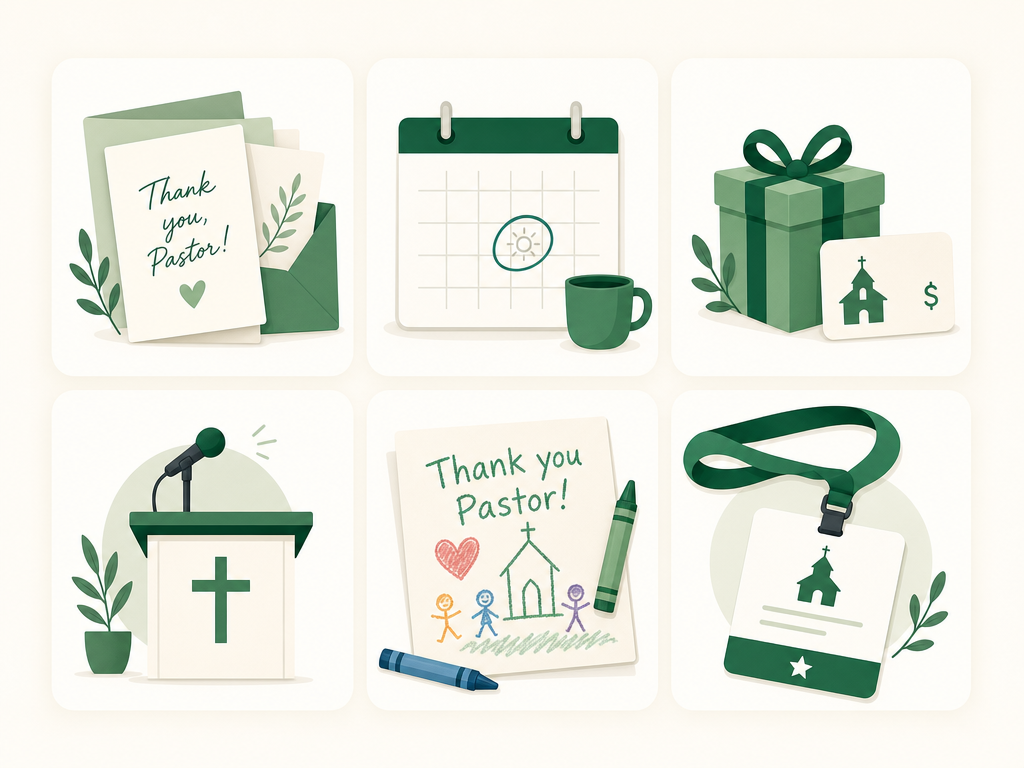
- A card-and-word blitz. Hand out cards one Sunday and ask everyone to write one specific thing their pastor did that mattered — a hospital visit, a sermon that landed, a hard conversation handled well. Specific beats generic every time. Collect them into a book the pastor can reread on a discouraging Monday.
- Real, extra time off. Give a Sunday (or two) fully covered by a guest speaker so the pastor can genuinely rest — not “take Monday off” while the phone still rings. For a longer-tenured pastor, floating the idea of a sabbatical can be the single most restorative gift a church gives.
- A gift card to something they’d never buy themselves. A favorite restaurant, a bookstore, a hardware store, tickets to a game. It’s small, personal, and it tells the pastor the church knows them as a person. (Note the tax wrinkle below — cash and gift cards are handled differently than a physical gift.)
- A book or a hobby gift. A commentary set they’ve mentioned wanting, fly-fishing gear, a good coffee grinder, seeds for the garden. The point is that someone remembered what lights them up outside the pulpit.
- Public recognition done well. A heartfelt spoken tribute, a short video of members saying thank you, a reception after the service. Keep it warm and specific rather than a stiff award presentation.
- A written note from the kids. Have the children’s ministry make cards or a banner. There is no pastor alive who throws away a crayon drawing that says “thank you for teaching me about Jesus.”
- Practical help. Organize a workday at the parsonage, a freezer stocked with meals, a housecleaning, snow removal for the winter, or an oil change. Serving the pastor’s household says “we’ve got you” more concretely than words.
- Cover a conference or continuing education. Send the pastor (and spouse) to a ministry conference, a marriage retreat, or a class they’ve wanted to take. It honors them and invests in the church at the same time.
- A love-offering collection. Many churches take up a special offering to bless the pastor financially — a completely fine and generous thing to do. Just handle it correctly, which is the part the rest of this guide is about. For running the collection itself well, see these church fundraising ideas.
Pick two or three, not all ten. A card book, a covered Sunday, and a specific gift will land far better than a rushed everything-at-once.
Are pastor appreciation gifts taxable? The rule churches miss
Here’s the part good-hearted churches get wrong, and it’s the one that can actually hurt the pastor: a monetary appreciation gift that the church collects and gives to the pastor is taxable compensation — not a tax-free gift — and it goes on the W-2. It feels like a gift. Under the tax code, it isn’t.
The reason is a single subsection. IRC §102(a) says gifts aren’t taxable income — the rule everyone remembers. But §102(c) is the one that decides it: the gift exclusion “shall not exclude from gross income any amount transferred by or for an employer to, or for the benefit of, an employee.” The pastor is the church’s employee. So the moment the church routes appreciation money to the pastor, the statute takes “it’s a gift” off the table. It’s pay.
The IRS applies exactly that logic to church appreciation collections. As StartCHURCH summarizes the rule, when a church gives a love offering, appreciation gift, or Christmas gift to the pastor from the congregation as a whole and it goes beyond a token amount, it is generally taxable income — and there are no major exceptions. And the courts back it: in Goodwin v. United States, a congregation’s organized, thrice-yearly “gifts” to its pastor were held to be taxable compensation, because “regular, sizable payments made by persons to whom the taxpayer provides services are customarily regarded as a form of compensation.” The full mechanics of why — and how to report a love offering to a guest speaker, too — are covered in the companion guide on whether love offerings are taxable.
The one real exception: a purely personal gift from an individual
There is a genuine tax-free case, and it’s the mirror image of a church collection: money one member gives the pastor directly, on their own, with the church never involved. If a family in the congregation writes the pastor a personal check out of affection — not for a specific service, not organized by the church, never receipted as a donation — that can be a nontaxable personal gift under §102(a).
The line is control and motive, not warmth:
| Church-collected appreciation gift | Personal gift from an individual | |
|---|---|---|
| Who collects it | The church solicits and pools it | One person gives directly |
| Church involvement | Announced, receipted, paid out | None — church never touches it |
| Tax result for the pastor | Taxable — goes on the W-2 | Usually not taxable |
| Deductible for the giver? | Yes (it’s a gift to the church) | No (person-to-person gift) |
Two traps hide in that table. First, the church can’t have it both ways: if it gives donors a charitable receipt for the money so they can deduct it, then it’s a gift to the church, and what the church pays out to the pastor afterward is compensation. The same dollars can’t be a deductible gift on the way in and a tax-free gift on the way out. Second, a “personal” gift stops being personal the moment leadership organizes it — passing a basket to “bless Pastor Dave” and handing over the pooled cash is the Goodwin fact pattern, not a spontaneous individual gift.
The honest exception: small non-cash de minimis tokens
One narrow category truly is tax-free even from the church: a de minimis gift — something so small and infrequent that tracking it would be unreasonable. Per the IRS de minimis fringe benefit rules, a holiday ham or turkey, a fruit basket, a book, or flowers can qualify.
But read the fine print, because it’s counterintuitive: cash and gift cards are never de minimis, no matter how small. The IRS is explicit that “cash and cash equivalent fringe benefits (for example, gift certificates, gift cards…), no matter how little, are never excludable as a de minimis fringe benefit.” So a $25 physical gift may be tax-free; a $25 Visa gift card is taxable pay. If your church wants to give something genuinely tax-free, make it a modest physical item — not cash and not a general-purpose gift card.
How to give an appreciation gift the right way
The fix is mechanical, and it protects the pastor from a surprise at tax time. When the church collects an appreciation offering for the pastor, run it through payroll and add it to the pastor’s taxable pay so it lands on the W-2.
- Report it as compensation. Add the appreciation offering to the pastor’s Form W-2 wages for the year. Because ministers have a dual tax status — employee for income tax, self-employed for Social Security — the church generally doesn’t withhold FICA, but the offering is still income-taxable and part of the pastor’s SECA base.
- Consider voluntary income-tax withholding. Offering to withhold a bit of federal income tax on the gift is a kindness, so the pastor isn’t blindsided in April.
- Keep the honest tax-free options honest. Person-to-person gifts stay outside the church entirely; a small physical de minimis token can be given as-is.
- Book it, don’t hide it. Don’t stash the offering in a “gift” account that quietly bypasses the W-2. Record it against the pastor’s compensation the moment it comes in.
None of this makes the church itself owe income tax. Getting it wrong creates a problem on the pastor’s return (underreported income) and a possible reporting penalty for the church — not a tax bill for the congregation. For the full picture of how a pastor is paid, reported, and taxed — salary, housing allowance, and benefits — see the guide to pastor salary.
Keep the appreciation clean: record it to the pastor’s pay
The reason appreciation gifts go sideways is rarely bad intent — it’s that the money moves outside the normal payroll path, so it never reaches the W-2. The discipline is simple: collect it, book it as compensation, report it.
Vestrybooks lets you record an appreciation love offering straight to the pastor’s compensation, so it flows onto the W-2 and the books stay clean — no separate “gift” account hiding taxable pay, and an audit trail behind every dollar.
Do that, and a generous congregation’s October gift blesses the pastor without setting up an unpleasant surprise the following spring.
FAQ
When is Pastor Appreciation Month? Pastor Appreciation Month is October, every year. The focal point, Pastor Appreciation Day, falls on the second Sunday in October — October 11 in 2026. The observance grew from a 1992 Hallmark initiative into a full month after Focus on the Family began promoting Clergy Appreciation Month in 1994. Many churches also call it Clergy Appreciation Month and extend it to all their ministers and staff.
Are pastor appreciation gifts taxable? Usually yes, when the church collects them. A monetary appreciation gift the church solicits, pools, and gives to the pastor is taxable compensation — it belongs on the pastor’s W-2 — because IRC §102(c) says a transfer from an employer to an employee isn’t an excludable gift, and cases like Goodwin v. United States treat organized congregational “gifts” as pay. A purely personal gift one member gives the pastor directly, with the church never involved, can be tax-free.
What are good, inexpensive pastor appreciation ideas? The most meaningful ones are nearly free: a card blitz where members write one specific thank-you each, a fully covered Sunday off so the pastor genuinely rests, notes and drawings from the kids, a heartfelt public tribute, and practical help around the parsonage. A modest physical gift — a book, a fruit basket, flowers — is tax-free as a de minimis item; cash and gift cards are not.
Can we give the pastor a tax-free cash gift for appreciation? Not through a church-collected offering. Because of IRC §102(c), any cash or gift card the church transfers to the pastor is taxable wages, and per the IRS de minimis rules, cash and gift cards are never de minimis regardless of amount. A tax-free option is a small physical item, or an individual member giving a personal gift directly on their own.
Should we take up a love offering for our pastor in October? It’s a generous and completely fine thing to do — just handle it correctly. Run the collection like any other special offering, then add the proceeds to the pastor’s taxable pay so it lands on the W-2. The reporting works the same way for an employee-pastor (it goes on the W-2) and for a paid guest speaker (a 1099-NEC once the year’s total crosses the threshold).
This is general information, not tax or legal advice — confirm your church’s specific situation with a qualified tax professional.
Once the appreciation offering is collected, the rest is just bookkeeping — record it against the pastor’s compensation, let it flow onto the W-2, and keep the audit trail. Vestrybooks does exactly that, so a warm October gift never turns into a reporting mistake. See how it works.
This article is general information for church treasurers, not professional tax or legal advice. For your church's situation, consult a qualified accountant or attorney.
Church accounting a volunteer can actually do.
Vestrybooks is church accounting + giving for the volunteer treasurer — fund tracking, one-click year-end statements, and online giving with $0 taken from every gift.
A real free plan · no credit card · your data stays yours