Blog · Payroll & clergy taxes
How church payroll works for treasurers
June 27, 2026 · By Benjamin Reinke
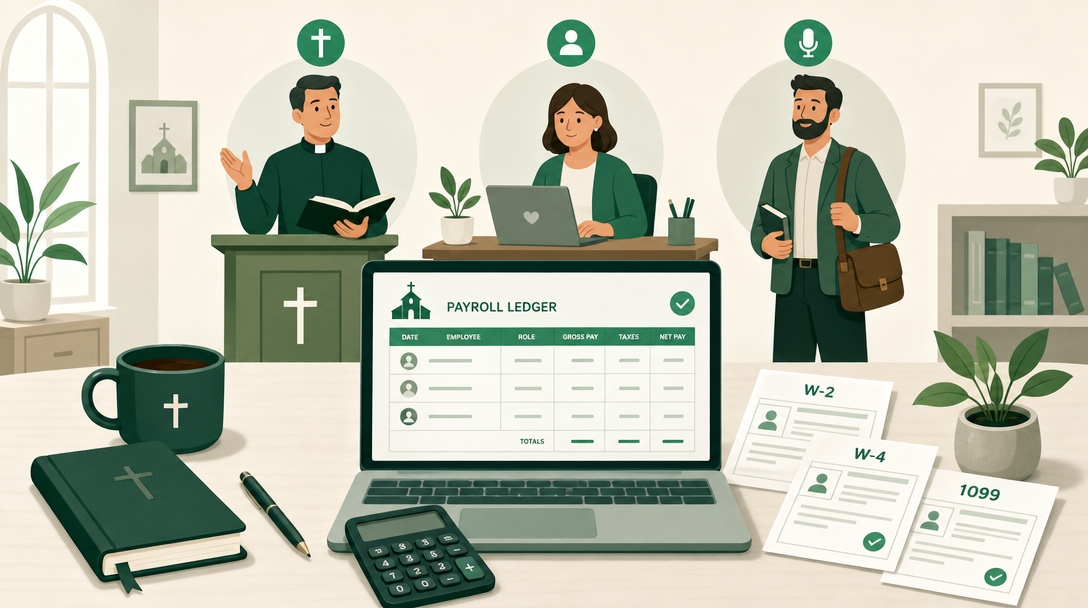
Short answer: Church payroll is the process by which a church pays and reports the people who work for it — and the rules change depending on which of three groups a worker falls in. A non-minister employee (secretary, custodian, childcare worker) is normal payroll: the church withholds federal income tax plus the employee’s share of FICA, matches the employer FICA, and issues a W-2. A minister has a “dual tax status” — a W-2 employee for income tax, but self-employed for Social Security, so the church does not withhold FICA and the minister pays SECA themselves. A one-off independent contractor (a guest speaker, a repair person) gets no withholding and a 1099-NEC if paid $2,000 or more (the 2026 threshold, up from $600). Getting the clergy worker’s treatment right is the part churches break most.
The three kinds of worker a church pays
Church payroll starts with one question, and almost everything else follows from it: which of these three is this person? The forms, the withholding, and the year-end reporting are different for each, so misclassifying someone quietly creates a tax problem that surfaces later.
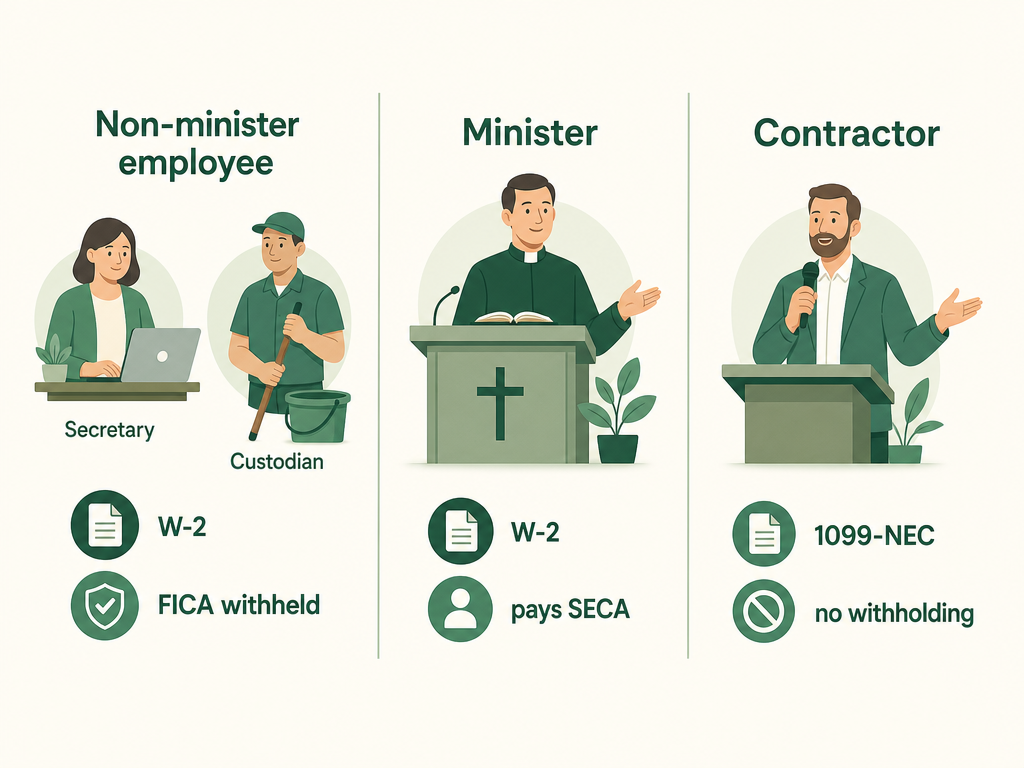
| Worker type | Form they get | Withholding | How the church treats them |
|---|---|---|---|
| Non-minister employee (secretary, custodian, childcare) | W-2 | Federal income tax + employee FICA; church matches employer FICA | Normal payroll — collect a W-4, withhold, remit |
| Minister (pastor performing ministerial duties) | W-2 | No FICA withheld; income tax withheld only if the minister asks (voluntary) | Dual status — employee for income tax, self-employed for Social Security (pays SECA) |
| Independent contractor (guest speaker, one-off help) | 1099-NEC (if $2,000+) | None — they handle their own taxes | Not on payroll; collect a W-9, file a 1099-NEC if the year’s total hits $2,000 |
The sections below walk through each row.
Non-minister staff are ordinary W-2 payroll
A church’s non-minister employees — the office secretary, the custodian, the paid nursery or childcare worker, the bookkeeper you hired as staff — are treated exactly like employees at any small business. The church collects a Form W-4 when they’re hired, then on every paycheck it withholds federal income tax and the employee’s half of FICA (Social Security and Medicare), and the church pays the matching employer half of FICA out of its own pocket. At year-end each one gets a W-2.
There’s nothing church-specific here; the mechanics are the standard employer rules in IRS Publication 15 (Circular E), Employer’s Tax Guide. “We’re a tax-exempt church” does not exempt the staff member’s paycheck from income or FICA tax — the exemption belongs to the organization, not its people.
Ministers have a dual tax status — W-2, but no FICA withheld
A minister is the one worker that trips churches up, because clergy sit in two tax worlds at once. For income tax, a minister who works for the church is an employee and gets a W-2. But for Social Security and Medicare, a minister is treated as self-employed with respect to ministerial services — so the church does not withhold FICA from a pastor’s pay, and the church does not pay the employer FICA match on it. Instead the minister pays SECA (self-employment tax, the combined 15.3% both halves) on their own, usually through quarterly estimated payments (IRS Publication 517, Social Security and Other Information for Members of the Clergy and Religious Workers; IRS Publication 1828, Tax Guide for Churches & Religious Organizations).
Two practical points fall out of this:
- A minister can have part of their pay designated as a housing allowance, which is excluded from income tax (though not from SECA). That’s a whole topic on its own — see how the clergy housing allowance works.
- Because no income tax is withheld automatically, a minister can ask the church to voluntarily withhold income tax from their paychecks, which is a common, sensible way to cover both the income tax and the SECA bill so the pastor isn’t blindsided at filing time.
A small number of ministers formally opt out of Social Security with Form 4361, but that’s a permanent, religious-objection decision, not a payroll default.
Contractors get a 1099-NEC, not a paycheck
A genuine independent contractor — a guest speaker or evangelist you bring in for one weekend, a musician hired for a single event, a plumber, a one-off cleaner — is not on payroll at all. The church withholds nothing; the contractor handles their own taxes. Before you pay them, collect a Form W-9 so you have their legal name and taxpayer ID. Then, if you pay one unincorporated contractor $2,000 or more (the 2026 threshold, up from $600) for services over the calendar year, you file a Form 1099-NEC — one copy to the contractor and one to the IRS — by January 31.
The line that matters: a pastor on staff is an employee (W-2), not a contractor. Putting a regular salaried pastor on a 1099 to dodge payroll is a classic, costly mistake. The deeper how-to on the 1099 threshold, the W-9 step, and the corporation exceptions lives in do nonprofits issue 1099s.
The payroll filings a church actually files
Once non-minister staff are on payroll, the church has a short, predictable set of filings:
- Form 941, Employer’s Quarterly Federal Tax Return — filed every quarter to report the federal income tax the church withheld and the FICA (employee + employer share) on its non-minister employees. This is the workhorse form. (A few small employers qualify to file annually on Form 944 if the IRS notifies them, but quarterly Form 941 is the default — see Publication 15.)
- Form W-2 for each employee in January (due to employees and the Social Security Administration by January 31), reporting the year’s wages and withholding.
- Form 1099-NEC for each contractor paid $2,000+, also by January 31.
One genuine break: churches and other 501(c)(3) organizations are generally exempt from federal unemployment tax (FUTA), so a church typically does not file Form 940 (IRS Publication 15; IRS Publication 1828). State unemployment rules vary, so check your state separately. The point is that the federal unemployment piece most businesses deal with usually doesn’t apply to a church.
Setting up church payroll the first time
If your church is starting payroll from scratch, the setup is short:
- Get an EIN (Employer Identification Number) from the IRS if the church doesn’t already have one — you need it to report and deposit payroll taxes.
- Collect a W-4 from every employee (and a W-9 from every contractor before you pay them).
- Pick how you’ll run it — a payroll service, payroll software, or a careful spreadsheet-plus-deposits setup for a tiny staff. A service mainly earns its keep by handling deposits and the quarterly Form 941 so a volunteer treasurer isn’t doing it by hand.
- Get the clergy treatment right — this is the one churches break. Do not withhold FICA from a minister, and do not put a salaried pastor on a 1099. A pastor is a W-2 employee who pays SECA; the church withholds income tax only if the pastor asks. Setting the pastor’s pay package — salary, housing allowance, benefits — is its own decision, covered in pastor salary.
Keeping every worker classified correctly, every paycheck recorded, and every quarter’s numbers ready is ordinary church bookkeeping done on time, not anything exotic.
Vestrybooks keeps your church’s pay records, housing-allowance designations, and contractor totals clean and provable — so the quarter’s Form 941 numbers and January’s W-2s are always one click away. See plans →
FAQ
Do churches have payroll? Yes. Any church with paid staff — a pastor, a secretary, a custodian, a childcare worker — runs payroll. It withholds income tax and FICA on non-minister employees, handles ministers under their dual tax status, and files Form 941 each quarter and W-2s in January.
How do small churches handle payroll? A small church gets an EIN, collects a W-4 from each employee, and either uses a payroll service or runs it carefully in-house. The common path is a low-cost payroll service that files Form 941 and the W-2s, so a volunteer treasurer isn’t managing deposits and quarterly returns by hand.
How do you do church payroll? Classify each worker (non-minister employee, minister, or contractor), collect the right form (W-4 or W-9), withhold income tax and FICA on non-minister staff, withhold no FICA from ministers, file Form 941 quarterly, and issue W-2s and any 1099-NECs by January 31.
Does a church withhold Social Security and Medicare from a pastor? No. A minister is self-employed for Social Security purposes, so the church does not withhold FICA from clergy pay and does not pay the employer FICA match. The minister pays SECA themselves, usually through quarterly estimated taxes, and can ask the church to withhold income tax voluntarily.
Do churches pay federal unemployment tax (FUTA)? Generally no. Churches and 501(c)(3) organizations are typically exempt from FUTA, so a church usually does not file Form 940. State unemployment rules vary, so confirm your state’s treatment separately.
Does a church have to do payroll? Yes, once it pays anyone. As soon as a church has even one paid worker, it must run payroll properly — for a non-minister employee that means withholding income tax and FICA and remitting them on time, and for a pastor it means handling the clergy dual status correctly. Being tax-exempt does not excuse a church from withholding and reporting on the people it pays.
What’s different about church payroll? The main difference is the minister. A pastor performing ministerial duties is a W-2 employee for income tax but self-employed for Social Security, so the church withholds no FICA from clergy pay and pays no employer FICA match — the minister pays SECA instead. Beyond that, a church classifies workers as W-2 employees or 1099 contractors like any employer, and it is usually exempt from federal unemployment tax (FUTA). The body above walks through each piece.
How long should a church keep payroll records? IRS guidance directs employers to keep employment-tax records for at least four years after the tax becomes due or is paid, whichever is later, so a church should hold its payroll records at least that long (IRS Publication 15). Some records are worth keeping longer, and a written document retention policy sets clear, consistent timelines for the whole church.
Should the pastor be in charge of the church’s finances? No. The pastor should not control the church’s money end to end — separation of duties means the person who can spend or sign isn’t also the one who records and reconciles. A board, a treasurer, and an independent review (or audit) provide the check that protects both the church and the pastor, and it is one of the strongest guards against church embezzlement.
This is general information, not tax or legal advice — confirm your church’s situation with a qualified professional.
This article is general information for church treasurers, not professional tax or legal advice. For your church's situation, consult a qualified accountant or attorney.
Church accounting a volunteer can actually do.
Vestrybooks is church accounting + giving for the volunteer treasurer — fund tracking, one-click year-end statements, and online giving with $0 taken from every gift.
A real free plan · no credit card · your data stays yours