Blog · Nonprofit compensation
Nonprofit salaries and executive compensation, by the numbers
June 28, 2026 · By Benjamin Reinke
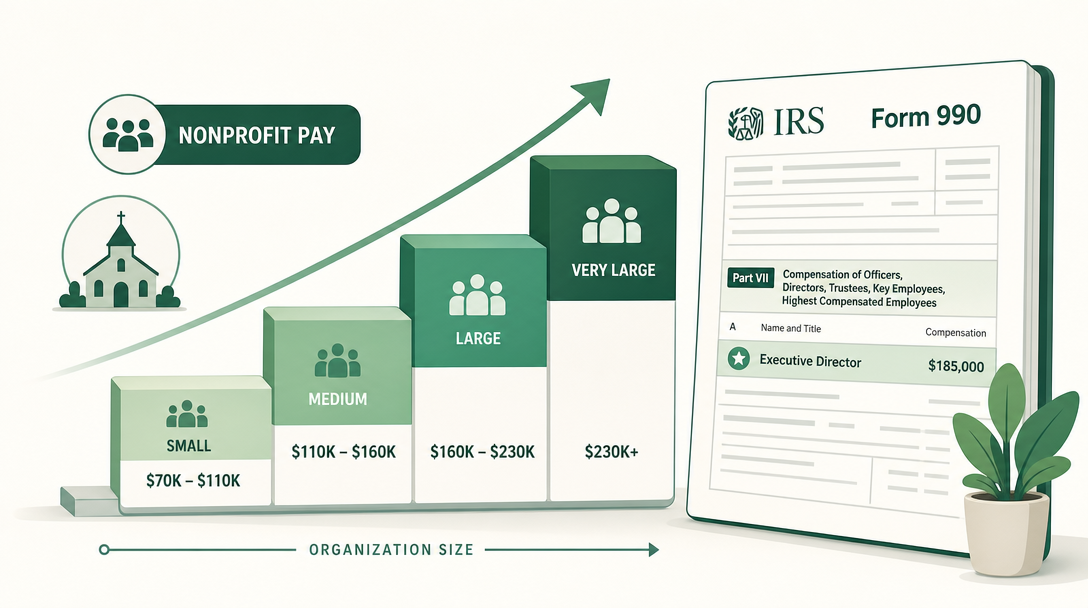
Short answer: A salary for nonprofit organizations spans a wide range, but the best single benchmark for the top job is Candid’s analysis of IRS filings, which puts median executive/CEO compensation at about $110,000 as of 2023 (Candid 2025 Nonprofit Compensation Report). Most rank-and-file nonprofit staff earn far less — the average across the sector lands near $67,000 (NonProfit Times 2025 Salary & Benefits Report). Two facts shape every figure below. First, pay scales with budget size more than any other variable: a director at a sub-$1M organization may earn well under $70,000, while a CEO of a $50M-plus organization can clear several hundred thousand (Candid 2024 report). Second, much of this is public — every 501(c)(3) discloses its leaders’ pay on Form 990, Part VII, so donors and watchdogs can read it line by line (IRS). Every number here traces to a named source and is current as of 2026 from the studies cited.
Pay is one line in a much larger financial picture, and how a nonprofit records, budgets, and reports it sits inside the broader discipline of nonprofit accounting. The figures below are benchmarks for setting and sanity-checking that line — not a promise of what any single organization pays.
What nonprofit roles pay
No two compensation studies count the same population the same way. Candid’s reports are built from actual IRS Form 990 filings rather than voluntary surveys, which makes them unusually authoritative for executive pay (Candid); job-data sites and staffing surveys lean toward self-reported, often higher figures for advertised roles. Read the ranges below as overlapping estimates segmented the way the data actually segments — by role and by organization size — not as a single paycheck. Wide variation is the honest finding.
| Role / segment (as of 2026) | Source | Figure / range |
|---|---|---|
| Executive director / CEO, all nonprofits — median | Candid 2025 report (2023 IRS data) | ~$110,000 |
| Executive director / CEO, small org (under ~$1M budget) | search-summarized from sector guides | ~$45,000–$70,000 |
| Executive director / CEO, mid org (~$1M–$2.5M budget) — median | search-summarized from sector guides | ~$75,000 |
| CEO, large org (over $50M budget) — median | Candid 2024 report (male/female medians) | $430,640–$559,770 |
| Social & community service managers — median wage | BLS, May 2024 | $78,240 |
| Social & community service managers — 10th–90th percentile | BLS, May 2024 | <$50,020 to >$129,820 |
| Top finance position — median | Candid 2024 report (2022 data) | ~$125,000 |
| Top administrative position — median | Candid 2024 report (2022 data) | ~$135,000 |
| Average nonprofit staff salary, all roles | NonProfit Times 2025 report | ~$67,000 |
A few cautions belong under the table as much as above it. The Candid medians cover all reporting nonprofits, which is why the headline executive figure ($110,000) sits well below the large-organization medians and well above the small-organization ranges — it is a midpoint across a hugely uneven sector. The small- and mid-organization rows are summarized from sector compensation guides rather than a single primary dataset, so treat them as directional. The BLS “social and community service managers” line is the closest federal occupation to a nonprofit program director and is useful precisely because it is government data, though it does not map perfectly onto the “executive director” title. A board benchmarking its own director should pull comparables for its budget size, sector, and region — exactly the dimensions Candid’s full report breaks out into 25th-percentile, median, and 75th-percentile bands (Candid 2025 report).
Stated plainly, the data shows a long tail in both directions. Median pay growth has been steady: executive compensation rose from a $97,000 median in 2019 to $110,000 in 2023 (Candid 2025 report), and average nonprofit salaries grew about 4.77% in the most recent year measured (NonProfit Times 2025 report). The most useful version of this table, as first-party survey responses accumulate, is a full percentile breakdown segmented by budget bracket and program area — because an average alone hides exactly the variation that decides what any one organization should pay.
What drives nonprofit pay
Four factors explain most of the spread, and they compound.
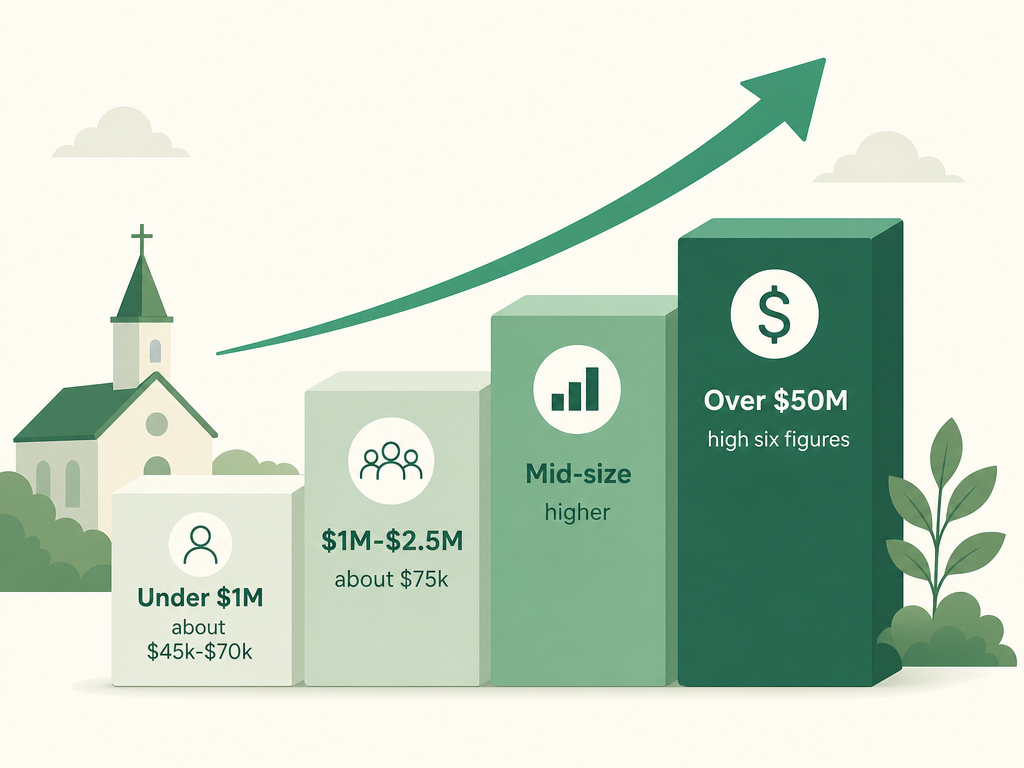
- Budget size. Organization revenue is the strongest single predictor of executive pay. Pay climbs steeply across budget brackets: directors at organizations under $1M in budget often sit in the $45,000–$70,000 band, the median at $1M–$2.5M organizations is around $75,000, and at organizations over $50M the median CEO earns between $430,640 and $559,770 (Candid 2024 report). A larger budget simply funds a larger payroll line.
- Sector. Mission area moves the number sharply because revenue models differ. Median executive compensation runs about $200,000 at science and technology research institutes and $198,000 at health and rehabilitative organizations, but only about $67,000 at religious institutions and $97,000 in arts, culture, and humanities (Candid 2024 report). Health and higher-education nonprofits pay more largely because insurance reimbursements, tuition, and large grants support higher payroll (NonProfit Times 2025 report).
- Geography. Location tracks local cost of living. The District of Columbia, New York, and Massachusetts post the highest median executive pay, with the Northeast leading among regions (Candid 2024 report). Directors in major metros typically earn 15% to 30% more than peers in rural or mid-sized markets (NonProfit Times 2025 report).
- Role. Title sets the tier within an organization. Below the CEO, the top finance position runs a median near $125,000, the top administrative position near $135,000, and the top development position near $150,000, while frontline program and support staff earn closer to the sector-wide ~$67,000 average (Candid 2024 report; NonProfit Times 2025 report).
Two more forces sit underneath those four. Experience and credentials nudge pay up within any band, so a director with fifteen years and a relevant graduate degree tends to land above an entry-level peer at the same organization. And the funding mix matters as much as the headline budget: an organization whose revenue is restricted grant money has less flexibility to fund a large salary than one with the same budget in unrestricted gifts, even though both report similar totals on the 990.
Crucially, these factors interact rather than add up cleanly. A finance director at a $60M health system in Boston can sit near the top of every band at once; a sole executive director of a $400,000 arts nonprofit in a rural county sits near the bottom of all of them. A single “average nonprofit salary” is therefore close to meaningless on its own — the honest answer is always a range with the organization’s own budget, sector, region, and the specific role plugged in.
Form 990 makes nonprofit pay public
Here is what sets nonprofit compensation apart from the private sector: a large share of it is disclosed by law. Form 990, the annual return most tax-exempt organizations file, requires in Part VII the names and reportable compensation of every officer, director, and trustee, plus key employees and the highest-paid staff (IRS). The thresholds are specific. A key employee must be listed when reportable compensation exceeds $150,000 and the person controls a significant slice of the organization, and every filer must also report its five highest-compensated employees earning more than $100,000 (IRS). When pay or the role is larger, Schedule J breaks it down further into base, bonus, and other compensation.
Public disclosure is the point, not a side effect. A donor deciding where to give, a journalist checking a charity, or a watchdog rating it can pull the 990 and read leadership pay directly — Candid’s own compensation report is built entirely from these filings, which is why it covers more than 130,000 organizations without a single survey (Candid 2025 report). Reading a 990 well takes a little practice. Part VII lists each person’s title, average weekly hours, and reportable compensation, so a careful reader can see whether a high number reflects a full-time CEO or a part-time officer paid mostly by a related entity. The mechanics of locating and reading those numbers, and how an organization’s own 990 fits the wider filing, are covered in the Form 990 guide. The practical lesson for a board: pay is on the record, so set it deliberately and document why.
Keeping pay legal: reasonable compensation
Disclosure raises the stakes, because the IRS holds nonprofit pay to a standard. Compensation must be reasonable — roughly, what a similar organization would pay for similar work — and pay that is unreasonably high can trigger excise taxes on both the recipient and the board members who approved it (IRS, intermediate sanctions). A board protects itself by following the rebuttable presumption process: approve pay in advance through a body with no conflicts, rely on comparability data from peer organizations of similar size and region, and document the decision in the minutes (National Council of Nonprofits). The full rules, the comparables a board needs, and the documentation that shifts the burden of proof are laid out in the nonprofit reasonable compensation guide.
Board pay is its own question with a different default. Most nonprofit board members serve unpaid, and paying them at all changes the governance and tax calculus — the when, why, and how is covered in do nonprofit board members get paid.
FAQ
What is the average nonprofit executive director salary? The most authoritative benchmark, drawn from actual IRS filings, puts median executive/CEO compensation at about $110,000 as of 2023 (Candid 2025 report). That midpoint hides a huge spread: directors at small organizations under $1M in budget often earn $45,000–$70,000, while CEOs at organizations over $50M post medians in the $430,640–$559,770 range (Candid 2024 report). Budget size, sector, and region drive the difference, so a national average says little about any specific organization.
Can nonprofits pay high salaries? Yes — within limits. A nonprofit may pay competitive, even six-figure, salaries; the constraint is that pay must be reasonable for the role, the organization’s size, and its location, not that it must be low (IRS). The largest organizations legitimately pay their CEOs several hundred thousand dollars (Candid 2024 report). Pay that exceeds what comparable organizations pay, however, can be treated as an excess benefit and penalized, which is why boards benchmark against peers and document the decision.
Are nonprofit salaries public? Much of executive pay is. Every 501(c)(3) reports its officers’, directors’, and highest-paid employees’ compensation on Form 990, Part VII, and those returns are public (IRS). Anyone can read the executive director’s pay, plus any key employee over $150,000 and the top five staff over $100,000. Rank-and-file individual salaries are not itemized by name, but total salary expense appears in the financials and aggregate leadership pay is on the record.
How much of a nonprofit’s budget should go to salaries? There is no fixed legal ratio, and the right share depends heavily on the mission. A direct-service or staff-intensive organization may spend most of its budget on people, while a grantmaking or volunteer-run organization spends far less. Rather than chase a target percentage, a board should set each salary against comparable organizations of similar size and region and confirm the total is sustainable against revenue (National Council of Nonprofits). Reasonableness per role, not a budget-wide rule of thumb, is the standard that matters.
This is general information, not tax or legal advice — confirm your organization’s situation with a qualified professional.
Once a board sets nonprofit pay, the work shifts to tracking it. Vestrybooks budgets and tracks staff compensation in the nonprofit’s books, so salary lines stay clean for the budget, the financial statements, and the next 990. See how it works.
This article is general information for church treasurers, not professional tax or legal advice. For your church's situation, consult a qualified accountant or attorney.
Nonprofit accounting, minus the headache.
Vestrybooks does fund accounting, donor tracking, and board-ready reports for churches and faith-based nonprofits.
A real free plan · no credit card · your data stays yours