Blog · Clergy compensation
How to build a pastor's compensation package
June 28, 2026 · By Benjamin Reinke
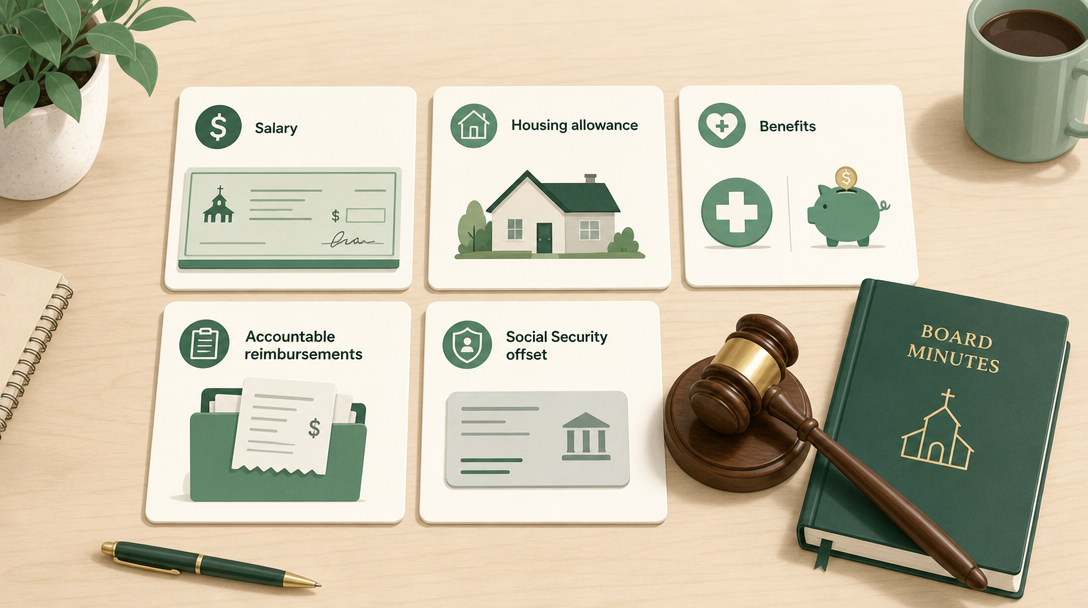
Short answer: A pastor is not paid a salary — a pastor is paid a package, and the difference is the whole point. A well-built clergy compensation package has five parts: a cash salary, a designated housing allowance, benefits like health and retirement, an accountable reimbursement plan for ministry expenses, and often a Social Security (SECA) offset. Each piece is taxed differently, and one of them — the housing allowance — only works if the board designates it in writing, in advance. A board or compensation committee builds the package using comparable pay data and minutes the decision, both as good stewardship and to stay inside the IRS rule that a church leader’s pay must be “reasonable.” For the underlying numbers — what pastors actually earn by size, region, and role — start with the pastor salary guide; this page is the how-to for turning those numbers into a structured, compliant package.
Knowing the market figure is only half the job. A church that hears “the median is around $60,000” and writes one $60,000 salary line has missed where most of the value, and most of the tax risk, actually lives. The market data tells you how much; structuring the package tells you how — and a thoughtfully built package can deliver the same total cost to the church while leaving the pastor meaningfully better off after tax. The sections below walk through the five pieces, the housing-allowance move that matters most, the reimbursement plan churches most often get wrong, and how a board sets and documents the whole thing.
The pieces of a pastor’s compensation package
Five components make up a typical full-time pastor’s package. Each one behaves differently for tax purposes, which is exactly why they belong on separate lines rather than buried in a single “salary” number.
-
Cash salary. The taxable wage — what the surveys usually headline and what most people picture when they hear “pastor’s pay.” It is reported on a W-2 and subject to both income tax and self-employment tax. Everything else in the package sits on top of this.
-
Housing allowance. A portion of the package the board designates for the minister’s housing costs, which the pastor can then exclude from income tax under IRS Publication 517. This is the single most valuable piece for the pastor and the one with the strictest rule — it must be designated in advance, covered in its own section below.
-
Benefits. Employer-paid health insurance and retirement contributions, plus paid time off. Churches commonly fund a medical plan and contribute to a 403(b) retirement account — the 403(b)(9) church retirement plan is built for exactly this purpose (Clergy Financial Resources). Properly structured benefits are generally not taxable wages, so a dollar of health coverage is worth more to the pastor than a taxable dollar of salary.
-
Accountable reimbursement plan. The mechanism for paying ministry expenses — mileage, books, conferences, continuing education — back to the pastor without it counting as income. Done under an accountable plan, these reimbursements never hit the W-2. Done as a flat “expense allowance,” every dollar becomes taxable pay. This distinction has its own section.
-
Social Security (SECA) offset. Because a minister is self-employed for Social Security and pays the full 15.3% SECA tax themselves, many churches add an allowance to help cover it. A common practice is to provide an offset equal to 7.65% of salary and housing — half the SECA rate, mirroring the employer’s share a non-minister would get (California Southern Baptist Convention). One catch: the offset is taxable pay, not a tax credit, so it shows up as additional income on the W-2.
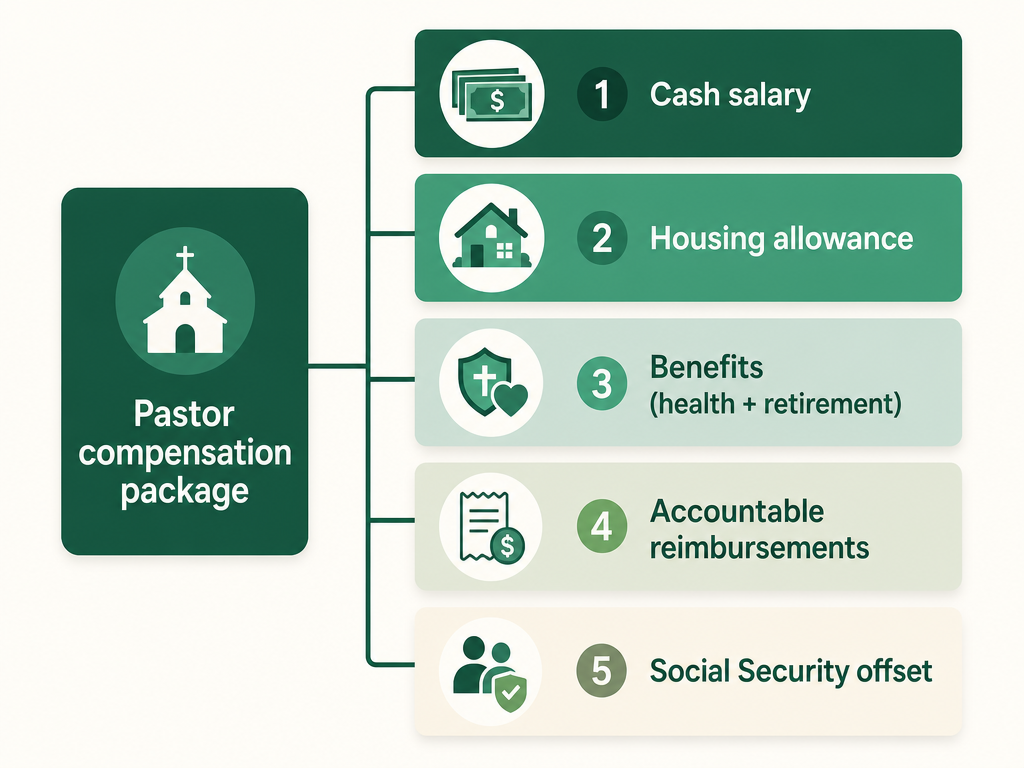
A useful way to read this list: only the first piece is plain taxable salary. The housing allowance is excluded from income tax, accountable reimbursements aren’t pay at all, and benefits are largely tax-free — so two churches spending the identical total can leave their pastors in very different after-tax positions depending on how the package is split.
The housing allowance: designate it in advance
If a board does only one thing right, it should be this. The minister housing allowance lets an ordained, commissioned, or licensed minister exclude a portion of pay from income tax — but the exclusion exists only if the church officially designates the amount before paying it. The IRS is blunt on the sequence: the employing organization must designate the allowance in advance, set a definite amount, and cannot decide or change it retroactively (IRS, Ministers’ compensation & housing allowance). A designation voted in December for the year already underway protects only the pay that comes after the vote.
Two limits keep it honest. The amount a pastor can actually exclude is the lowest of three figures: the amount the board designated, the actual housing costs the pastor incurred, and the fair rental value of the home including utilities (IRS Publication 517). And the exclusion is for income tax only — the housing allowance is still subject to SECA, so a pastor pays self-employment tax on it even though it escapes income tax. The mechanics, the “lesser of three” test, and the way the allowance is reported are worked through in the clergy housing allowance guide.
The practical move for a board: pass a written housing-allowance resolution every year, before the year starts, recorded in the minutes, naming a specific dollar amount. It costs nothing and it is the single most valuable line in the entire package.
Accountable reimbursements vs taxable allowances
Ministry costs money — gas, books, a conference registration, hospitality. How a church pays those back decides whether they are tax-free or taxable, and the gap is large. Under an accountable reimbursement plan, the pastor submits actual expenses and the church pays them back; under IRS Publication 517, those reimbursements are excluded from income entirely and never appear on the W-2. The plan has to meet three conditions: the expense has a genuine ministry (business) connection, the pastor substantiates it with records within a reasonable period, and any excess advance is returned. The IRS treats roughly 60 days as a reasonable window to substantiate and 120 days to return excess (Clergy Financial Resources, Accountable Reimbursement Plans).
Pay the same money as a flat expense allowance instead — a fixed monthly sum with no receipts required — and it becomes a non-accountable plan. Every dollar gets added to the pastor’s wages in Box 1 of the W-2 and taxed as income (IRS Publication 517). Same out-of-pocket cost to the church, but the pastor now pays income tax and SECA on money that simply covered ministry expenses.
The takeaway for budgeting: fund an accountable plan as a reimbursement line, not a salary line. A common mistake is rolling expenses into salary “to keep it simple” — simple, and quietly more expensive for the pastor every April.
How the board sets and documents the package
Setting clergy pay is a governance act, not a favor or a guess. The right body is a board or compensation committee with no conflict of interest — never the pastor setting their own number, and never a committee of the pastor’s relatives. That body should gather comparable compensation data for churches of similar size, budget, and region, decide the package against that data, and write down what it decided and why.
The reason this matters beyond fairness is a specific tax rule. A pastor is a “disqualified person” — an insider — at a tax-exempt church, and the IRS can treat unreasonably high pay as an excess benefit transaction, hitting the recipient with an excise tax of 25% of the excess (rising to 200% if not corrected in time) under the intermediate-sanctions rules (IRS, Intermediate sanctions — excess benefit transactions). A board can largely protect itself by earning the rebuttable presumption of reasonableness: approve the pay in advance through a body without conflicts, rely on appropriate comparability data, and document the basis for the decision concurrently in the minutes (IRS, Rebuttable presumption). Do those three things and the burden shifts to the IRS to prove the pay was unreasonable.
So the documented process looks like this: pull comparables for the church’s size, region, and the pastor’s role; build the full package — salary, designated housing allowance, benefits, accountable reimbursements, and any SECA offset; approve it through a clean committee; and record the figures, the comparable data relied on, the date, and who voted in the board minutes. Congregations are also reminded that the duty runs the other way too — a church is responsible for paying its pastor adequately, with medical, disability, and retirement provision, not merely cheaply (Servant Solutions). Reasonableness cuts both directions.
Paying it correctly
Once the package is set, paying it brings the clergy “dual tax status” into play, and this is where churches most often slip. A minister performing ministerial duties is a W-2 employee for income tax but self-employed for Social Security, so the church does not withhold FICA from the pastor’s pay and does not pay the employer FICA match. The pastor instead owes SECA — the full 15.3% — on salary plus the housing allowance, usually paid through quarterly estimates (IRS Publication 517). Putting a salaried pastor on a 1099 to dodge payroll, or withholding FICA as if the pastor were ordinary staff, are both classic, costly errors.
Each component lands on the W-2 differently: cash salary and the SECA offset go in taxable wages, the designated housing allowance is excluded from Box 1 (often noted in Box 14 instead), accountable reimbursements appear nowhere on it, and a non-accountable allowance gets folded back into wages. A minister can also ask the church to voluntarily withhold income tax, a sensible way to cover both the income-tax and SECA bills so April isn’t a shock. The full mechanics — which forms each worker gets, how the housing allowance is reported, and how the quarterly filings work — are in the church payroll guide.
FAQ
What is included in a pastor’s compensation package? A typical package has five parts: cash salary, a designated housing allowance (excluded from income tax but not SECA), benefits such as health insurance and retirement, an accountable reimbursement plan for ministry expenses, and often a Social Security offset to help cover the pastor’s self-employment tax. Only the salary and the offset are plain taxable wages; the housing allowance, accountable reimbursements, and most benefits are tax-advantaged (IRS Publication 517).
How is a pastor’s salary different from total compensation? Salary is just the taxable cash wage — one line of the package. Total compensation adds the housing allowance, benefits, reimbursements, and any SECA offset on top, so total compensation runs meaningfully higher than the “salary” figure most surveys report. Comparing two church jobs by base salary alone is misleading; a lower-salary church with a generous housing allowance and full benefits can out-pay a higher-salary one with neither.
Does the church have to designate the housing allowance in advance? Yes. The exclusion only applies to amounts the church officially designates before paying them — a specific dollar amount, set in advance, recorded in the minutes (IRS, Ministers’ compensation & housing allowance). A retroactive designation does not work, so most boards pass a written housing resolution each year before the year begins.
Who decides how much a pastor is paid? A board or compensation committee with no conflict of interest — not the pastor. The body should rely on comparable pay data, approve the package in advance, and document the decision in the minutes; doing so earns a rebuttable presumption that the pay is reasonable and guards against IRS excess-benefit penalties (IRS, Rebuttable presumption).
This is general information, not tax or legal advice — confirm your church’s situation with a qualified professional.
Vestrybooks records the whole package in the church’s books — cash salary, the designated housing allowance, benefits, and accountable reimbursements — each on its own line, so the figures stay clean for the budget, the W-2, and the next compensation review. See how it works.
This article is general information for church treasurers, not professional tax or legal advice. For your church's situation, consult a qualified accountant or attorney.
Church accounting a volunteer can actually do.
Vestrybooks is church accounting + giving for the volunteer treasurer — fund tracking, one-click year-end statements, and online giving with $0 taken from every gift.
A real free plan · no credit card · your data stays yours