Blog · Nonprofit compensation
Nonprofit reasonable compensation: the IRS rules
June 28, 2026 · By Benjamin Reinke

A nonprofit can pay competitive salaries — there is no IRS cap on what a 501(c)(3) may pay — but the pay has to be “reasonable,” meaning comparable to what similar organizations pay for similar work. Pay an insider more than that and the IRS treats the excess as an “excess benefit transaction” under Internal Revenue Code §4958, then imposes excise taxes on the person who got the money and on the board members who approved it. The safe path is a three-part process that earns what the IRS calls the rebuttable presumption of reasonableness: an independent board, comparable salary data, and a documented decision. As of 2026; confirm any specific situation with a tax professional or the IRS, because the figures and rules below can change.
This page sits under the broader question of nonprofit salaries — how much nonprofits pay and why. That overview answers “what do these jobs pay”; this guide answers the compliance half: how the IRS decides whether a given salary is legal, and what happens to a board that gets it wrong.
What “reasonable compensation” means
Reasonable compensation is the amount that would ordinarily be paid for like services by like enterprises under like circumstances — the same fair-market standard the IRS applies to for-profit pay. Nothing in that standard requires a nonprofit to underpay. A charity competing for a skilled executive director, surgeon, or investment manager may pay a market salary, and many large nonprofits pay six figures or more without any problem, because the pay matches what comparable organizations pay for comparable roles.
The test is comparison, not a number. The IRS does not publish a maximum nonprofit salary, and there is no statutory dollar ceiling. What the agency looks at is whether the total compensation package — salary, bonuses, deferred pay, benefits, and perks combined — lines up with what similarly situated organizations pay people doing functionally comparable work in the same kind of market. Pay that fits the comparables is reasonable. Pay that runs well past them, with no explanation, is where the agency starts asking whether an insider is being enriched at the organization’s expense.
That enrichment has a name in the tax code: inurement. A 501(c)(3)‘s earnings may not “inure” to the benefit of any insider, and overpaying one is a classic way it happens. Before 1996, the IRS had only one tool against it — revoke the organization’s tax exemption, a penalty so severe it was rarely used. Congress added §4958 to give the agency a middle option: tax the abuse instead of destroying the charity. That middle option is what the rest of this page covers.
The rebuttable presumption of reasonableness
The rebuttable presumption of reasonableness is a safe harbor written into the Treasury regulations at 26 CFR §53.4958-6. Follow its three steps when you set an insider’s pay and the burden flips: the IRS must presume the pay is reasonable, and it can only overturn that presumption by producing its own evidence that the comparables the board relied on were wrong. For a board, that shift in burden is the whole game — it is the difference between defending a salary and making the IRS attack it.
The regulation lists three requirements, and all three have to be met:
- Advance approval by an independent body. The pay is approved ahead of time by the board or a committee made up of people who have no conflict of interest in the transaction. Anyone who would benefit from the decision, or whose own pay it affects, is not part of the body that approves it.
- Reliance on comparability data. Before deciding, the body obtains and actually relies on “appropriate data as to comparability.” The regulation names the kinds that count — compensation paid by similar organizations (taxable and tax-exempt) for functionally comparable positions, independent compensation surveys, and written offers from organizations competing for the person’s services.
- Contemporaneous documentation. The body documents the basis for its decision at the time it makes it — not months later when a question arises. The minutes have to record the terms approved, who approved them, the comparability data relied on, and the date.
A smaller organization gets a defined shortcut. Under the regulation’s safe harbor, a nonprofit with annual gross receipts of less than $1 million is treated as having appropriate comparability data if it relies on data from three comparable organizations in the same or similar communities for similar services. Larger organizations are expected to reach further. The $1 million figure is a regulatory threshold as of 2026 — verify the current number before relying on it.
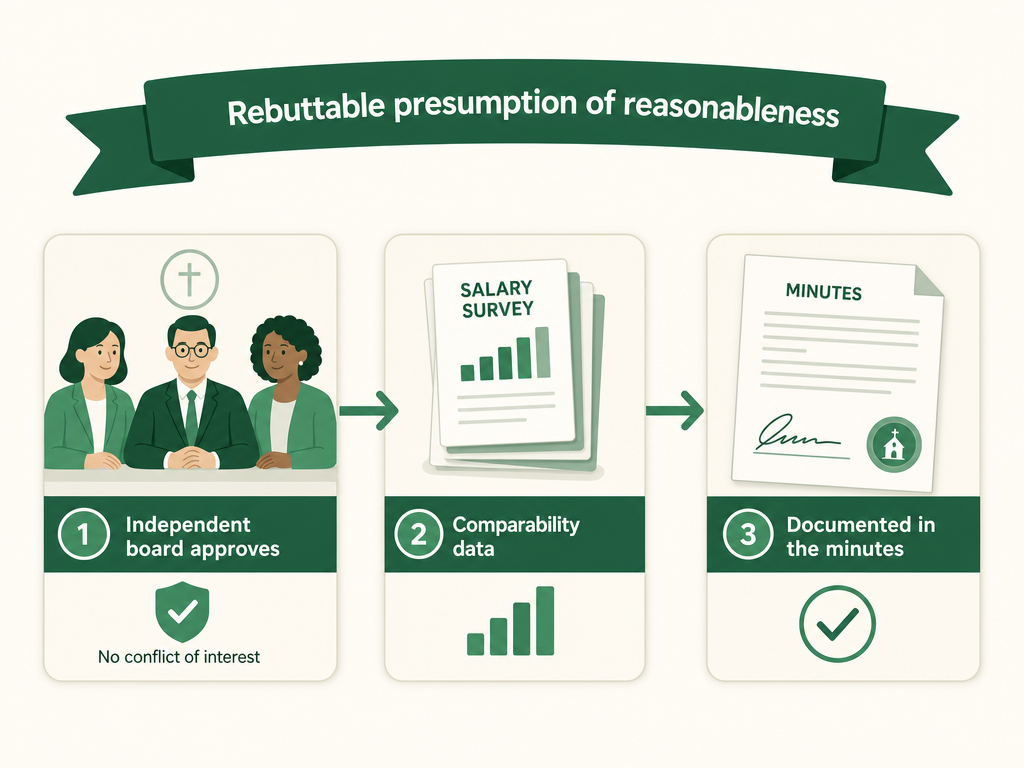
Worth being precise about the word “rebuttable”: meeting the three steps does not make a salary bulletproof. The presumption can still be rebutted if the IRS shows the comparables were the wrong ones or the data was cherry-picked. What the safe harbor buys is a strong, defensible position and a shifted burden — not immunity. A board that skips the steps, by contrast, has to prove the pay was reasonable from scratch, with no presumption working in its favor.
Excess benefit transactions and intermediate sanctions
An excess benefit transaction is the technical violation §4958 punishes: an applicable tax-exempt organization gives an economic benefit to a “disqualified person” that exceeds the value the organization gets back. Overpaying an executive is the textbook case, but the rule reaches any insider deal where value flows out for less than it should — a below-market loan, a sweetheart lease, a bonus with no work behind it. The taxes that follow are called intermediate sanctions, because they sit between doing nothing and revoking the exemption outright.
A disqualified person, per the IRS definition, is anyone who was in a position to exercise substantial influence over the organization at any time during the five-year period ending on the date of the transaction. Actually using that influence is not required — being in the position is enough. The category covers voting board members, presidents, CEOs, treasurers, and CFOs, and it extends to their family members and to entities those people control by more than 35%. One scope note matters: §4958 applies to 501(c)(3) public charities and 501(c)(4) organizations. Private foundations are governed by a separate, stricter self-dealing rule under §4941 instead.
The excise taxes come in tiers, and each falls on a specific party:
- 25% first-tier tax on the disqualified person. A tax equal to 25% of the excess benefit is imposed on the person who received it. If an executive is overpaid by $50,000, that person owes a $12,500 excise tax — separate from the income tax already due on the pay.
- 200% second-tier tax on the disqualified person. If the excess benefit is not “corrected” — paid back, with interest — within the taxable period, an additional tax equal to 200% of the excess is imposed on the same person. Correcting in time is what avoids it.
- 10% tax on the organization managers. A tax equal to 10% of the excess benefit can fall on board members or officers who knowingly, willfully, and without reasonable cause approved the transaction. This manager-level tax is capped at $20,000 per transaction, and it only applies when the 25% tax is imposed on the disqualified person.
These figures — 25%, 200%, 10%, and the $20,000 manager cap — are drawn from the IRS intermediate sanctions guidance as of 2026. Verify each against current IRS materials before relying on it, since penalty provisions can be amended. The takeaway for a board is that the 10% manager tax is personal: a director who waves through an obviously inflated salary can be taxed individually, which is exactly why the documented, arm’s-length process matters.
How to document a compensation decision
Documentation is the part boards most often shortchange, and it is the part the IRS looks at first. The rebuttable presumption is only as good as the record behind it, so the board minutes have to capture the decision while it is being made. Strong minutes for a compensation vote record four things: the specific pay package approved, the names of the people who voted (and that none had a conflict), the comparability data the body reviewed, and the date of the decision. Minutes written that way are the evidence that the safe harbor was met; vague minutes that say only “the board approved the director’s salary” are not.
Comparability data has to be real and sourced. Acceptable sources include published nonprofit compensation surveys (national or regional), Form 990 data from peer organizations of similar size and mission, figures from professional compensation consultants, and documented written offers a candidate received elsewhere. A board should keep copies of whatever it relied on, attached to or referenced in the minutes, so the basis for the decision can be reconstructed years later.
Conflict-of-interest handling is the third leg, and it has to show in the record. Any board member whose own pay is being set, or who has a personal stake in the decision, discloses the conflict and recuses — leaves the discussion and the vote — and the minutes record that they did. Recusal is what makes the approving body “independent” in the regulation’s sense; without it, the body is not one the safe harbor recognizes. Setting up this process in advance is what a written conflict-of-interest rule does, and a compensation-setting procedure fits naturally alongside the rest of a nonprofit’s nonprofit financial policies. Clean, current books help here too, because the comparability and reasonableness of a package are easier to defend when the underlying numbers are not in dispute.
Board pay is a special case
Paying a board member raises every §4958 issue at once, which is why most nonprofits keep their boards unpaid. A voting board member is a disqualified person by definition, so any compensation for board service is an insider transaction the moment it happens — and a board setting its own members’ pay has a built-in conflict of interest that the independence requirement is designed to prevent. The norm, the expectation of donors and the public, and the safest posture is volunteer board service with reimbursement of real expenses only.
Pay for board service is not flatly illegal, but it carries a heavier burden of proof and gets more scrutiny than executive pay does. A nonprofit that does compensate directors has to run the same reasonable-compensation process — independent review, comparables, documentation — while managing the conflict that the people being paid are the people who normally approve pay. The full treatment of when and how that is allowed sits in the guide on whether do nonprofit board members get paid. For most organizations, the short answer is that keeping the board unpaid removes a compliance risk that is rarely worth taking on.
FAQ
Is there a legal limit on how much a nonprofit can pay? No. There is no statutory cap on nonprofit salaries, and a 501(c)(3) may pay market rates to attract skilled people. The only limit is that the pay must be “reasonable” — comparable to what similar organizations pay for similar work. Pay that fits the comparables is fine no matter how large the number; pay that runs well past them, with no justification, is what triggers IRS scrutiny under §4958. As of 2026; confirm with a tax professional.
What is the rebuttable presumption of reasonableness? A safe harbor in the Treasury regulations (26 CFR §53.4958-6) that shifts the burden of proof onto the IRS. A nonprofit earns it by doing three things when it sets an insider’s pay: getting advance approval from an independent body with no conflict of interest, relying on appropriate comparability data, and documenting the decision contemporaneously in the minutes. Meet all three and the IRS must presume the pay is reasonable unless it can produce evidence the comparables were wrong.
What happens if a nonprofit overpays an insider? The excess is treated as an excess benefit transaction under §4958, and excise taxes follow. The disqualified person who received the excess owes a 25% tax on it, rising to 200% if it is not paid back in time. Board members or officers who knowingly and willfully approved the deal can owe a separate 10% tax, capped at $20,000 per transaction. These are penalties short of revoking the exemption — verify the current percentages with the IRS, as they can change.
Do these rules apply to churches? Yes. A church is a 501(c)(3) public charity, so §4958 and the reasonable-compensation standard apply to clergy and staff pay the same way they apply to any other nonprofit — even though churches do not file Form 990. Private foundations are the exception: they fall under the separate self-dealing rules of §4941 rather than §4958. A church setting a pastor’s pay should still use independent approval, comparables, and documentation. Confirm specifics with a tax advisor familiar with church law.
Vestrybooks keeps a nonprofit or church’s books clean and reconciled and gives the board view-only access, so when a compensation decision has to stand up to the rebuttable-presumption test, the comparables, the minutes, and the numbers behind them are all in one defensible place. See how it works.
This is general information, not legal or tax advice — confirm your organization’s situation with a qualified professional or the IRS.
This article is general information for church treasurers, not professional tax or legal advice. For your church's situation, consult a qualified accountant or attorney.
Nonprofit accounting, minus the headache.
Vestrybooks does fund accounting, donor tracking, and board-ready reports for churches and faith-based nonprofits.
A real free plan · no credit card · your data stays yours