Blog · Clergy compensation
Are love offerings taxable? What churches get wrong
July 4, 2026 · By Benjamin Reinke

Short answer: A love offering collected by the church for a pastor, guest speaker, or staff member — a Christmas collection, a pastor-appreciation gift, a revival honorarium — is almost always taxable income to the person who receives it, not a tax-free gift. The near-universal myth is the opposite. When a church solicits, collects, and hands over a special offering in recognition of a minister’s work, the IRS and the courts treat that money as compensation for services, so it belongs on the recipient’s W-2 (for an employee-pastor) or a 1099-NEC (for a non-employee guest speaker paid enough to trigger reporting). The only common case that can truly be a tax-free gift is money one person gives another personally, with the church never touching it — and even that is narrower than most churches assume.
This trips up good-hearted churches constantly, because the whole point of a love offering feels like a gift. But “it feels like a gift” and “it’s a nontaxable gift under the tax code” are two different things, and the gap between them is where churches get pastors into trouble.
Why a love offering to a minister is taxable compensation
A love offering the church collects for a minister is taxable because the tax code and the courts look at why the money moved, not what it’s called. The controlling idea is simple: money transferred to someone in recognition of, or in exchange for, their services is compensation, even when the giver feels generous and calls it a gift. Generosity and compensation are not opposites — a raise can be given warmly and still be pay.
Two legal pillars hold this up.
The first is IRC §102. Subsection (a) is the rule everyone remembers: “Gross income does not include the value of property acquired by gift.” But subsection (c) is the one churches forget, and it’s decisive when the recipient is on staff: the gift exclusion “shall not exclude from gross income any amount transferred by or for an employer to, or for the benefit of, an employee.” Read plainly, that means the moment the church (the employer) routes money to the pastor (the employee), the “it’s a gift” argument is off the table by statute. It’s pay.
The second pillar is the transfer-in-exchange-for-services doctrine, which reaches even payments that don’t run through the church as employer. The Supreme Court’s long-standing test asks whether a transfer proceeds from “detached and disinterested generosity” (a gift) or is really a reward for services rendered (income). A congregation paying its pastor because he’s a good pastor is the second thing, not the first.
The clearest church-specific ruling on this is Goodwin v. United States (8th Cir. 1995). Reverend Goodwin’s congregation gave him special “gifts” three times a year — collected anonymously by church leaders through a routinized, organized program — on top of his modest salary. The Eighth Circuit held the payments were taxable income, not gifts. What made them compensation was structural: they were “made by the congregation as a whole, rather than by individual Church members,” they were regular and substantial relative to his pay, and the congregation “knew that without these substantial, on-going cash payments, the Church likely could not retain the services of a popular and successful minister at the relatively low salary it was paying.” The court’s phrase is worth memorizing: “Regular, sizable payments made by persons to whom the taxpayer provides services are customarily regarded as a form of compensation.”
That is a near-perfect description of how most love offerings actually work. The church announces it, passes the plate or the envelope, pools the money, and gives it to the minister for ministry. Collected and controlled by the church, tied to services — that’s compensation.
Gift vs. compensation: where the line actually falls
The line isn’t “did it feel like a gift?” It’s who controlled the money and why it was given. When the church organizes, solicits, collects, and distributes the offering, it’s compensation. When one individual hands money directly to a pastor out of personal affection, with the church never involved, it can be a genuine personal gift.
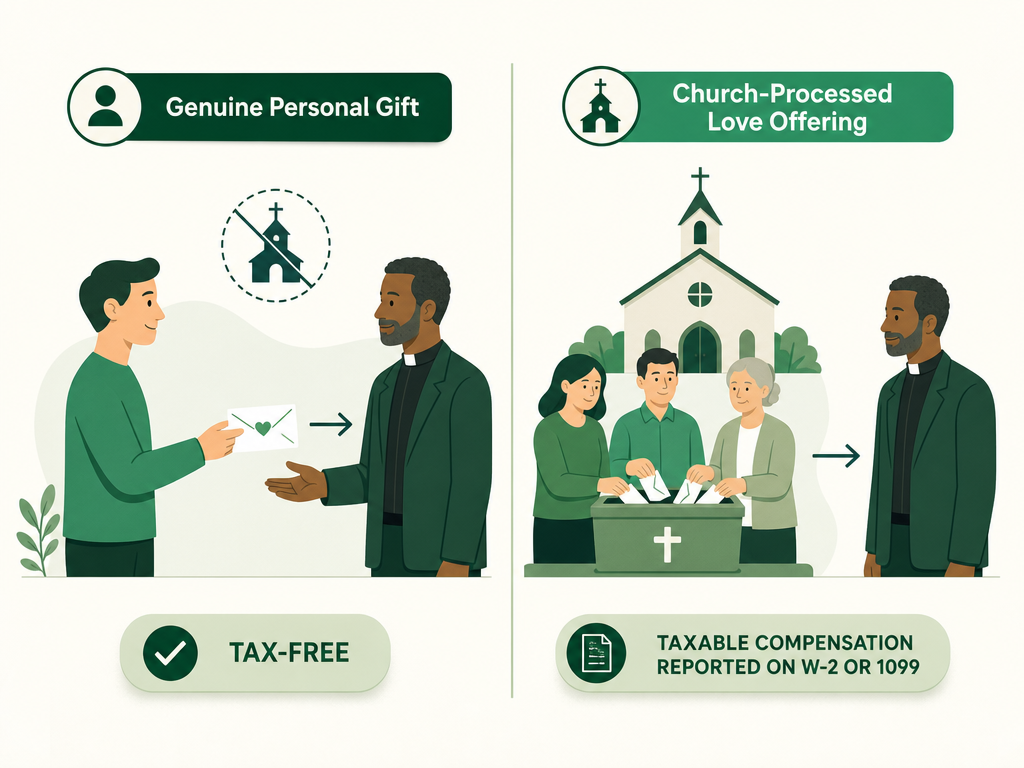
Here’s the same distinction laid out plainly:
| Church-collected love offering | Genuine personal gift | |
|---|---|---|
| Who collects it | The church solicits and pools it | One individual gives directly |
| Church involvement | Announced, receipted, distributed by the church | None — church never touches the money |
| Why it’s given | Recognition of the minister’s services | Personal affection, detached generosity |
| Deductible for the giver? | Yes, it’s a gift to the church | No, it’s a person-to-person gift |
| Taxable to the pastor? | Yes — reported as compensation | Usually no |
Two practical warnings live inside that table. First, a church can’t have it both ways: if the church gives donors a charitable-contribution receipt for the money (so they can deduct it), then by definition it’s a gift to the church, and money the church then pays out to its minister is compensation. You don’t get a deductible gift on the way in and a tax-free gift on the way out — the same dollars can’t be both.
Second, even a “personal” gift gets shaky when leadership organizes it. If the pastor announces “let’s bless Pastor Dave,” passes a basket, and hands over the pooled cash, that’s the Goodwin fact pattern, not a spontaneous individual gift — the coordination is what turns it into compensation. A true personal gift is one member, on their own, quietly handing the pastor a check the church never sees or receipts.
How to handle a love offering correctly
The correct handling is short: run a church-collected love offering through payroll, add it to the minister’s taxable pay, and report it. Don’t route it around the books as a “gift.” The specifics depend on whether the recipient is your employee or an outside guest.
- An employee-pastor or staff member. Add the love offering to their Form W-2 wages for the year and process it like any other taxable pay. Because ministers have a dual tax status — employee for income tax, self-employed for Social Security — the church generally does not withhold FICA from a minister’s wages, but the offering is still income-taxable and subject to SECA, which the minister pays. Voluntary federal income-tax withholding can be a kindness so the pastor isn’t blindsided at filing time.
- A non-employee guest speaker or evangelist. Pay it as nonemployee compensation and issue a Form 1099-NEC if the total you pay that person for the year hits the reporting threshold. Note the threshold changed: for payments made in 2026 and later, the 1099-NEC filing threshold rose from $600 to $2,000 under the 2025 tax law (ChurchTrac summary of the OBBBA change). But the reporting threshold only decides when you file a form — the recipient owes tax on the honorarium regardless of the amount, even a $200 revival gift.
Two knock-on effects are easy to miss. The love offering increases the minister’s SECA base, so it raises their self-employment tax, not just income tax. And it can interact with the housing allowance: a properly designated housing allowance is excluded from income tax but is itself still subject to SECA, and a love offering doesn’t get to hide inside the allowance — it’s separate, taxable pay unless it was designated as housing in advance under the normal rules. If your church has never mapped out how a minister is actually paid and reported, start with the category guide to pastor salary, which lays out the full salary-plus-housing-plus-benefits package a love offering rides on top of. The mechanics of the allowance itself — the “lesser of three” limit and the SECA catch — are in how the clergy housing allowance works.
The honest contrast: benevolence to a needy person can be tax-free
Here’s the case that is tax-free, and it’s worth stating clearly because it’s the exact mirror image of a love offering. Money a church gives from its own funds to a genuinely needy individual — someone in real financial distress, chosen for need rather than for services — is generally a tax-free gift to that person under IRC §102(a), with no 1099 required. That’s benevolence, and it turns on need.
A love offering to a minister is the opposite in every way that matters. Benevolence flows to someone because they’re in need; a love offering flows to a minister because of their ministry — for services, in other words. Same church, same collection plate, opposite tax result, and the deciding factor is why the money moved. The rules, documentation, and the board-adopted policy that keep benevolence genuinely charitable (and keep it from collapsing into disguised pay) are covered in the guide to a church benevolence fund policy. The one overlap worth flagging: §102(c) means benevolence paid to a church employee is usually taxable too — so “benevolence for the pastor” is a red flag that lands you right back in compensation territory.
None of this makes a church taxable, to be clear. Getting a love offering wrong creates a problem on the pastor’s return (underreported income), and possibly a penalty for the church for failing to report wages correctly — but the church itself doesn’t owe income tax on offerings. For the broader picture of what a church does and doesn’t owe, see do churches pay taxes.
Keep love offerings clean: run them through the books
The reason love offerings go wrong is rarely bad intent — it’s that the money moves outside the normal payroll path, so it never lands where the W-2 gets built. The fix is mechanical: treat a church-collected love offering as what it is, taxable pay, and record it against the minister’s compensation the moment it comes in.
Vestrybooks lets you record a love offering straight to a minister’s compensation, so it flows onto the W-2 and the books stay clean — no separate “gift” account that quietly hides taxable pay, and an audit trail behind every dollar.
That’s the whole discipline: collect it, book it as compensation, report it. Do that and a generous congregation’s love offering blesses the pastor without setting up an unpleasant surprise at tax time.
FAQ
Are love offerings taxable? Almost always, when the church collects them for a minister. A love offering the church solicits, pools, and hands to a pastor, staff member, or guest speaker in recognition of their ministry is taxable compensation — income to the recipient — not a tax-free gift. The IRC §102(c) employer-to-employee rule and cases like Goodwin v. United States settle it: money given for services is pay, however warmly it’s given.
Is a love offering a gift or income? It depends entirely on who controlled it and why it was given. If the church organized and distributed it in recognition of a minister’s services, it’s income. If one individual gave money directly to the pastor out of personal affection, with the church never involved and no charitable receipt issued, it can be a genuine gift. The coordination and the “for services” motive are what turn a love offering into taxable pay.
Does the church report a love offering on a W-2 or a 1099? Both can apply, depending on the recipient. For an employee-pastor or staff member, add the love offering to their Form W-2 wages. For a non-employee guest speaker or evangelist, issue a Form 1099-NEC if their total pay for the year hits the reporting threshold — which rose to $2,000 for payments made in 2026 and later. Either way, the recipient owes tax on it regardless of whether a form gets filed.
Can a church give a pastor a tax-free Christmas or appreciation gift? Not through a church-collected offering. Because of IRC §102(c), any amount the church (the employer) transfers to the pastor (the employee) is taxable wages, including a Christmas or pastor-appreciation collection. A truly tax-free gift would have to come from an individual personally, on their own initiative, with the church never handling or receipting the money — and even then, keep it modest and uncoordinated.
Are love offerings to a guest speaker or evangelist taxable? Yes. An honorarium or love offering to a guest speaker, evangelist, or revival preacher is taxable income to that person for the services they provided. If they’re not your employee, report it on a 1099-NEC when their yearly total reaches the threshold ($2,000 for 2026 forward), and have them fill out a W-9 up front so you have the information to file.
Is a love offering different from benevolence? Yes — they’re opposites. Benevolence goes to a needy person because of their need and is generally a tax-free gift under §102(a). A love offering goes to a minister because of their ministry — for services — and is taxable compensation. The deciding factor is why the money moved. Benevolence paid to a church employee, though, is usually taxable, so “benevolence for the pastor” almost always means compensation.
This is general information, not tax or legal advice — confirm your church’s specific situation with a qualified tax professional.
Once you treat a love offering as the compensation it is, the rest is just bookkeeping — record it against the minister’s pay, let it flow onto the W-2, and keep the audit trail. Vestrybooks does exactly that, so a generous collection never turns into a reporting mistake. See how it works.
This article is general information for church treasurers, not professional tax or legal advice. For your church's situation, consult a qualified accountant or attorney.
Church accounting a volunteer can actually do.
Vestrybooks is church accounting + giving for the volunteer treasurer — fund tracking, one-click year-end statements, and online giving with $0 taken from every gift.
A real free plan · no credit card · your data stays yours