Blog · Nonprofit board & governance
The 501(c)(3) board of directors requirements that protect your exemption
June 27, 2026 · By Benjamin Reinke
A 501(c)(3) board of directors has to clear a short list of requirements for the organization to win and keep its tax exemption: at least three directors in practice, a board where the majority are independent (not related to each other and not a majority of paid staff), a written conflict-of-interest policy, and real meetings with minutes. Only a few of these are hard legal rules — the rest are strong IRS preferences that, if you ignore them, put the exemption at risk. State law sets its own director minimums on top, and they vary, so the full answer is part federal rule, part federal best practice, and part state law.
This page is the compliance deep-dive under the broader nonprofit board of directors guide. It covers what the IRS and the states actually require of the board itself — distinct from what directors do day to day or what officer seats a board fills.
The 501(c)(3) board requirements at a glance
A 501(c)(3) board faces four core requirements, and it helps to see up front which are hard rules and which are strong best practices the IRS rewards.
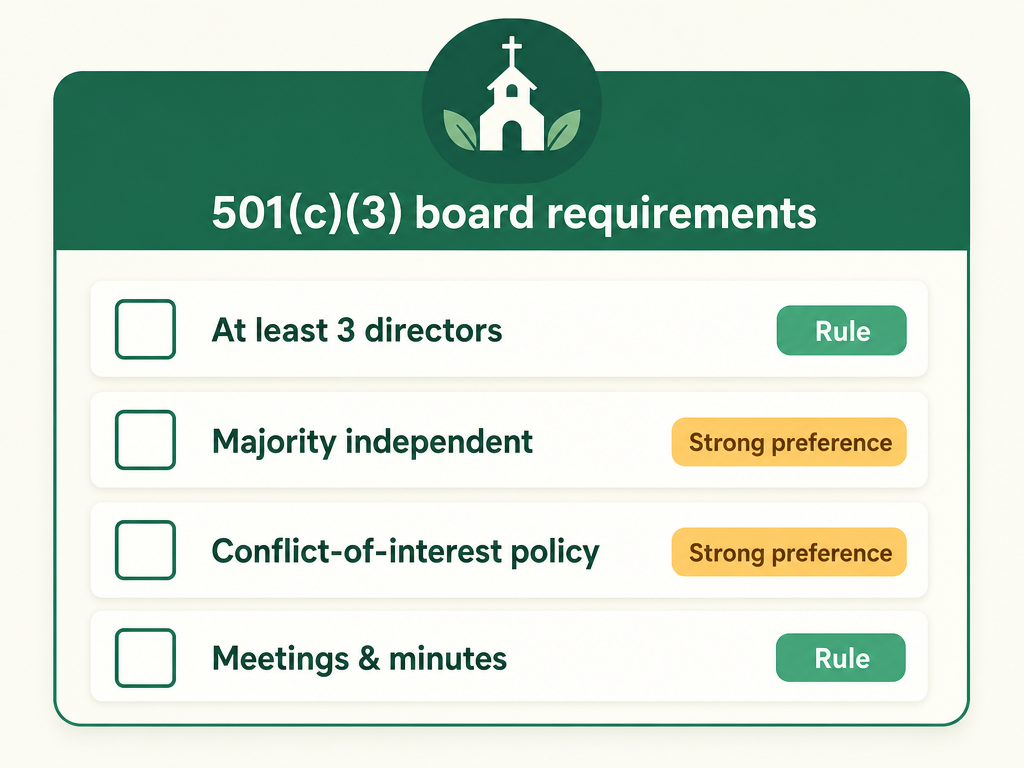
| Requirement | Hard rule or best practice | Why it matters |
|---|---|---|
| At least three directors | No federal minimum; ~3 in practice. State law sets a hard minimum (often 1–3). | Below three, the IRS doubts a board can give independent oversight. |
| Majority independent / unrelated | Strong IRS preference, not a statute | A board controlled by family or paid staff can’t credibly check itself — risks private inurement and public-charity status. |
| Conflict-of-interest policy | Strongly encouraged; asked about on Form 1023 and Form 990 | Shows the IRS the board guards against insiders steering money to themselves. |
| Meetings, minutes, records | Required in substance (state law + 990) | A board that exists only on paper is a red flag; minutes are the proof it actually governs. |
The sections below take each one in turn and separate the rule from the recommendation.
How many directors a 501(c)(3) board needs
A 501(c)(3) needs at least three directors as a practical matter, even though the IRS sets no hard federal minimum in the Internal Revenue Code. The number comes from two directions, and they have to be read together.
- Federal: The IRS doesn’t name a minimum board size in statute. In practice it expects at least three directors, and Form 1023 (the exemption application) is built around a board, not a sole founder. A one- or two-person board reads as a vehicle for one person rather than a public charity, which invites scrutiny.
- State: Every nonprofit incorporates under a state’s nonprofit corporation law, and the state sets the hard minimum. Many states require at least three directors; some allow as few as one. Because this is the binding legal floor, you check your own state’s nonprofit act, not a federal number.
The practical takeaway: build a board of at least three from the start, use an odd number to avoid tied votes, and treat your state’s minimum as the legal floor you can’t go under. Many nonprofits run five to nine directors so committees and turnover don’t leave the board too thin. This is also why “can one person be the sole director?” usually gets a no — a state may technically allow it, but a one-person board can’t satisfy the IRS’s expectation of independent oversight.
The majority-independent board the IRS strongly prefers
The single requirement that trips up new 501(c)(3)s is board composition: the IRS strongly prefers a board where the majority of directors are independent — not related to one another, and not a majority made up of the organization’s paid staff. A board that fails this test isn’t automatically denied, but it draws hard questions and can undercut the public-charity status the exemption depends on. (The seats themselves — chair, secretary, treasurer — are covered in nonprofit board positions.)
Two distinct lines matter here, and they’re easy to confuse:
- Related-party majority. A board that is a majority of one family, or of one person’s business partners, can’t provide independent oversight. The IRS asks on Form 1023 whether board members are related by blood, marriage, or business, precisely because a related-party majority can rubber-stamp decisions that benefit insiders.
- Paid-staff majority. Paid staff serving on the board is allowed — a founder or executive director often holds a seat — but the board can’t be a majority of paid employees and their relatives. A director may never vote on their own compensation. When staff dominate the board, the body that’s supposed to supervise the staff is really supervising itself.
The reason behind both lines is private inurement and private benefit — the rule that none of a 501(c)(3)‘s earnings may benefit an insider beyond reasonable pay. An independent majority is the structural defense against it, and it’s part of how an organization shows it’s organized and operated for the public, not for the people who run it. The IRS describes this private-inurement bar in IRS Publication 1828 and the broader exemption requirements in IRS Publication 557.
The conflict-of-interest policy the IRS asks about
A 501(c)(3) board is strongly encouraged to adopt a written conflict-of-interest policy, and the IRS asks about it directly — both on the Form 1023 application and on the annual Form 990. The policy isn’t mandated by statute, but the question is so prominent, and a “no” so conspicuous, that for practical purposes it’s expected.
A workable conflict-of-interest policy does three things:
- Defines a conflict. It spells out when a director has a personal, family, or financial stake in a decision — a contract with their company, a job for a relative, their own pay.
- Requires disclosure. A director with a conflict discloses it before the discussion, on the record.
- Removes them from the vote. The conflicted director leaves the room for the deliberation and abstains from the vote, and the minutes note that they did.
The IRS publishes a sample conflict-of-interest policy in the Form 1023 instructions, and adopting something close to it is the path of least resistance. The point isn’t the document — it’s the enforced practice. A policy in a binder that nobody follows offers no protection; a policy the board actually uses is evidence that insiders aren’t steering the organization’s money toward themselves.
Board meetings, minutes, and records a 501(c)(3) must keep
A 501(c)(3) board is required to actually function — meet, decide as a body, and keep records of what it decided — and the written minutes are the proof. This is the requirement organizations most often treat as optional, and it’s the one that’s hardest to fake after the fact.
- Hold real meetings. State nonprofit law typically requires the board to meet (often at least annually) and to act by vote rather than by any single director’s say-so. The bylaws set the quorum and notice rules.
- Keep written minutes. Minutes record who attended, what was decided, and how each vote went — including a director stepping out under the conflict-of-interest policy. Form 990 asks whether the organization contemporaneously documents its board (and committee) meetings, so minutes are effectively expected for filers.
- Retain governing records. The articles of incorporation, bylaws, exemption application, determination letter, and minutes are the organization’s permanent records. The public can inspect some of them, and the IRS can ask for them on audit.
A board that meets, votes, and writes it down is demonstrating the independent governance the exemption assumes. A board that never meets — or meets and keeps nothing — is the classic sign of an organization run by one person, which is exactly what the board requirements exist to prevent.
How these 501(c)(3) board requirements apply to churches
A church is a 501(c)(3), so the same board requirements apply to it — with one wrinkle: a church is automatically tax-exempt and never files a Form 1023 or an annual Form 990, so the IRS isn’t asking it the board-composition and conflict-of-interest questions on a form. That doesn’t make the requirements optional. The underlying rules — no private inurement, genuine independent governance — still govern a church, and the same governance protects its exemption.
The practical guidance for a church board is the same as for any other 501(c)(3): seat at least three directors, keep the board mostly unrelated and not a majority of paid staff, never let a pastor vote on their own pay, adopt and follow a conflict-of-interest policy, and keep minutes. Churches just have to self-enforce, since no annual return is prompting them. The faith-based version of this, with the polity-specific titles, is the church board of trustees guide, and the church side of the 501(c)(3) status itself is covered in are churches tax exempt. Whatever a congregation calls its board, the people named in its incorporation papers are its legal board of directors and carry these requirements.
FAQ
How many board members do you need for a 501c3? At least three in practice. The IRS sets no hard federal minimum in statute, but it expects roughly three directors and structures Form 1023 around a real board, so a one- or two-person board invites scrutiny. Your binding floor is your state’s nonprofit corporation law, which sets the legal minimum (often one to three). Build a board of at least three, use an odd number to avoid ties, and treat the state minimum as the line you can’t go under.
Can husband and wife serve on a nonprofit board? Yes, a married couple can both serve, but they count as related parties. The IRS strongly prefers a board where the majority of directors are independent and unrelated, so a spouse pair is fine on a larger board where they don’t make up a controlling bloc. A small board that is mostly one family draws hard questions, because a related-party majority can’t provide the independent oversight the exemption assumes.
What are the three legal responsibilities of a nonprofit board? The three are the fiduciary duties courts apply to any nonprofit board: the duty of care (stay informed and act prudently), the duty of loyalty (put the organization ahead of personal gain — the source of conflict-of-interest rules), and the duty of obedience (keep the organization inside its charitable purpose and follow its bylaws and the law).
What is the 80/20 rule for nonprofits? There’s no single IRS “80/20 rule” for board composition. The number most often refers to the public support test — broadly, a public charity should draw a sufficient share of its support from the general public rather than a few insiders, and a common safe-harbor threshold sits around one-third public support. Separately, “80/20” is sometimes used loosely to describe a board that should be mostly independent (not insiders). Confirm the specific test that applies to your organization rather than relying on the shorthand.
A board can only oversee money it can actually see. Vestrybooks gives the board view-only access to live, reconciled books, so the independence and clean records that protect a 501(c)(3)‘s exemption are documented instead of taken on faith. See plans →
This is general information, not legal or tax advice — confirm your organization’s situation with a qualified professional.
This article is general information for church treasurers, not professional tax or legal advice. For your church's situation, consult a qualified accountant or attorney.
Nonprofit accounting, minus the headache.
Vestrybooks does fund accounting, donor tracking, and board-ready reports for churches and faith-based nonprofits.
A real free plan · no credit card · your data stays yours