Blog · Nonprofit board & governance
Do nonprofit board members get paid?
June 27, 2026 · By Benjamin Reinke

Short answer: Usually no. The overwhelming majority of nonprofit board members serve as unpaid volunteers, and that’s the norm the IRS, donors, and the public expect of a 501(c)(3). A nonprofit may reimburse directors for real out-of-pocket expenses like travel, and a small number of organizations — mostly large nonprofits and foundations — pay reasonable compensation for actual board service. But paying a board is the rare exception, not the rule, and doing it carelessly can put the organization’s tax-exempt status at risk.
Why nonprofit board members serve unpaid
Nonprofit board members are volunteers because the structure is built on public trust. A nonprofit has no owners — its assets belong to its charitable mission, not to any person — and the board exists to hold the organization in trust for the public. An unpaid board is the clearest signal that directors are there to serve the mission, not to draw money from it.
There’s a legal reason underneath the cultural one. A 501(c)(3)‘s earnings can’t flow to insiders beyond reasonable pay for genuine work — a rule the IRS calls private inurement, with a broader cousin called private benefit. An organization that serves private interests rather than public ones risks losing its exemption (IRS Publication 1828). Board members are the ultimate insiders, so money paid to them gets the hardest look. Keeping the board unpaid is the simplest way to stay clear of that line.
Volunteer service also keeps the board independent. Directors are supposed to be the check on the organization — the people who approve the budget, review the books, and set the staff’s pay without a stake in the answer. A director who depends on board pay has a harder time being that disinterested check, which is exactly the conflict the fiduciary duty of loyalty is meant to prevent.
What a nonprofit can pay or reimburse a board member
A nonprofit board member can receive money in a few specific, defensible ways — they’re just narrower than a salary. The three categories below cover almost every situation.
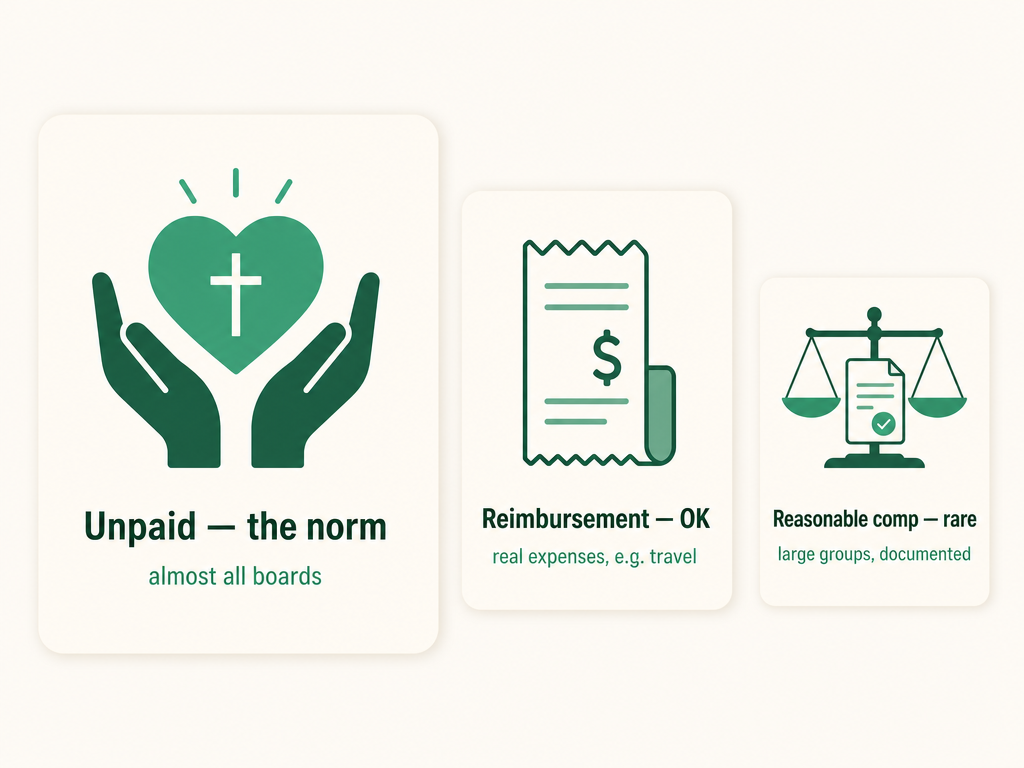
- Expense reimbursement (almost always fine). Reimbursing a director for real, documented costs of serving — mileage, travel to a meeting, a conference registration — is not compensation. The director is made whole, not enriched. Reimbursement is standard and uncontroversial as long as the expenses are legitimate and backed by receipts.
- Reasonable compensation for actual service (allowed, but limited). A nonprofit may pay directors for genuine board work, and some do — large national nonprofits, hospital systems, and private foundations are the usual examples. The pay has to be reasonable for the work and the organization’s size, set by people without a personal stake, and documented. It’s the exception, common mainly where board service is a real time commitment.
- A salary for separate paid work (a different question). Sometimes a person is both a board member and an employee or contractor of the nonprofit — a founder who also runs the organization, for instance. Pay for that other role is governed by the same reasonable-compensation rules, and the person should never vote on their own pay. Being paid as staff is not the same as being paid to sit on the board.
How the IRS reasonable-compensation rule limits board pay
The IRS doesn’t flatly ban paying nonprofit board members — it polices how much and how it’s decided. Any pay to an insider, including a director, has to be reasonable: no more than what a comparable organization would pay for comparable work. Pay that’s excessive is treated as private inurement, and in serious cases it can cost the organization its exemption — or trigger excise taxes on the insider and the board members who approved it (the “excess benefit” / intermediate-sanctions rules).
The safest way to set any insider pay is to follow the IRS’s rebuttable presumption of reasonableness: have the amount approved in advance by people with no conflict of interest, base it on real comparability data (what similar groups pay), and document the decision in the minutes. The director being paid leaves the room and never votes on their own compensation.
There’s no fixed legal salary cap and no official “33% rule” that caps board pay — that phrase is sometimes confused with public-support tests that have nothing to do with director compensation. The standard is simply reasonable, judged against comparable organizations. That same reasonable-compensation logic is what governs a pastor’s salary and any other insider pay a nonprofit sets.
Why paying a nonprofit board is discouraged and risky
Paying a 501(c)(3)‘s board is discouraged because the downside is bigger than the upside for most organizations. Several risks stack up:
- It invites IRS scrutiny. Money paid to insiders is the first place the IRS looks for private inurement. A paid board has to prove every dollar is reasonable; an unpaid board has nothing to defend.
- It can jeopardize exempt status. Compensation that’s unreasonable, or that crosses into self-dealing, is exactly the kind of private benefit that can put a 501(c)(3)‘s exemption at risk — the same line that protects a church’s tax-exempt status.
- It weakens independence. A board paid by the organization it oversees is a less credible watchdog, and conflict-of-interest problems multiply.
- It looks bad to donors. Funders and the public expect their gifts to fund the mission, not the people governing it. Most state charity regulators and watchdog ratings treat a volunteer board as a mark of good governance.
For the typical small or mid-size nonprofit, none of the reasons to pay a board outweighs those costs. The cases where compensation makes sense — heavy time demands, specialized fiduciary work, a foundation managing large assets — tend to be larger organizations that can document the need.
How this applies to a church board or board of trustees
A church board — whether it’s called a board of trustees, a body of elders, a vestry, or a session — is almost always unpaid. A church that incorporates is a nonprofit, so its governing board carries the same fiduciary duties and the same private-inurement limits as any other 501(c)(3), and volunteer service is the near-universal norm. The same caution against paying directors applies, and for the same reasons. The church board of trustees guide covers how that board governs.
The one case that confuses people is a pastor who also sits on the board. Paying that person is fine — but the pay is for their ministry role, not for board service, and it’s governed by the reasonable-compensation rules above. The board sets the pastor’s compensation using comparables, documents the decision, and the pastor doesn’t vote on their own salary. A church can pay its pastor generously and still keep an entirely unpaid board.
Vestrybooks keeps a church’s compensation records, reimbursements, and board decisions clean and provable — so the things that protect exempt status are always documented. See plans →
FAQ
How much can board members of a nonprofit be paid? There’s no fixed legal cap — the limit is reasonable compensation, meaning no more than a comparable organization would pay for comparable work. Most nonprofit board members are paid nothing; pay is the exception, mainly at large nonprofits and foundations, and it has to be set independently and documented.
What is the 33% rule for nonprofits? There’s no “33% rule” that governs board pay. The figure people usually mean is a public-support test (whether enough of a charity’s support comes from the public), which is about funding sources, not director compensation. Board pay is judged by the reasonable-compensation standard instead.
How do nonprofit board members make money? Most don’t — they serve as volunteers. When money does change hands, it’s usually reimbursement for real expenses like travel, occasionally reasonable compensation for board service at a larger organization, or a salary for a separate paid role (such as a founder who also works as staff).
What is the highest paying job in a nonprofit? The top-paid role is typically the chief executive (executive director or CEO) at a large nonprofit, not a board seat. Even then, the pay must be reasonable for the organization’s size and the work, and it’s set by the board, not by the executive.
A board can only oversee money it can actually see. Vestrybooks gives the board view-only access to live, reconciled books, so oversight is real instead of a report taken on faith.
This is general information, not legal or tax advice — confirm your organization’s situation with a qualified professional.
This article is general information for church treasurers, not professional tax or legal advice. For your church's situation, consult a qualified accountant or attorney.
Nonprofit accounting, minus the headache.
Vestrybooks does fund accounting, donor tracking, and board-ready reports for churches and faith-based nonprofits.
A real free plan · no credit card · your data stays yours