Blog · Nonprofit board & governance
Nonprofit board positions and what each one actually does
June 27, 2026 · By Benjamin Reinke

A nonprofit board has four standard officer positions — board chair (or president), vice-chair, secretary, and treasurer — plus general members at large and the chairs of any committees. The officers run the board’s machinery: the chair leads meetings, the secretary keeps the records, the treasurer watches the money, and the vice-chair backs up the chair. Everyone on the board, officer or not, is a director with equal legal responsibility for the organization. Most nonprofits run a board of five to nine people, with three as the floor most states require. The IRS-facing rules are in 501(c)(3) board requirements.
This page is about the structure of a board — the seats and who fills them. If you want the duties a board owes its mission, start with the nonprofit board of directors overview; this guide stays on positions.
Officers vs. directors — every officer is also a director
A nonprofit board has two layers of membership, and people mix them up constantly. Everyone elected to the board is a director — a voting member with full legal responsibility for the organization. A smaller group of those directors also holds an officer title (chair, vice-chair, secretary, treasurer), which is a job within the board, not a higher rank.
The distinction matters for one reason: liability doesn’t follow the title. A member at large with no officer role carries the same fiduciary duty as the chair. Officers have extra tasks — running meetings, signing documents, reporting on finances — but not extra authority over the organization and not less responsibility for it. A director can’t escape accountability by declining an officer seat, and an officer doesn’t get a bigger vote.
State nonprofit-corporation law usually requires a board to fill a few specific officer roles (most commonly a president or chair, a secretary, and a treasurer) and lets the bylaws define the rest. The bylaws are where a nonprofit names its positions, sets terms, and says how officers get elected.
The four standard nonprofit officer positions and their duties
The four officer positions below are the ones nearly every nonprofit board fills, because each handles a distinct part of running the board. The table is the fast version; the notes after it add what the table can’t.
| Position | Also called | What this officer does |
|---|---|---|
| Board chair | President, presiding officer | Leads board meetings, sets the agenda, speaks for the board, and supervises the executive director |
| Vice-chair | Vice president, chair-elect | Stands in when the chair is absent, often chairs a committee, and is frequently the next chair |
| Secretary | Clerk | Keeps the minutes, maintains official records and bylaws, and confirms meetings are properly noticed |
| Treasurer | Finance officer | Oversees the organization’s finances, presents financial reports, and chairs the finance committee |
Board chair (or president). The chair is the board’s leader, not the organization’s. The chair runs the meetings, keeps the board focused, and is usually the board’s main link to the executive director — the paid staffer who runs day-to-day operations. A common point of confusion: in a staffed nonprofit, “president” on the board is a volunteer role, separate from a “president/CEO” job title on staff. The chair governs; the executive director manages.
Vice-chair (or vice president). The vice-chair backs up the chair and steps in when the chair can’t serve. On many boards the vice-chair is the chair-elect, learning the role before taking it, which is how a board avoids a leadership gap when terms turn over. The vice-chair often also leads a standing committee.
Secretary. The secretary owns the board’s official memory. That means accurate minutes of every meeting, custody of the bylaws and key documents, and making sure meetings are noticed and quorum is recorded. Clean minutes aren’t busywork — they’re the record that shows a decision was actually made by the board, which is exactly what an auditor, the IRS, or a court would ask to see.
Treasurer. The treasurer is the board’s financial conscience. The role is oversight, not bookkeeping: the treasurer presents the financials to the board in plain terms, makes sure the numbers are reconciled and honest, usually chairs the finance committee, and answers the board’s questions about the money. The same role exists in a church under the same name — the church treasurer carries this exact set of duties for a congregation.
Members at large and committee chairs — the rest of the board
Most of a nonprofit board is members at large (also called general directors or board members) — directors who hold no officer title. They aren’t lesser members. They vote, they sit on committees, they carry the same fiduciary duty as the officers, and on a healthy board they ask the hard questions the officers are too close to ask. A board built only of officers, with no independent members, has nobody left to hold the officers accountable.
Committee chairs are the other working positions. A committee is a small group of directors (sometimes with non-director volunteers) assigned to one area — finance, governance, fundraising, programs — so the full board doesn’t have to do detailed work in the meeting. The committee chair runs that group and reports back. Chairing a committee is a position of responsibility even though it isn’t a corporate officer role.
Some boards add specialized seats — a development or fundraising lead, a governance lead, a member with legal or accounting expertise. These are useful but optional; they’re roles the board chooses to define in its bylaws, not positions the law requires.
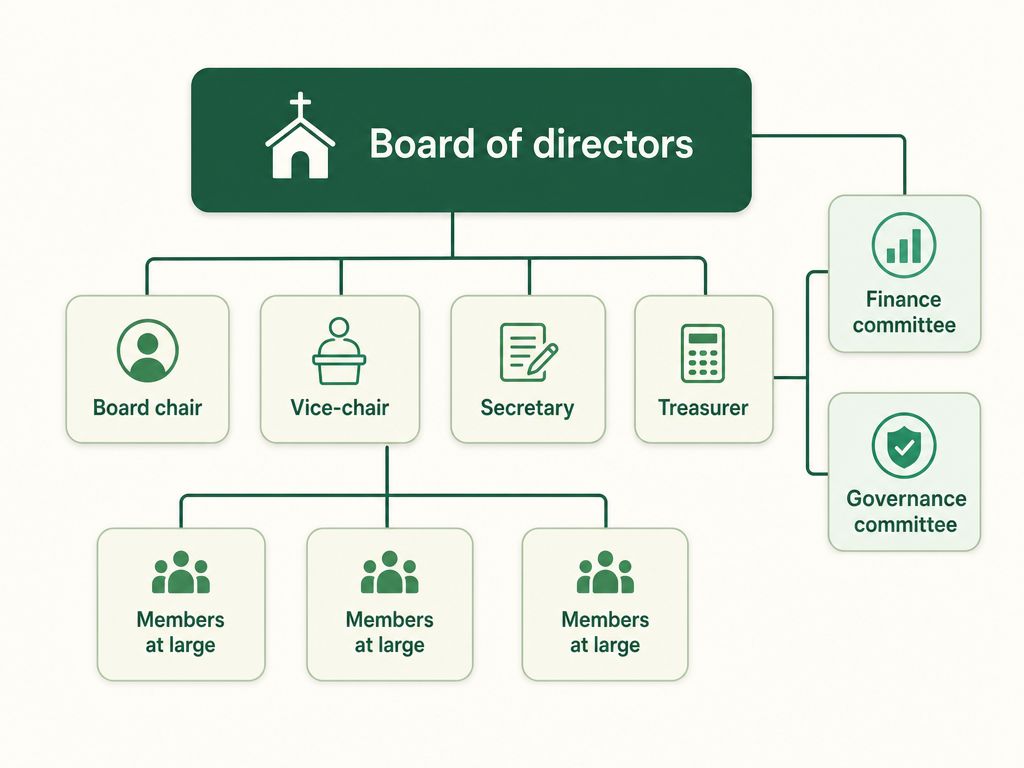
Common nonprofit board committees — finance, governance, and executive
Most nonprofit boards organize their work through a few standing committees, and three show up almost everywhere:
- Finance (or finance and audit) committee. Reviews the budget before the full board votes on it, monitors spending against that budget through the year, and oversees the annual audit or review. The treasurer usually chairs it. Larger nonprofits often split off a separate audit committee so the people overseeing the outside auditor aren’t the same people who prepared the books.
- Governance (or nominating) committee. Recruits and vets new board members, manages elections and terms, runs board self-evaluation, and keeps the bylaws current. This is the committee that keeps the board itself healthy.
- Executive committee. A small group — typically the officers — empowered by the bylaws to act between full board meetings on urgent matters. It’s a convenience, not a substitute board; major decisions still belong to the full board, and an executive committee that quietly runs everything is a governance red flag.
Beyond these three, boards add committees to fit the work: fundraising/development, programs, personnel. The rule of thumb is to create a committee only where the full board genuinely needs a smaller group to dig in, then have that group report back so the whole board stays informed.
How many people a nonprofit board needs — size and independence
A nonprofit needs at least three board members in most states, but a board of five to nine is far more common and usually works better. The number isn’t arbitrary; it comes from a few practical and legal pressures.
- Three is the legal floor in most states. Nearly every state’s nonprofit-corporation law sets a minimum of three directors, and the IRS expects a real, functioning board when it reviews a 501(c)(3) application. A board of one or two isn’t a board — it’s a person.
- Five to nine is the practical sweet spot. Enough members to staff committees, cover the officer roles, and survive a resignation, but small enough to actually decide things. Very large boards tend to go passive, with the real work falling to a few.
- Use an odd number. An odd headcount avoids tied votes. It’s a small thing that saves real headaches.
- Keep the board mostly independent and unrelated. The IRS scrutinizes boards where a majority are related by blood, marriage, or business, or are paid staff and their relatives — because such a board can’t credibly oversee the people it’s supposed to check. A board that’s mostly insiders invites a private inurement problem, where the organization’s resources flow to insiders. The IRS lays this expectation out for churches and religious nonprofits in IRS Publication 1828, and the same independence principle applies to nonprofits generally.
The thread running through all of it: a board exists to provide oversight, and oversight only works when enough independent people are watching. Size and independence are two sides of that one requirement.
How church boards map to nonprofit board positions
A church is a nonprofit corporation, so it has the same board positions underneath whatever its tradition calls them. The titles shift with polity — the people in your incorporation papers are your legal board of directors, even if the congregation knows them as trustees, elders, deacons, or a vestry.
- Trustees (common in Methodist and many Baptist churches) usually map to the property-and-finance side of the board.
- Elders (Presbyterian, many non-denominational) often hold spiritual leadership and governance together.
- Deacons (Baptist, many congregational) tend toward service and practical operations.
- Vestry (Episcopal/Anglican) is the lay governing body, finances included.
Whatever the names, the officer positions still appear: someone chairs the meetings, someone keeps the minutes, and someone serves as treasurer over the money. A fuller account of how a church’s governing body is built and what it owes the congregation is in the church board of trustees guide. The positions are the same; the vocabulary is what changes.
FAQ
What are the positions on a nonprofit board? The standard nonprofit board positions are four officers — board chair (or president), vice-chair, secretary, and treasurer — plus general members at large and the chairs of any committees. The officers run the board’s operations; the members at large and committee chairs carry the same legal duties without an officer title.
What job titles are there on a board? The most common board titles are chair (or president), vice-chair (or vice president), secretary, and treasurer for the officers, and director or member at large for everyone else. Boards may add committee-chair roles (finance, governance, fundraising) and occasionally specialized seats like a development lead.
What are the positions of a non-profit? On the board, the positions are the officers (chair, vice-chair, secretary, treasurer) and the general directors. Those are governance positions, distinct from paid staff positions like an executive director, who runs day-to-day operations and reports to the board rather than sitting on it as an equal.
What is the difference between an officer and a director on a nonprofit board? Every officer is also a director. A director is any voting board member with full legal responsibility for the organization; an officer is a director who also holds a specific job within the board — chair, secretary, or treasurer. The officer title adds tasks, not authority, and never reduces a director’s underlying fiduciary duty.
How many board members does a nonprofit need? Most states require a minimum of three, but five to nine is more common and generally healthier. Use an odd number to avoid tied votes, and keep the board mostly independent — not a majority of related parties or paid staff — so it can provide real oversight.
A board can only fill its positions well if every member can actually see the money. Vestrybooks gives the treasurer, the finance committee, and the whole board view-only access to live, reconciled books, so oversight is real instead of a report taken on faith. See how it works.
This is general information, not legal or tax advice — confirm your organization’s situation with a qualified professional.
This article is general information for church treasurers, not professional tax or legal advice. For your church's situation, consult a qualified accountant or attorney.
Nonprofit accounting, minus the headache.
Vestrybooks does fund accounting, donor tracking, and board-ready reports for churches and faith-based nonprofits.
A real free plan · no credit card · your data stays yours