Blog · Contributions & statements
How a church benevolence fund works
June 26, 2026 · By Benjamin Reinke
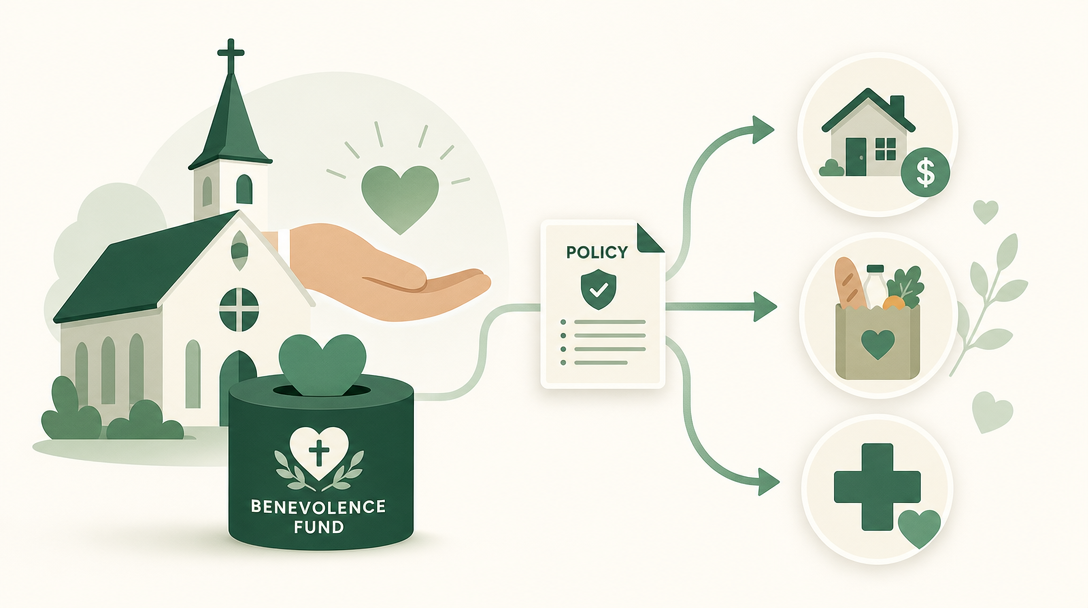
Short answer: A church benevolence fund is money a church sets aside to help people facing genuine financial hardship — rent, utilities, food, medical bills. Gifts to the fund are tax deductible only when the church controls who gets the money; a gift earmarked for a specific named person is not deductible. And benevolence paid to someone in real need is generally a tax-free gift to the recipient, not income — as long as it’s based on need, not payment for services. The whole thing runs on a written benevolence policy and good records.
What a church benevolence fund is
A church benevolence fund is a designated pool of church money used to meet the basic needs of people in financial distress, both members and others in the community. Typical help covers rent or mortgage, utilities, groceries, medical expenses, transportation, and emergencies after a job loss, illness, or disaster. It exists because caring for people in need is a core charitable and religious purpose — which is also exactly why the IRS allows it and why it has to be run carefully.
Because the fund holds money restricted to one purpose, it’s tracked as its own fund in the church’s books — the same fund accounting logic that keeps a building fund or missions fund separate.
The IRS rules: deductibility and the earmarking trap
A donation to the benevolence fund is tax deductible only if the church — not the donor — decides who receives it. When someone gives to the general benevolence fund and the church’s committee distributes it by need, that’s a deductible charitable gift. But when a donor says “use this to help the Smith family,” the gift is earmarked, the church is just a pass-through, and the IRS treats it as a non-deductible personal gift from one individual to another (IRS Publication 526).
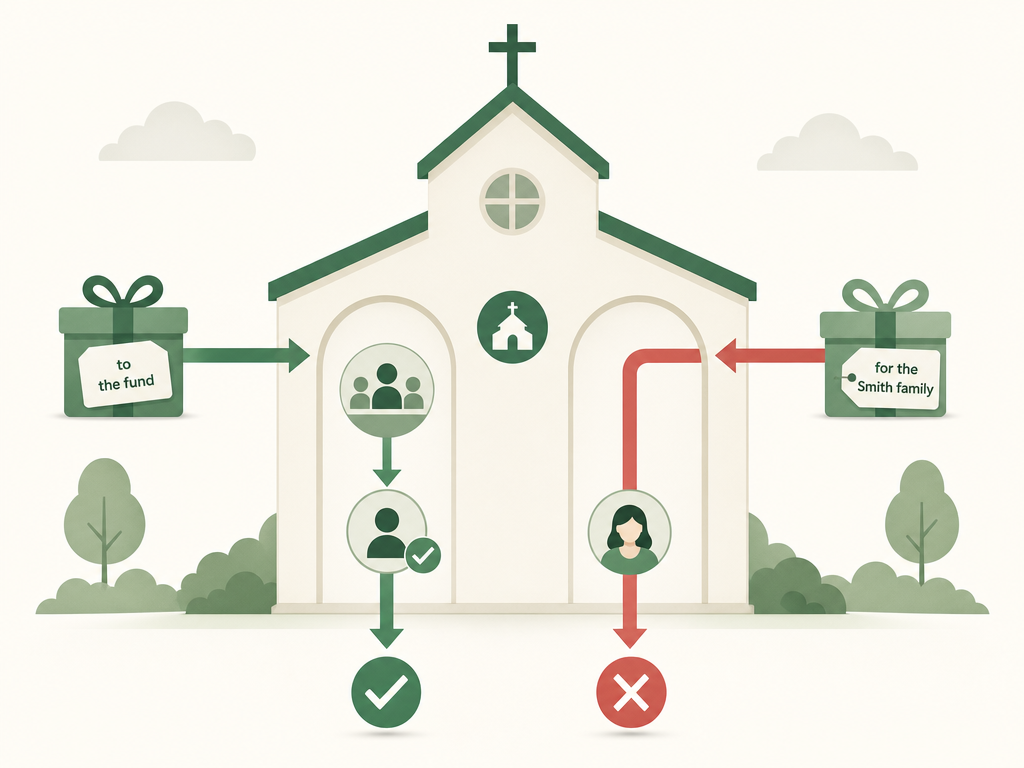
This is the single most common benevolence mistake, and it’s the same earmarking trap that applies to designated funds. A church can let donors give toward benevolence generally; it cannot promise a donor that their gift goes to one named individual and still call it deductible — and an earmarked gift shouldn’t be acknowledged as deductible on the donor’s church contribution statement.
Is church benevolence taxable to the person who receives it?
Benevolence paid to someone in genuine need is generally a tax-free gift, not taxable income, so the church does not issue a 1099 for it. What flips that is compensation: if the payment is really for services — paying a volunteer, a staff member, or a worship leader “benevolence” in place of pay — it becomes taxable wages, reportable like any other compensation. The test is whether the money is given for need or for work done. Need-based help to someone who isn’t being paid for services stays a gift; disguised pay does not.
There’s also a hard line on insiders: routing benevolence to board members, the pastor, or their families raises private-benefit and inurement concerns that can threaten the church’s tax-exempt status, so those cases need extra documentation and arms-length review.
Can a church give money directly to individuals?
Yes — a church can give money to individuals for charitable and benevolent purposes, as long as the recipients are part of a charitable class (people in need), the decision is the church’s, and it’s documented. What a church can’t do is hand out funds in a way that serves private interests, pays for services off the books, or operates as a pass-through for one donor to benefit one chosen person. Help the needy by policy: fine. Move money for a specific insider or a donor’s chosen beneficiary: not fine.
How to set up a benevolence policy and process
A defensible benevolence program runs on a written policy adopted by the board, so decisions aren’t ad hoc and the records hold up:
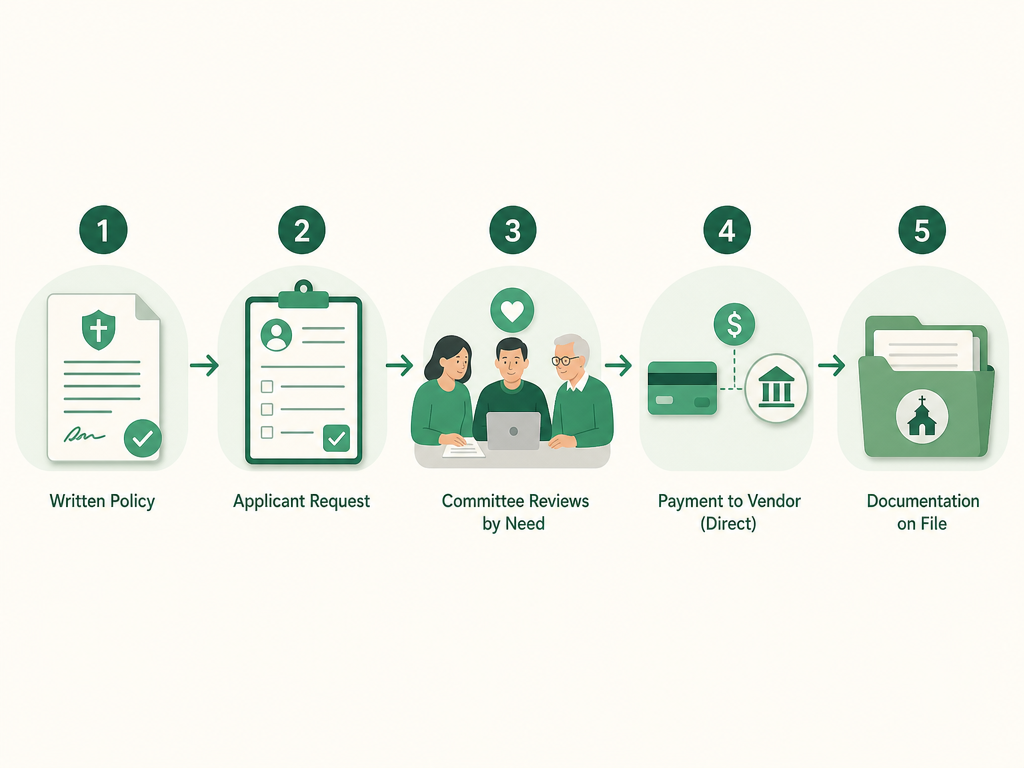
- Adopt a written policy defining who qualifies, what’s covered, and any limits.
- Have applicants request help in writing (a short form is enough).
- Let a committee or board approve based on need, not relationship.
- Pay vendors directly where possible — the landlord, the utility, the hospital — rather than cash to the individual.
- Document every decision: the request, the need, the amount, and the approval.
The “80/20 rule” for churches — a benevolence myth
There is no IRS “80/20 rule” that limits church benevolence or dictates that 80% of funds go one place and 20% another. It’s a persistent piece of church-finance folklore, not tax law. The real constraints are the ones above: gifts must serve a charitable class, the church must control the funds, payments for services are taxable, and insiders can’t be enriched. Govern by those, document well, and the fund does what it’s meant to.
Vestrybooks tracks restricted funds like benevolence separately and keeps the paper trail behind every disbursement, so a good deed never turns into a bookkeeping problem. See plans →
FAQ
What is a benevolence fund at a church? A pool of church money set aside to help people in genuine financial hardship — rent, utilities, food, medical bills — distributed by the church based on need.
What are the IRS guidelines for church benevolence funds? Gifts are deductible only when the church controls the recipient (not earmarked for a named person), benevolence for true need isn’t taxable to the recipient, payments for services are taxable wages, and insiders can’t be enriched.
Can churches give money to individuals? Yes, for charitable benevolent purposes to people in need, when the church decides and documents it — but not as a donor pass-through or as off-the-books pay for services.
What is the 80/20 rule for churches? There isn’t one for benevolence — no IRS rule splits church funds 80/20. The real limits are charitable purpose, church control, taxable compensation, and no private inurement.
Can a church give money to an individual? Yes, when the church decides the gift serves a charitable or benevolent purpose — helping someone in genuine need. The church can’t let a donor direct the money to a specific person and still treat that donor’s gift as tax deductible, because the church, not the donor, must control who receives it. Document the need and the board’s decision before paying.
Can a church give money to an individual missionary? Yes — a church can support a missionary as part of its own exempt religious mission. The catch is donor earmarking: if a member gives a gift “for missionary Jane Doe,” the church is acting as a conduit and that donor loses the deduction. The church keeps deductibility by controlling the funds and choosing whom it supports.
What can church funds be used for? Church funds must go toward the church’s exempt religious and charitable purposes — ministry, worship, programs, benevolence, and operations. Restricted gifts can only be spent on their stated purpose, the same rule that governs restricted funds generally. Funds can never provide private benefit to insiders like board members or the pastor’s family.
Is benevolence money taxable to the person who receives it? For a non-employee in genuine need, benevolence is generally a non-taxable gift, and the church does not issue a 1099 for it. The exception is an employee: benevolence paid to staff is usually taxable wages, not a tax-free gift, because the IRS treats payments to employees as compensation. Always flag whether the recipient is an employee before deciding how to report it.
This is general information, not tax or legal advice — consult a qualified professional for your church’s situation.
This article is general information for church treasurers, not professional tax or legal advice. For your church's situation, consult a qualified accountant or attorney.
Track every gift, print statements in one click.
Vestrybooks records each gift by donor and fund, builds IRS-ready year-end statements, and takes $0 of every online gift.
A real free plan · no credit card · your data stays yours