Blog · Contributions & statements
How to write a church benevolence fund policy
July 4, 2026 · By Benjamin Reinke

Short answer: A church benevolence fund policy is a written document the board adopts that spells out who the fund can help, what it covers, dollar limits, who approves each request, and what documentation is required. It matters because that policy is what keeps generosity from becoming a tax problem: benevolence paid from the church’s own funds to a genuinely needy individual — with the church keeping control and discretion — is generally a tax-free gift to the recipient, not income, and needs no 1099 or W-2. But pay it to an employee and it’s usually taxable wages, and let a donor earmark a gift for one named person and that donor generally can’t deduct it. The policy is how you stay on the right side of all three.
This is the policy-and-mechanics companion to the broader overview of church benevolence fund basics — what the fund is and why it exists. Here we go deep on the document itself: how to write it, how to run the approval process, and how the IRS treats the money.
Why a church needs a board-adopted benevolence policy
A church needs a written, board-adopted benevolence policy because without one, every request becomes a judgment call made under pressure — and the IRS, an auditor, or a member can later ask “on what basis did you give that money away?” A policy is the answer. It turns one-off decisions into a repeatable, defensible process, and it does three jobs at once:
- Protects the recipient. Money given under a real charitable policy to someone in genuine need is a tax-free gift, not reportable income.
- Protects the donor’s deduction. A policy that keeps the church in control of who gets helped is what makes gifts to the fund deductible in the first place — and eligible for the year-end church contribution statement.
- Protects the church’s exempt status. It shows the fund serves a charitable class, not the private interests of insiders — the line between charity and forbidden private benefit.
Adopting it by board vote (recorded in the minutes) is what makes it stick. An unadopted “policy” in a drawer is a suggestion; a board-adopted one is governance — part of the same church internal controls that keep any church’s money accountable.
What the benevolence policy must include: a checklist
A defensible policy is short but specific. Vague good intentions don’t hold up; concrete rules do. Every church benevolence policy should contain these items:
- Purpose. A plain statement that the fund exists to relieve genuine financial hardship — rent, utilities, food, medical bills, emergencies — as an expression of the church’s charitable and religious mission.
- Who qualifies (a charitable class based on genuine need). Define the group broadly enough that it’s a real charitable class — people in financial distress, members and non-members — not a list of pre-chosen friends. The IRS requires the class of possible recipients to be “large or indefinite” so that helping it benefits the community, and recipients must be needy or distressed, meaning they lack the resources to obtain basic necessities (IRS Publication 3833).
- What the fund covers. List eligible needs (housing, utilities, groceries, transportation, medical) and exclusions (business debts, legal fines, ongoing subsidies) so decisions stay consistent.
- Dollar limits. Set a per-request cap and, ideally, a per-household annual cap. Above the cap, require a higher level of approval.
- Who approves. Name the decision-maker — usually a benevolence committee or the board — and require that no single person can approve a payment to themselves or a relative.
- Required documentation. Spell out what each request must include (see the next section).
- No favoritism to insiders. State plainly that the fund can’t be used to enrich board members, the pastor, staff, or their families, and that any request touching an insider gets arms-length review by people with no conflict.
- Payment method. Prefer paying the vendor directly — the landlord, the utility, the hospital — rather than handing cash to the individual.
Put those eight items in writing, have the board vote, and record the vote. That’s the whole document.
The application and approval process
The policy is the rulebook; the process is how a single request actually moves through it. A clean, repeatable flow — request, documentation, approval, payment — is what an auditor wants to see, and it’s what keeps decisions from being made on the fly.
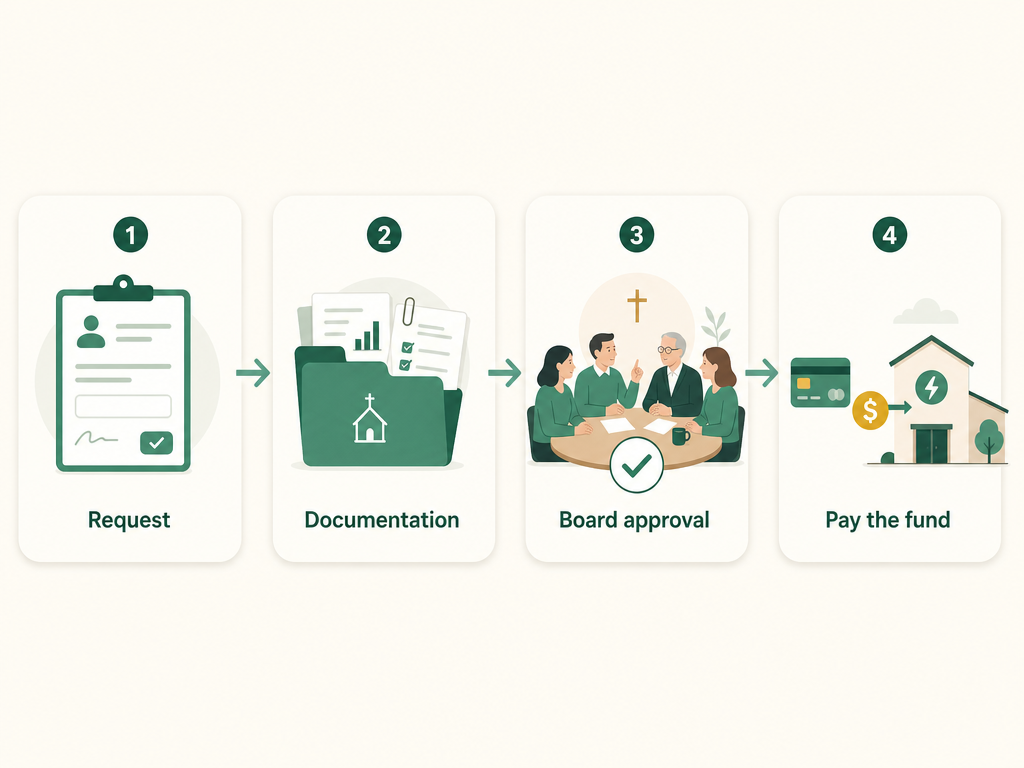
- Request. The person seeking help fills out a short written application — who they are, the need, the amount, and any circumstances. A one-page form is enough. Written requests, not hallway conversations, are what create the record.
- Documentation. Gather supporting proof of the need where you reasonably can — the overdue utility bill, the eviction notice, the medical statement. You’re not running a credit check; you’re showing the decision was based on real need.
- Board or committee approval. The committee reviews the request against the policy’s criteria and votes. The decision is based on need, applied by the same standard to everyone — never on how close the person is to leadership. Record who approved it and why.
- Pay from the fund. Disburse the approved amount, paying the vendor directly when possible, and log the payment against the benevolence fund.
The single most valuable habit here is documentation at every step. If you can’t later show the request, the need, the approval, and the payment, you effectively can’t prove the money was charitable.
The tax treatment: benevolence to individuals is generally not taxable
Benevolence paid from the church’s own funds to a genuinely needy individual — where the church keeps control and discretion over the money — is generally not taxable income to the recipient, and the church does not issue a Form 1099 for it. The reason: a payment a charity makes in response to an individual’s need, motivated by charitable intent rather than any legal or moral obligation, is treated as a gift excluded from the recipient’s gross income under IRC §102(a). The IRS reached exactly this conclusion in a private letter ruling holding that need-based charitable assistance to members of a charitable class isn’t compensation and doesn’t require a 1099 — a point summarized well by Church Law & Tax. Welfare-type payments made to meet basic needs are likewise not taxable (IRS Publication 525).
Two conditions carry all the weight: the recipient must be part of a genuine charitable class (needy or distressed), and the money must be given for need, not for services. Meet both and it’s a tax-free gift with no reporting — the whole story for most benevolence a church does.
The exception: benevolence paid to employees is taxable compensation
Benevolence paid to a church employee — a pastor, an office administrator, a paid worship leader — is generally taxable compensation, added to their Form W-2, not a tax-free gift. This isn’t a gray area. IRC §102(c) says outright that the gift exclusion “shall not exclude from gross income any amount transferred by or for an employer to, or for the benefit of, an employee.” So the “it’s a gift” logic that works for a needy stranger collapses the moment the recipient is on payroll. Love offerings, Christmas gifts, and “benevolence” handed to staff flow through as wages and are subject to the usual payroll withholding.
There’s a narrow exception: an employee genuinely part of a large charitable class (say, everyone harmed by a widespread disaster, chosen by an independent committee on objective need) can sometimes receive tax-free aid (IRS Publication 3833). But that’s a documented, specific situation — not a workaround for paying staff. When the recipient is an employee, the safe default is: treat it as taxable pay unless a tax professional confirms a real exception applies.
The earmarking trap: donor-directed gifts aren’t deductible
A gift a donor earmarks for a specific named individual is generally not tax-deductible, even if the check is written to the church. IRS Publication 526 is explicit: you can’t deduct contributions earmarked for the relief of a particular individual or family. The rule turns on control: for a gift to be deductible, the church — not the donor — must have full control of the funds and discretion over how they’re used.
So the mechanics matter enormously. If a member gives “to the benevolence fund” and the committee decides by need who gets helped, that’s a deductible gift to the church. If the same member gives “for the Smith family,” the church is just a conduit passing one person’s gift to another, and it’s a non-deductible personal gift. This is the same control-and-discretion principle that governs church designated funds generally, and it’s why the policy has to keep the church in the decision seat. A church can accept gifts toward benevolence in general; it can’t promise a donor that their money goes to one chosen person and still call it deductible — a nuance that also shapes what a church can honestly acknowledge when it answers whether are church donations tax deductible.
Avoiding private benefit and inurement
The hardest line a benevolence policy has to hold is the one against private benefit and inurement — using tax-exempt money to enrich insiders. A charity’s funds are never supposed to serve the personal interests of the people who run it. Routing benevolence to a board member, the pastor, or their families raises exactly this concern, and unchecked private benefit can threaten the church’s exempt status.
The policy defends against this in three ways: it defines a real charitable class (so help flows by need, not relationship); it forbids self-dealing (nobody approves a payment benefiting themselves or a relative); and it requires arms-length review for any request touching an insider. Written criteria applied the same way to everyone are the proof that the fund serves charity, not favoritism — the record that keeps a good deed from looking like a payoff.
Track benevolence as a designated fund with an audit trail
Once the policy and process are set, the accounting has to match — and the cleanest way is to run benevolence as its own designated fund, separate from the general fund, so its balance and every disbursement live in one place. That answers two questions instantly: how much benevolence money do we have, and where did every dollar go? Restricted-purpose money should never blend into general operating cash.
Vestrybooks tracks benevolence as its own fund and audit-logs every approval and payment, so the request, the amount, and who signed off are all attached to the money — a complete paper trail behind every act of help, without extra work. See plans →
That audit trail is the same thing an auditor, a board, or the IRS would ask for: a request on file, a documented need, a recorded approval, and a payment tied to the benevolence fund. Build it into the software and it’s just how the fund works.
FAQ
Are benevolence payments taxable to the person who receives them? Generally no. Benevolence paid from the church’s own funds to a genuinely needy individual who isn’t an employee is a tax-free gift under IRC §102(a), not income, as long as it’s given for need rather than for services. The recipient owes no tax on it, and the church reports nothing. The exception is an employee — see below.
Does a church report benevolence on a 1099? No. A church does not issue a Form 1099 for need-based benevolence to a non-employee, no matter the amount, because the payment is a gift to a member of a charitable class, not compensation for services. The IRS has confirmed this. If a payment is actually for work done, it’s compensation and the usual reporting rules apply.
Is benevolence to a church employee or pastor taxable? Yes, usually. Under IRC §102(c), the gift exclusion doesn’t apply to amounts an employer transfers to an employee, so benevolence paid to a pastor or staff member is generally taxable wages added to their W-2, subject to normal payroll withholding. A narrow charitable-class exception can exist, but treat employee benevolence as taxable unless a tax professional confirms otherwise.
Can a donor give to the benevolence fund and deduct it if they name the recipient? No. A gift earmarked for a specific named individual or family isn’t deductible, even if the check goes to the church, because the church must have full control and discretion over the money for it to be a deductible charitable contribution (IRS Publication 526). Donors can give toward benevolence generally and deduct that; they can’t direct the money to one person and still deduct it.
Who should approve benevolence requests? A benevolence committee or the board — never a single person acting alone, and never someone approving a payment to themselves or a relative. The policy should name the approver, set dollar limits that trigger higher review, and require the decision to be recorded. That structure is both good governance and the evidence that help was given by need, not favoritism.
How much detail does the documentation need? Enough to show the money was charitable: a written request, the nature and amount of the need, supporting proof where reasonable (the bill, the notice), and a record of who approved it and when. You’re not running an investigation — you’re creating a paper trail that proves need-based intent if anyone ever asks.
This is general information, not tax or legal advice — consult a qualified professional for your church’s specific situation.
This article is general information for church treasurers, not professional tax or legal advice. For your church's situation, consult a qualified accountant or attorney.
Track every gift, print statements in one click.
Vestrybooks records each gift by donor and fund, builds IRS-ready year-end statements, and takes $0 of every online gift.
A real free plan · no credit card · your data stays yours