Blog · Nonprofit policies & compliance
The nonprofit investment policy your board adopts to govern its reserves
June 27, 2026 · By Benjamin Reinke

A nonprofit investment policy — usually written as an investment policy statement, or IPS — is the document a board adopts to set the rules for how the organization invests its reserves and endowment: the objectives the money is invested for, how much risk the board will accept, the mix of stocks, bonds, and cash it will hold, how much of an endowment can be spent each year, and who has authority to make the calls. A nonprofit board needs one so that reserves aren’t invested on a whim, chased into whatever’s hot, or steered by a single person’s hunch. The IPS turns “we trust the treasurer with the money” into a written standard the board set in advance and can hold anyone to. In most states, a law called UPMIFA already requires the board to manage and spend those funds prudently; the investment policy is how the board proves it did. A church that holds reserves or an endowment is a 501(c)(3) like any other nonprofit, so the same policy applies.
This policy is one of the written rules a board adopts to govern its money; for the full set and how they fit together, see nonprofit financial policies.
Why a nonprofit board adopts a written investment policy statement
A nonprofit board adopts a written investment policy statement because investing the organization’s money is a fiduciary act, and fiduciary acts need a standard, not an opinion. Without an IPS, the reserves get invested however the current treasurer or a well-meaning board member happens to prefer — too cautiously, so inflation eats them; too aggressively, so a bad year wipes out a chunk of the operating cushion; or simply inconsistently, changing every time the people change. The policy fixes the rules in place so the money is managed the same way regardless of who holds the checkbook.
The IPS does three concrete things for a board:
- It sets the guardrails in advance. The board decides, when no specific trade is on the table and no one is under pressure, how much risk it will accept and what the money is for. That decision then governs every later choice.
- It defines who may act, and how far. A finance or investment committee, a hired advisor, or an officer gets a clear lane — what they can do on their own and what has to come back to the full board.
- It creates the evidence of prudence. If a loss happens, or a donor or auditor asks how the endowment is being run, the policy and the minutes that adopt it show the board acted deliberately and within a standard. That record is the board’s defense.
The same governance logic the IRS lays out for tax-exempt organizations applies here: a 501(c)(3)‘s assets must be managed for its exempt purpose, not for any insider’s benefit. The IRS guide to exempt status, Publication 557, frames that duty, and an investment policy is one of the documents that shows the board takes it seriously.
What goes in a nonprofit investment policy statement
A nonprofit investment policy statement covers the same building blocks whether the organization is a charity, a foundation, or a church holding an endowment. Each one answers a question the board would otherwise be answering on the fly.
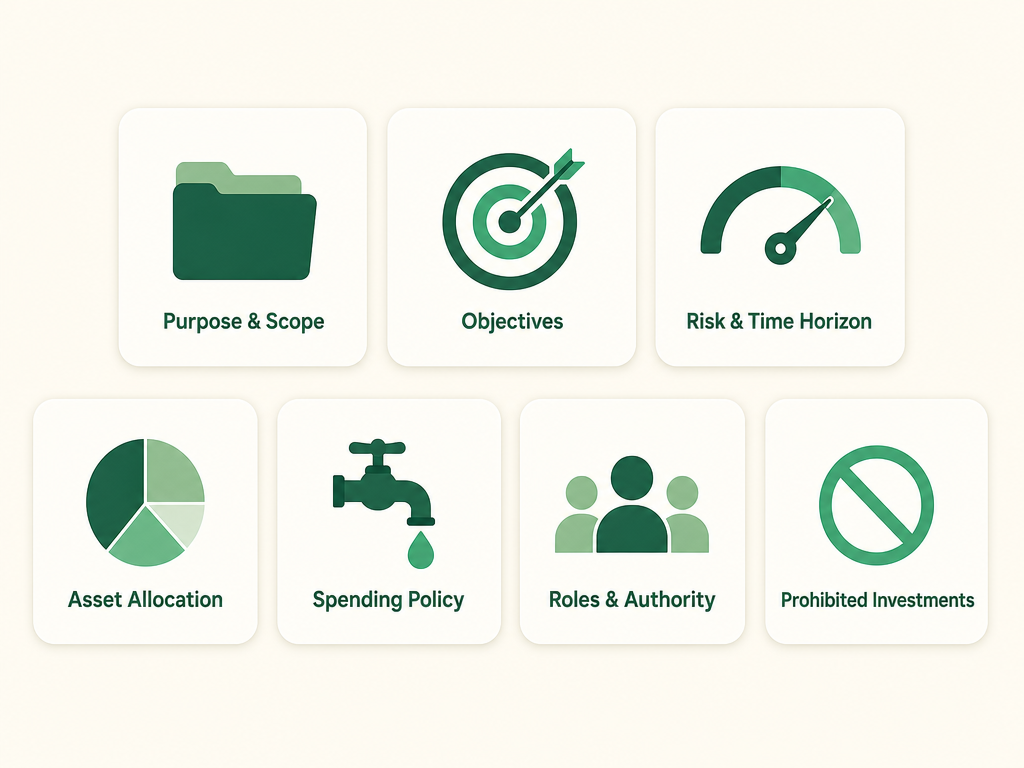
| Section | What it sets | Why it matters |
|---|---|---|
| Purpose & scope | Which funds the policy governs — operating reserves, a building fund, a permanent endowment | The rules for a 6-month operating cushion are not the rules for a 50-year endowment |
| Investment objectives | What the money is invested for: preserve capital, generate income, grow over time, or some weighting of all three | The objective drives every other choice; a reserve you may need next year is invested nothing like a perpetual endowment |
| Risk tolerance & time horizon | How much short-term loss the board will accept, and how long the money can stay invested | A long horizon lets the board ride out volatility for higher returns; a short one can’t |
| Asset allocation ranges | Target percentages and min/max bands for stocks, bonds, and cash | Ranges keep the portfolio in bounds without forcing a trade on every market move |
| Spending / withdrawal policy | How much of an endowment may be spent each year (often a set percentage of a multi-year average value) | This is what keeps an endowment lasting — spend too much and you erode the principal donors gave |
| Roles & authority | Who decides, who executes, who reviews — board, finance/investment committee, outside advisor | Removes the “who’s allowed to do this?” question before money moves |
| Prohibited investments | What the organization will not hold — individual speculative stocks, options, crypto, anything off-mission | A short list of “never” prevents the worst mistakes outright |
| Monitoring & review | How often the board reviews performance against benchmarks and re-reads the policy | A policy no one revisits drifts out of date as the organization’s needs change |
The next few sections take the load-bearing pieces in turn.
Investment objectives — preserve, income, or growth
The investment objectives are the heart of the IPS, because they decide what every other rule is in service of. Most nonprofits write the objective as a blend of three aims, weighted by what the money is for:
- Preservation of capital — protect the dollar value of the fund. This dominates for operating reserves the organization may need on short notice.
- Income — generate a steady, spendable yield. This matters most when the fund is meant to support operations or programs year after year.
- Growth — grow the fund’s value faster than inflation over time. This is the priority for a permanent endowment that has to last and keep its purchasing power for decades.
A 6-month operating reserve and a permanent endowment sit at opposite ends. The reserve is weighted almost entirely toward preservation and liquidity — you cannot afford a 20% drawdown in the fund you’d tap to make payroll in a bad quarter. The endowment can tolerate that volatility because its horizon is measured in decades, so it leans toward growth to outrun inflation. Naming the objective for each fund is what tells the committee how to invest it.
Asset allocation ranges keep the portfolio in bounds
The asset allocation section translates the objectives into a target mix of asset classes — typically stocks (equities), bonds (fixed income), and cash — and gives each a range rather than a single number. A growth-leaning endowment might target 60% stocks, 35% bonds, 5% cash, with bands like 50–70% stocks. The range is deliberate: it lets the portfolio drift with the market without triggering a trade every time, and it tells the committee when to rebalance — when an asset class breaks out of its band, the committee trims or adds to bring it back. Writing the ranges down means a board member can’t quietly load up on one stock or shift everything to cash out of fear; the policy already decided the bounds.
A spending policy keeps an endowment from being spent down
The spending policy — sometimes called a withdrawal or draw policy — is the section that decides how much of an endowment the organization may use each year, and it’s the piece churches and small nonprofits most often skip. The risk it guards against is real: an endowment exists to support the mission in perpetuity, and if the board spends 8% or 10% in a good year because the money is there, it quietly erodes the principal donors meant to last forever. A common approach is to spend a fixed percentage — often in the 4–5% range — of the fund’s average value over the trailing three years, which smooths out market swings so the annual draw doesn’t lurch up and down with the market. The exact number is the board’s call, but writing one down is what separates a managed endowment from a slowly disappearing one. This connects to how the organization tracks money it isn’t free to spend at will; see nonprofit restricted funds for how donor restrictions and endowments sit in the books.
Who has authority — board, committee, and advisor
The roles-and-authority section names who may do what, so an investment decision is never one person acting alone. A typical structure has three layers:
- The board adopts the policy, sets the objectives and risk tolerance, and holds final authority. It can’t delegate away its fiduciary duty, but it can delegate the day-to-day.
- A finance or investment committee carries out the policy — selecting investments within the policy’s bounds, monitoring performance, and reporting back to the board. For a small organization this might be two or three board members.
- An outside advisor (a registered investment advisor or institutional fund manager) may be hired to manage the portfolio. The board still owns the policy; the advisor invests within it and answers to the committee.
The point of spelling this out is that no single individual — not the treasurer, not the pastor, not a generous board member with strong market opinions — should be able to move the organization’s money on their own judgment. Naming the layers, and what each may decide without coming back to the board, is what enforces that. Setting and overseeing this structure is part of the board’s core fiduciary work, covered in nonprofit board of directors responsibilities.
How UPMIFA sets the prudence standard for nonprofit funds
UPMIFA — the Uniform Prudent Management of Institutional Funds Act — is the state law that governs how a nonprofit manages and spends its institutional funds, and it’s the legal standard an investment policy is built to meet. A version of UPMIFA has been adopted in nearly every U.S. state, and it replaced an older law (UMIFA) to modernize the rules for endowments. The act doesn’t tell a board what to buy. Instead, it sets a standard of conduct: when managing and investing an institutional fund, those responsible must act in good faith and with the care an ordinarily prudent person in a like position would exercise under similar circumstances.
In practice, UPMIFA directs a board to weigh a set of factors — among them general economic conditions, the possible effect of inflation, the expected total return on the fund, the organization’s other resources, and, crucially, the purposes of the organization and of the fund itself. It also expects the board to diversify investments unless there’s a good reason not to, and to consider each investment as part of the whole portfolio rather than in isolation. That language maps almost one-to-one onto the sections of an IPS: stating the fund’s purpose, setting objectives and a time horizon, diversifying through an asset allocation, and adopting a reasonable spending rate. The model act and its state-by-state adoption are published by the Uniform Law Commission. A well-drafted investment policy is, in effect, the board’s written plan for satisfying UPMIFA’s prudence standard — and the record that it tried.
Conflict of interest and self-dealing in investment decisions
A nonprofit investment policy carries a conflict-of-interest tie-in because investment decisions are exactly where self-dealing tends to hide. The board member who steers the endowment toward a fund their own firm manages, the advisor selected because they’re the treasurer’s brother-in-law, the bank chosen because a director sits on its board — each is an investment decision that benefits an insider, and each is the kind of private-benefit problem that can put a 501(c)(3)‘s exempt status at risk. The fix is the same one the board already uses elsewhere: anyone with a financial stake in an investment decision discloses it and steps out of the vote.
For that reason, a good IPS either references the organization’s existing conflict-of-interest policy or restates the rule directly — no director, officer, or committee member may participate in selecting an investment, advisor, or custodian in which they have a financial interest, and any such interest must be disclosed and recorded. The mechanics of disclosure and recusal are the subject of their own guide; see the conflict-of-interest policy for how the disclose-recuse-document procedure works. Folding it into the investment policy makes sure the rule travels with the decisions where it matters most.
How churches adopt an investment policy for reserves and endowments
A church adopts an investment policy the same way any nonprofit does, because a church holding reserves or an endowment faces the same questions: what is this money for, how much risk is acceptable, and who decides. Many congregations carry a building fund, a cemetery or perpetual-care fund, a memorial endowment, or simply an operating reserve — and all of it can sit invested for years with no written rule governing how. The body that adopts the policy may be called a vestry, a session, a board of trustees, a finance committee, or a deacon board; in the eyes of the law it plays the role of the board of directors, and it owes the same duty of prudence under UPMIFA.
Churches do have a few distinctive wrinkles. Donor-restricted gifts are common — a bequest “for the building” or “the income to support youth ministry” — and the IPS has to respect those restrictions alongside the general reserves. Some congregations also screen investments against their values, excluding certain industries; that belongs in the prohibited-investments section. None of this changes the structure. The church names what each fund is for, sets objectives and an allocation, writes a spending rule for any endowment, and assigns authority to a committee or advisor. For how the underlying books handle money the church isn’t free to spend at will, see church fund accounting.
Where to get a nonprofit investment policy template
You don’t have to draft a nonprofit investment policy from a blank page. Our free investment policy template gives you each section above — purpose and scope, objectives, risk tolerance and time horizon, asset allocation targets and ranges, a spending policy, roles and authority, prohibited investments, monitoring and review, and a UPMIFA prudence note — with plain-English [BRACKETED] placeholders a volunteer board can actually fill in. It includes an adoption block and a short notes-for-churches section. Fill in the brackets to fit your organization’s funds and risk appetite, have a qualified investment advisor and an attorney in your state review it, and adopt it by a recorded board vote.
FAQ
What is a nonprofit investment policy statement? A nonprofit investment policy statement (IPS) is the written document a board adopts to govern how the organization invests its reserves and endowment. It states what the money is invested for (preserve capital, generate income, or grow), how much risk the board will accept, the target mix of stocks, bonds, and cash, how much of an endowment can be spent each year, who has authority to make investment decisions, and what investments are off-limits. It’s the standard the board sets in advance so the money isn’t invested on anyone’s whim.
Does a nonprofit have to have an investment policy? No federal law flatly requires a nonprofit to adopt an investment policy. But if the organization holds reserves or an endowment, a written policy is what lets the board show it’s meeting the prudence standard that state law — UPMIFA, adopted in nearly every state — already imposes on how institutional funds are managed and spent. Auditors expect one, the Form 990 asks about investment practices, and donors who fund an endowment expect their gift to be managed under a real policy. In practice, any nonprofit with money invested should have one.
What is UPMIFA and how does it affect a nonprofit’s investments? UPMIFA is the Uniform Prudent Management of Institutional Funds Act, a state law adopted in nearly every U.S. state that governs how nonprofits manage and spend institutional funds, including endowments. It requires those responsible for a fund to act in good faith and with the care a prudent person would use, to consider factors like inflation and the fund’s purpose, to diversify, and to spend at a reasonable rate. An investment policy is the board’s written plan for meeting that standard.
How much of an endowment can a nonprofit spend each year? There’s no fixed legal cap, but a common practice is to spend a set percentage — often in the 4–5% range — of the endowment’s average value over the prior three years. Averaging over multiple years smooths out market swings so the annual draw is steady. The board sets the exact rate in its spending policy, balancing today’s program needs against the goal of preserving the fund’s purchasing power for the long term. UPMIFA expects that rate to be reasonable and prudent rather than draining the fund.
Who is responsible for a nonprofit’s investments? The board of directors is ultimately responsible for a nonprofit’s investments — it adopts the policy, sets the objectives and risk tolerance, and holds the fiduciary duty. The board typically delegates the day-to-day work to a finance or investment committee, and may hire an outside investment advisor to manage the portfolio within the policy’s bounds. The board can delegate the tasks but not the responsibility, which is why it oversees the committee and reviews performance.
A clean investment policy is only as trustworthy as the books behind it. Vestrybooks gives your board view-only access to live, reconciled finances — including restricted and endowment funds — so the money in the account matches the policy your board adopted. See how it works.
This is general information, not investment, legal, or tax advice — confirm your organization’s situation with a qualified advisor.
This article is general information for church treasurers, not professional tax or legal advice. For your church's situation, consult a qualified accountant or attorney.
Nonprofit accounting, minus the headache.
Vestrybooks does fund accounting, donor tracking, and board-ready reports for churches and faith-based nonprofits.
A real free plan · no credit card · your data stays yours