Blog · Contributions & statements
Tithing at church — what it is, how much, and the tax side
June 27, 2026 · Updated July 4, 2026 · By Benjamin Reinke
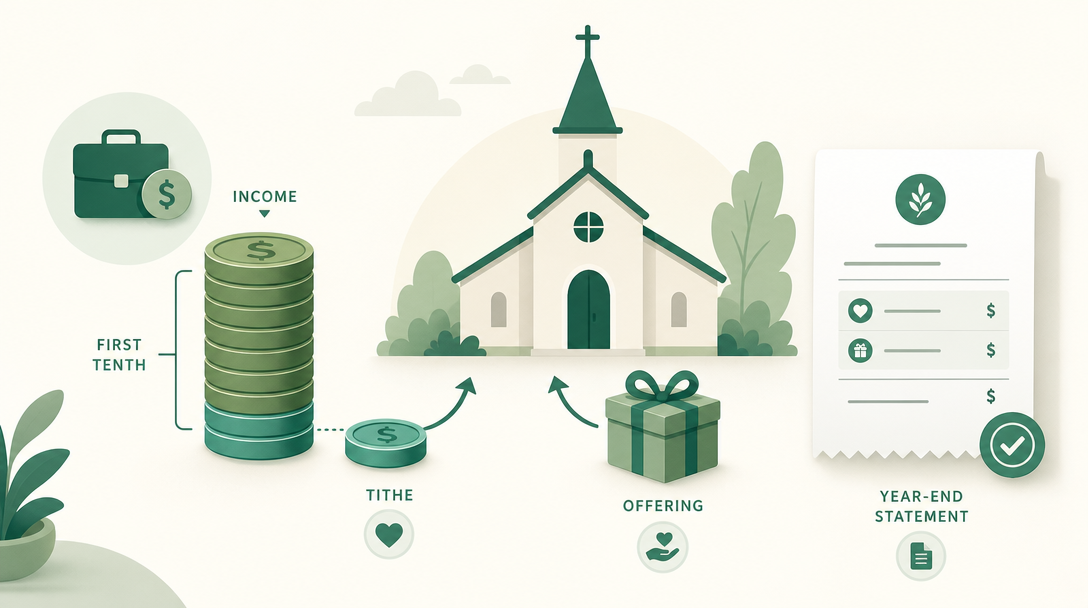
Short answer: Tithing at church means giving a tenth (10%) of your income to your local church — a practice rooted in the Bible. It isn’t a legal requirement or something a church can enforce; it’s a faith commitment, and how you apply it (10% of gross or net, weekly or monthly) is a matter of personal conviction. On the practical side: tithes given to a qualifying church are tax-deductible if you itemize, and your church should give you a year-end statement to prove them.
What tithing at church means
A “tithe” literally means a tenth. Tithing is the long-standing Christian practice of returning 10% of your income to the church, with biblical roots in the Old Testament (firstfruits and the tithe in passages like Malachi 3) carried into church tradition. The New Testament emphasizes giving generously and cheerfully rather than prescribing a percentage — so most churches teach the tithe as a faithful baseline, not a tax the church collects. To see what 10% comes to per week or month on your income, run it through the tithe calculator.
Tithe vs. offering
The two words get used interchangeably, but they’re different:
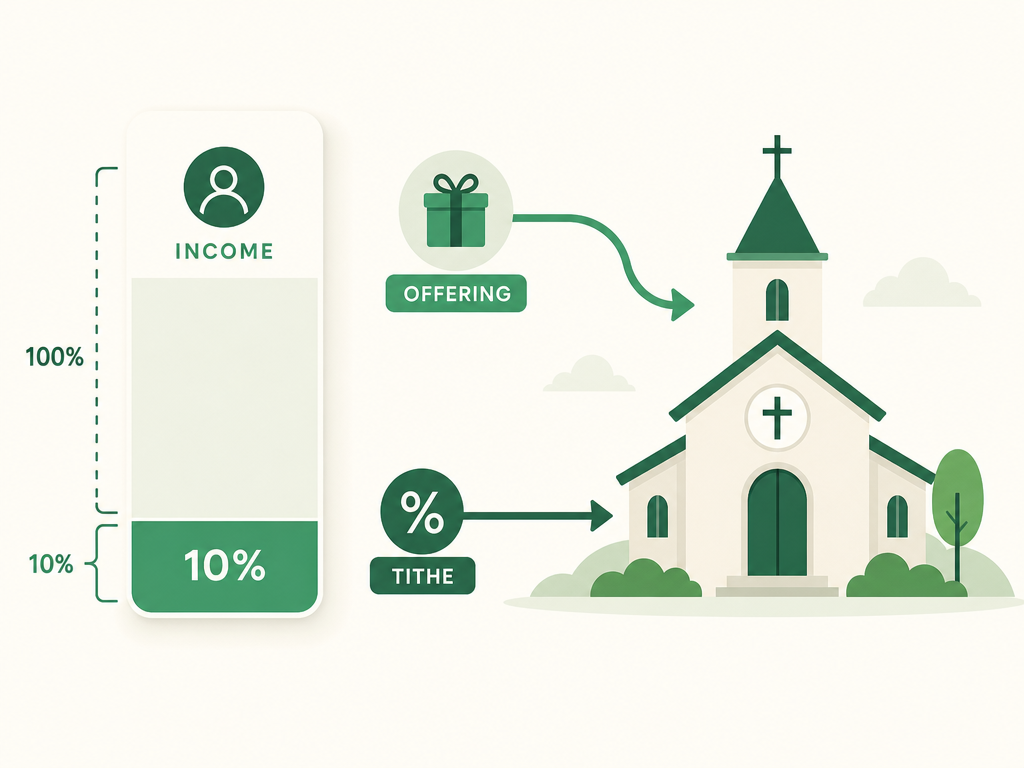
- Tithe — the baseline tenth, given regularly to your local church.
- Offering — anything given above the tithe: a building fund gift, missions, benevolence, a special collection.
Both are charitable gifts to the church; the distinction is mostly about intent and amount, not tax treatment.
How much should you tithe — and gross or net?
The traditional figure is 10%, but the common questions are of what and how often. Gross vs. net (before or after taxes) is a matter of personal conviction — Scripture doesn’t specify, so churches generally leave it to the giver. Many people tithe weekly or per paycheck; others give monthly. The honest guidance most churches offer: pick a consistent percentage you can give faithfully, and grow it over time — the regularity matters more than hitting an exact number.
Is tithing required?
No — not legally, and not as something a church enforces. Tithing is a voluntary faith practice. A church can’t compel it, and your giving record is between you and the church. Many Christians treat the tithe as a spiritual commitment; others give a different percentage. Either way, it’s giving, not a fee.
Are tithes tax-deductible?
Yes — a tithe is a cash gift to a church, so it’s deductible on the same terms as any church donation: the church must be a qualifying organization (churches automatically qualify), and you claim it either by itemizing or — starting in 2026 — through a new above-the-line deduction of up to $1,000 (single) or $2,000 (joint) for non-itemizers (IRS Publication 526). For any single gift of $250 or more, you need the church’s written acknowledgment — which is exactly what a year-end church contribution statement provides.
How churches track tithes
For the church side, every tithe and offering should be recorded to the giver and the fund — which online giving does automatically — so the church can produce an accurate year-end statement and keep its fund accounting straight. Good records protect both the giver (who needs the deduction substantiated) and the church (which has to show every restricted gift was used as intended).
Vestrybooks records every gift to the donor and fund automatically and generates IRS-ready year-end statements in one click — so tithes and offerings are always tracked and provable. See plans →
FAQ
Do you tithe 10% every Sunday? Traditionally the tithe is 10% of income given regularly — many give weekly, others per paycheck or monthly. The percentage is the baseline; the schedule is up to you.
What is the correct way to tithe? There’s no single rule — most churches teach giving a consistent tenth of your income faithfully, whether of gross or net, weekly or monthly. Consistency matters more than the exact mechanics.
Does the Bible say you must tithe to a church? The Old Testament commands the tithe; the New Testament emphasizes generous, cheerful giving without a fixed percentage. Most churches teach the tithe as a faithful baseline, not a legal requirement.
Is tithing at church tax-deductible? Yes, if the church qualifies (churches automatically do) and you itemize. Keep the church’s year-end statement as proof, especially for single gifts of $250 or more.
This is general information, not tax advice — confirm your situation with a qualified professional.
This article is general information for church treasurers, not professional tax or legal advice. For your church's situation, consult a qualified accountant or attorney.
Track every gift, print statements in one click.
Vestrybooks records each gift by donor and fund, builds IRS-ready year-end statements, and takes $0 of every online gift.
A real free plan · no credit card · your data stays yours