Blog · Nonprofit policies & compliance
The conflict-of-interest policy every nonprofit board should adopt
June 27, 2026 · By Benjamin Reinke

A conflict-of-interest policy is the written rule a nonprofit board adopts so that any director or officer with a personal financial stake in a decision discloses it, steps out of the discussion and the vote, and lets the rest of the board decide whether the deal is fair to the organization. A nonprofit needs one because it’s the policy the IRS most wants to see — Form 1023, the application for 501(c)(3) status, asks whether you’ve adopted one, and the IRS even publishes a sample policy you can copy. The point isn’t to ban directors from ever doing business with the organization; it’s to make sure that when they do, an independent board approved it at arm’s length and wrote down why it was fair. A church is a 501(c)(3) like any other nonprofit, so the same policy applies to a congregation. This guide covers what the policy says, the procedure it sets up, and where to get a template you can adapt.
This policy is one of the core written rules a board adopts; for the full set and how they fit together, see nonprofit financial policies.
Why the IRS asks about a conflict-of-interest policy on Form 1023
The IRS treats a conflict-of-interest policy as a marker of a board that will govern in the public interest rather than for insiders. When an organization applies for 501(c)(3) status, Form 1023 asks whether it has adopted a conflict-of-interest policy, and the instructions to that form include a complete sample policy in Appendix A that the IRS offers as a model. Adopting a policy isn’t strictly a legal condition of exemption, but the IRS strongly encourages it, and answering “no” on the application invites questions the rest of your file then has to answer.
The reason sits in the law the exemption rests on. A 501(c)(3) organization may not let its earnings benefit an insider beyond reasonable pay — the rule against private inurement — and the IRS can impose excess-benefit penalties on insiders who get an unfair deal and on the board members who approved it. A conflict-of-interest policy is the board’s standing defense against both. It forces the conversation into the open before money moves, and it produces the paper trail that shows the organization acted for its mission and not for a director’s wallet. The IRS lays out the underlying exemption requirements in Publication 557.
What counts as a conflict of interest on a nonprofit board
A conflict of interest exists when a director, officer, or key person — what the policy calls an interested person — has a financial interest in a transaction the organization is considering. The financial interest is usually one of these:
- An ownership or investment stake in a company the nonprofit is about to buy from, contract with, or sell to.
- A compensation arrangement with the nonprofit or with anyone the nonprofit is doing a deal with — pay, a fee, or a gift of more than nominal value.
- The same kind of stake held by a close relative — a spouse, child, parent, or sibling — rather than the director personally.
A financial interest is not automatically a conflict, and a conflict is not automatically wrong. The board’s job is to decide, in the open, whether the deal is fair. Renting office space from a board member’s company can be perfectly fine if the rent is at or below market and the board approved it without that member in the room. The problem is never that a director has an interest; it’s an interest that nobody disclosed and a board that voted on a deal it never examined. That distinction — disclose and decide, rather than forbid — is the whole design of the policy, and it traces straight back to a director’s duty of loyalty, covered in nonprofit board of directors responsibilities.
The disclose, recuse, document, and decide procedure
Every conflict-of-interest policy sets up the same four-step procedure, and following it in order is what protects the organization and the director both.
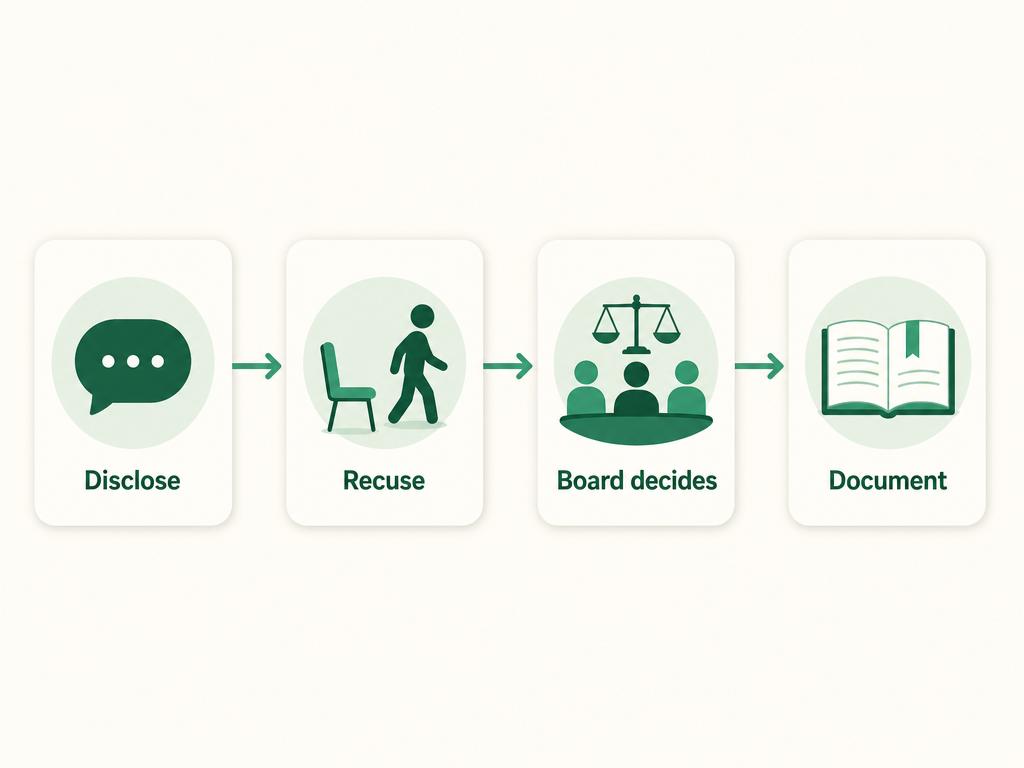
| Step | What happens | Why it matters |
|---|---|---|
| 1. Disclose | The interested person tells the board the material facts of the interest as soon as a relevant matter comes up. | The board can’t weigh a conflict it doesn’t know about. Silence is the failure the policy exists to prevent. |
| 2. Recuse | After answering the board’s questions, the interested person leaves the discussion and the vote. They aren’t counted toward the quorum on that vote. | An interested person in the room shapes the outcome even without voting. Stepping out keeps the decision independent. |
| 3. Board decides on fairness | The disinterested directors discuss the transaction, gather any comparable prices or terms, and determine by majority vote whether it’s fair and in the organization’s best interest. | This is the substantive test. A fair, well-documented deal is defensible even when an insider is on the other side of it. |
| 4. Document in the minutes | The minutes record who disclosed what, that the person recused, the alternatives considered, and the board’s finding that the deal was fair. | The minutes are the evidence. If the IRS or a donor ever asks, the record shows the board did its job. |
The order matters. Disclosure before discussion means nobody is blindsided; recusal before the vote keeps the interested person from steering it; a finding of fairness before approval means the board actually examined the deal; and the minutes preserve all of it. Skip the minutes and you’ve done the right thing with no way to prove it — which, for a YMYL matter like tax-exempt status, is nearly as bad as not doing it.
Annual disclosure statements keep conflicts visible
A conflict-of-interest policy works best when conflicts surface before they’re urgent, and an annual disclosure statement is how boards make that happen. Once a year, every director, officer, and key employee signs a short statement confirming they’ve received the policy, understand it, agree to follow it, and listing any interests that could create a conflict — businesses they own, organizations they’re tied to, relatives who do business with the nonprofit. The board keeps the signed statements on file.
The annual statement does two things. It puts known relationships on the record before any specific deal is on the table, so the board isn’t learning about a director’s company for the first time mid-vote. And it’s a yearly reminder that the policy exists and binds everyone, which is most of what keeps a policy from gathering dust. Most adopt this as a standing item the secretary circulates at the start of the fiscal year, alongside the board’s other annual housekeeping.
How a conflict-of-interest policy protects tax-exempt status
A conflict-of-interest policy is the board’s first line of defense for its 501(c)(3) status, because the threats to that status mostly come from inside. Two IRS rules put the organization and its leaders at risk:
- Private inurement. No part of a 501(c)(3)‘s net earnings may benefit an insider — a director, officer, or their family — beyond reasonable compensation. A serious inurement violation can cost the organization its exemption outright.
- Excess-benefit transactions. When an insider gets more than fair value from the nonprofit, the IRS can levy excise taxes on that insider and on the board members who knowingly approved the deal. These penalties land on individuals, not just the organization.
A conflict-of-interest policy, followed and documented, is what lets a board show it approved an insider transaction at arm’s length and for fair value. The IRS recognizes a “rebuttable presumption of reasonableness” when an independent body approves a transaction using comparable data and records its decision — which is exactly the disclose–recuse–decide–document procedure above. The policy doesn’t just look good on the application; it builds the evidence that keeps the exemption safe. For where this sits among a board’s broader duties, the nonprofit board of directors overview covers the fiduciary duties in full.
What goes in a nonprofit conflict-of-interest policy
A conflict-of-interest policy modeled on the IRS Appendix A sample has the same articles whether the organization is a charity, a foundation, or a church. A complete policy covers:
- Purpose — that the policy protects the organization’s interest when it considers a transaction that might benefit an interested person, and supplements (doesn’t replace) state nonprofit law.
- Definitions — who is an interested person and what counts as a financial interest.
- Procedures — the duty to disclose, how the board determines whether a conflict exists, recusal from the discussion and vote, and how the board decides the matter.
- Violations — what the board does if someone fails to disclose, up to and including discipline.
- Records of proceedings — that disclosures, recusals, and the board’s fairness findings go in the minutes.
- Compensation — that anyone whose pay the board is setting can’t vote on or be present for the decision on their own compensation.
- Annual statements — the yearly signed acknowledgment described above.
- Periodic reviews — a regular check that the organization’s insider deals stayed at fair value and that the policy is being followed.
You don’t have to draft this from scratch. Our free conflict-of-interest policy template gives you each of these articles with plain-English placeholders, written in the spirit of the IRS sample but in language a volunteer board can actually use. Fill in the brackets, have an attorney in your state look it over, and adopt it by board vote.
How churches use the same conflict-of-interest policy
A church is a 501(c)(3), so the same conflict-of-interest policy applies — the names on the board may differ, the rule doesn’t. Whether a congregation calls its leaders trustees, elders, a vestry, a session, or a deacon board, those people are the organization’s directors in the eyes of the law, and they owe the same duty of loyalty. When the church buys land from a member of the board, hires a relative of the pastor, or contracts with an elder’s construction company, the policy runs exactly the same way: the interested person discloses, steps out of the discussion and vote, the rest of the board decides whether the deal is fair, and the secretary writes it in the minutes.
Church boards have a few extra spots where conflicts show up — setting the pastor’s compensation, benevolence payments to people connected to leadership, building projects awarded to members. None of that changes the procedure. Many churches fold a short conflict-of-interest article straight into their governing documents; if you’re writing or revising yours, the nonprofit bylaws guide shows where the clause goes and what it should say.
FAQ
Does a nonprofit have to have a conflict-of-interest policy? A conflict-of-interest policy is not, by itself, a legal requirement for federal tax exemption — a nonprofit can technically be a 501(c)(3) without one. But the IRS asks whether you’ve adopted one on Form 1023, strongly encourages it, and publishes a sample policy for you to use, so in practice nearly every well-run nonprofit adopts one. Some states also require it, and many grantmakers won’t fund an organization that lacks it. Treating it as optional is a mistake even where the law allows it.
What is the IRS sample conflict-of-interest policy? The IRS sample conflict-of-interest policy is a model policy printed in Appendix A of the instructions to Form 1023, the application for 501(c)(3) status. It lays out the standard articles — purpose, definitions of interested person and financial interest, the disclosure and recusal procedure, records, compensation, annual statements, and periodic reviews — and many nonprofits adopt a version of it almost verbatim. You can reach it through the IRS Form 1023 page.
What is a conflict of interest for a nonprofit board member? A conflict of interest for a nonprofit board member is any situation where the member, or a close relative, has a financial stake in a decision the board is making — owning a company the nonprofit wants to hire, being paid by someone on the other side of a deal, or setting their own compensation. Having an interest isn’t wrong on its own. The conflict only becomes a problem if the member fails to disclose it or votes on the matter instead of stepping out.
What happens if a board member has a conflict of interest? When a board member has a conflict of interest, the policy directs them to disclose the material facts to the board, answer any questions, and then leave the room for the discussion and the vote. The remaining disinterested directors examine the transaction, decide whether it’s fair to the organization, and approve or reject it. The secretary records the disclosure, the recusal, and the board’s decision in the minutes. Handled this way, the board can still do the deal — it just does it transparently and on the record.
Who signs a conflict-of-interest policy at a nonprofit? Every director and officer signs the conflict-of-interest policy, and most nonprofits extend it to key employees and committee members who help make financial decisions. They typically sign an annual disclosure statement confirming they’ve read the policy, agree to follow it, and listing any interests that could create a conflict. The signed statements stay on file as proof the board takes the policy seriously.
A clean record of who disclosed what, who recused, and how the board decided is only as good as the books behind it. Vestrybooks gives your board view-only access to live, reconciled finances, so the decisions in your minutes match the money in the account. See how it works.
This is general information, not legal or tax advice — confirm your organization’s situation with a qualified professional.
This article is general information for church treasurers, not professional tax or legal advice. For your church's situation, consult a qualified accountant or attorney.
Nonprofit accounting, minus the headache.
Vestrybooks does fund accounting, donor tracking, and board-ready reports for churches and faith-based nonprofits.
A real free plan · no credit card · your data stays yours