Blog · Nonprofit policies & compliance
The document retention policy every nonprofit board should adopt
June 27, 2026 · By Benjamin Reinke
Short answer: A nonprofit document retention policy is the written rule its board adopts that sets how long the organization keeps each kind of record and when it may destroy them. It does two jobs at once — it makes sure the records you’ll need for an audit, the Form 990, or a lawsuit still exist, and it gives you permission to throw out the rest on a consistent schedule instead of hoarding everything or shredding selectively. The IRS asks whether you have one on the Form 1023 exemption application, which is why most boards adopt it alongside the rest of their nonprofit financial policies. A church is a 501(c)(3), so the same policy applies to a congregation; the body that adopts it may be a vestry or session instead of a board, but the rules don’t change.
What a nonprofit document retention and destruction policy is
A nonprofit document retention and destruction policy is two policies in one document. The retention half is a schedule that lists each type of record — incorporation papers, board minutes, bank statements, donation records, payroll — and says how long to hold it. The destruction half says that once a record passes its retention period, the organization disposes of it on a routine schedule, with one exception: it stops destroying anything connected to a lawsuit or investigation the moment one is anticipated.
That second half is the part boards underestimate. A retention policy is also a destruction policy on purpose. If your organization is ever investigated and you can show it destroys old records on a fixed schedule that applies to everyone, the destruction looks like routine housekeeping. If there’s no schedule and records vanish right when trouble appears, the same act looks like spoliation — getting rid of evidence. The policy protects the organization precisely because it’s mechanical and applied the same way every time.
Why a nonprofit board adopts a document retention policy
A nonprofit board adopts a document retention policy for four concrete reasons, not as paperwork for its own sake:
- The IRS asks about it. The Form 1023 application for 501(c)(3) recognition includes a governance section, and a document retention and destruction policy is one of the practices the IRS expects a well-run organization to have. Answering “no” doesn’t automatically sink an application, but it invites questions.
- Audits need the records to exist. A church audit or any independent review traces a sample of gifts and expenses back to source documents. If the bank statements, invoices, or count sheets were thrown out, there’s nothing to trace to.
- The Form 990 and tax filings depend on it. Nonprofits that file a Form 990 — and the financial records behind it — have to be able to substantiate the numbers. Churches generally don’t file a 990, but the IRS still expects them to keep records that substantiate income and expenses (IRS Publication 1828).
- Legal needs. Contracts, employment records, and donor restrictions can surface years later. The policy makes sure the document that settles the question still exists.
The throughline is that records nobody decided to keep are records nobody can find, and records nobody decided to destroy pile up into a liability of their own. A written schedule replaces both guesses with a system.
The nonprofit document retention schedule, by record type
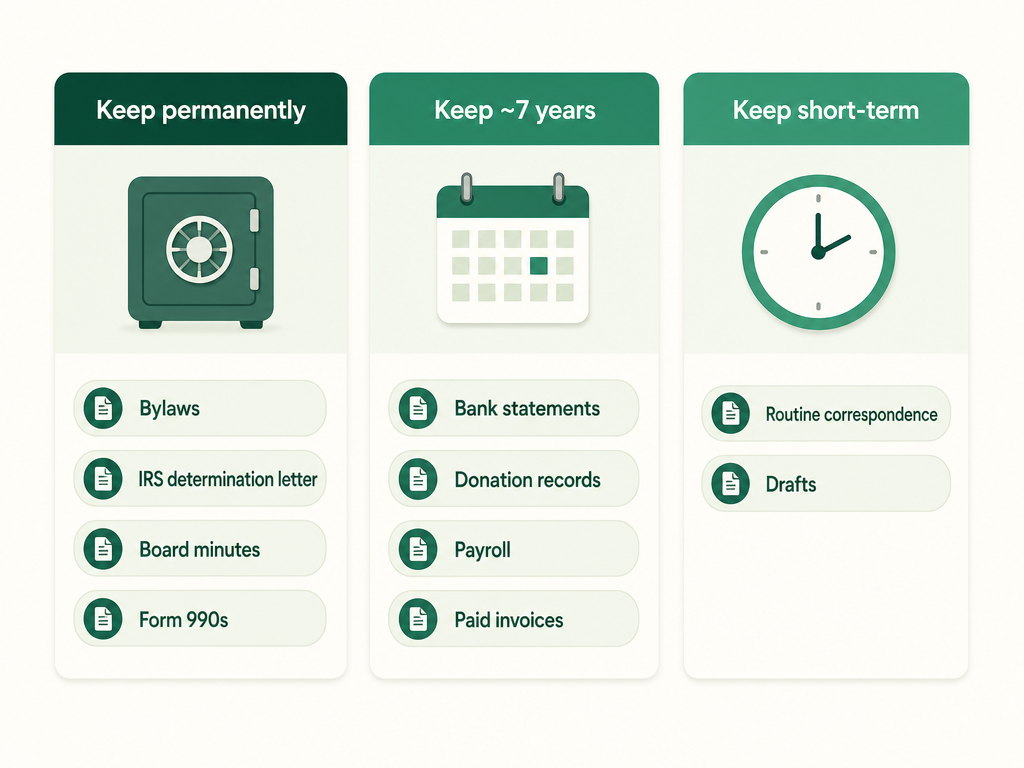
The heart of the policy is a schedule that pairs each record type with a holding period. Three buckets do most of the work: a handful of records you keep permanently, the bulk of financial records you keep about seven years, and routine paperwork you keep only briefly. The table below is a reasonable, general starting point — exact periods vary by state, by record, and sometimes by a grant or contract, so confirm yours with an accountant or attorney before you adopt it.
| Record type | How long to keep it |
|---|---|
| Articles of incorporation, amendments | Permanently |
| Bylaws and amendments | Permanently |
| IRS determination (exemption) letter | Permanently |
| Board and committee meeting minutes | Permanently |
| Form 990 and other annual returns | Permanently |
| Audit reports and year-end financial statements | Permanently |
| Key contracts, deeds, leases, insurance policies (while in force) | Permanently |
| General ledger and accounting records | ~7 years |
| Bank statements and reconciliations | ~7 years |
| Donation and contribution records | ~7 years |
| Payroll records and tax filings | ~7 years |
| Paid invoices and expense documentation | ~7 years |
| Grant records (after the grant closes) | ~7 years, or per the grant terms |
| Routine correspondence and internal memos | 1–3 years |
| Drafts and superseded working copies | Until final, then discard |
A few notes on the “permanent” column. Those records aren’t kept because the law sets an exact number of years; they’re kept because they define the organization or because you may need to prove something about it decades later — that it was properly formed, what its board decided, that it filed its returns. The seven-year window for financial records is a common, conservative default that comfortably covers most tax look-back periods, but it’s a convention, not a single federal mandate, so treat it as a floor you confirm rather than a rule you can quote. Clean, well-organized nonprofit bookkeeping is what makes a schedule like this easy to follow, because the records are already grouped the way the schedule asks you to keep them.
The destruction side of the policy, and the litigation hold
Destruction is the half of the policy that gives it teeth. Once a record reaches the end of its retention period, the policy directs that it be disposed of — paper shredded, electronic files deleted — on a regular, scheduled basis. The point of putting destruction on a schedule is that it’s consistent: every record of a given type meets the same fate at the same age, so no one is deciding case by case what to keep and what to lose.
The one thing that overrides the schedule is a litigation hold. The moment the organization learns of, or reasonably anticipates, a lawsuit, government investigation, audit, or similar proceeding, it must immediately suspend destruction of any record that could relate to the matter — even records that would otherwise be due for routine disposal. Destroying records after that point can amount to obstruction or spoliation, with serious consequences. So a working policy says two things plainly: destroy on schedule by default, and freeze everything relevant the instant a dispute is on the horizon. The hold stays in place until counsel says it’s lifted.
Who owns the document retention policy at a nonprofit or church
The board owns the document retention policy, and a named administrator runs it day to day. The board’s job is to adopt the policy and review it periodically; it shouldn’t be filing paperwork itself. The day-to-day job — making sure records are actually kept for their period, that scheduled destruction happens, and that a litigation hold is honored when one is called — belongs to a specific person the policy names. In a nonprofit that’s often the executive director, treasurer, or a designated records officer; in a church it might be the church treasurer or church administrator.
Naming an owner is what turns the policy from a document in a binder into something that happens. A schedule with no one responsible for it drifts back into the old habit of keeping everything and deciding under pressure. The policy should say who administers it, who they report to, and that the board reviews the whole thing on a set cadence — usually once a year. When you’re ready to put one in place, start from the document retention policy template and adapt the schedule and the owner to your organization.
FAQ
Does a nonprofit need a document retention policy? It’s not strictly required by law, but it’s strongly expected. The IRS Form 1023 application for 501(c)(3) status asks whether the organization has a document retention and destruction policy as part of its governance review, and auditors look for one. Most boards adopt it because it keeps the records an audit or the Form 990 needs, gives a defensible basis for destroying old records, and shows good governance. A church is a 501(c)(3) too, so the same expectation applies.
How long should a nonprofit keep its records? It depends on the record. A small set — articles of incorporation, bylaws, the IRS determination letter, board minutes, Form 990 returns, and audit reports — is kept permanently. Most financial records, including bank statements, donation records, payroll, and paid invoices, are commonly held for about seven years. Routine correspondence and drafts can go much sooner. Exact periods vary by state and by record, so confirm yours with a professional rather than relying on a single number.
What is a document retention and destruction policy? It’s a written board policy that does two things: it sets a schedule for how long the organization keeps each type of record, and it directs that records be destroyed on a routine schedule once that period ends. The destruction half matters as much as the retention half — disposing of records consistently, rather than selectively when a problem appears, is what makes the practice defensible if the organization is ever investigated.
What is a litigation hold? A litigation hold is the rule that suspends scheduled destruction the moment a lawsuit, investigation, or audit is anticipated. The organization must preserve every record that could relate to the matter, even ones that would otherwise be due for disposal, until counsel lifts the hold. Destroying records after a dispute is foreseeable can be treated as obstruction, so the hold always overrides the routine schedule.
Who is responsible for document retention at a nonprofit? The board adopts and reviews the policy, and a named administrator — often the executive director, treasurer, or a designated records officer, or in a church the treasurer or administrator — runs it day to day. That person makes sure records are kept for their full period, that scheduled destruction happens, and that a litigation hold is honored when one is called.
Vestrybooks keeps a church’s financial records reconciled and organized year-round, so the documents your retention policy promises to keep are already in order when an auditor or the board asks for them. See how it works.
This is general information, not legal or tax advice. Retention periods vary by state and record type — confirm your organization’s schedule with a qualified accountant or attorney.
This article is general information for church treasurers, not professional tax or legal advice. For your church's situation, consult a qualified accountant or attorney.
Nonprofit accounting, minus the headache.
Vestrybooks does fund accounting, donor tracking, and board-ready reports for churches and faith-based nonprofits.
A real free plan · no credit card · your data stays yours