Blog · Nonprofit policies & compliance
How an accountable reimbursement plan pays staff back tax-free
June 27, 2026 · By Benjamin Reinke

An accountable reimbursement plan is the written policy a church or nonprofit adopts so it can pay back an employee’s or clergy member’s business expenses without that money counting as taxable income. Under IRS rules, a reimbursement is tax-free — not reported as wages on the W-2 — only if the plan meets three tests: the expense has a business connection, the employee substantiates it (amount, date, place, and business purpose) within a reasonable time, and the employee returns any excess advance within a reasonable time. Pay the same expenses without those rules and it’s a non-accountable plan, where every dollar is taxable wages subject to withholding. For a pastor especially, an accountable plan is the tax-smart way to handle ministry expenses, because the alternative — deducting them personally — barely works anymore.
This page is part of the nonprofit financial policies every board should adopt. Here’s exactly what an accountable plan is, the three requirements in plain language, why the clergy angle matters, and how a board puts one in place.
What an accountable reimbursement plan is, and why the taxability flips on it
An accountable reimbursement plan is a set of rules — usually a one-page board-adopted policy — that governs how an organization repays employees for money they spent on the organization’s behalf. The plan itself isn’t filed with the IRS; it lives in the board minutes and the bookkeeping. What it controls is the single thing that matters here: whether reimbursements are tax-free or taxable wages.
The rules come from the IRS’s expense-reimbursement regulations, summarized for individuals in IRS Publication 463 (Travel, Gift, and Car Expenses). When a plan is accountable, reimbursements stay out of the employee’s income entirely — they’re not in Box 1 of the W-2, no income tax or payroll tax is withheld on them, and the employee doesn’t report them. When a plan is non-accountable, the IRS treats the payments as ordinary pay: they go on the W-2 as wages, they’re subject to income-tax withholding and FICA (or, for clergy, they swell the base SECA is figured on), and the employee is taxed on money they only ever spent on the job.
That flip is the whole reason a board bothers to write the policy down. A church that reimburses a youth pastor $400 for camp supplies wants that to be a wash, not a $400 raise the pastor pays tax on.
Accountable vs. non-accountable plan — the same dollars, taxed differently
The difference isn’t the expense or the amount. It’s whether the reimbursement followed the rules. The same $400 of camp supplies is tax-free under one plan and taxable wages under the other.
| Accountable plan | Non-accountable plan | |
|---|---|---|
| Business connection required? | Yes | Not enforced |
| Receipts / substantiation required? | Yes, within a reasonable time | No |
| Excess returned? | Yes, within a reasonable time | No |
| Reported as wages on the W-2? | No | Yes (Box 1) |
| Income-tax withholding / payroll tax? | No | Yes |
| Who’s taxed on it? | Nobody | The employee |
A plan also tips into non-accountable for just the part that breaks a rule. If an employee gets a $500 advance, documents $380 of real expenses, and keeps the leftover $120, that $120 — the un-returned excess — becomes taxable wages even though the $380 was handled correctly. The mechanics are in Publication 463.
The three IRS requirements an accountable plan has to meet
To be accountable, a plan must satisfy all three of these tests. Miss any one and the reimbursement (or the part that failed) becomes taxable.
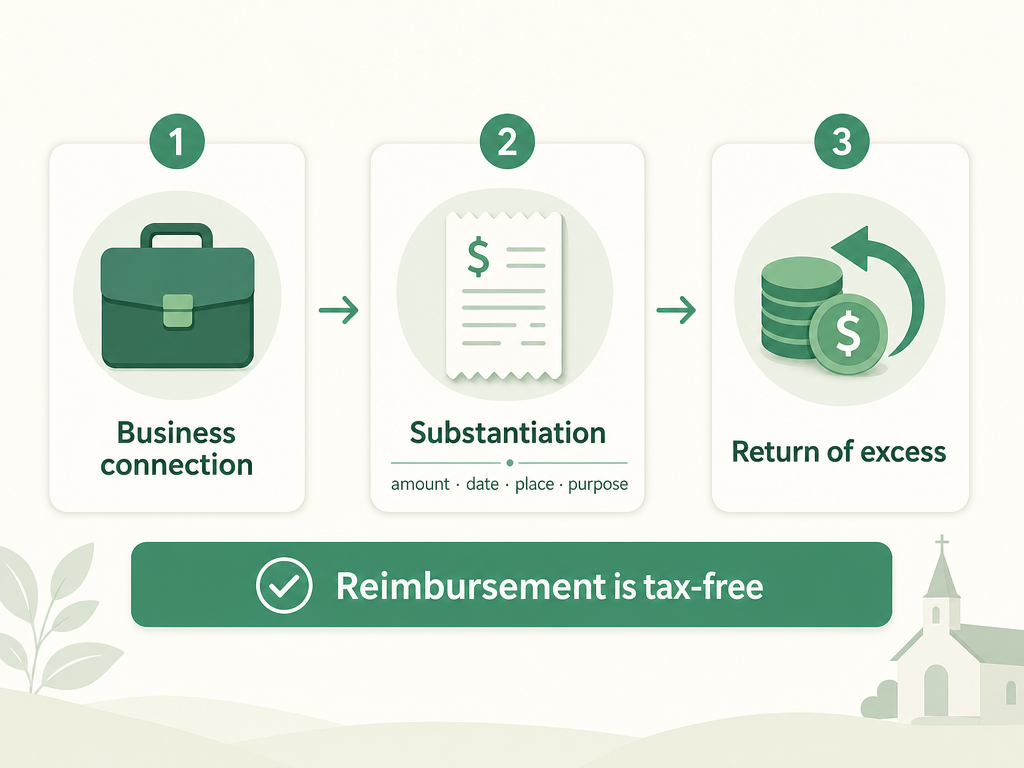
1. Business connection — the expense had a real ministry or business purpose
The expense has to be a legitimate, deductible business expense the employee paid or incurred while doing their job for the organization. Mileage to a hospital visit, supplies for a children’s program, registration for a ministry conference — those have a business connection. A personal dinner with the family does not. The plan can only reimburse expenses that would have been the organization’s to begin with.
2. Substantiation — the employee documents amount, date, place, and purpose
Within a reasonable time, the employee has to adequately account for each expense: the amount, the date, the place, and the business purpose, backed by receipts or other records. A mileage log with date, destination, purpose, and miles driven does this for car travel; receipts do it for purchases. The IRS doesn’t set the “reasonable time” as a hard number, but its own safe-harbor example treats substantiation within 60 days of the expense as reasonable. A common, clean rule is to require expense reports within 60 days.
3. Return of excess — unspent advances come back within a reasonable time
If the organization pays an advance or a per-item allowance and the employee spends less than they received, the excess has to be returned. Keep it and that surplus is taxable wages. As with substantiation, the IRS’s safe-harbor example treats returning the excess within 120 days of the expense as a reasonable time. Most plans that give advances at all set a 120-day return rule.
A practical way to sidestep the return-of-excess problem entirely is to reimburse actual, documented expenses after the fact instead of advancing money. If you only ever pay back what was spent and proven, there’s no excess to chase.
What a church or nonprofit commonly reimburses under the plan
An accountable plan can cover any genuine business expense an employee or minister incurs for the organization. The usual ones:
- Mileage for ministry or business driving — visits, errands, off-site meetings — reimbursed at the IRS standard mileage rate (the per-mile figure the IRS publishes and updates; the church multiplies the logged miles by that rate). A mileage log is the substantiation.
- Travel — airfare, lodging, and meals for conferences, mission trips, and denominational meetings.
- Supplies and materials — curriculum, office and program supplies, books bought for the work.
- Continuing education — seminars, conferences, and courses that keep a staff member or pastor sharp in their role.
- Professional dues and subscriptions — denominational fees, professional memberships, ministry software, work-related subscriptions.
Each of these still has to clear the three tests — documented, business-connected, and (if advanced) any excess returned.
Why an accountable plan matters most for clergy
For a pastor, an accountable reimbursement plan isn’t just tidy — it’s usually the only good way to handle ministry expenses, and the reason is a quirk of the tax law. Unreimbursed employee business expenses are extremely hard to deduct now: the miscellaneous itemized deduction that employees once used for them is suspended through 2025, so a pastor who pays out of pocket for mileage, books, and conferences generally can’t write those costs off against income tax at all. Worse, ministers have a dual tax status, and unreimbursed business expenses don’t reduce the self-employment (SECA) base the way many pastors assume.
So the math is stark. If the church hands a pastor a flat “expense allowance” with no documentation rules, that allowance is taxable wages — the pastor pays income tax and SECA on it, then spends it on the very expenses they can’t deduct. Run the same money through an accountable plan and it’s tax-free in and tax-free out: the church reimburses the documented expense, nothing hits the W-2, and the pastor is made whole. IRS Publication 1828 (Tax Guide for Churches and Religious Organizations) is the IRS’s overview of how churches handle compensation and reporting, and an accountable plan is the standard tool here.
This is the same instinct behind getting the clergy housing allowance and the rest of a pastor’s pay package structured right: a few documented decisions made in advance keep money that should never be taxed from being taxed.
How a board adopts an accountable reimbursement plan
A church or nonprofit puts the plan in place by board action, before the expenses are incurred — the same advance-adoption logic that governs the housing allowance. The steps:
- Adopt a written policy by board resolution. The resolution states that the organization reimburses business expenses under an accountable plan meeting the three IRS requirements, and that it does so in addition to salary — never by reducing the employee’s pay (a salary-reduction reimbursement arrangement fails to be accountable). Record it in the minutes.
- Set the substantiation and return rules. Spell out what employees must submit (receipts plus amount, date, place, purpose), the deadline to submit it (commonly 60 days), and the deadline to return any excess advance (commonly 120 days).
- Reimburse against documentation, and keep the records. Pay back only documented, business-connected expenses, file the expense reports, and post the reimbursements to an expense account — not to wages. Clean books make the plan provable if anyone ever asks; this is ordinary nonprofit bookkeeping discipline applied to one policy.
You can start from our accountable reimbursement plan template and adapt the bracketed fields — purpose, the three requirements, eligible expenses, timing, the return-of-excess and no-salary-reduction language, and the board-resolution block — to your organization.
Vestrybooks keeps your church’s reimbursements posted to the right accounts and the expense records one click away — so an accountable plan stays provable and nothing lands on a W-2 by accident. See plans →
FAQ
What is considered an accountable plan for reimbursement? An accountable plan is a reimbursement arrangement that meets three IRS tests: each expense has a business connection, the employee substantiates it (amount, date, place, purpose) within a reasonable time, and any excess advance is returned within a reasonable time. Meet all three and the reimbursements aren’t taxable income.
What is an accountable reimbursement policy? It’s the written, board-adopted version of an accountable plan — a short policy that says the organization reimburses documented business expenses under the IRS rules, lists eligible expenses, and sets the deadlines for turning in receipts and returning unused advances.
How do I set up an accountable reimbursement plan? Adopt a written policy by board resolution before the expenses are incurred, in addition to salary (not as a pay cut). State the three requirements, set a substantiation deadline (commonly 60 days) and an excess-return deadline (commonly 120 days), then reimburse only documented expenses and keep the records.
What is an accountable plan for auto reimbursement? For driving, the employee keeps a mileage log (date, destination, business purpose, miles), and the organization reimburses the logged business miles at the IRS standard mileage rate. Done that way, the mileage reimbursement is tax-free and isn’t reported as wages.
Are reimbursements under an accountable plan taxable? No. Reimbursements that meet all three requirements aren’t taxable income and aren’t reported on the W-2. The same payments under a non-accountable plan are taxable wages subject to withholding.
This is general information, not financial or legal advice — adopt your plan with your board and a qualified tax advisor.
This article is general information for church treasurers, not professional tax or legal advice. For your church's situation, consult a qualified accountant or attorney.
Nonprofit accounting, minus the headache.
Vestrybooks does fund accounting, donor tracking, and board-ready reports for churches and faith-based nonprofits.
A real free plan · no credit card · your data stays yours