Blog · Payroll & clergy taxes
What is a parsonage? Housing, allowance, and taxes
July 4, 2026 · By Benjamin Reinke

Short answer: A parsonage is a home a church owns and provides to its minister to live in, usually rent-free, as part of pay. Under IRC §107, the rental value of that home is excluded from the minister’s federal income tax — living there costs the pastor nothing in income tax. But here’s the catch nearly everyone misses: for Social Security and Medicare (self-employment tax), the parsonage’s fair rental value is counted as earnings. So a parsonage is income-tax-free but not SE-tax-free. The church can also designate a separate parsonage allowance to cover utilities and upkeep the minister pays out of pocket — but only if it’s designated in advance.
What a parsonage is and why churches provide one
A parsonage (also called a manse, rectory, or clergy residence) is a house the church owns and lets its minister live in as part of the compensation package. It’s the older of the two ways a church houses its pastor. The other is a cash clergy housing allowance, where the minister owns or rents their own place and the church designates part of pay as housing. This page is about the first one — the church-owned home.
Churches provide a parsonage for practical and historical reasons:
- It keeps the pastor close. A home next to the church means the minister is present for early services, evening meetings, and emergencies.
- It removes a housing worry from a modest salary. Many small churches can’t pay a large salary, and a rent-free home is a real, tangible benefit.
- The church already owns the property. A parsonage bought decades ago is an asset the congregation keeps using instead of selling.
- It smooths pastoral transitions. When one pastor leaves and another arrives, the home is already there — the new minister can move in without house-hunting.
The trade-off, which we cover below, is that the pastor builds no home equity and doesn’t choose the house. That matters, and thoughtful churches weigh it.
How a parsonage is taxed: income-tax-free, but counted for SECA
Parsonage taxation is the part that trips up new treasurers and new pastors, so read it slowly. A parsonage gets two different tax treatments depending on which tax you’re talking about.
For federal income tax, the rental value of a church-provided home is excluded from the minister’s gross income. IRC §107 says gross income does not include “the rental value of a home furnished to him as part of his compensation.” So if the church owns the house and the pastor lives in it rent-free, that benefit never shows up as taxable income. The IRS confirms this plainly: if a congregation “furnishes housing in kind as pay for your services as a minister… you may exclude the fair market rental value of the housing from income” (IRS: Ministers’ Compensation & Housing Allowance).
For Social Security and Medicare, the answer flips. Ministers have a dual tax status — they’re employees for income tax but self-employed for Social Security, so they pay SECA (self-employment tax) rather than having FICA withheld. And IRC §1402(a)(8) says a minister computes self-employment earnings without regard to section 107. In plain terms: the §107 exclusion that saves the pastor income tax does not apply to self-employment tax. The IRS says it directly — you “must include the fair market rental value of the housing in net earnings from self-employment for self-employment tax purposes” (IRS: Ministers’ Compensation & Housing Allowance).
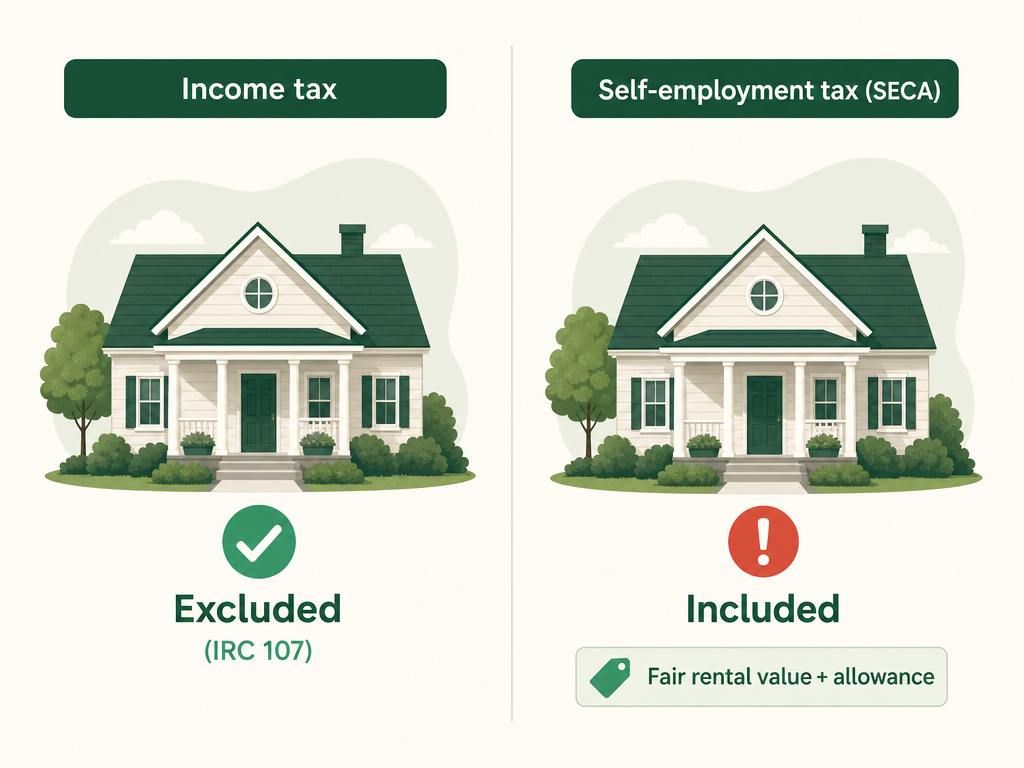
Here’s a concrete example the IRS itself uses. Say a minister gets a $67,000 salary and a parsonage with a $24,000 fair rental value. For income tax, only the $67,000 salary is taxable — the $24,000 of housing is excluded. But for self-employment tax, the base is $91,000 — salary plus the fair rental value of the home. This is the single most important nuance about a parsonage: it saves income tax, but the pastor still owes 15.3% SECA on the home’s rental value unless they’ve opted out. More on how that self-employment math works is in the guide to ministers and self-employment (SECA) tax.
Only ministers get this treatment. IRC §107 and §1402 apply to a “duly ordained, commissioned, or licensed minister” performing ministerial services. A church custodian, secretary, or bookkeeper living in a church-owned house does not get the parsonage exclusion — for a non-minister, free housing is ordinary taxable income.
The parsonage allowance: a separate benefit for out-of-pocket costs
A minister who lives in a parsonage can also receive a designated parsonage allowance (sometimes called a utility allowance). Living rent-free doesn’t mean living cost-free — the pastor often still pays for utilities, furnishings, minor repairs, and personal upkeep on the home. A parsonage allowance lets the church exclude the money it pays the minister for those out-of-pocket housing costs from income tax, on top of the rent-free home itself.
Two rules govern it, and both come straight from the statute and IRS guidance:
- It must be designated in advance. The allowance is excludable only if it’s “officially designated (in advance of payment) as a housing allowance” by official church action (IRS: Ministers’ Compensation & Housing Allowance). You cannot designate it retroactively in December for a year that’s already happened. The board votes on it before the year (or before the payments), and the vote goes in the minutes.
- It’s capped at actual expenses. The exclusion only covers what the minister actually spends on eligible housing costs — utilities, furnishings, repairs, insurance the minister carries, and similar. Designate more than the pastor spends, and the excess is taxable income reported on their Form 1040.
So the rule most churches break is the same one that trips up the cash allowance: designate it in advance, in writing. A parsonage allowance the board forgot to designate before the year started simply doesn’t qualify.
And the SECA rule from the last section applies here too. Like the parsonage itself, a parsonage allowance is excluded from income tax but included in self-employment earnings. Both the home’s rental value and the allowance go into the minister’s SECA base.
Who owns, insures, and maintains the parsonage
Because the church owns the parsonage, the church carries the ownership responsibilities — and this is a genuine advantage for the pastor.
- Ownership. The property is titled to the church, so it stays a church asset. The minister is a resident, not an owner, and builds no equity.
- Insurance. The church insures the structure through its property policy. The minister should carry a renter’s / tenant’s policy for their own belongings and personal liability, because the church’s building coverage won’t replace the pastor’s furniture or possessions.
- Property taxes. A parsonage is often exempt from local property tax as church-owned religious-use property, though the exemption and its rules vary by state and locality — confirm with your county assessor.
- Maintenance and repairs. The church, as owner, typically handles major repairs, systems (roof, furnace, plumbing), and structural upkeep. Who pays for what — utilities, lawn care, minor repairs — should be spelled out in a written parsonage-use agreement so there’s no confusion later.
Put the arrangement in writing. A short parsonage policy covering utilities, upkeep, insurance responsibilities, and expectations when the pastor leaves prevents most disputes before they start.
The trade-offs for a pastor: no equity or rent, but taxable for SECA
A parsonage is neither strictly better nor worse than a cash housing allowance — it’s a genuine set of trade-offs, and a pastor weighing a call should understand both sides.
| Living in a parsonage | Cash housing allowance (own/rent) | |
|---|---|---|
| Monthly housing cost | $0 rent or mortgage | Pays own rent/mortgage from the allowance |
| Income tax on housing | Rental value excluded (§107) | Allowance excluded, up to the lesser-of-three limit |
| Self-employment (SECA) tax | Rental value + allowance included | Allowance included |
| Home equity | None — the church owns it | Builds equity if buying |
| Choice of home | The church’s house | The pastor picks the home |
| When the pastor leaves | Moves out; home stays with church | Keeps the home they own/rent |
The two real costs of a parsonage are no equity — years of rent-free living don’t build a nest egg the way a mortgage does — and the fact that the home stays with the church when the pastor moves on. A minister who lived in a parsonage for 20 years can retire without a house of their own, which is why many denominations and churches pair a parsonage with a retirement or equity allowance to help the pastor build savings on the side.
What happens when a minister retires or leaves
When a pastor leaves the church, the parsonage stays. The home is the church’s asset, so the departing minister moves out and the next minister (or the congregation’s plans) takes over. That’s the equity trade-off in action — the pastor doesn’t walk away with the house.
Retirement adds one important wrinkle to the SECA rule. During active ministry, a parsonage’s rental value is included in self-employment earnings. But IRC §1402(a)(8) carves out an exception for retirement: the rental value of a parsonage or a parsonage allowance provided after the minister retires is not included in self-employment earnings. So a retired minister who continues to receive housing (for example, through a church retirement plan) generally does not owe SECA on it — the opposite of the working-years rule. Because retirement clergy housing gets specialized treatment, confirm the details with a CPA who knows clergy tax.
How a church should record a parsonage
For the treasurer, a parsonage creates two record-keeping jobs — and getting them right is what keeps the minister’s pay reported correctly.
- Track the fair rental value for the SECA base. The parsonage’s fair rental value doesn’t go in W-2 Box 1 (it’s excluded from income-tax wages), but the minister needs that number to figure self-employment tax. Determine a reasonable fair rental value (what the furnished home plus utilities would rent for), document how you arrived at it, and give it to the minister each year. This is the figure that gets added to salary for the SECA calculation. It’s common to note the parsonage’s fair rental value informationally in W-2 Box 14 or in a separate letter — the mechanics parallel how the housing allowance appears on a W-2.
- Designate the parsonage allowance in the board minutes. If you pay the minister a utility or parsonage allowance, the board must designate it in advance by official action, and that resolution belongs in your minutes. Keep it with the year’s records so the amount and the date are provable.
Neither of these is hard — they just have to be done, and done on time. A parsonage that’s furnished but never valued, or an allowance that was never formally designated, is exactly the kind of gap that surfaces at tax time. Getting the compensation structure right from the start is part of setting a fair pastor salary, where the home is one piece of the whole package.
Vestrybooks keeps the pieces straight: record the parsonage’s fair rental value and the board-designated parsonage allowance alongside the minister’s pay, so the numbers that feed the W-2 and the SECA base are ready when you need them. See plans →
FAQ
Is a parsonage taxable? It depends on which tax. For federal income tax, the rental value of a church-provided parsonage is excluded from the minister’s income under IRC §107 — living there rent-free isn’t taxed. For Social Security and Medicare, it’s the opposite: the parsonage’s fair rental value is included in the minister’s self-employment (SECA) earnings. So a parsonage is income-tax-free but not SE-tax-free.
What is a parsonage allowance? A parsonage allowance (or utility allowance) is money a church pays a minister who lives in a parsonage to cover out-of-pocket housing costs — utilities, furnishings, minor repairs. It’s excludable from income tax, but only if the church designates it in advance by official action, and only up to what the minister actually spends. Like the parsonage itself, it still counts for self-employment tax.
What is the difference between a parsonage and a housing allowance? A parsonage is a home the church owns and provides. A cash housing allowance is money the church designates when the minister owns or rents their own home. Both are income-tax-excluded under §107 and both are included for SECA. The parsonage means no rent and no equity; the allowance lets the pastor choose and keep their own home.
Who can live in a parsonage tax-free? Only a minister — someone ordained, licensed, or commissioned who performs ministerial services. A non-minister church employee (custodian, secretary, bookkeeper) living in a church-owned home is taxed on the value of that housing as ordinary income; the §107 exclusion doesn’t apply to them.
What happens to the parsonage when a pastor leaves? It stays with the church. Because the church owns the home, a departing or retiring minister moves out and the property remains a church asset for the next pastor. This is the main downside of a parsonage — the minister builds no home equity, which is why some churches also fund a retirement or equity allowance.
This is general information, not tax or legal advice. Clergy taxation is genuinely unusual and the details depend on your situation — confirm your church’s parsonage arrangement with a CPA or tax professional who knows ministry.
This article is general information for church treasurers, not professional tax or legal advice. For your church's situation, consult a qualified accountant or attorney.
Church accounting a volunteer can actually do.
Vestrybooks is church accounting + giving for the volunteer treasurer — fund tracking, one-click year-end statements, and online giving with $0 taken from every gift.
A real free plan · no credit card · your data stays yours