Blog · Nonprofit policies & compliance
A gift acceptance policy for your nonprofit board
June 27, 2026 · By Benjamin Reinke

A gift acceptance policy is the written rule a nonprofit’s board adopts to decide which gifts the organization will accept, which it will review first, and which it will turn down — and on what terms. The point is that not every gift is worth taking: some carry strings the organization can’t honor, some cost more to keep than they’re worth, and some bring real liability. This is an intake policy — it governs the decision to say yes or no to a gift, not how you receipt or book the gift once you’ve accepted it. Grab the free gift acceptance policy template below, adapt the bracketed parts to your organization, and have the board adopt it.
What a gift acceptance policy is and why a nonprofit board needs one
A gift acceptance policy is a board-adopted document that answers one question in advance: will we take this gift, and under what conditions? The instinct at most nonprofits is to accept everything, because turning down a gift feels ungrateful. But a few gifts are genuinely worse than no gift at all:
- A piece of real estate with contaminated soil, where the cleanup cost dwarfs the property’s value and the liability follows whoever holds title.
- A restricted gift for a program you don’t run and can’t staff — money you’re now legally bound to spend a way you can’t.
- Shares in a private company you have no way to sell, leaving you holding an asset you can’t turn into mission.
- A gift whose conditions quietly pull the organization off mission, like a donor who’ll fund a building only if it’s named and used a way the board never agreed to.
Having the policy on paper does two things. It makes the answer consistent — a staff member or volunteer knows what to say without improvising — and it lets the board decline a gift without it being personal. The donor isn’t being rejected; the policy already drew the line. A gift acceptance policy is one of the core written rules that sit under a nonprofit’s broader set of nonprofit financial policies, alongside conflict-of-interest and document-retention rules.
Accept, review, or decline — the three lanes every gift falls into
The simplest way to write the policy is to sort gifts into three lanes: gifts staff can accept outright, gifts that need a review before you say yes, and gifts you won’t take.
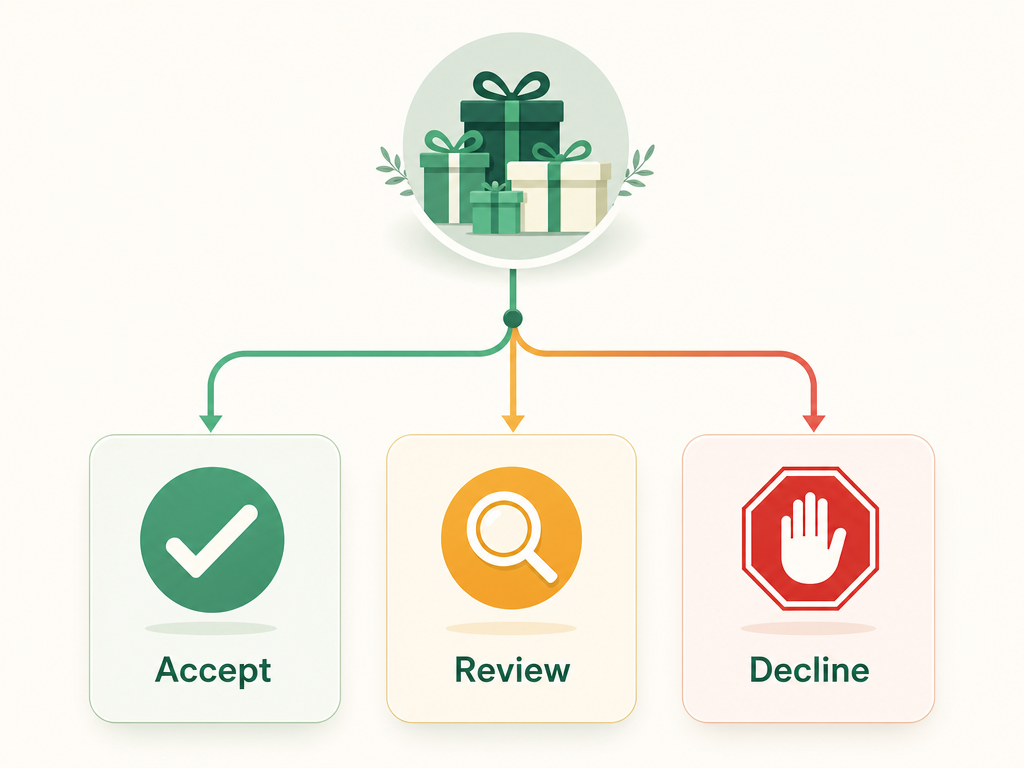
| Gift type | Lane | How to treat it |
|---|---|---|
| Cash, checks, card, ACH, payroll deduction | Accept | The easy case — no review needed. |
| Publicly traded securities (stock, bonds, mutual funds) | Accept | Commonly accepted; sell promptly on receipt. |
| Non-cash / in-kind property (equipment, goods, collectibles) | Review | Can you use it or sell it? What does it cost to keep? |
| Restricted gifts (limited to a purpose or time) | Review | Accept only if the restriction fits the mission. |
| Real estate | Review | Check title, liens, carrying cost, and environmental risk. |
| Vehicles | Review | Often more hassle to title, store, and sell than they’re worth. |
| Closely held / private-company stock | Review | Hard to value and harder to sell. |
| Planned gifts (bequests, trusts, gift annuities) | Review | Loop in legal/tax counsel. |
| Gifts with conditions you can’t meet or that are off-mission | Decline | The policy lets you say no cleanly. |
How to treat cash and publicly traded securities
Cash is the easy case. Currency, checks, card and ACH gifts, and payroll-deduction gifts go straight in — no review, no special handling beyond a receipt.
Publicly traded securities — stock, bonds, and mutual-fund shares listed on a public exchange — are the other gift almost every policy accepts outright, because a donor who gives appreciated stock they’ve held over a year can deduct the full fair market value and skip the capital-gains tax they’d owe on a sale. The standard rule to write into your policy is to sell donated securities promptly rather than hold them, so the organization isn’t taking a market bet with a gift. You set up a brokerage account once, the donor transfers the shares in, and you sell on receipt.
How non-cash and in-kind gifts are valued — the donor decides, not the charity
The most misunderstood part of any gift acceptance policy is valuation, so write it down plainly: the charity does not put a dollar value on a non-cash gift — the donor does. When someone gives in-kind property — a used vehicle, office equipment, a piece of art, boxes of canned goods — your acknowledgment describes the item (“one used Dell laptop,” “12 boxes of canned food”) but states no value. Determining the fair market value of donated property is the donor’s job for their own tax return, not the charity’s, as laid out in IRS Publication 561, Determining the Value of Donated Property.
For larger non-cash gifts the donor carries extra paperwork, not you. A donor claiming a deduction over $500 files Form 8283 with their return, and for most property the donor values above $5,000 they must get their own qualified appraisal (IRS Publication 526, Charitable Contributions). The charity may sign Form 8283 to acknowledge it received the item — but that signature confirms receipt, not value. Your acceptance policy should make this split explicit so no one on staff ever guesses a number for a donor.
That keeps the acceptance decision and the receipt clean. For the mechanics of writing the acknowledgment itself, see church contribution statement requirements — that’s the accounting side, separate from the intake decision this policy governs.
How restricted gifts tie back to your fund tracking
A restricted gift is one the donor limits to a specific purpose, program, or time — “$10,000 for the food pantry,” “for the new roof,” “to be spent in 2027.” Restricted gifts belong in the review lane, because the test isn’t whether you want the money. It’s whether the restriction fits the mission and whether you can actually carry it out and track it. A grant for a tutoring program you don’t run is a liability dressed up as a gift: once you accept it, you’re legally bound to spend it that way or give it back.
So the acceptance policy and the books work together. Accept a restricted gift only when you can honor it, then track it as a restricted fund — recorded separately, spent only on its purpose, and released from restriction when the purpose is met. If a proposed restriction is too narrow or off-mission, the time to fix it is before you accept, by talking the donor into broader language or declining. Once the gift is in, the restriction is binding.
Which gifts a nonprofit should decline or send for review
Risky gifts are where a good policy earns its keep. Send any of the following to the board or a gift acceptance committee before saying yes — and be ready to decline:
- Real estate, especially anything with possible environmental contamination. The liability attaches to the owner, so cleanup costs can swamp the property’s value. Check title, liens, mortgages, and carrying costs (taxes, insurance, upkeep), and require an environmental assessment at the donor’s expense before accepting.
- Vehicles, boats, and other titled property that’s often more trouble to store, insure, title, and sell than it’s worth.
- Closely held or private-company stock and partnership interests — hard to value, often impossible to sell quickly.
- Gifts with conditions you can’t or won’t meet — a naming demand, a use restriction, control over staffing or programming, or anything that pulls the organization off mission.
- Anything that risks the organization’s reputation, finances, or tax-exempt status.
The policy should name who decides (staff, treasurer, a gift acceptance committee, or the full board) and say plainly that the organization will use legal or tax counsel on real estate, planned gifts, and any gift with unusual conditions or unclear risk. Spelling out who and when is what keeps a hard “no” from landing on one person.
Vestrybooks keeps the bookkeeping side simple: once the board accepts a restricted gift, you pick its fund from a dropdown and the money is tracked to its purpose without anyone building a spreadsheet. See plans →
FAQ
What is a gift acceptance policy for a nonprofit? It’s the written rule a nonprofit’s board adopts to decide which gifts the organization will accept, which it will review first, and which it will decline — and on what terms. It governs the intake decision, not how the gift is later receipted or booked.
Why does a nonprofit need a gift acceptance policy? Because some gifts cost more than they’re worth or carry strings and liability — real estate with environmental risk, restricted gifts for programs you don’t run, unsellable private stock. A policy gives a consistent answer and lets the board decline a gift without it being personal.
Does the charity put a value on a non-cash gift? No. For in-kind gifts the charity describes the item but states no dollar value — the donor determines the fair market value for their own tax records, and for property the donor values over $5,000 the donor obtains a qualified appraisal and files Form 8283 (IRS Pub 561).
Which gifts should a nonprofit decline? Gifts with conditions you can’t meet or that are off-mission, real estate with environmental or title problems, vehicles and property that cost more to keep than they’re worth, illiquid private stock, and anything that risks the organization’s finances, reputation, or tax-exempt status.
Is a gift acceptance policy the same as a donation receipt? No. The policy is the decision to accept a gift; the receipt is the acknowledgment after you’ve accepted it — two separate steps. The acceptance decision comes first; the written acknowledgment follows once the gift is in.
This guide is general information, not legal or tax advice — have your own attorney or tax advisor adapt the policy to your organization before the board adopts it.
This article is general information for church treasurers, not professional tax or legal advice. For your church's situation, consult a qualified accountant or attorney.
Nonprofit accounting, minus the headache.
Vestrybooks does fund accounting, donor tracking, and board-ready reports for churches and faith-based nonprofits.
A real free plan · no credit card · your data stays yours