Blog · Nonprofit policies & compliance
What a nonprofit whistleblower policy is and why your board adopts one
June 27, 2026 · By Benjamin Reinke

A nonprofit whistleblower policy is a written board policy that lets staff, volunteers, and board members report suspected financial misconduct, fraud, or a legal violation without fear of being punished for it. It names who can report, gives them a way to do it confidentially — including a channel that bypasses the person a complaint might be about — promises no retaliation, and says how the report gets investigated and brought to the board. It isn’t legally mandatory for most nonprofits, but the IRS Form 1023 application asks whether you have one, and the federal anti-retaliation rules in the Sarbanes-Oxley Act apply to charities, so adopting one is a basic governance step. This guide walks through what the policy covers, the law behind it, and the template your board can adopt.
A whistleblower policy is one of a handful of written policies a board adopts together; for the full set, see the nonprofit financial policies every board should have in place.
What a nonprofit whistleblower policy does
A nonprofit whistleblower policy exists to get a problem in front of someone who can fix it, before it becomes a scandal or a loss. The people most likely to notice that money is being misused — a bookkeeper who sees a forged signature, a volunteer who counts an offering that doesn’t match the deposit — are also the people with the most to lose by speaking up. The policy removes that risk. It tells them exactly where to take a concern, guarantees they won’t be fired or punished for raising it in good faith, and commits the organization to actually looking into it.
That last part matters as much as the protection. A policy that promises confidentiality but has no process behind it is just a poster on the wall. A real one runs a concern through four stages: someone reports, the policy protects them, the matter gets investigated, and the findings go to the board.
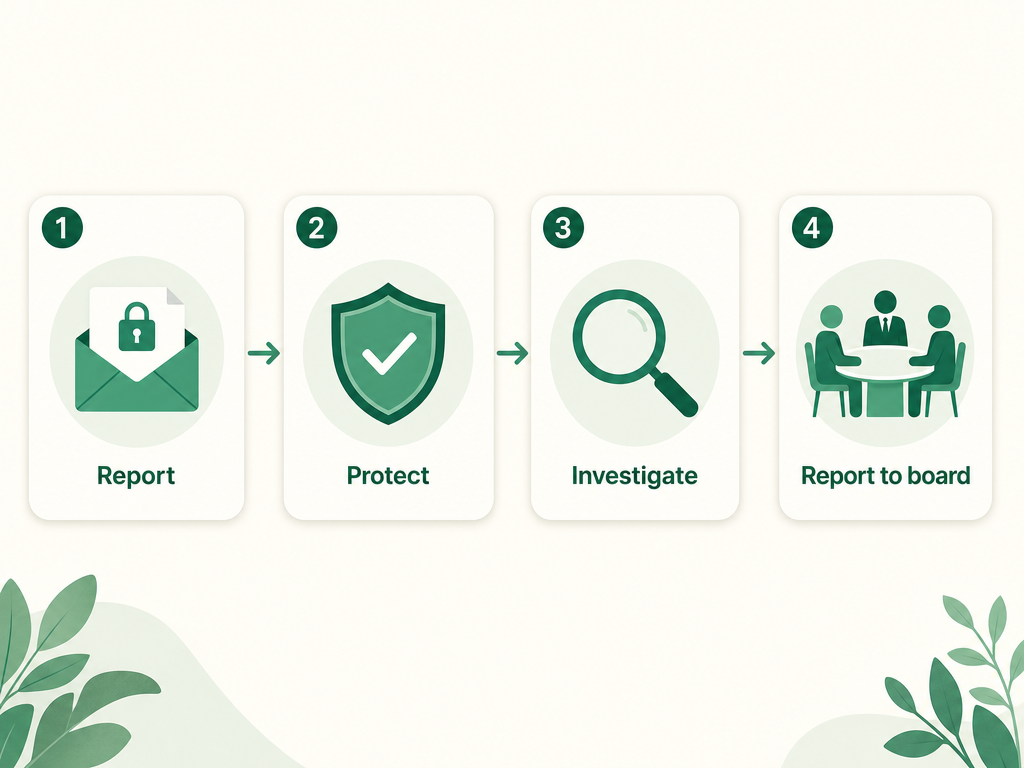
Why the IRS and the Sarbanes-Oxley Act make this matter
Two pieces of federal background are why nonprofit boards adopt this policy rather than treat it as optional.
The first is the IRS. The application for tax-exempt status, Form 1023, asks whether your organization has adopted a whistleblower policy. Answering yes signals to the IRS that the board takes governance and accountability seriously — and a board that has thought through how a fraud report would be handled is exactly the kind of board the exemption is meant to require. The annual Form 990 asks the same question.
The second is the Sarbanes-Oxley Act. Most of that 2002 law was aimed at public companies after the Enron collapse, and almost none of it touches charities. But two of its provisions reach every organization, nonprofits included: it is a federal crime to retaliate against someone who reports a suspected legal violation to the authorities, and it is a federal crime to knowingly destroy or alter documents to obstruct an investigation. A nonprofit can’t be careless here. A board member who pushes out the staffer who reported a problem, or a director who shreds records once an inquiry starts, is exposed personally, and the organization is too. A written policy — with its no-retaliation clause and its no-document-destruction rule — is how a board makes sure nobody crosses those lines by accident.
The core elements of a nonprofit whistleblower policy
A nonprofit whistleblower policy that does its job has seven parts. Each one closes a gap that would otherwise let a real concern die quietly.
| Element | What it does |
|---|---|
| Who can report | Names the people the policy covers — employees, volunteers, officers, and board members — so no one wonders whether it applies to them. |
| What to report | Lists the conduct in scope: theft, fraud, falsified records, misused restricted funds, hidden conflicts, and other legal or policy violations. |
| How and to whom | Gives a named contact and a confidential channel — plus a second, independent contact that bypasses the person a complaint might be about. |
| No retaliation | Bars firing, demotion, or any other punishment of a person who reports in good faith, with discipline for anyone who retaliates. |
| Confidentiality | Limits who learns the reporter’s identity and the details, and commits not to hunt down an anonymous reporter. |
| Investigation process | Says how a report is acknowledged, reviewed, investigated, and resolved — so a concern can’t just be ignored. |
| Board / audit-committee role | Puts final oversight with the board, and routes accounting and audit concerns to it independently of management. |
The two pieces people most often get wrong are the bypass channel and the good-faith standard. The bypass channel is the part that makes the policy trustworthy: if every report goes to the treasurer, a report about the treasurer has nowhere safe to go. A second contact — usually the board chair or an audit-committee member — fixes that. The good-faith standard means a person is protected when they reasonably believe something is wrong, even if it turns out they were mistaken; they don’t need proof, and they don’t have to be right. Only a knowingly false report falls outside the protection.
How the board and audit committee handle a report
The board, not the staff, is the backstop of a whistleblower policy. Day to day, a named compliance officer — often the treasurer, board chair, or a business administrator — receives reports and oversees the investigation. But the policy hands final oversight to the board, acting through its audit committee where one exists. The board makes sure reports are handled properly, and it takes direct responsibility for any concern that touches accounting, internal controls, or the audit — the matters management shouldn’t be left to investigate about itself.
This is the same oversight muscle a board already uses elsewhere. Catching misuse of money is one of a board’s core jobs; it’s part of the broader nonprofit board of directors responsibilities around financial oversight. A whistleblower policy just gives that oversight a front door — a defined way for a concern to reach the board instead of dying two levels below it.
How a whistleblower policy works with internal controls and the audit
A whistleblower policy is the human early-warning system that sits on top of a nonprofit’s internal controls. Controls are the structural defenses: separating duties so the person who records a gift isn’t the one who reconciles the bank, requiring two people to count an offering, getting a second signature on large payments. Those make most fraud hard to commit and easy to catch. But no set of controls catches everything, and the people best placed to spot what slips through are the ones doing the work. The policy gives them a safe way to say so.
The audit is where the two meet. A church audit or a nonprofit’s annual review tests whether the controls are actually working — and the auditor will ask whether you have a whistleblower policy and whether any reports came in during the year. A real report, handled well, is evidence the system works. Strong nonprofit bookkeeping underneath all of it means that when someone does raise a concern, the records are clean enough to confirm or clear it quickly. Policy, controls, and the audit are three parts of one accountability system, not three separate chores.
How a whistleblower policy protects a church
A church needs a whistleblower policy for the same reason any nonprofit does, and the policy fits a congregation without changes. A church that incorporates is a nonprofit, so the same protection that lets an employee report misuse of a charity’s money lets a staff member, volunteer, or member report misuse of the congregation’s offerings. The Sarbanes-Oxley anti-retaliation and document-destruction rules reach churches too. And the policy is a quiet act of care: the people who handle the plate are also protected by it, because a clear process and an outside check remove the suspicion that hangs over money nobody can see being watched.
The only adjustment a church makes is to its vocabulary. The “board of directors” may be your vestry, session, elders, deacons, or trustees; the “compliance officer” may be your treasurer or business administrator. Keep the second, independent contact a different person than the first, so a concern about whoever handles the money can still reach someone above them.
Get the nonprofit whistleblower policy template
Rather than write one from scratch, start from a complete draft and adapt it. Our free whistleblower policy template is a full, adoptable policy with bracketed placeholders for your organization’s name, your compliance officer, and your independent second contact. It includes the no-retaliation clause, the confidentiality and good-faith language, the investigation steps, the board and audit-committee role, the no-document-destruction note, and a board-adoption block — plus a short notes-for-churches section. Fill in the brackets, have an attorney review it, approve it by a board vote, and record the vote in your minutes.
FAQ
Does a nonprofit need a whistleblower policy? A whistleblower policy isn’t legally required for most nonprofits, but two things make it close to expected. The IRS Form 1023 and Form 990 both ask whether you have one, so adopting it signals good governance to the IRS. And the federal anti-retaliation and document-destruction rules in the Sarbanes-Oxley Act apply to nonprofits, so a board that has no policy is still on the hook for the conduct the policy is meant to prevent. Almost every well-run nonprofit adopts one.
Do charities need a whistleblower policy? Yes, in the practical sense that a charity is the kind of organization these protections are built for. A charity handles other people’s money on behalf of the public, and the people who notice it being misused — staff, volunteers, board members — need a safe way to say so. The same IRS questions and the same Sarbanes-Oxley rules that apply to other nonprofits apply to charities, so a charity that wants to take accountability seriously adopts a policy.
Is it a legal requirement to have a whistleblower policy? For most U.S. nonprofits, no federal law flatly requires you to adopt a whistleblower policy. What the law does require is that you not retaliate against someone who reports a legal violation and not destroy records to obstruct an investigation — those two Sarbanes-Oxley rules apply whether or not you have a written policy. Some states also impose their own requirements. A written policy is the standard way a board makes sure it stays on the right side of all of that, which is why the IRS asks about it.
Who should a whistleblower report to in a nonprofit? A report normally goes to a named compliance officer — often the treasurer, board chair, or business administrator. The key is that the policy also names a second, independent contact, usually a board chair or audit-committee member, for when the concern is about the compliance officer or someone they answer to. That bypass route is what guarantees a report can always reach someone who isn’t the subject of it.
A whistleblower policy only works if the books behind it are clean enough to confirm or clear a concern fast. Vestrybooks keeps a nonprofit’s records reconciled and gives the board a live view, so financial oversight is real instead of a report taken on faith. See how it works.
This is general information, not legal or tax advice — confirm your organization’s situation with a qualified professional.
This article is general information for church treasurers, not professional tax or legal advice. For your church's situation, consult a qualified accountant or attorney.
Nonprofit accounting, minus the headache.
Vestrybooks does fund accounting, donor tracking, and board-ready reports for churches and faith-based nonprofits.
A real free plan · no credit card · your data stays yours